Opinion
The human measure in the age of AI: What Europe can learn from Pope Leo XIV’s first encyclical
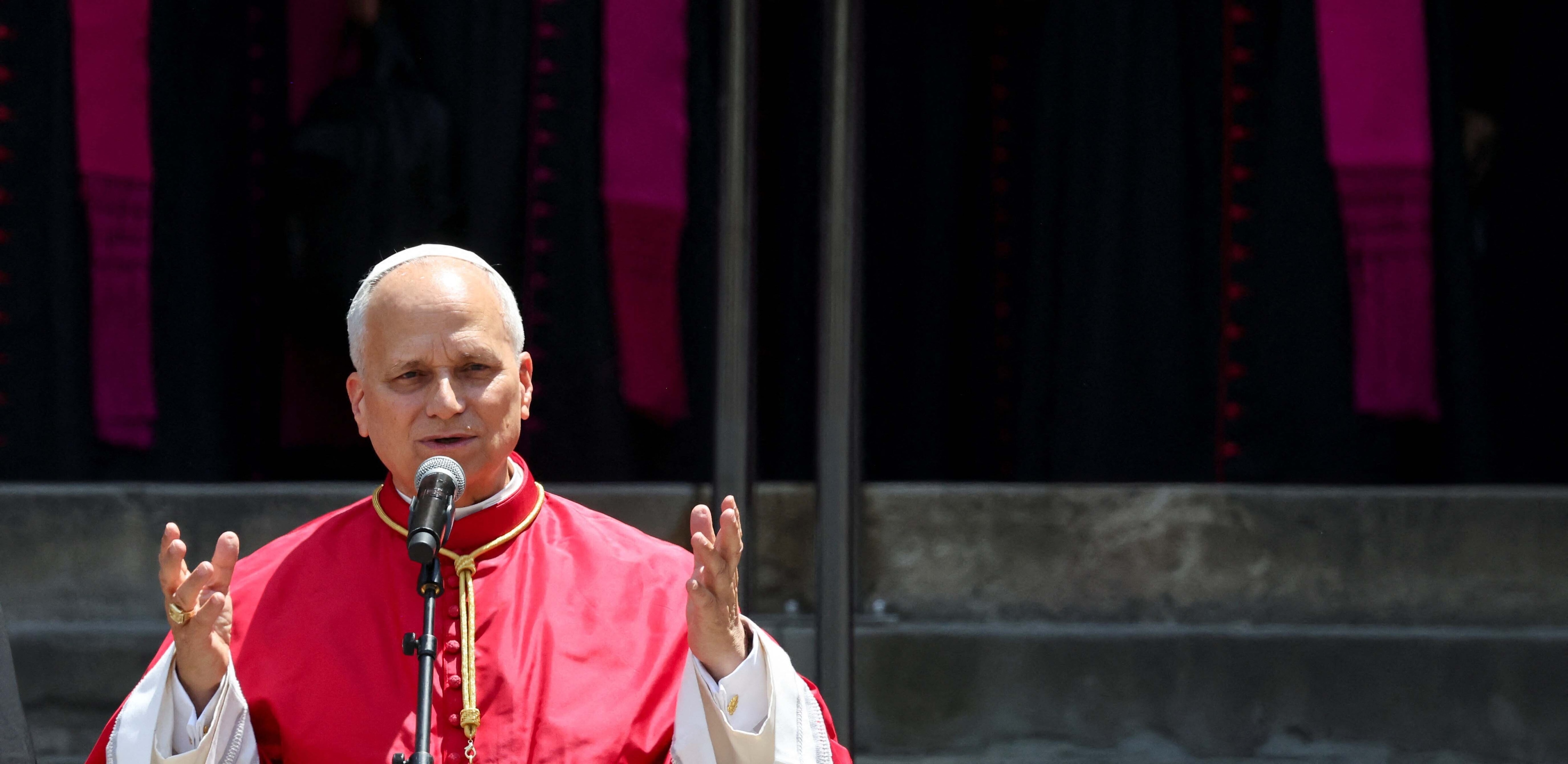
The Pope outlined why AI's progress must be measured by its impact on the human person and the common good. Image: Reuters/Yara Nardi
- Pope Leo XIV recently published his first encyclical, Magnifica Humanitas.
- It challenges the assumption that technological capability automatically translates into social progress and asks who benefits.
- The message is clear: AI's progress must be measured by its impact on the human person and the common good.
In 1891, Pope Leo XIII published Rerum Novarum, the foundational text of modern Catholic social doctrine. Written amid the upheavals of the Industrial Revolution, it sought a path between laissez-faire capitalism and revolutionary socialism, insisting that economic transformation could not come at the expense of human dignity.
One hundred and thirty-five years later, Pope Leo XIV has chosen similarly transformative terrain for his first and much-awaited encyclical. In Magnifica Humanitas, the leader of the Catholic Church turns his attention to artificial intelligence (AI), digital power and the concentration of technological authority.
The message of the letter to the bishops of the Catholic church is clear: technological progress cannot be judged solely by efficiency, productivity or market value. It must ultimately be measured by its impact on the human person and the common good.
For political and business leaders, particularly in Europe, the encyclical is more than a religious document. It is a strategic intervention in one of the defining debates of the century: how societies can remain human in an era increasingly shaped by algorithms.
A new social question in the era of AI
The historical parallel matters. In 1891, Leo XIII confronted the social consequences of mechanization (“the condition of the working classes"). Today, Leo XIV confronts the social consequences of cognition itself becoming partially automated.
The Pope explicitly frames AI as a transformative force comparable to the Industrial Revolution, warning that societies are once again entering a period in which economic gains risk being concentrated while social costs are widely distributed.
His concern is not technological innovation per se. The encyclical does not reject AI. Rather, it challenges the assumption that technological capability automatically translates into social progress.
The deeper question is political: who benefits, who governs and who bears the risks?
In that sense, the document sits firmly within the tradition of Catholic social teaching, which has long emphasized the dignity of work, solidarity, subsidiarity and the moral responsibilities attached to economic power.
What changes is the object of concern – no longer the factory, the wage and the power of industrial capital, today’s argument is about who controls the systems through which societies communicate, organize, produce and decide.
The challenge of concentrated power
One of the encyclical’s most striking themes is its warning against the concentration of digital power.
The Pope argues that technologies increasingly shaping public life, economic opportunity and even access to information are often governed by institutions whose scale exceeds that of many states. Questions of transparency, accountability and democratic oversight become particularly acute when technological systems are embedded in essential functions of society.
Europe's debates over technological sovereignty, from cloud infrastructure to AI governance, reflect similar concerns about dependency and control.
The encyclical approaches this challenge from a moral rather than geopolitical angle. Yet, the underlying logic is remarkably similar. Excessive concentration of power – whether economic, technological or political – reduces the ability of communities to shape their own futures.
Human dignity as a strategic principle
Perhaps the most important contribution of Magnifica Humanitas is its insistence that human dignity should remain the organizing principle of technological development. If the human person is no longer “the measure” against which progress is judged, innovation risks producing not liberation, but “the eclipse of human dignity”.
That argument belongs to a longer tradition of dialogue between the Church and modernity. Gaudium et Spes (Joy and Hope), the Second Vatican Council’s 1965 pastoral constitution, affirmed that “the human person is and ought to be the beginning, the subject and the object of every social organization”. Leo XIV is applying that principle to the digital age.
The point matters because the logic guiding technological development is not always the same as the one guiding human development. Contemporary debates about AI often focus on speed, scale and market advantage. Governments worry about falling behind competitors; companies, about losing ground to rivals; investors, about the next wave of growth. The encyclical introduces a different metric.
A society should not ask only what technology can do, but what it should do. Nor should it evaluate success solely through productivity gains. It should also consider whether technological systems strengthen human capabilities, reinforce social cohesion and expand genuine human flourishing.
Pope Benedict XVI made the same point in Caritas in Veritate in 2009, insisting that “if it does not involve the whole man and every man, it is not true development”. Technological progress, in other words, cannot be separated from the fuller question of human development.
For Europe, the point is clear: its advantage may lie less in scale than in governance. The General Data Protection Regulation, commonly known as GDPR, for all its imperfections, showed that European Union rules can shape global standards. AI may be the next test.
Yet, the encyclical suggests something even more ambitious than regulation: a distinctly human-centred vision of innovation. One that asks not only how societies can become more productive, but how they can remain free, cohesive and meaningful.
Reopening the dialogue between faith and reason
Perhaps the most unexpected contribution of the encyclical lies elsewhere.
Magnifica Humanitas is not only a reflection on AI; it is also an implicit argument for restoring a dialogue that has weakened across much of the Western world: the dialogue between faith and reason.
This was the central concern of Pope John Paul II in his 1998 encyclical Fides et Ratio. There, he warned against the growing separation of scientific rationality from deeper questions of meaning, ethics and purpose. Reason without moral orientation risks becoming purely instrumental; faith without reason risks becoming dogmatic. Human flourishing depends on their encounter, not their separation.
Three decades later, the challenge has acquired a new form.
Artificial intelligence is forcing societies to confront questions that are ultimately philosophical before they are technological: what constitutes human intelligence, which decisions should never be delegated to machines, and what responsibilities accompany power?
These are not questions that engineers, regulators or markets can answer alone.
The paradox is that technological progress has accelerated just as shared moral frameworks have weakened. Public debate is more polarized, trust in institutions lower, and social media has fragmented discourse into parallel realities. In this context, faith traditions can offer more than theology: long-term ethical reflection and a vocabulary connecting innovation to enduring questions of human purpose.
Europe’s opportunity to define AI’s trajectory
At a moment when much of the global conversation oscillates between technological utopianism and technological anxiety, Magnifica Humanitas offers a third perspective.
For Europe, the challenge is especially acute. The continent is trying to close gaps in innovation, productivity and technological capability while preserving democratic accountability and social cohesion.
Magnifica Humanitas reminds us that these objectives are not alternatives. Competitiveness is ultimately a means, not an end. Europe’s real opportunity may lie not in being first, but in showing that innovation, competitiveness and human dignity can still reinforce one another.
The debate over AI is often presented as a race. Pope Leo XIV invites us to see it instead as a question of direction. And in the long run, direction may matter more than speed.
Don't miss any update on this topic
Create a free account and access your personalized content collection with our latest publications and analyses.
License and Republishing
World Economic Forum articles may be republished in accordance with the Creative Commons Attribution-NonCommercial-NoDerivatives 4.0 International Public License, and in accordance with our Terms of Use.
The views expressed in this article are those of the author alone and not the World Economic Forum.
Stay up to date:
Artificial Intelligence
Related topics:


Forum Stories newsletter
Bringing you weekly curated insights and analysis on the global issues that matter.
More on Artificial IntelligenceSee all

Sander Zeijlemaker and Michael Siegel
September 8, 2026


