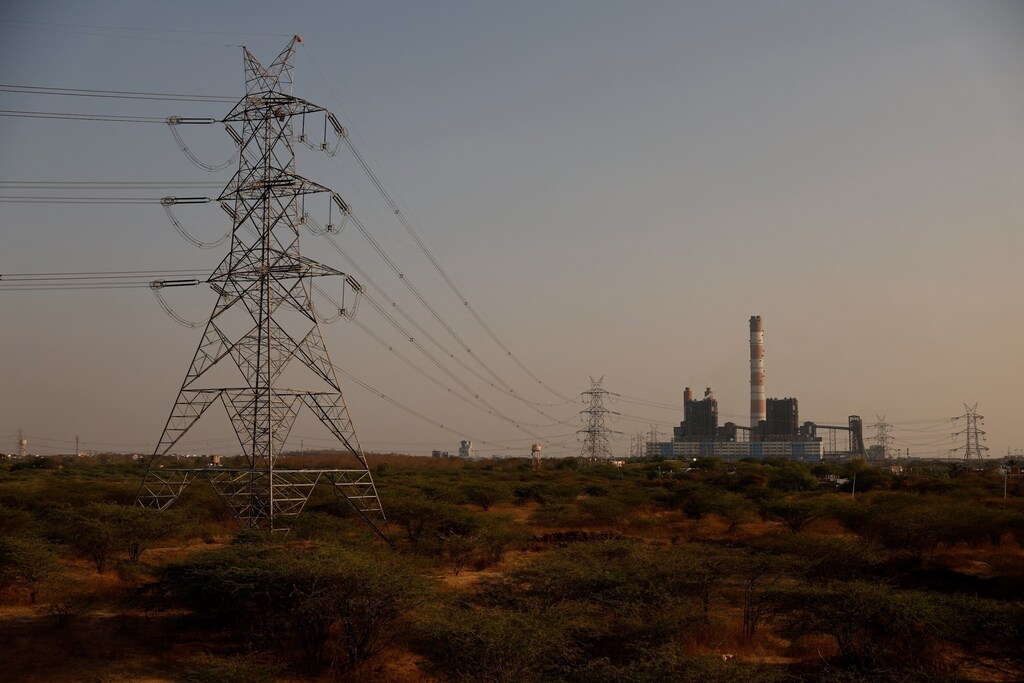
Nearly half of clean energy investments in emerging economies are financed by governments or state-owned institutions.
A new analysis shows public utilities in developing economies performing far better on the energy transition than conventional assumptions suggest.
Across Asia, Africa, Latin America and the Middle East, state-owned utilities are increasingly acting as strategic architects of energy transformation, not passive executors of government mandates.
Countries across Asia, Africa, Latin America and the Middle East are expected to account for nearly two-thirds of future growth in global energy demand over the coming decades.
As the world pushes for net zero emissions, one reality is becoming increasingly evident: the global energy transition will not succeed unless emerging and developing economies are able to decarbonize while expanding access to affordable and reliable energy.
Emerging economies face a complex development challenge of meeting rising electricity needs, ensuring affordability for growing populations, strengthening resilience against global energy shocks and reducing dependence on carbon-intensive fuels.
In many of these economies, private capital alone cannot deliver the scale and pace of transformation required. Investment risks remain high, infrastructure gaps persist and regulatory frameworks are still maturing.
Dispelling the doubts over state-owned enterprises
In this environment, state-owned enterprises are emerging as some of the most important yet underappreciated actors in the global clean energy transition. Across the Global South, state-owned utilities are increasingly becoming strategic architects of energy transformation rather than passive executors of government mandates.
For decades, state-owned energy enterprises have formed the backbone of national electricity systems in developing economies. Nearly half of clean energy investments in emerging economies are currently financed by governments or state-owned institutions, underscoring the central role of public-sector leadership in markets where private investment remains cautious. Their role has extended beyond power generation to include rural electrification, infrastructure creation, energy affordability, industrial growth and economic stability. Unlike private-sector utilities, which are largely driven by shareholder returns, state-owned enterprise operate under public mandates that require them to deliver both commercial performance and social outcomes. This institutional design gives them a unique advantage in addressing the three interconnected dimensions of the energy transition: energy security, energy equity, and environmental sustainability.
Measuring transition leadership
To understand how state-owned enterprise are contributing to the clean energy transition, our study evaluated eleven leading utilities (see Figure 1) across Asia, Africa, Latin America and the Middle East using the World Economic Forum’s energy transition framework.
This framework assesses energy systems across three critical pillars: energy security, which focuses on reliability and resilience; energy equity, which emphasizes universal access and affordability; and environmental sustainability, which measures progress toward decarbonization and clean technology adoption.
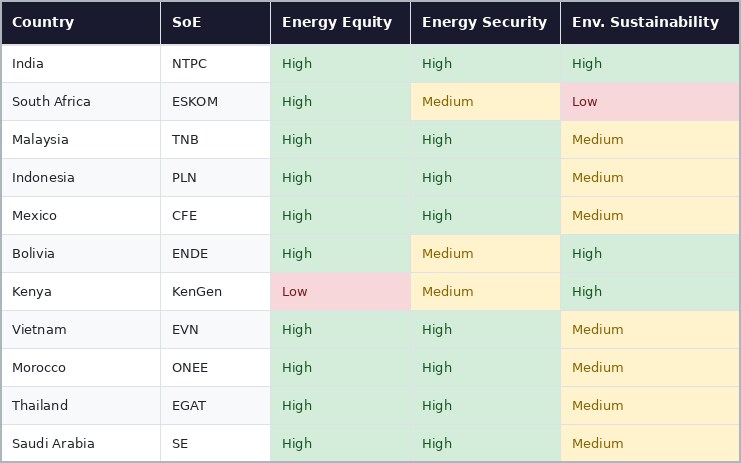
These findings challenge long-held assumptions that public utilities are inherently slow, inefficient or resistant to change. Most of the enterprises examined demonstrated medium to high performance across multiple dimensions.
India’s NTPC scored highly across all three pillars due to its rapid renewable energy expansion, green hydrogen initiatives and strong contribution to grid reliability. Other notable examples include Kenya’s KenGen, which has leveraged geothermal energy to build a low-carbon electricity system, and Saudi Arabia’s SE, which is driving large-scale grid modernization and demand-side management initiatives. Similarly, utilities such as Malaysian company TNB, Indonesia’s PLN and Vietnam’s EVN are advancing renewable integration, storage deployment and electrification at scale while continuing to meet rapidly growing energy demand.
A key driver behind this progress is the national climate ambitions set by respective countries. Many countries have adopted ambitious Nationally Determined Contributions (NDCs) and net zero targets, empowering public utilities to scale investments in renewable energy, transmission infrastructure, storage systems and clean fuels. India, for example, has set a target of achieving 500 GW of non-fossil fuel electricity capacity by 2030, while Saudi Arabia aims to generate nearly half of its electricity from renewable sources within the same timeframe. Increasingly, these national ambitions are being translated into concrete investment priorities for state-owned utilities.
The role of policymakers
If the world is serious about achieving a just and inclusive energy transition, strengthening state-owned enterprise must become a strategic global priority.
Governments need to provide these institutions with greater operational autonomy, stronger governance structures and access to innovative financing tools such as green bonds, blended finance and concessional climate capital. Multilateral development banks, and international climate institutions should deepen direct partnerships with high-performing state-owned enterprise with the goal of replicating successful transition models across regions. Strategic international collaboration, technology sharing and capacity building will be essential to accelerate progress where private markets alone cannot deliver.
State-owned enterprises as leaders
These companies are emerging as some of the world’s most important climate champions. They are successfully balancing affordability with ambition, resilience with innovation and national development with global climate responsibility.
As the world moves towards a more complex and electrified energy future, the role of state-owned enterprise will become even more significant, particularly in regions where private capital alone cannot deliver the scale of investment required. With the right policy frameworks, stronger governance mechanisms, access to climate finance and international partnerships, state utility companies could emerge as one of the most decisive forces in building a cleaner, more resilient, and more inclusive global energy system.
The next chapter of the energy transition may therefore be shaped not only by private innovation and market forces, but also by the ability of state-led institutions across the Global South to drive transformation at scale. The broader lesson is clear: governments can significantly amplify the impact of state-owned enterprise through coherent policy direction, long-term planning frameworks, and targeted financial incentives.
Views expressed are personal.


