How mapping the future of technology provides an edge in a converging world

Recent technology convergence has connected industrial hardware, sensors and edge AI to enhance manufacturing processes. Image: iStockphoto / ipopba
- Every industry is organized around constraints, but when different technologies converge, those constraints can shift.
- To navigate the impact of this convergence, leaders need a clear view of their business and the technologies that could reshape it.
- Mapping helps leaders see what technologies exist and how they may move, combine and create new capabilities over time.
Imagine two versions of the same day as an engineer on a factory floor.
In the first version, as you start your shift you see that a machine has been flagging intermittent errors since 3am. To find out what’s wrong, you spend the next 20 minutes extracting logs to understand where the potential issue is coming from.
By the time you think you’ve identified the fix, an hour has gone by. And then, at the end of the production run, quality inspection flags that some parts of the prototype are not compliant. This means a new prototype and a new round of testing is required, while the defective batch has to be scrapped. The delay will prevent this product from hitting the market on time.
In the second version, as you arrive on the factory floor, that faulty machine is already undergoing maintenance. A digital twin detected early signs of degradation hours ago and triggered a predictive maintenance intervention.
While that maintenance is underway, you review the latest virtual prototype and see that digital twin testing shows the need for updated parameters. You validate those and launch the prototype production run, confident that quality will meet expectations.
You then return to the digital twin platform and use real-time monitoring to track production performance against the simulated model. This helps you identify a way to reduce downtime and prepare for scale.
The technology convergence effect
Both versions of this day are full of technology. The difference is what each version asks of you – the operator.
In the first, you are more reactive. You spend your time problem-solving and troubleshooting existing errors. In the second, you are more proactive. You identify potential issues before they occur and anticipate what will be needed to scale prototype production.
This shift only became possible because several technology components combined to create a digital twin. This convergence connected industrial hardware, sensors and edge AI to collect high-fidelity data that’s directly integrated into a live system.
Technology convergence across industries
Convergence is already addressing everyday problems. A World Economic Forum report, Technology Convergence: The New Logic for Competitive Advantage, maps out a series of value chains for industries including healthcare, energy and manufacturing to analyse the progressive impacts of technology combinations.
The report shows that every industry is ultimately organized around its constraints – what is scarce, slow, expensive, risky – but when a new technology combination enters the system, those constraints shift.
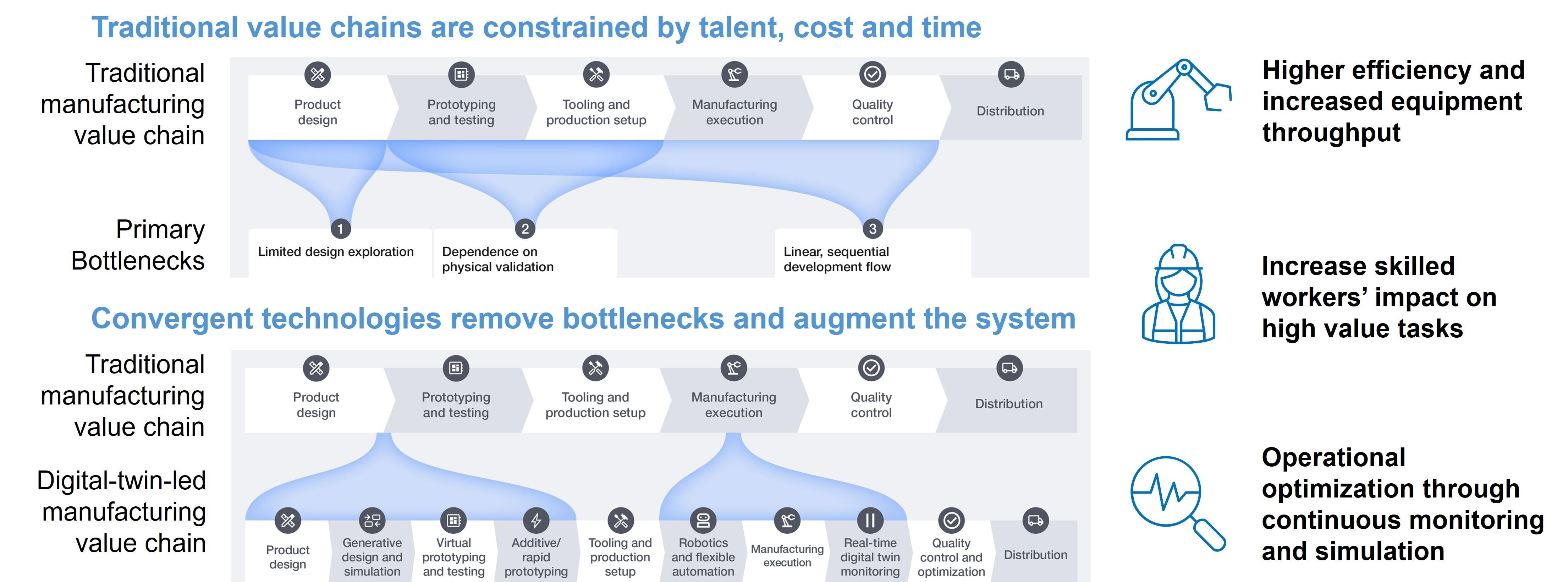
In manufacturing, for example, constraints often come from the cost and speed of a physical product’s design, testing and production. But as digital twins are integrated into manufacturing processes, they can optimize operations and equipment efficiency, increasing throughput and reducing downtime.
Prototyping and testing remain essential, but are less of a limiting factor. Instead, a firm’s operating bottleneck shifts from physical prototyping towards managing a physical-digital integrated simulator – and the workforce’s ability to adapt to the new technology combination.
The case for mapping technology convergence
So how can business leaders anticipate technology combinations ahead of the competition?
Value chains, as evidenced in the manufacturing sector diagram above and across industries in the latest Technology Convergence report, are one way to map a technology landscape. Maturity arcs, as evidenced by the Forum's Technology Maturity Index, are another. Inspired by Wardley Maps, they aim to make technology more navigable – to see the landscape, anticipate change and make choices before others see the same moves.
Wardley Maps were created to make strategies easier to see by turning a system into a landscape. They place the user need at the top, then show the components to meet that need underneath. Lines moving from left to right show how those components can evolve from uncertain ideas into industrialized capabilities.
Mapping the manufacturing value chain
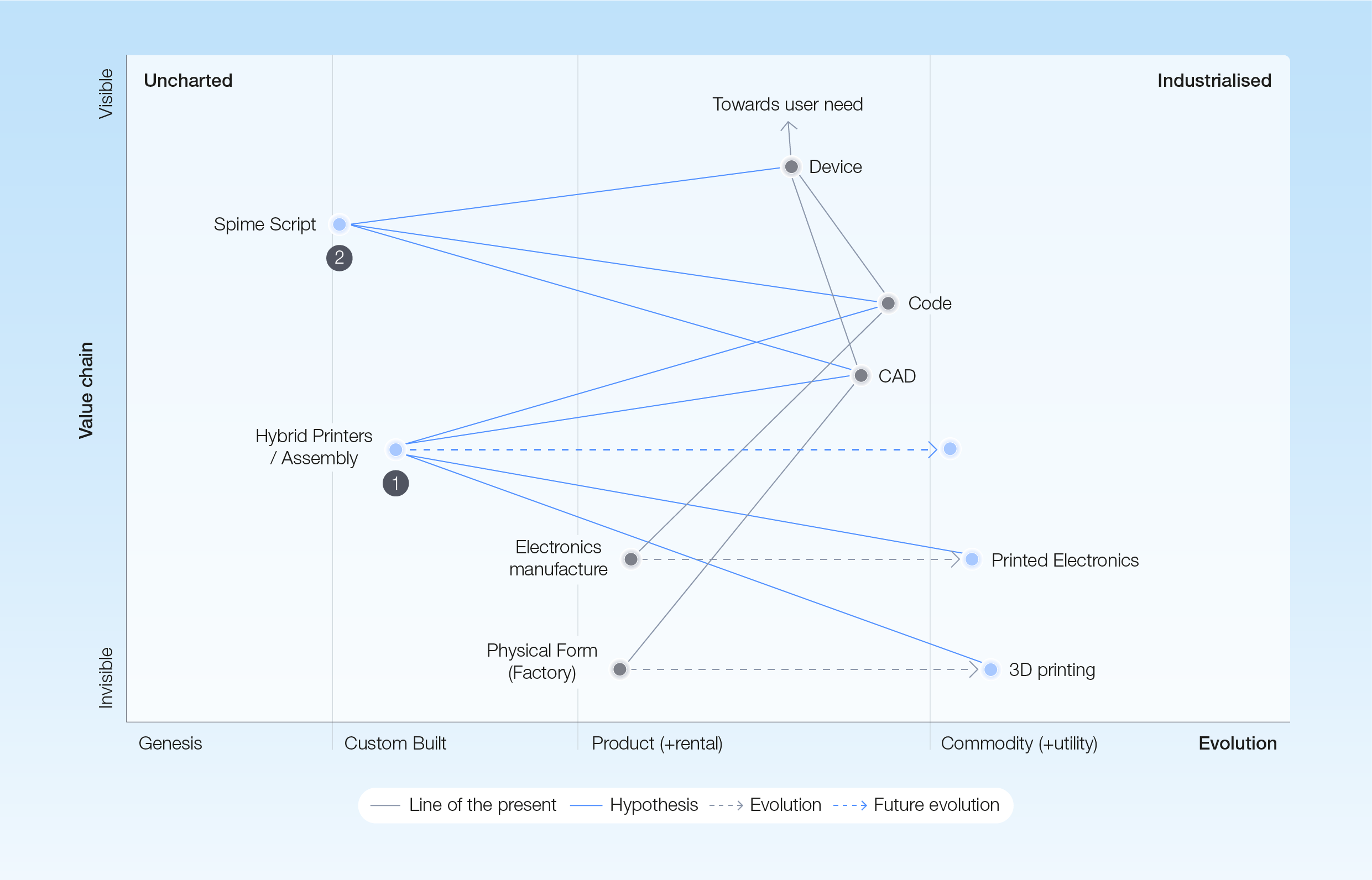
The map above applies that logic to the future of manufacturing. It's an illustration rather than a diagram to read in full. It shows that separate technologies can eventually mature and combine to create new capabilities over time – see the dotted lines and the points marked 1 and 2.
As 3D printing and printed electronics began to be used in manufacturing, three previously separate domains started to merge: making physical parts (physical form), producing electronics (electronics manufacture) and writing software (code).
The map shows what could happen as these paths continue to mature and combine. The black lines show the landscape at the time the map was created – a device is built from several components (shown on the map as CAD, code, electronics manufacture and physical form), with each sitting at a different stage of maturity.
The map then anticipates a path (the dotted line) from 3D printing and printed electronics towards hybrid manufacturing, compiled manufacturing, and eventually, more programmable forms of cyber-physical production (“spime script”). This reflects the logic in the Technology Convergence report, which shows how technologies combine, reshape value chains and compound into new systems.
Navigating technology convergence
Mapping makes convergence navigable. It helps leaders see not just what technologies exist, but how they may move, combine and create new capabilities over time. And while these maps are not perfect, they do provide a way of seeing potential futures.
The simple act of mapping a technological and economic landscape enables business leaders to:
1. See technology combinations early
By placing domains such as artificial intelligence, spatial intelligence, advanced materials, robotics, quantum, next-generation energy, omni-computing or engineering biology components on the same map, leaders can see where mature foundations enable novel activities.
2. Turn "magic" into patterns
Convergence becomes explainable through evolution, inertia, commoditization, bottlenecks and ecosystem shifts – not hype or isolated breakthroughs.
3. Improve strategic actions
Maps help users decide what to build, buy, outsource, standardize or exploit.
Most importantly, maps are a vehicle for communication and challenge. Placing technology stories in map form helps to challenge concepts neutrally, while enabling everyone to bring their ideas to the table.
Why leaders should start mapping today
Convergence is not a future trend to watch. It is a strategy problem that every organization already has – whether or not they are working on it. The constraints your business is built around today will not remain the same. And the combination that forces the change could come from an industry you do not think of as connected to yours.
To navigate the impact of convergence, leaders need a clear view of their business and the technologies that could reshape it. Your map won’t be perfect on day one, and it doesn’t need to be. The point is to start, because the places that feel uncertain or uncomfortable are often where the next opportunity sits.
Don't miss any update on this topic
Create a free account and access your personalized content collection with our latest publications and analyses.
License and Republishing
World Economic Forum articles may be republished in accordance with the Creative Commons Attribution-NonCommercial-NoDerivatives 4.0 International Public License, and in accordance with our Terms of Use.
The views expressed in this article are those of the author alone and not the World Economic Forum.
Stay up to date:
Strategic Foresight
Related topics:


Forum Stories newsletter
Bringing you weekly curated insights and analysis on the global issues that matter.
More on Artificial IntelligenceSee all

Elizabeth Henderson, Daniel Raizman and Daniel Murphy
October 8, 2026


