How can we harness AI for a resilient and sustainable energy sector?

AI is a powerful enabler across the value chain of sustainable energy Image: REUTERS/Amr Alfiky
- Artificial intelligence (AI) is emerging as a powerful enabler across the energy value chain, with the potential to unlock up to $550 billion in operations and maintenance cost savings by 2030.
- ADNOC, in collaboration with Bain & Company, prototyped two AI-enabled tools to strengthen climate resilience planning and ESG (environmental, social and governance) performance management.
- The Resilience Intelligence Suite and the Sustainability Performance Navigator offer a blueprint for how energy companies can harness AI to advance sustainability.
The energy sector is in the midst of a complex and uneven transition. Markets can shift in days, technology evolves in months, and expectations for reliable, affordable and cleaner energy continue to rise.
In 2025, global energy demand grew by 1.3%, just below the previous decade’s average, as slower economic growth and weaker activity in energy-intensive industries in some regions tempered demand. Against this backdrop, energy companies must increasingly balance growth, affordability, resilience and decarbonization simultaneously.
AI is proving to be a powerful enabler in achieving this balance. The International Energy Agency estimates that AI could unlock up to $550 billion in operations and maintenance cost savings by 2030, while freeing up to 175 gigawatts in existing transmission capacity, accelerating the integration of new renewable sources and alleviating grid congestion.
At the same time, AI introduces a parallel imperative: the rapid growth in energy demand from AI applications and data centres raises important questions about how the sector can scale responsibly without compromising net-zero pathways.
Maximizing AI's value while managing its environmental footprint will be essential.
AI as a strategic tool for energy resilience and sustainability
To explore how AI can address these dual imperatives in practice, the Abu Dhabi National Oil Company (ADNOC) in the United Arab Emirates, partnered with the World Economic Forum and Bain & Company under the Leaders for a Sustainable MENA initiative.
Over an eight-week innovation sprint, the team prototyped and tested two AI-enabled tools designed to strengthen resilience planning and sustainability performance management across the energy sector.
The first, the Resilience Intelligence Suite (RIS), translates complex climate data into decision-ready insights for asset and value-chain resilience planning.
Drawing on geospatial datasets covering more than 10 climate hazard types, including rainfall, wind and heat, RIS evaluates operational risks under evolving climate scenarios, estimates potential losses across interconnected infrastructure and recommends adaptation measures ranked by cost and return on investment.
A central design insight was the importance of moving beyond individual asset assessments toward a system-level view that captures how disruptions cascade across interconnected operations in ways that traditional tools miss.
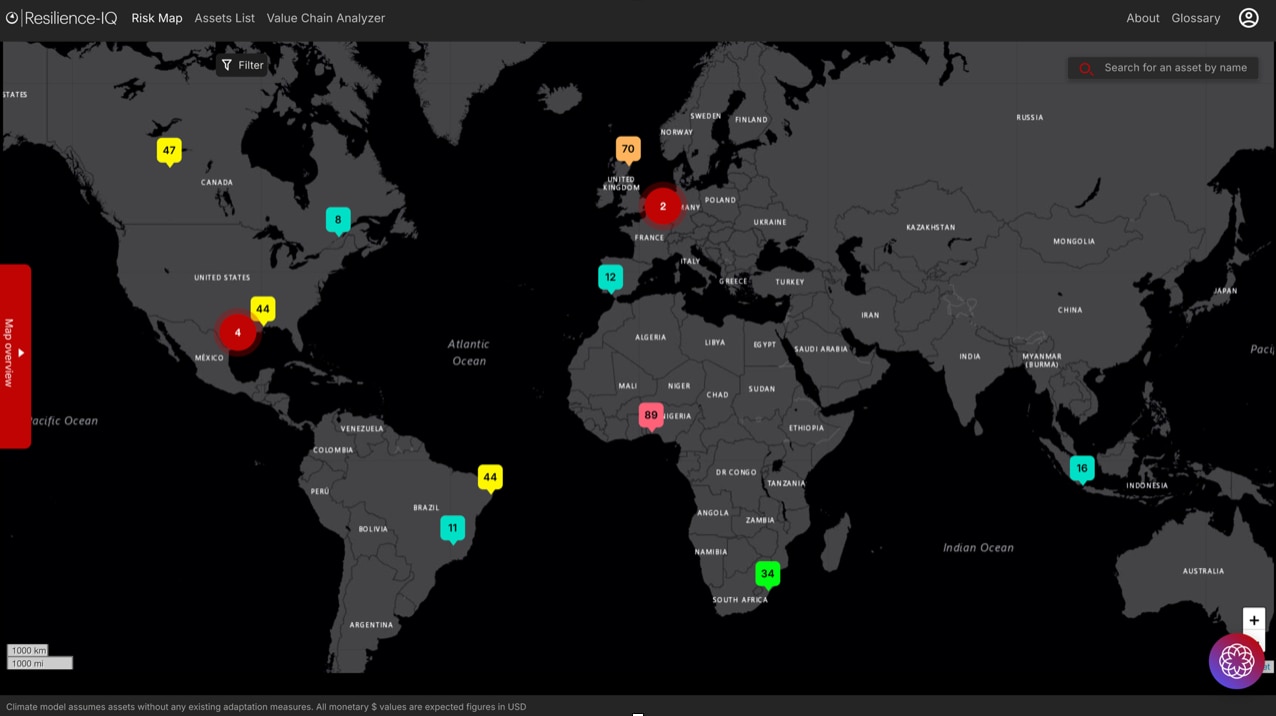
User testing with ADNOC's climate teams validated the platform's potential to consolidate risk information across assets and infrastructure, enabling clearer visibility into how disruptions could propagate across the value chain and which resilience investments should be prioritized.
The second AI-enabled tool, the Sustainability Performance Navigator (SPN), applies generative AI to interpret sustainability disclosures and benchmark performance against leading ESG (environmental, social and governance) rating frameworks.
Within ADNOC's multi-subsidiary structure, SPN maps performance against rating criteria, identifies material gaps and converts findings into prioritized action plans at the enterprise and subsidiary level.
User testing demonstrated significant reductions in manual benchmarking effort and improved coordination across business units. A critical learning was that executive adoption was driven by the quality of analytical outputs and by clear traceability between data inputs, rating criteria and recommendations.
A regional blueprint for the energy sector
The insights from ADNOC's sprint offer a valuable blueprint for the broader MENA energy sector.
AI-enabled platforms such as RIS can help companies better understand portfolio-level risk exposure and allocate resources toward the most effective resilience measures. Tools such as SPN can support stronger alignment with external ESG expectations, potentially improving market perceptions and long-term value creation.
The sprint demonstrates that focused experimentation can translate emerging AI capabilities into practical, decision-ready tools. The approach is replicable: by combining technical expertise with domain knowledge and clearly defined use cases, energy companies across the region can apply similar methods.
Scaling will require continued collaboration among companies, technology providers and sustainability specialists, alongside stronger data integration and governance frameworks.
The trajectory for climate risk and sustainable energy
AI's application to sustainability and resilience in the energy sector remains in its early stages but the potential is clear.
The RIS and SPN prototypes show how AI can move beyond operational efficiency to support more structured, forward-looking decision-making on climate risk and sustainability performance.
ADNOC's experience demonstrates that realizing this potential requires investment in innovation and data integration and highlights the importance of strong governance and cross-disciplinary collaboration.
With these requirements met, AI-enabled tools can play an increasingly important role in building energy systems that are not only more efficient, but also more resilient and sustainable, for the region and for the world.
Don't miss any update on this topic
Create a free account and access your personalized content collection with our latest publications and analyses.
License and Republishing
World Economic Forum articles may be republished in accordance with the Creative Commons Attribution-NonCommercial-NoDerivatives 4.0 International Public License, and in accordance with our Terms of Use.
The views expressed in this article are those of the author alone and not the World Economic Forum.
Stay up to date:
Artificial Intelligence


Forum Stories newsletter
Bringing you weekly curated insights and analysis on the global issues that matter.
More on Energy TransitionSee all

Prajeev Rasiah
September 23, 2026


