From fragmented deals to scale: what market infrastructure does carbon dioxide removal need?

Carbon dioxide removal needs to attract a broader investment base to accelerate deployment as an industrial sector. Image: Getty Images/iStockphoto
- Carbon dioxide removal (CDR) needs to scale rapidly, but today’s market remains fragmented, costly and reliant on bespoke transactions, limiting its ability to attract capital at scale.
- A common market architecture – connecting standards, contracts, demand, financing, registries, transparency and market infrastructure – is essential to move CDR towards greater bankability, liquidity and global integration.
- A functioning CDR market can unlock institutional capital, accelerate deployment and transform CDR from individual projects into a scalable, globally integrated asset class.
Carbon dioxide removal (CDR) is moving from a climate policy concept to an emerging industrial sector, but the gap between ambition and deployment remains substantial.
Today, about 2 gigatonnes of carbon dioxide equivalent (GtCO₂) is removed globally each year, yet approximately 99.9% comes from conventional land-based approaches. Durable CDR methods, including direct air capture (DACCS), bioenergy with carbon capture and storage (BioCCS), biochar and enhanced weathering, currently account for less than 2 megatonnes of carbon (MtCO₂) per year.
Paris-aligned scenarios point to about 4 GtCO₂ of annual removal being needed by 2035 and 9 GtCO₂ by 2050, illustrating the scale of the deployment gap.
The challenge, therefore, is no longer simply developing carbon dioxide removal technologies. It is building the financial, regulatory and market infrastructure needed to move CDR from early-stage projects to industrial-scale deployment.
The implication is clear: CDR must move from a collection of projects and bilateral contracts into a functioning market. It requires a deliberate market architecture that progressively reduces transaction costs, standardizes what can be standardized, differentiates what must remain differentiated, aggregates risk and demand, regulates what needs to be regulated to establish transparency and trust, and ultimately creates the conditions for institutional capital.
A fragmented market built on bespoke deals
Today’s carbon dioxide removal market remains fragmented across standards, registries, contracts and jurisdictions. Bespoke transactions, extensive due diligence, limited comparability and regulatory uncertainty increase costs and constrain the market’s ability to mobilise capital at scale.
As CDR moves towards industrial deployment, it must attract a broader investor base, including banks, institutional investors, insurers and asset managers. This requires clearly defined assets, comparable risks, predictable cash flows and reliable market infrastructure.
The objective is not to eliminate differences between CDR projects, but to standardize the market architecture around them. Modular contracts can establish common commercial terms while preserving flexibility for differences in technology, permanence and project risk.
Over time, greater alignment in asset definition – including certification standards, measurement, reporting and verification, data, registries and quality classifications – can further improve comparability and reduce transaction costs.
Scaling CDR therefore requires a common market architecture that advances standardization at both the contract and asset frameworks, enabling the sector from bespoke bilateral transactions to greater bankability, liquidity and global integration.
The architecture of a scalable carbon dioxide removal market
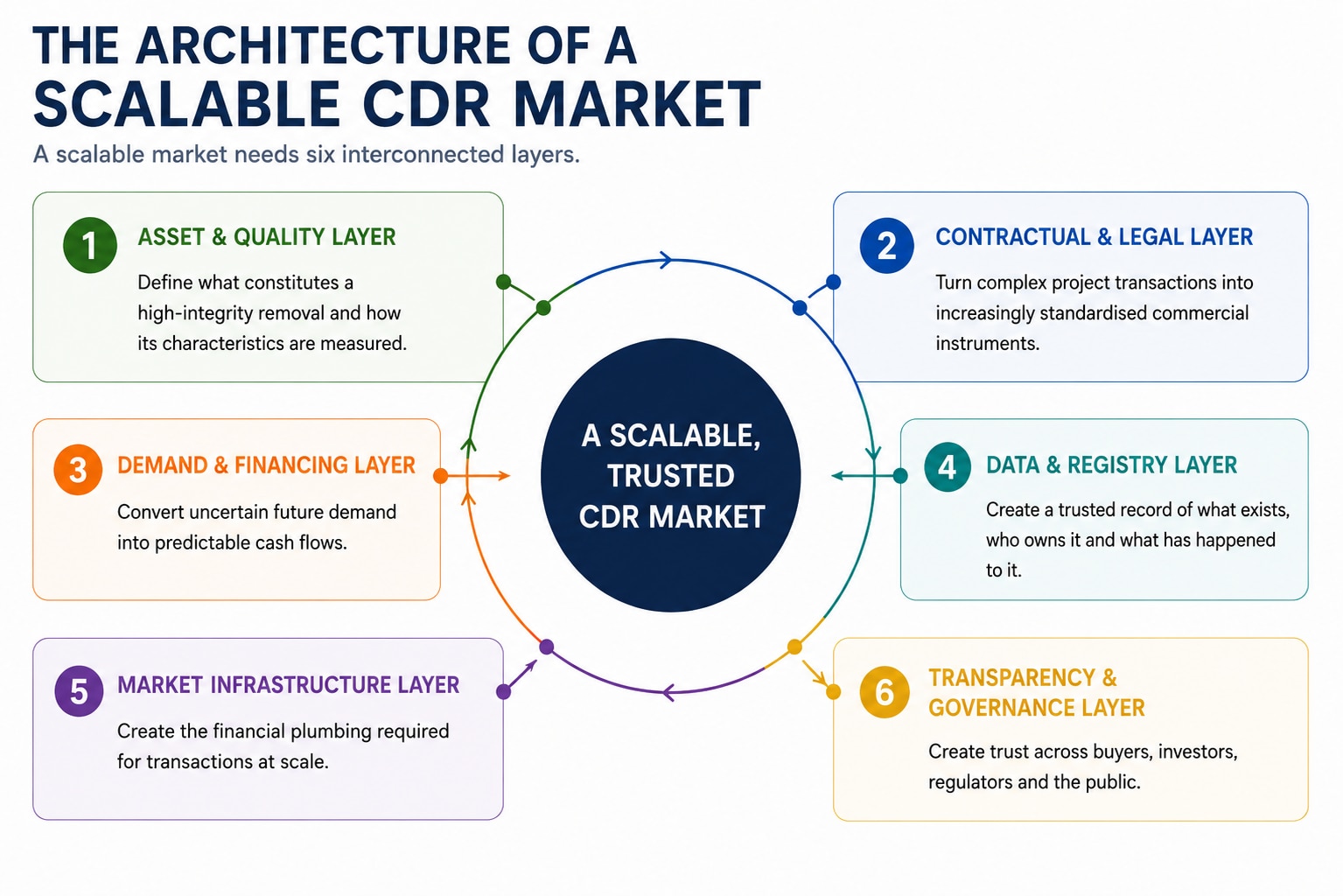
A scalable and trusted CDR market depends on six interconnected layers, each addressing a critical condition for market development.
- The asset and quality layer establishes what constitutes a credible, high-integrity removal.
- The contractual and legal layer provides the rules and standardised instruments needed to transact with confidence.
- The demand and financing layer turns future demand into predictable revenues that can support investment.
- The data and registry layer provides traceability and a reliable record of ownership and use.
- The market infrastructure layer provides the financial plumbing needed for efficient transactions at scale.
- The transparency and governance layer creates accountability and confidence among buyers, investors, regulators and the public.
No single layer is sufficient on its own. Only when all six are developed and connected can the market become credible, investable, efficient and ultimately scalable and trusted.
A phased path from today's market to a scalable asset class
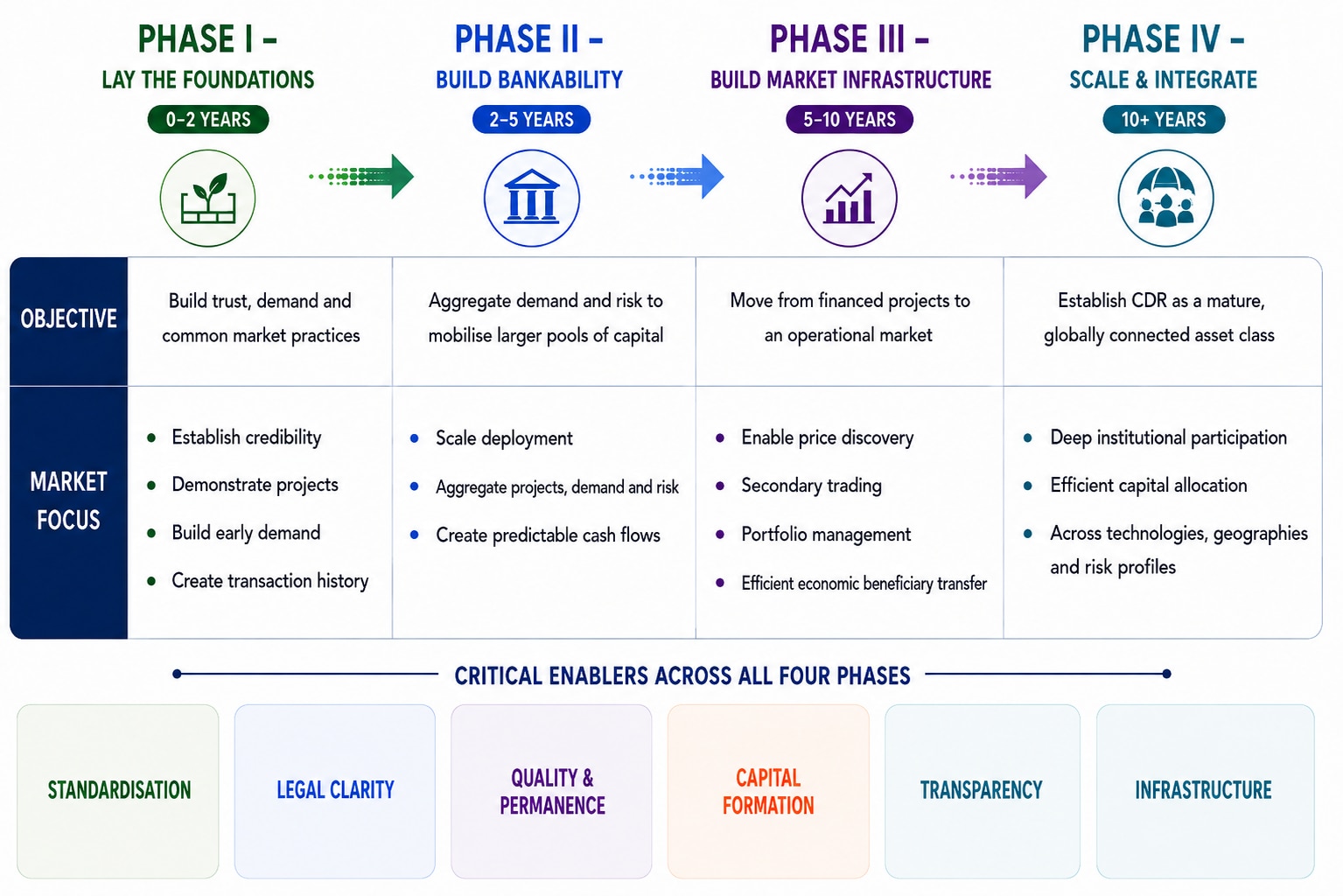
The transition from today’s fragmented carbon dioxide removal market to a scalable, institutional asset class will not happen in a single step. It requires a sequenced evolution in which each phase addresses the market’s most important constraint and creates the conditions for the next:
- Phase I – Lay the foundations: focuses on building trust, demand and common market practices, establishing the credibility and repeatability needed for the market to grow.
- Phase II – Build bankability: shifts the focus to aggregating demand and risk so that CDR projects can generate more predictable cash flows and mobilise larger pools of capital.
- Phase III – Build market infrastructure: moves the market from financed projects towards an operational market, with the infrastructure needed for price discovery, efficient ownership transfer, portfolio management and secondary transactions.
- Phase IV – Scale and integrate: aims to establish CDR as a mature, globally connected asset class capable of allocating capital efficiently across technologies, geographies and risk profiles.
Progress therefore depends not only on moving through these four phases, but on ensuring that the critical enablers – standardization, legal clarity, quality and permanence classification, capital formation, transparency and infrastructure – advance together. The result would be a connected market of differentiated CDR products operating on common infrastructure, capable of attracting institutional capital at scale.
Momentum is building, infrastructure must follow
Building carbon dioxide removal market infrastructure is more urgent than ever. What has been a largely voluntary, project-led market is beginning to intersect with formal climate policy, public procurement and financial-market development.
In early 2026, the Carbon Removals and Carbon Farming (CRCF) framework moved into implementation, with EU certification methodologies for permanent removals including DACCS, BioCCS and biochar, while the CRCF Buyers’ Club is being developed to aggregate demand and support due diligence, contracting and transactions.
In July 2026, another potentially significant step followed, when the European Commission proposed integrating domestic permanent removals into the EU Emissions Trading System (ETS). Under the proposal, the Commission would auction 250 million additional EU ETS allowances between 2031 and 2040 and use the revenues to purchase an equivalent volume of CRCF-certified domestic permanent removals from DACCS and BioCCS projects.
This would effectively create a public-authority mechanism linking permanent removals to the EU’s principal compliance carbon market, while maintaining control over their quality and quantity.
Similar developments are emerging elsewhere. The UK published its first full-form Greenhouse Gas Removals contract and standard terms in 2025 as part of a business model designed to support investment in engineered removals. Meanwhile, Singapore is integrating eligible international credits into its carbon-tax framework, allowing companies to use them for up to 5% of taxable emissions; by May 2026, it had signed 11 Article 6 implementation agreements.
In Switzerland, Article 6.2 cooperation already provides a foundation for international carbon transfers, and this is beginning to extend directly into removals. Switzerland and Norway are piloting international transfers of negative emissions; Switzerland and Denmark signed cooperation arrangements covering carbon capture and storage (CCS) and permanent CDR in 2025; and Switzerland and Sweden launched pilot transfers of industrial removals in May 2026. Combined with Switzerland’s financial-market capabilities, this creates an opportunity to help connect carbon assets, registries, contracts, financing and cross-border settlement.
At the same time, corporate demand is reaching a scale that exposes the limitations of bespoke transactions: Microsoft contracted 45 million tonnes of carbon removals with 21 companies in FY2025 but paused new CDR contracting in 2026, reinforcing the need for broader, more structured sources of demand.
Some progress has already been made by market participants and independent experts to standardize CDR contracting. Notable examples include Frontier’s Carbon Removal Offtake Agreement template, published in 2024 based on experience from seven offtake transactions worth more than $300 million, and the Open Standard Carbon Removal Purchase Agreement (OSCAR), launched in 2025 as an open contractual framework that legal teams can adapt rather than develop agreements from scratch.
The window for action is here. Standards, procurement mechanisms and regulatory frameworks are taking shape, while demand is moving from individual transactions towards larger and more institutional structures.
Don’t wait for the carbon dioxide removal market, build It
The scale of the challenge makes delay costly. Building a liquid, transparent and institutionally investable carbon dioxide removal market requires the standards, legal frameworks, demand mechanisms and infrastructure to be developed now, transforming today’s fragmented ecosystem into a market capable of mobilising capital at scale.
The World Economic Forum’s First Movers Coalition and SIX Group are committed to supporting this transition, bringing together stakeholders to accelerate market development.
The ambition is clear: do not wait for a mature carbon dioxide removal market, build the architecture that makes it possible.
Don't miss any update on this topic
Create a free account and access your personalized content collection with our latest publications and analyses.
License and Republishing
World Economic Forum articles may be republished in accordance with the Creative Commons Attribution-NonCommercial-NoDerivatives 4.0 International Public License, and in accordance with our Terms of Use.
The views expressed in this article are those of the author alone and not the World Economic Forum.
Stay up to date:
CO2 Capture, Utilization and Storage

Forum Stories newsletter
Bringing you weekly curated insights and analysis on the global issues that matter.
More on Climate Action and Waste Reduction See all

Alliance of CEO Climate Leaders
October 8, 2026


