Three ways AI hyperscalers can seize the clean energy opportunity
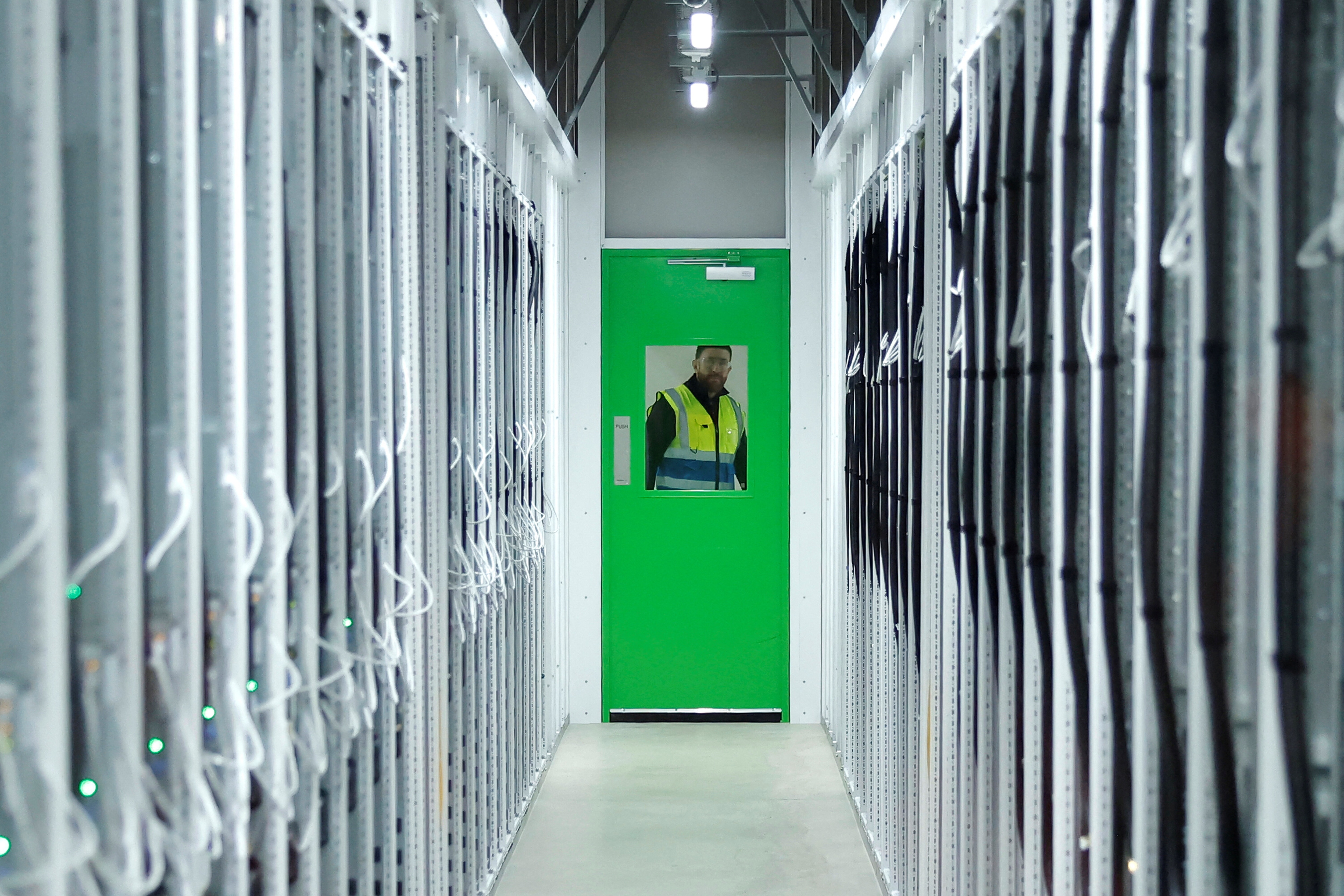
Hyperscalers and the data centres they are building are the perfect opportunity for some of the world's largest companies to move the needle towards renewable energy. Image: REUTERS/Clodagh Kilcoyne
- The four largest AI hyperscalers account for 87% of all corporate clean energy procurement in the US - purchasing power capable of redirecting energy markets at scale.
- Data centre energy demand is predicted to double by 2030, yet 40% of that supply is still projected to come from fossil fuels.
- Earth alignment a strategic choice hyperscalers can no longer defer.
Artificial Intelligence hyperscalers are among the world's largest corporate buyers of renewable electricity – but their outsized potential impact on the environment and the energy industry means they also have a responsibility to push further on delivering renewable AI expansion.
In the US, the four largest - Google, Meta, Microsoft and Amazon Web Services - now account for 87% of all corporate clean energy procurement.
This formidable purchasing power can redirect markets with huge potential for accelerating the energy transition. Since 2024, for example, their power purchase agreements have driven a surge in nuclear energy.
AI hyperscalers can have an outsized impact on renewables development
But rapid AI growth also risks locking in new fossil infrastructure. In Pike County, Ohio, developers have proposed a colossal data centre campus served by what its backers call the world's largest gas power plant. The 9.2-gigawatt capacity could power New York.
Globally, energy demand for data centres is predicted to double by 2030. At a moment when the world needs to rapidly reduce emissions, clean energy including nuclear power is estimated to contribute about 60% of the needed electricity supply, leaving 40% powered by fossil fuels.
Increasingly, companies are turning to gas turbines as a bridging technology while clean energy catches up. But gas turbines are capital-intensive infrastructure that can operate for decades. Hyperscalers have the power to do more to remove bottlenecks to carbon-free generation, grids, storage and flexibility.
Data centres are only one part of the challenge of aligning AI with the goal of a stable climate system and resilient biosphere. How AI is used may be an even more significant factor in its climate impact. Without deliberate direction, AI agents and tools could contribute to increasing fossil-energy demand, lock in high-carbon infrastructure and help companies extract more oil and gas.
Three ways hyperscalers can align AI development and the Earth
The principle of Earth alignment should guide AI development and use because hyperscalers command capital and innovation ecosystems at exceptional scale. As the AI rollout and infrastructure buildout gains pace, now is a crucial time to lay the foundations for a sustainable energy industry. Three shifts can make that opportunity real.
1. Build the clean-power system faster than AI demands
Hyperscalers must deploy carbon-free generation, grids, storage and flexibility significantly faster than their own load growth, while accelerating toward 24/7 Carbon-Free Energy on every grid where they operate. Annual certificate matching does not show that demand is matched by carbon-free supply in the same hour and grid region.
Hyperscaler purchasing power can help remove barriers to clean generation, grids and storage. Integrated planning can locate facilities where energy and water systems can support them responsibly, shift suitable workloads and use batteries or demand response to reduce peaks.
AI growth should not shift grid costs onto households, crowd out other sectors requiring clean energy or lock in unabated fossil generation. The opportunity is to leave the wider power system cleaner, more resilient and affordable.
2. Make radical efficiency and transparency the default
Greater efficiencies are real but they are not out-scaling the insatiable appetite for compute. Google reports that Gemini’s energy and carbon footprints dropped by 33x and 44x, respectively, in a year. But emissions of all hyperscalers are rising.
Hyperscalers should drive and disclose full-stack efficiency gains across chips, models, software, servers, cooling and hardware life. Per-task gains must lower absolute impacts: any temporary emissions bump must be bounded, with a stated peak in absolute emissions and credible goal to sustained decline aligned with the highest possible climate ambition.
Location matters: comparable workloads can have very different impacts depending on facility efficiency and local power. Google's 2025 regional grid data report says places such as Stockholm and Finland, for example, can provide around 100% carbon free energy, while other regions can provide close to zero carbon free energy.
3. Prioritise climate solutions at gigatonne scale
AI can shorten the path to positive tipping points, shifting the cost curves for key climate solutions so they scale sooner. The IEA's Widespread Adoption Case estimates existing AI applications could cut 1.4 gigatonnes of CO2 in 2035. Google already aims to enable a gigatonne of reductions annually by 2030, and reported 41 million tonnes from nine products in 2025: roughly 4% of the goal, with four years left.
Set that against contracts with fossil-fuel extractors. McKinsey estimates AI could unlock $230 billion a year in upstream oil and gas at full potential. This has climate implications. A recent analysis found that if AI increases productivity in the fossil fuel sector, then clean-energy productivity gains must be at least four times fossil-fuel gains to balance out the losses.
Clearly, in a profoundly carbon constrained world, hyperscalers must not use AI to expand fossil extraction or prolong high-emitting assets. We would like to see hyperscalers disclose revenue and compute serving fossil extraction alongside claimed enabled reductions.
Making Earth-alignment a market requirement
Corporate and public-sector customers can influence hyperscalers. Contracts for data centre, cloud and AI services should carry four requirements alongside security, reliability and cost: hourly carbon-free energy reporting by grid region; energy, water and lifecycle emissions per workload on a comparable basis; an absolute emissions pathway with a named peak year and decline rate; and a commitment that the services procured will not be used to expand fossil extraction.
The European Commission's green public procurement criteria show it is possible to build data centre and cloud service climate performance into tenders.
Hyperscalers operate at immense scale and speed. Their responsibility is to minimise their own footprint and help power a clean, circular and resilient economy. Rewarding leaders who take this kind of Earth-first action turns it into a competitive opportunity. Hyperscalers must earn and retain their licence to scale by proving that their growth accelerates us towards an Earth-aligned economy, not towards climate tipping points.
Don't miss any update on this topic
Create a free account and access your personalized content collection with our latest publications and analyses.
License and Republishing
World Economic Forum articles may be republished in accordance with the Creative Commons Attribution-NonCommercial-NoDerivatives 4.0 International Public License, and in accordance with our Terms of Use.
The views expressed in this article are those of the author alone and not the World Economic Forum.
Stay up to date:
AI and Energy Use
Related topics:

Forum Stories newsletter
Bringing you weekly curated insights and analysis on the global issues that matter.
More on Artificial IntelligenceSee all

Rakesh Kumar Murugan
September 27, 2026


