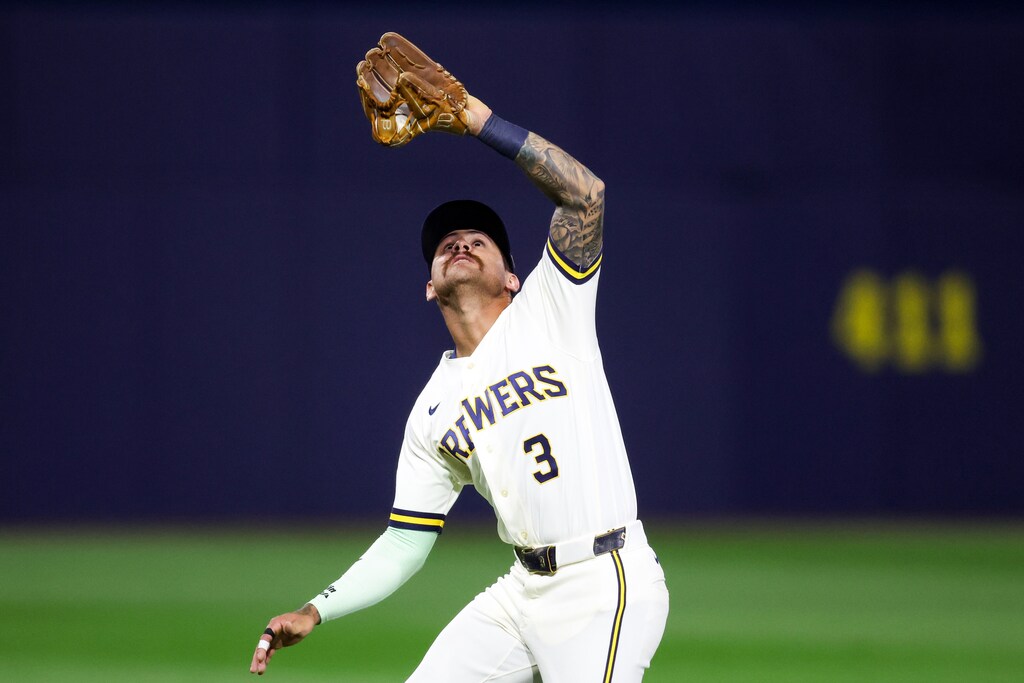
Players in baseball’s premier professional league are about as organized as labour gets. But they’re not immune to a global trend affecting many workers: a declining share of income.
If even this AI-proof workforce with a strong union is affected, it’s worth considering what that means... and whether it matters.
Karl Marx might have been a baseball fan.
Not of the physical act of striking and tossing a little sphere around a grassy field, necessarily. But the revolutionary German philosopher probably would’ve appreciated the players’ ability to collectivize.
When Marx died in 1883 the average American professional ballplayer was earning about $2,000 a year for his services – equivalent to roughly $66,000 today. Off-season side hustles like factory work or selling cars were necessary well into the next century. Then players got serious about their union.
The first collective bargaining agreement they signed in 1968 lifted minimum pay and set the stage for a free-agency system where teams had to start bidding for talent (like pretty much any other kind of company). The average salary for Major League Baseball players this year: $5.3 million.
And yet!
That’s still probably fallen behind the pace of league proceeds. An academic study found that players’ share of league income started declining in the first part of this century, and there are signs the slump continues. Now, team owners are proposing a salary cap. The legitimate counter-argument is that this would “not just squeeze the highest salaries, it will squeeze all the way down,” said Michael Haupert, an economics professor at the University of Wisconsin-La Crosse. A labour-deal deadline in December looms. So does a possible work stoppage.
Peeved millionaires don’t often elicit sympathy. But in some ways the players’ situation mirrors a global trend affecting just about anyone who works for a living.
Labour’s global share of income, or the portion of economic output that flows to workers as opposed to owners, has also slipped since the dawn of the 21st century. The Bank for International Settlements recently suggested it could fall as low as 20% in the next few decades, with artificial intelligence speeding the decline. Economists debate exactly why it’s happening and to what extent, but most agree that it matters. It is, after all, widely considered an indication of rising inequality.
Baseball players might have been expected to buck the trend. Their job is relatively AI-proof. And they have “the strongest union in the history of unions,” according to Haupert. Members at the bottom of the pay scale (league minimum: $780,000) tend to be as committed as those at the top (highest salary this year: $61.9 million).
A caveat for Karl Marx: these labourers are often more interested in potential personal wealth than collective well-being. The advent of free agency did boost their shared slice of the financial pie for a while, but as the business of baseball becomes more complex it’s harder to keep track of what’s coming in – and who should be entitled to what. Players earn more every year, Haupert said, but “what’s not clear is if that percentage is as great of the total revenue as it used to be.”
The league puts on 2,430 games per year. Each is a drama staged in nine acts. Successive bat-wielding employees venture out to the bases hoping they can eventually return home to score, like wandering Greek heroes. If sufficient guile and determination are deployed to bring just one more player back safely than their opponents, a team wins.
It’s a labour pool with specific aptitude. Hughie Jennings posted elite numbers because he eagerly exploited a rule awarding a free base to batters struck by a pitch (he suffered multiple skull fractures along the way). Frank Howard, a nearsighted goliath who feared baserunning, belatedly donned eyeglasses to help him belt home runs so he could amble through the bases at his own pace. The powerful wrists on an otherwise average-sized Hank Aaron enabled him to hit far more home runs than Howard or nearly anyone else. Then there was Norm Cash, likened to a Kewpie doll but reputed to have once hit a ball an astounding 515 feet (157 metres).
Watch Cash and his peers lumber onto the field during introductions for the 1971 All Star Game, a showcase of baseball’s top athletes. Very particular sets of skills.
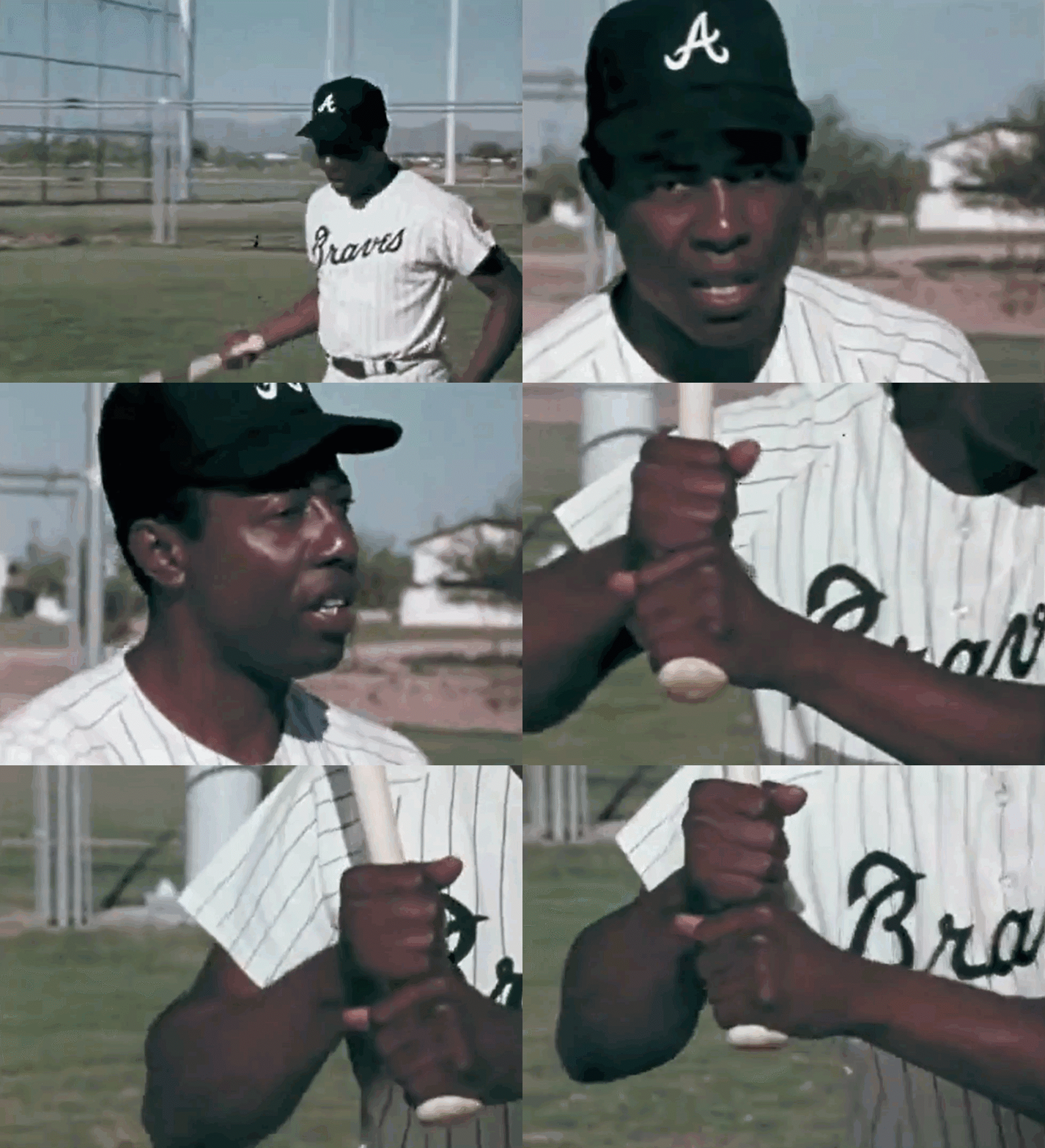
Players are often fitter and more photogenic now, though the physical assets enabling their achievements can still be surprising. As a workforce they’ve always been bound by an uncanny ability to use a bat to access bases, or to pitch a ball in ways that deny entry.
One thing that has not changed, at least in outline, is the diversity of the workforce. An essential job on any team is translator. For every Ben Rice there’s a Roki Sasaki, for every Jung Hoo Lee a Luisangel Acuña. They all have to stay on the same page. At the moment, that means the rank-and-file being just as displeased with the idea of a salary cap as the lavishly compensated superstars.
Players of the league, unite
The economics of baseball can be murky. Haupert’s quest for edifying financial records long ago led to the Baseball Hall of Fame, a Valhalla tucked away in rural New York state, which directed him to a back room filled with tens of thousands of index cards. A mostly forgotten accumulation of player contract records. Twenty years of work later, he emerged with an enviable dataset.
More is now made public about player compensation, but the particulars of team income can still be mysterious. Only one club, the Atlanta Braves, has an obligation to disclose extensive financial information because it sells shares to the public (the public has been shorting those shares lately, or betting against them, amid scepticism about a new labour deal).
Real estate near a ballpark can earn income for a team, for example – should the Braves have to share proceeds from their new residential building and hotel named after Hank Aaron with the players? “It’s a legitimate question,” Haupert said.
Players generally want the kind of compensation appropriate for a workplace with unique hazards. Mickey Cochrane, shouldering management duties while playing catcher for the reigning champion Detroit Tigers, suffered what was described a nervous breakdown mid-game in 1936. That season, he was earning the highest salary in the league. The next season, a pitch to the head ended his career.
Hitters wear helmets now, but the velocity of pitches hurled in their direction has also ticked up notably – in tandem with pitchers’ arm fatigue. Meanwhile statistics-based scrutiny only increases.
Office workers fret about having more of their day tracked by AI-powered “bossware,” yet ballplayers have long had everything they do quantified in granular detail. A less-than-optimal launch angle when hitting a ball can impact their market value. So can the amount of spin generated when throwing it. There’s even a niche statistic to detect slippage into an otherwise imperceptible early stage of decline – something mid-career employees everywhere may want to ponder.
Another connection between ballplayers and the broader workforce: systemic inequality has been exploited to suppress wages. The existence of the “Negro Leagues” was a glaring example. Some of the highest-performing employees in history were underpaid because owners could collude to marginalize black baseball talent until 1947.
The lack of free agency in the old days also resulted from collusion. Owners said that no longer being able to restrict players to a single employer would ruin the game. Its popularity may ebb and flow, but the money continues to pour in.
“Attendance is up, television ratings are up, the money we can see coming in is definitely going up,” Haupert said. “Every time a team goes up for sale, there are multiple bidders and the price keeps going up.” The Los Angeles Angels were sold last week in a deal valuing them at a league record $4 billion. In 2003, they’d been sold for $183 million.
The Angels have a middling payroll of $179 million, far below the largest at well over $300 million. Owners argue that a salary cap would level the competitive balance. But it isn’t clear that bigger budgets are always a decisive advantage. If the players rebuff the cap, of course, they risk being painted as greedy.
After a work stoppage erased part of the 1981 season, play restarted with an All Star Game. Immediately after the first pitch, a piercing sound filled the stadium.
The TV announcers said whistles had been distributed to fans. It was a “blow the whistle on the players” campaign, one announcer tried to explain, or maybe it was just blow the whistle on baseball. Pete Rose, a hitter whose typically mulish intensity at the plate had been interrupted, peered around in confusion. “You can’t very well whistle on the owners,” the announcer continued, “they’re not here.”
Is it greedy to insist on maintaining a particular share of income as a workforce? That may not even be how most baseball players think about their situation – or anyone else, for that matter. The freedom to quit one job for a better alternative is probably a more tangible goal.
That’s a potential misread of human nature by Marx and others. Or maybe just willful optimism.
“I don’t think the average worker really goes into things thinking, 'I should have X-percent of the total revenue',” Haupert said.
With labour’s share trending the way it has, it might be time to start.