How renewable energy can restore Europe’s industrial competitiveness
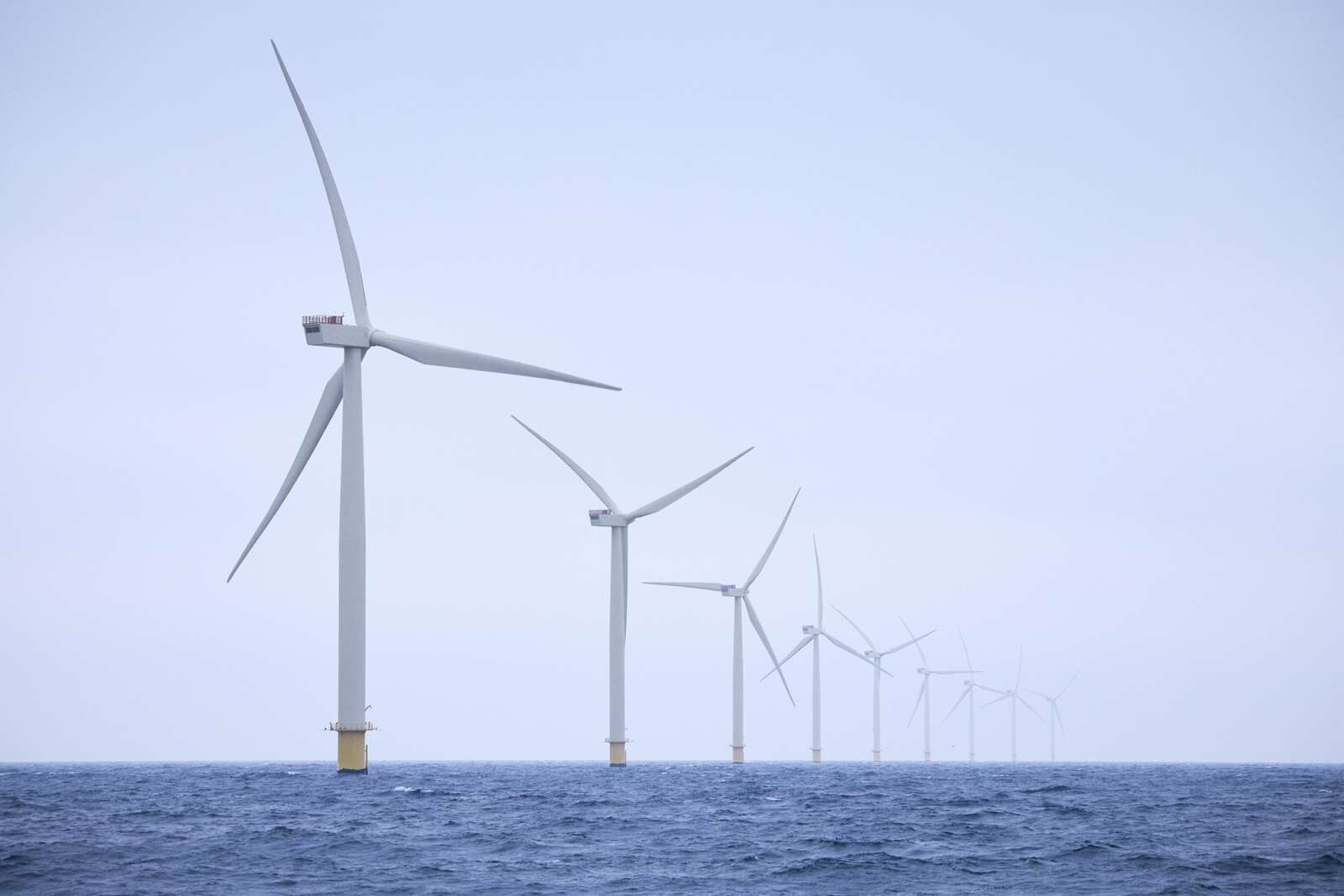
Europe’s high dependency on energy imports has in recent years translated into price volatility. Image: Ørsted
- European energy prices remain double pre-Russia-Ukraine war levels, contributing to 1 million lost manufacturing jobs.
- Expanding wind and solar to 70-90% of the power mix would cut total electricity system costs by 30%.
- Targeted policy levers, smarter grid investment and a fast expansion of renewables can bridge the electricity-to-gas cost gap.
Europe is facing a severe energy competitiveness crisis. Lacking local low-cost energy sources, the European Union imports nearly 60% of its energy, including over 90% of its oil and gas. In contrast, the US is a net energy exporter, while China’s import dependency stands at just 20%.
This high dependency on imports has in recent years translated into price volatility and high energy prices. European energy prices are still more than double what they were before the Ukraine war. Average EU industrial electricity prices are typically around 50% higher than in China and about twice of the US, although there are significant variations between European countries and within China and the US. The higher energy prices have contributed to the erosion of Europe’s global competitiveness, which has resulted in a 10–15% drop in production between 2021 and 2024, and the loss of nearly one million manufacturing jobs since 2019.
To restore industrial competitiveness, Europe must rapidly scale a clean, independent power system anchored by wind, solar and a modern grid infrastructure – something Ørsted is working on achieving with other businesses and public sector representatives through the Leaders for European Growth and Competitiveness Initiative. Here are our recommendations on how policy-makers and energy leaders can accelerate that transition.
Closing the electricity-to-gas cost gap
Accelerating electrification offers a direct path to lowering industrial energy costs. Electrification reduces CO2 emissions, improves energy efficiency, and cuts Europe’s dependence on fossil fuel imports.
The European Commission projects that more than a doubling of electricity demand will be needed to meet European energy and climate objectives. The recently released Electrification Action Plan (EAP) calls for a 46% share of electricity in final energy consumption by 2040, up from 23% currently.
However, the EAP identifies the cost gap between electricity and fossil fuels as one of the main barriers to this transition. In fact, electricity is on average 3 times as expensive as natural gas for industrial end-users in the EU. The EAP aims to reduce this ratio to a maximum of 2 for industry and 2.5 for households by 2030, and one of the clearest actions to address this gap is a faster expansion of renewable power.
Lowering system costs with wind and solar
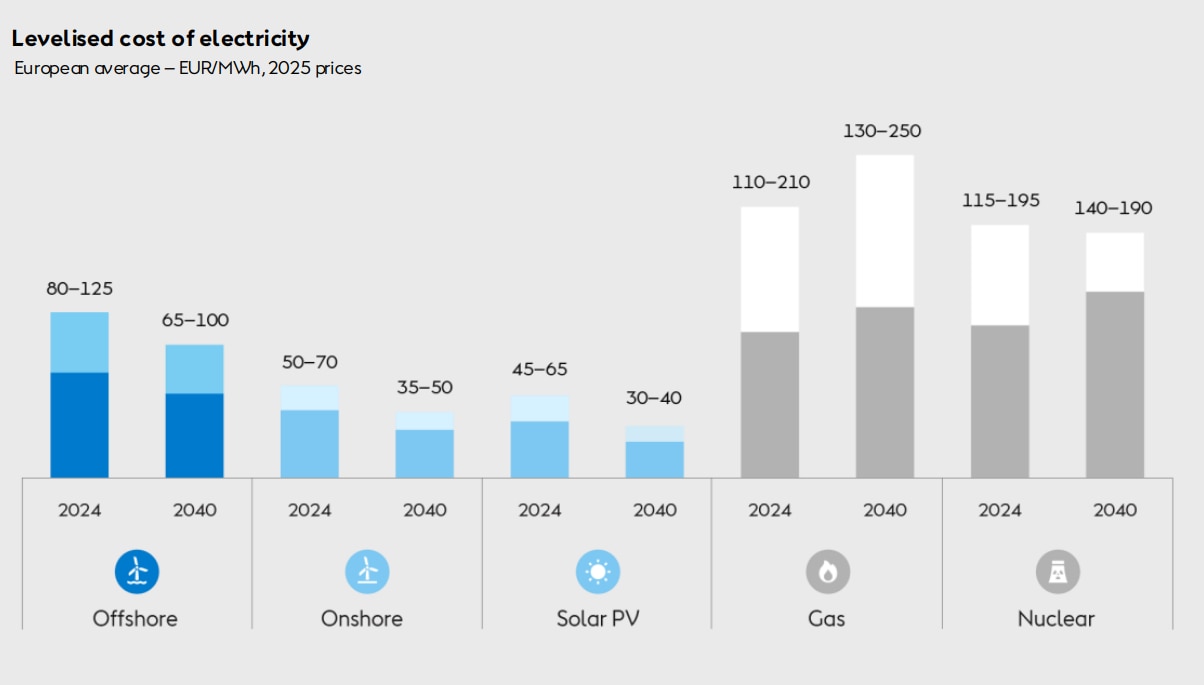
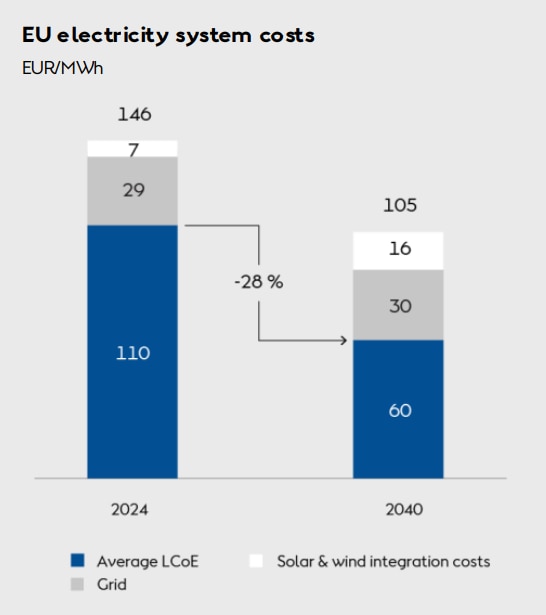
Long-term scenarios for the European electricity system show that solar and wind will account for 70% to 90% of the European power mix by 2050, increasing from around 30% today. Offshore wind will account for 20% to 26% of that total. This shift will reduce the total electricity system costs by almost 30%, from around 150 EUR/MWh currently, due to the lower cost of solar and wind compared to fossil-based power generation.
The cost of integrating solar and wind will increase, while grid investments are expected to double, largely driven by the old age of the grid and growing electricity demand. The larger size of the power system, however, ensures that grid costs on a per MWh basis only increases slightly, while total system costs per MWh decrease.
The benefits to society of more solar and wind are clear: it reduces both system costs and electricity wholesale prices. Higher shares of solar and wind drive down electricity prices as they displace more expensive generators, such as gas power. The continued deployment of solar and wind will therefore, together with the expansion of battery capacity and grid infrastructure, enable lower electricity prices that are decoupled from fossil fuel prices.
Tackling variability
A common concern is that a power system reliant on solar and wind cannot provide a stable, continuous electricity supply. While higher renewable penetration increases short-term variability, a balanced capacity mix ensures steady, year-round generation. On a seasonal basis, a target ratio of one-third solar and two-thirds wind aligns closely with European supply and demand: wind generation peaks during high-demand winter months, while solar peaks during summer.
Periods of prolonged low solar and wind – known as dunkelflaute – do occur, but there is significant regional variation in the frequency. One study found that Belgium has the highest occurrence, with on average three per year, while Portugal averages none. Across Europe, the annual figure stands at 1.6.
Managing this variability requires a complementary power mix supported by battery storage, dispatchable capacity, cross-border interconnections and demand-side flexibility. Crucially, the cost of these grid-balancing measures and back-up reserves is already factored into projected total system cost savings, proving that a decarbonized grid remains economically superior to fossil-fuel reliance.
Three policy levers to unlock competitive power
To reap the full benefits of clean energy, grid investments and new generation capacity must keep pace with growing electricity demand. This creates a virtuous cycle that prevents price spikes as demand grows. Without this proactive investment, rising power costs would penalize early adopters and create a major barrier to further electrification.
Large-scale energy projects have long lead-times and require investments decisions far in advance of the need for them, increasing their risk considerably. Because of this, and that they require decades of capital commitment and rely heavily on government net-zero targets, policy-makers must de-risk these upfront investments. Three practical actions can unlock competitive electrification across the continent:
- De-risk forward-looking grid investments: Protect transmissions and distribution system operators by enabling longer payback periods and providing state-backed financing for infrastructure built ahead of demand.
- Deploy two-way Contracts for Difference (CfDs): Expand two-way CfDs for offshore wind projects. These contracts stabilize revenues for developers during price drops while shielding society from extreme energy price spikes.
- Rebalance energy taxes and levies: Shift fixed government taxes and levies off electricity bills to permanently reduce the price ratio between electricity and fossil fuels.
By taking these steps to de-risk clean energy today, European leaders can eliminate the continent’s structural energy disadvantage, shield industries from price shocks, and secure long-term industrial competitiveness.
Don't miss any update on this topic
Create a free account and access your personalized content collection with our latest publications and analyses.
License and Republishing
World Economic Forum articles may be republished in accordance with the Creative Commons Attribution-NonCommercial-NoDerivatives 4.0 International Public License, and in accordance with our Terms of Use.
The views expressed in this article are those of the author alone and not the World Economic Forum.
Stay up to date:
Renewable Energy


Forum Stories newsletter
Bringing you weekly curated insights and analysis on the global issues that matter.
More on Energy TransitionSee all

Espen Mehlum and Lia Maffini
October 13, 2026


