How we rebalance the health data economy for shared value

Rebalancing the health data economy requires outcome-based value sharing. Image: Unsplash+/Getty
- Health data suffers from a structural value asymmetry: those who generate and steward it bear much of the cost while returns are often realized downstream and later.
- Rebalancing the system means shifting from input-based pricing to outcome-based value sharing, with returns linked to the impact data enables and ring-fenced for the capacity that produced it.
- Fair health-data economies require value to circulate to patients, health systems and countries – making trust, sovereignty and transparent benefit-sharing essential to sustainable innovation.
Data is often described as "the new oil." Like crude oil, much of its value emerges only when refined. However, oil is an extractive metaphor, implying linear and one-time drilling, purchase and consumption. Health data is different: it can be reused, enriched and recombined without being consumed, while generating shared benefits.
The data journalist David McCandless offered a different analogy more than a decade ago: data is not the new oil; it is the new soil.
Yet large swathes of that potential go uncultivated. A 2025 Organisation for Economic Co-operation and Development (OECD) review found that fragmented frameworks governing health data use can block the benefits of secondary use, even as advances in data and technology create immense opportunities.
This untapped value has become a structural problem. At the point of collection, a dataset’s economic value is often undefined, becoming visible downstream once in the hands of whoever turns it into a medicine, device or algorithm; by then, the transaction that governed access has closed.
Pricing data upfront, rather than linking its value to outcomes, disconnects contribution from reward and weakens incentives to invest in data quality, stewardship and reuse.
1. Reframe value of health data as outcome-based
What goes unpriced is not the data but the documentation time, coding quality, longitudinal linkage and information governance that go into it. Nearly all of this contribution is funded from care budgets but isn’t reflected in the data transfer fee.
Clinical notes are written to treat and bill a patient, not to answer a research question five years later. Closing that gap, with consistent coding, complete follow-up and linkable identifiers, is extra unfunded work.
A robust health data economy requires outcome-based value sharing, linking returns to the benefits that data enables. No comprehensive model has yet emerged but several approaches illustrate how elements of this principle can be operationalized:
- Outcome-based partnerships and tiered access. Imperial College London’s National Neonatal Research Database, for example, uses a commercial value-sharing framework under which value may be reflected through upfront, subscription, milestone or royalty payments depending on the project.
- Data trusts and cooperatives that steward data under shared governance. Switzerland’s MIDATA illustrates cooperative governance and individual control, while Spain's Salus Coop has developed a “personal return” licence for uses that generate economic returns.
- Non-monetary returns. Access to resulting models, tools and research capacity, for example, is recognized as fair value by the UK National Health Service (NHS), as mentioned in its guidance on data partnerships.
The design principle in each case is the same: returns are indexed to outcomes rather than settled in a single upfront transaction and ring-fenced for whoever helped produce the data.
That avoids costs getting absorbed into a deficit and means a university, for example, can produce research more cheaply. If a dataset produces no commercial return, the share given back is nil; if it does, contributors benefit from the value created.
2. Recognize that access is being solved, value is not
Access is maturing. Finland’s Findata, one of the most established national authorities, issues permits for secondary use and runs a secure processing environment. However, its fees cover operational costs only; nothing connects what a data holder receives to what the data ultimately produces.
Where value sharing has been attempted, the instruments have been crude. UK NHS trusts took equity in clinical AI company Sensyne Health in return for access to anonymized patient data; Chelsea and Westminster’s holding fell from £5.77 million to £387,000 in 12 months.
Equity-tied returns follow the company's fortunes, not the data itself and even where data usage can be logged and audited, outcomes remain invisible.
The European Health Data Space (EHDS) regulation entered into force in March 2025, providing the first framework to test these questions at scale: how its cost-recovery model reconciles with outcome-based value sharing and whether the quality and utility label can inform future approaches to paying contributors for the value they generate.
3. Value has to circulate, not concentrate
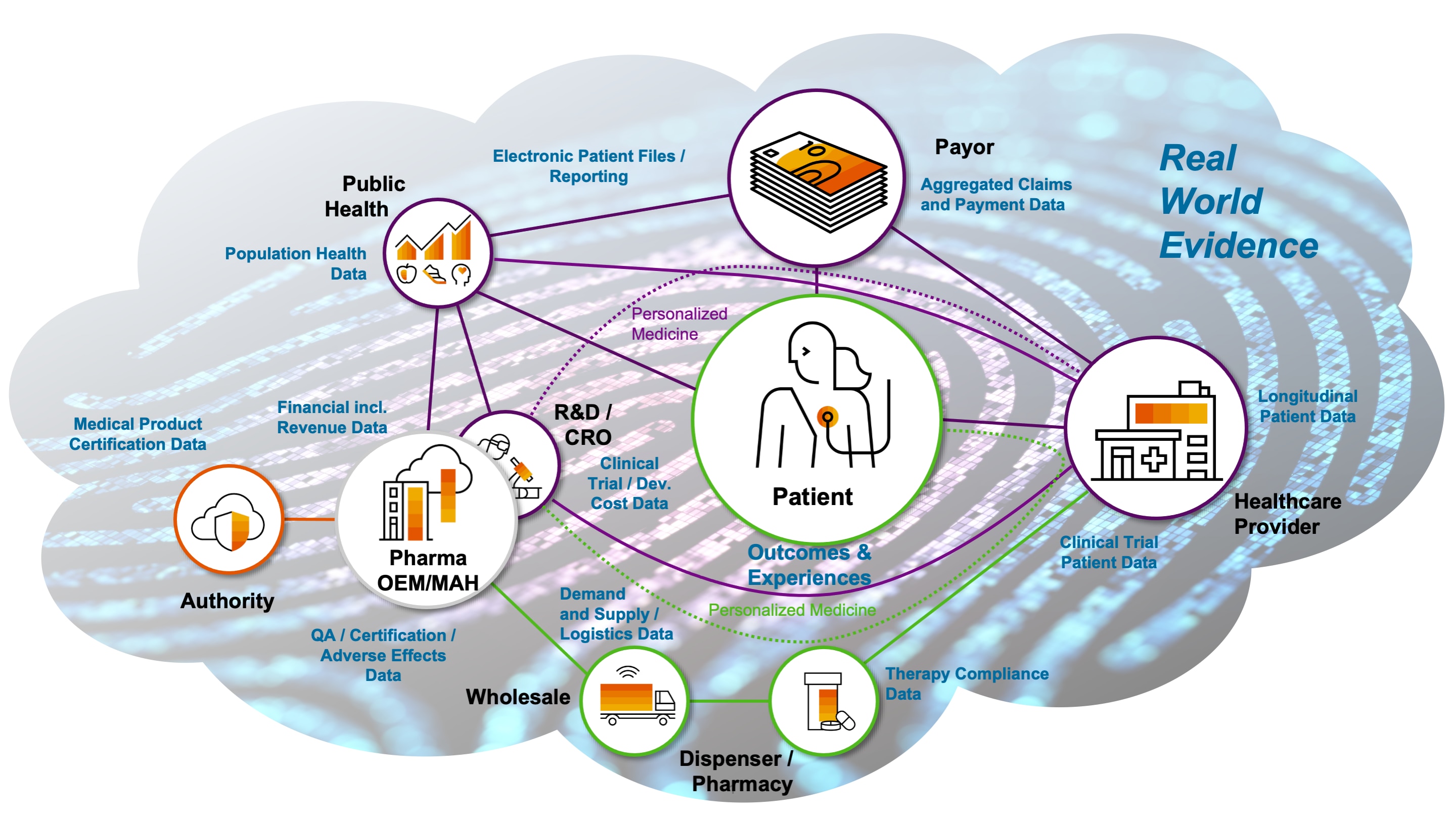
A hospital that generates data without sharing in the value it ultimately enables is structurally in the same position as a national health system that licenses access for a one-off payment. In both cases, the architecture is extractive: value is diverted rather than circulated.
Underfunding does not stop data from being shared; it degrades what gets shared. The data arrives with thinner coding, shorter follow-up and weaker linkage, precisely the complete, longitudinal and linkable datasets on which high-performing algorithms depend.
So populations that already had the best care get the best algorithms.
Similarly, resource asymmetries limit some low- and middle-income health systems’ ability to steward and derive value from their health data, increasing the risk of extractive arrangements with better-resourced partners.
Under-representation in health data is usually treated as a data-science problem but much of it is a budget problem. The pattern can reproduce features of historical resource extraction: data is collected in one setting, refined elsewhere and the resulting products sold back or not at all, to the populations that provided the raw material.
Health data is not a commodity to be extracted.
”The right of a country to govern the collection, storage and use of its population’s health data, a principle increasingly codified as data sovereignty, is now being tested in practice.
At the February 2026 World Health Organization Executive Board session, some member states called for stronger national ownership and control of health data, including less reliance on externally funded data collection.
This wisdom is visible in Rwanda, where a locally adapted Kinyarwanda-language AI tool developed through the Centre for the Fourth Industrial Revolution improved accuracy from 8% to 71% in a community health worker use case.
Patient participation is equally important but can occur only with trust and an understanding of the benefits; otherwise, they may opt out of consenting to share their data or permit secondary use, which can reduce the completeness and representativeness of the resulting datasets.
The same pseudonymous linkage that makes secondary use possible can record which contributions sat behind which result, without re-identifying anyone. What a patient is owed may not be money but at a minimum, an account of what their data helped achieve.
Health data is not a commodity to be extracted. It is the soil of 21st-century health systems, whose value grows when it is cultivated and whose benefits should flow back through the ecosystem that sustains it.
Building a data economy that is fair to the hospital, the patient, the country that produced the data, and the companies that invest in turning it into medicines and technologies is the defining governance challenge of digital health. The technologies are in place; the question is whether the rules will follow.
Michael Byczkowski developed the value-asymmetry argument at greater length in a peer-reviewed perspective in BMJ Health & Care Informatics.
This article was developed with the contributions of Antonio Spina, Global Lead for Digital and AI in Health, World Economic Forum.
Don't miss any update on this topic
Create a free account and access your personalized content collection with our latest publications and analyses.
License and Republishing
World Economic Forum articles may be republished in accordance with the Creative Commons Attribution-NonCommercial-NoDerivatives 4.0 International Public License, and in accordance with our Terms of Use.
The views expressed in this article are those of the author alone and not the World Economic Forum.
Stay up to date:
Data Policy


Forum Stories newsletter
Bringing you weekly curated insights and analysis on the global issues that matter.