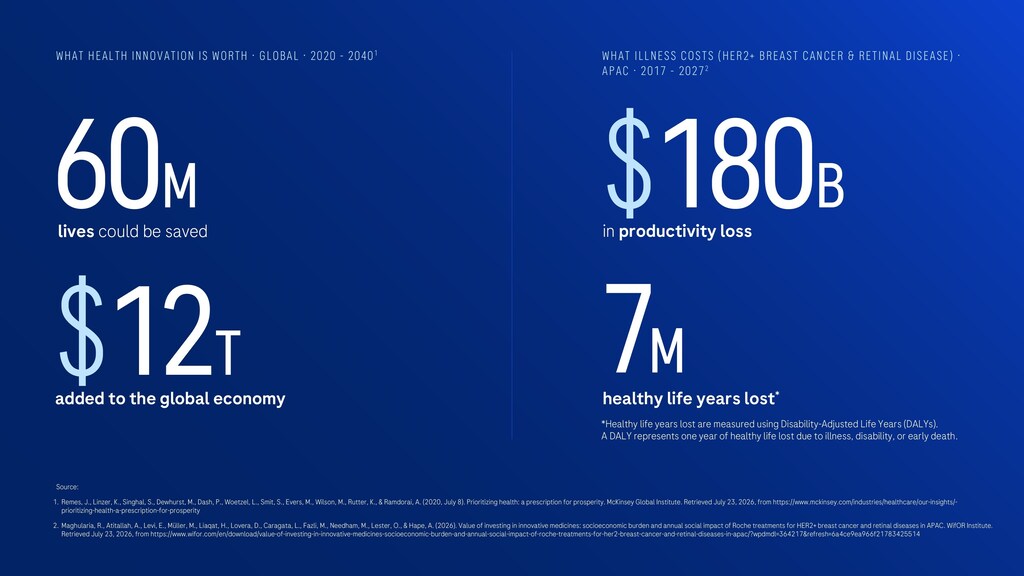
New research estimates that HER2-positive breast cancer and two retinal diseases will end up costing 11 Asia-Pacific economies $180 billion in lost productivity over the decade to 2027.
Health expenditure is routinely counted. But the value health protects through work, income, independence and unpaid care is far less visible.
Three shifts could help close this gap: recognizing the full value health creates; broadening how health interventions are assessed; and making unpaid care more visible in national measures.
What is health really worth? Asia-Pacific is ageing rapidly, but longer lives are not always healthier ones. That has consequences not only for health systems, but for whether people can keep working, live independently and care for those around them. Yet decisions are made with only part of this picture: health expenditure is routinely counted, while much of the value protected by better health remains invisible.
What is not measured is harder to protect, prioritize or invest in. New research from the WifOR Institute, developed in collaboration with Roche, begins to put a number on that missing value.
Two disease areas, a $180 billion burden
The research examines two disease areas across 11 Asia-Pacific economies: HER2-positive breast cancer, often diagnosed while women are working and raising families, and two retinal diseases, neovascular age-related macular degeneration and diabetic macular edema, which threaten the sight people need to work, live independently and care for others.
When a woman, often in her prime, is diagnosed with breast cancer, the immediate consequences are human: fear, treatment, a family mobilizing to support her. The economic consequences surface later and elsewhere: interrupted work, lost income, care that must come from someone else. When an older person begins to lose their sight, the pattern often holds: their spouse or children take on additional responsibilities and may reduce their own working hours.
Different diseases, different stages of life, the same pattern: ill health moves through households, changing who works, who earns, who cares and who remains independent. We understand these consequences instinctively. We measure them less consistently.
The WifOR research estimates that HER2-positive breast cancer and retinal diseases will have cost 11 Asia-Pacific economies $180 billion in lost productivity over the decade to 2027. The complete cost is even larger as it does not count the time and income lost by caregivers, lost independence or the disruption families absorb. The loss is still climbing: the annual cost of each condition is projected to rise by close to a third between 2023 and 2027.
The costs no one adds up
The wider consequences of ill health scatter across households, employers and public revenue, and no single account records them all.
In a survey of more than 4,300 adults over 40 across eight Asia-Pacific markets, 46% expected vision loss to limit their ability to keep working. Among caregivers of someone with vision impairment, 95% reported significant challenges, and one in four reported income loss.
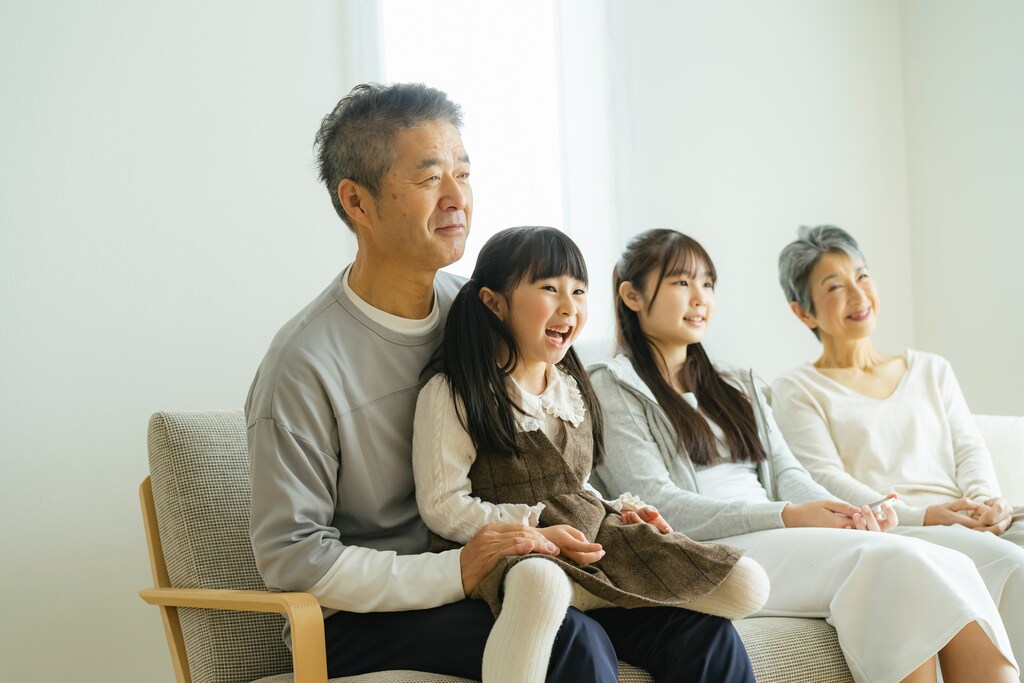
One of the largest blind spots is unpaid work. Cooking, childcare and eldercare sustain families and enable the formal economy; when that work stops, someone else absorbs it or cuts paid work. In many homes across Asia-Pacific, the multigenerational household is the first safety net, running on work our accounts do not see: grandparents caring for grandchildren while parents are working, spouses caring for partners, adult children supporting ageing parents. Unpaid care work does not disappear when it is unmeasured; it is absorbed by families, usually by a woman.
The case for investing in health, by contrast, is well documented. Every $1 invested in eye health in low- and middle-income countries returns an estimated $28, and the World Health Organization estimates that early diagnosis and comprehensive treatment of breast cancer can return up to $7.80 for every $1. Many of these returns rest, in part, on innovation: better ways to prevent and detect disease, treat it and deliver care.
How Asia-Pacific can close the gap
Governments across the region are already adapting to the challenges of ageing societies. Counting what health gives back, as intentionally as they count what they spend, would be an extension of that work. Three shifts would get us there.
1. Recognize the full value health creates. When people stay healthy, the benefits accumulate over years, through continued employment, independence and reduced need for care. Annual budgets capture immediate expenditure but can miss these longer-term gains; frameworks that take a longer view can allow decision-makers to plan for them.
2. Broaden how health interventions are assessed. Assessments today typically weigh clinical benefit, safety and cost to the health system, and these remain essential. Adding a societal perspective, including effects on productivity, caregiver time and socioeconomic participation where credible evidence exists, would give decision-makers a fuller basis for judging value.
3. Make unpaid care more visible. National statistics capture paid work far more consistently than the unpaid care beside it: the childcare, eldercare and household support that allow others to hold down paid jobs. Bringing it into the numbers would make a major hidden contribution visible, and strengthen decisions on ageing, chronic disease and health-system resilience.
An intervention can look very different when evaluated beyond a single year’s health budget, with continued employment, caregiver time and independence weighed alongside clinical outcomes. This is where the wider value of health innovation becomes visible: advances that preserve work and independence, and reduce the demands on families.
Why we need partnerships across healthcare and beyond
No single institution can deliver this: the value of health is created far beyond the health sector, and so are the returns. It calls for partnership across the healthcare ecosystem and beyond: researchers, health systems, employers, civil society and industry each play a critical role.
Health does not need an economic return to have human value. But its economic and societal value is real, and leaving it unmeasured leads to incomplete choices.
Systems that recognize what is gained when people stay healthy, and what families absorb when they do not, will allow for better decisions to be made about ageing, chronic disease and investment. The value is already there. The task now is to measure it.