What Ukraine’s energy system can teach the world about resilience
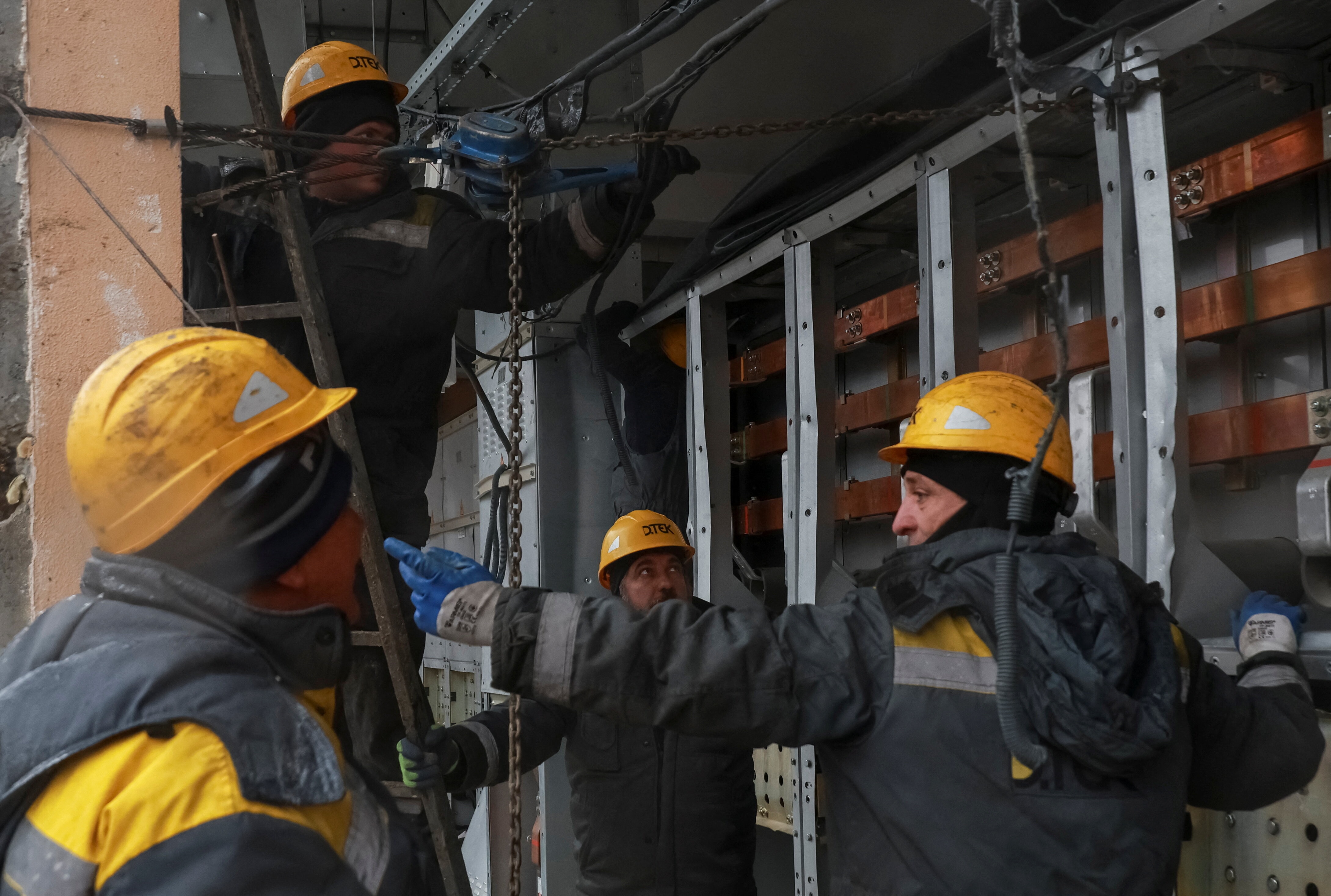
Workers in Odesa repair a power substation damaged by a Russian drone and missile strike. Image: Reuters/Nina Liashonok
- As pressures on energy systems rise, Ukraine's wartime experience provides an example of how to build resilience.
- Conventional energy planning does not always place value on infrastructure deployment and recovery time, which are part of the resilience equation, as Ukraine has been forced to learn.
- The country also demonstrates how energy security and decarbonization are increasingly intertwined.
Most energy systems are designed around predictable stresses: changing weather, peaks in demand and equipment failures. Today’s risks are harder to predict.
Global electricity demand is rising as transport, industry and data centres become more electrified. Grids in many places are struggling to keep pace. More than 2,500 GW of generation, storage and large electricity loads are awaiting grid connections worldwide.
Security is also harder to separate from the energy transition. The World Economic Forum’s 2026 Energy Transition Index found that energy security was the only measure of system performance to decline globally, while transition readiness fell for the first time in over a decade. Only 24% of countries improved simultaneously across security, affordability and sustainability.
Ukraine offers an extreme example of what happens when these pressures become immediate. Since Russia’s full-scale invasion in 2022, Ukraine’s energy system has faced repeated attacks intended to disable it. By spring 2024, nearly two-thirds of Ukraine’s dispatchable generation capacity had been occupied, damaged, or destroyed. Between November 2025 and March 2026, Russia launched more than 700 missiles and nearly 19,000 drones at Ukraine. Smaller substations took 58% of all strikes on the energy system, up from 31% a year earlier.
Working inside an energy system under this pressure has changed how I think about resilience. Ukraine’s challenge is not simply that the risks are greater; it is that many of the risks have already materialized. Other countries still have the opportunity to act before they face the same issues.
One lesson stands out: Resilience cannot only mean preventing infrastructure from failing. It must also mean limiting the consequences when something fails and restoring power quickly.
Decentralization changes the resilience equation
Ukraine’s pre-war energy system, like many others, was built around large, centralized assets. Those assets remain essential; nuclear power still provides a major share of Ukraine’s electricity. The war has shown the risk of concentrating too much capacity in assets whose loss can remove hundreds of megawatts at once.
Distributed energy can reduce that exposure and give operators more options when part of the network is unavailable. Ukraine is now combining smaller gas-fired and cogeneration units, renewables, battery storage, smart grids and local energy solutions as part of its energy security strategy.
We need to think differently about speed
Ukraine has also been forced to think differently about time. Planning, procurement, construction and repair now take place in a context where delay means hours without electricity.
In 2025, DTEK and Fluence built 200 MW of battery storage across six locations in Ukraine, completing construction in six months, compared with 12 to 18 months for projects of this scale. The lesson is not that every project should be built at that speed. It is that deployment and recovery time have a value conventional energy planning does not always capture.
In the United States, Wood Mackenzie estimated in June 2026 that permitting delays could expose 92 GW of renewable projects, representing more than $121 billion of investment, to greater risk. The International Energy Agency (IEA) estimates that new wind and solar projects typically take one to five years to develop, and data centres one to three years, while new grid infrastructure can take up to 15 years.
Rigorous planning, environmental assessment, community engagement and technical standards remain important. But planning systems also need to reflect how quickly security risks are changing. Ukraine’s experience raises a wider question: How can governments create urgency while risks remain theoretical, rather than waiting for disruption to make the case for them?
Security and decarbonization are converging
Before the full invasion, I would have viewed energy security and decarbonization as related but often competing objectives. Ukraine’s experience has challenged that assumption. There are trade-offs, and not every low-carbon investment improves resilience. But our lived experience shows the two are converging.
Wind and solar diversify generation and are inherently more dispersed in their design. Battery storage can respond rapidly when generation or transmission capacity is disrupted. Smarter grids allow operators to understand, isolate and respond to disruption.
The same trend towards decarbonization is visible at the household level. One analysis estimates that by mid-2026, Ukraine’s installed solar capacity was about 7-8.5 GW, of which roughly 2.25 GW sits with active consumers: households, businesses and communities installing for self-consumption. In the US, a record 45% of residential solar installations in Q1 2026 included battery storage, which Wood Mackenzie links partly to demand for energy security.
Technologies associated with energy transition are increasingly part of the security architecture of energy systems. In my view, the investment question needs to change. Rather than separating security from decarbonization, governments and investors should ask whether infrastructure improves reliability, flexibility, emissions and the ability to recover from disruption.
Resilience also has to be investable
Decentralization also creates challenges. Managing thousands of connected assets requires digital control systems, grid upgrades and skilled people. All require capital.
Ukraine’s regional resilience plans covering small-scale generation, storage, backup heating and local energy systems are estimated to cost around €5.3 billion. Kyiv can fund only around €203 million of its €1.1 billion plan from its own budget. Places most exposed to energy disruption may not have the capital to prepare for it.
A distributed asset may look expensive if assessed only against the cost of generation. The calculation changes when avoided outages, restoration speed and flexibility are counted.
Governments, development finance institutions and private investors need better ways to recognize the value of resilience before infrastructure is built. Assessments should consider how much of a system can keep operating when part of it fails, and how quickly lost supply can be restored.
Build resilience before it is needed
Ukraine did not choose to become a test case for energy resilience. Four years of attacks since the invasion have exposed weaknesses and forced adaptation at a pace no conventional energy transition would. The broader lesson is that energy systems should be designed not only for efficiency in normal conditions, but for how they perform when conditions stop being normal.
Energy security and decarbonization increasingly belong on the same side of the investment debate. Many of the technologies that make electricity cleaner also make it more flexible and quicker to restore. Ukraine has learned this while trying to keep the lights on. Other countries have the opportunity to act before urgency is imposed on them.
Don't miss any update on this topic
Create a free account and access your personalized content collection with our latest publications and analyses.
License and Republishing
World Economic Forum articles may be republished in accordance with the Creative Commons Attribution-NonCommercial-NoDerivatives 4.0 International Public License, and in accordance with our Terms of Use.
The views expressed in this article are those of the author alone and not the World Economic Forum.
Stay up to date:
Renewable Energy
Related topics:

Forum Stories newsletter
Bringing you weekly curated insights and analysis on the global issues that matter.
More on Resilience, Peace and SecuritySee all

Sander Zeijlemaker and Michael Siegel
September 8, 2026


