How investing in wildfire resilience protects communities, forests and markets
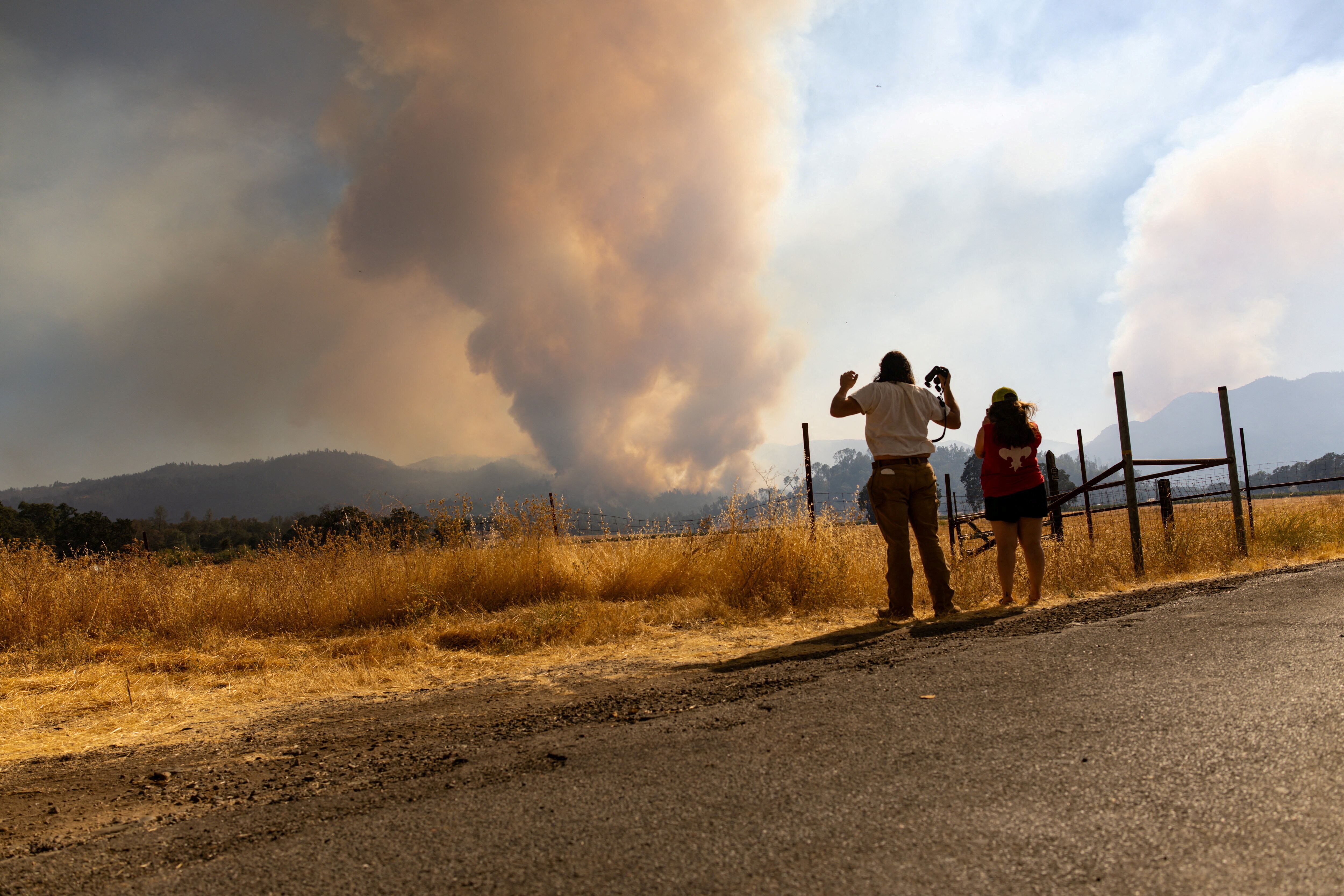
The threat of wildfires demands new strategy that moves beyond just managing disasters to investing in proactive resilience. Image: Reuters/Carlos Barria
- The accelerating wildfire crisis is an urgent challenge that is increasingly defined by its environmental and economic cost.
- This threat to ecosystems, communities and economies requires moving beyond managing disasters to investing in proactive resilience.
- The From Wildfire Risk to Resilience: The Investment Case for Action report lays out an economic roadmap on how investing in wildfire prevention is essential to building long-term resilience.
The accelerating wildfire crisis presents an urgent challenge increasingly defined by its environmental and economic cost.
The most recent data on the state of wildfires underscores this. In 2024, tree cover loss in the Amazon rose by 110%, with fires accounting for 60% of this. Between 2024 and 2025, wildfires emitted more than 8 billion tonnes of carbon dioxide (CO₂), 10% above the 2003 average. In addition, over this same period, $215 billion in assets were exposed to fire.
This threat to ecosystems, communities and economies demands a new strategy that moves beyond just managing disasters to investing in proactive resilience.
At COP30 in Belem in November 2025, global leaders signalled this shift with Brazil’s President Luiz Inácio Lula da Silva announcing the Call to Action on Integrated Fire Management and Wildfire Resilience. Endorsed by 50 countries, the call to action commits to moving away from a reactive, suppression-heavy wildfire response model towards a prevention model aimed at building long-term resilience.
Forests are a key part of this transformation. Forest conservation, restoration and stewardship not only reduce fire ignition, but also create measurable co-benefits including everything from greater biodiversity to water security and carbon sequestration.
In parallel to the Call to Action on Wildfires, the launch of the Tropical Forest Forever Facility (TFFF) put forward a plan to compensate countries for preserving their tropical forest through a blended finance model.
Together, these initiatives demonstrate a critical reframing: proactive prevention is key to long-term wildfire and forest resilience and TFFF provides an innovative financing mechanism to enable it.
Financing is not just helpful, but an essential mechanism to combat the complex climate challenges of our time and provides an opportunity to deliver resilience and unlock new economic value.
Turning commitment into capital for wildfire resilience
At the Annual Meeting 2026 in Davos, the World Economic Forum’s Global Wildfire Leadership Network, in partnership with PwC, is releasing the From From Wildfire Risk to Resilience: The Investment Case for Action report, which lays out an economic roadmap on how investing in wildfire prevention is essential to building long-term resilience.
In line with the COP30 call to action, this report advocates for actionable investment models to build wildfire resilience, globally. The four-pillar framework, outlined below, shows how risk reduction can be valued, priced and financed for long-term resilience.
- Finance and insurance: Develop and scale new funding mechanisms (e.g., blended finance, resilience bonds) and insurance mechanisms designed to reward verified risk reduction and integrate private capital into prevention
- Nature-based solutions (NbS): Scale ecological and Indigenous practices as cost-effective, high impact mechanisms of risk reduction to unlock co-benefits for ecosystems and communities.
- Technology, data and governance: Invest in artificial intelligence (AI) and fire technologies, to establish shared metrics and predictive models to better forecast, prevent and respond to fires.
- Community, equity and coordination: Promote inclusive, community driven approaches that position local communities as co-inventors in wildfire management, aligning stakeholders with wildfire management for long-term wildfire resilience.
Prevention delivers the strongest return on investment
The white paper makes the economic case that wildfire prevention is not just environmentally essential, but also financially rational, and increasingly measurable, financeable and investable.
When prevention, mitigation and adaptation operate as one system, wildfire resilience becomes a continuous investment cycle supported by (re)insurers, investors, tech, utilities, governments, philanthropy, civil society and communities. Critically, this white paper also argues that when wildfire resilience is paid for by a broad cross-section of stakeholders, risk is shared and, more importantly, the benefits and return on investments are shared as well.
Prevention delivers the strongest return on investment. Evidence from the National Institute of Building Sciences finds that every $1 spent on wildfire mitigation generates $4 in avoided losses. Innovative partnerships across the wildfire space already demonstrate this shift toward prevention-focused models are under way.
In Lake Tahoe in the US, the $2.5million homeowners association insurance policy offered by The Nature Conservancy and Willis Towers Watson provides rewards for verified forest treatments, cutting premiums by 39% and showing 40-60% estimated reduced losses.
Simultaneously, increased investments in technology and AI are proving how early detection/warning, modelling and verification tools are helping to reduce wildfire risk in unprecedented ways.
FireSat, an Earth Fire Alliance partnership with Google.org and the Gordon and Betty Moore Foundation and Muon, is a satellite constellation designed for rapid wildfire detection, scanning every 15-20minutes. In California alone, FireSat could avoid 4-8 million tonnes of CO₂ emissions.
Community-driven action is equally important to the success of wildfire resilience. Globally, communities are delivering prevention work, ensuring co-benefits are shared equitably.
In Türkiye, the World Bank provided a $400 million loan to the Turkish Directorate of General Forestry to build wildfire resilience, protecting 6.8 million of hectares of forest, 6 million people and 2,000 women-led enterprises.
Davos an opportunity to build on COP action on forests
One year ago in January, Los Angeles faced one of the most devastating wildfires in US history in which 18,000 structures were burned, amounting to around $131 billion in total losses.
As wildfire risk intensifies globally, resilience must become a shared investment priority. At Davos this January, the Forum will convene leaders at the Annual Meeting to discuss wildfires and forest restoration under the wider theme of 'Spirit of Dialogue'.
It is an opportunity to build onto COP30’s call to action and drive coordinated efforts that align finance, technology, nature and communities around shared investment in resilience, for wildfires, for forests and our shared future.
This Global Wildfire Leadership Network is housed within the Forest Future Alliance, previously known as 1t.org, at the World Economic Forum, which supports private sector and philanthropic investors to navigate complex risks whilst harnessing collective action, solution-thinking and innovation to conserve, restore and steward critical forest landscapes.
Don't miss any update on this topic
Create a free account and access your personalized content collection with our latest publications and analyses.
License and Republishing
World Economic Forum articles may be republished in accordance with the Creative Commons Attribution-NonCommercial-NoDerivatives 4.0 International Public License, and in accordance with our Terms of Use.
The views expressed in this article are those of the author alone and not the World Economic Forum.
Stay up to date:
Wildfires
Related topics:


Forum Stories newsletter
Bringing you weekly curated insights and analysis on the global issues that matter.
More on Nature and BiodiversitySee all

Will Hicks and Louise Thomas
March 9, 2026


