Live from Davos 2026: What to know on Day 2
More about the meetingDavos 2026 Opening Film
Forum live blog team
Stay up-to-date with Davos 2026 daily live blogs
Ideas on the Move - with Gita Gopinath
What drives an international macroeconomist at a moment of global uncertainty?
For Gita Gopinath, Harvard professor and former first deputy managing director of the International Monetary Fund, it’s about being part of the solution – not watching from the sidelines. From stablecoins to tariffs, and from academia to global policy, this is a moment that matters.
Look out for more on-the-move conversations from Davos Ray Dalio, Johan Rockstrom and Yoshua Bengio – coming soon!

New growth prospects
Leaders are under pressure to find new sources of growth without destabilizing fragile economies.
Salesforce Chair and CEO Marc Benioff, AXA CEO Thomas Buberl, President and Chief Investment Officer at Alphabet and Google Ruth Porat, Canada's Minister of Industry Melanie Joly and Mubadala Investment Company Group CEO Khaldoon Khalifa Al Mubarak discussed.
Porat was asked about the prospects for artificial intelligence to contribute to growth. “AI is clearly more than a chatbot, and it cannot just be about cost-cutting,” she said. Ideally, it can change what’s possible for businesses.
“We're drunk on the growth, it’s awesome,” Benioff said of AI's financial and economic benefits to date, but we need to be mindful of the technology’s many potential downsides.
You have to be responsible, but there’s a tech piece and a “change leadership” piece, Buberl said. For Europe, AI will be particularly crucial for healthcare, he said – where related costs must come down.
Panellists were asked about one policy they’d put in place to ensure sustainable growth – and what they’d tell a university student to study now.
Porat's response: a policy to help build energy infrastructure at a faster pace while keeping costs affordable, and philosophy.
Closing the AI diffusion divide
Artificial intelligence has become the defining competition of our era – a race without rules or referees.
The session AI Power Play, No Referees explored how AI is reordering global competition, governance and the pathways for shared prosperity.
Panellists were: Brad Smith, Vice-Chair and President, Microsoft; Kristalina Georgieva, Managing Director, International Monetary Fund (IMF); Khalid Al-Falih, Minister of Investment, Ministry of Investment of Saudi Arabia and Ashwini Vaishnaw, Minister of Electronics and Information Technology, Minister of Railways, and Minister of Information and Broadcasting of India, Ministry of Electronics and Information Technology of India.
“A tsunami is hitting the labour market,” said Georgieva.
The world as a whole is already experiencing the arrival of AI, but I do worry about the accordion of opportunities that are much more present in some places than in others.
”The IMF calculates that on average 40% of jobs are touched by AI either enhanced or scrapped or changed quite significantly without implications for better pay. In advanced economies, this is 60%, but in low-income countries, 20 to 26%.
Vaishnaw said creating a large model doesn’t give you power as a country - we have to understand the economics of what he calls the 5th Industrial Revolution: “The economics of [this revolution] is going to come from ROI. ROI is going to come from deploying the lowest cost solution to get the highest possible return.”
The race is on, said Al-Falih. “Everybody wants to build the infrastructure for it, but the essence of AI's power is it has to be accessible… Diffusion is not just within economies that have to compete, but I believe it has to be done globally.”
Georgieva said jobs are being both enhanced and replaced by AI. “We have a fairly big range of impact on global growth from 0.1 to 0.8%...” A 0.8% boost of productivity would make growth higher than pre-pandemic.
AI is boosting productivity in translation and interpretation and for research analysts - it is enhancement, not replacement. But she worries about communities where AI is not present - how do people prepare for it?
The world is a “quilt with different colours of fabrics” when it comes to creating data centres, said Smith. In the US, they are being blocked, while in Europe governments want to use taxpayers’ money to fund them. In the US it’s incumbent on companies who run data centres to assuage the concerns of local people about their energy and water supply - and explain who will benefit.
Technology and AI is a key enabler for Saudi Arabia, said Al-Falih. Under its Vision 2030 strategy, it is building policy, regulation, platforms and data centres. AI is already having a positive impact on health outcomes.
AI will only close the global digital divide if we embark on building infrastructure across the global South, “and we need strategies that stimulate demand that furnish supply”, said Smith. Generative AI is used by 25% of the population in the global North, but only 14% in the global South, according to Microsoft data, and the gap is getting wider.
The panellists agreed governments need to invest more in upskilling people across the globe. For every one data scientist in Africa, there are 14 in Europe.
Watch the session here.
For some background reading, take a look at these blogs:
Yuval Noah Harari: 'More intelligence doesn’t mean less delusion'
This session took on where AI is heading next: not just capability, but integration into real environments, how humans stay in the loop and what accountability looks like as autonomy increases.
Nicholas Thompson from The Atlantic was joined by Eric Xing, President, Mohamed bin Zayed University of Artificial Intelligence; Yoshua Bengio, Full Professor, University of Montreal; Yuval Noah Harari, Distinguished Research Fellow, Centre for the Study of Existential Risk and Yejin Choi, Professor and Senior Fellow, Stanford University.
The big question here was whether humans can stay meaningfully in control as AI autonomy increases. The short answer was 'maybe'.
Yuval Harari underlined the fact that we have "no experience with building a hybrid human AI society" and called for humility and a "correction mechanism" should things go wrong.
Yoshua Bengio warned about how today’s systems are trained. Current models, he argues, imitate humans too closely – including our worst tendencies. It's a misnomer, he said, to want AI's "to be like us".
Yejin Choi came in at the other end of the spectrum. Large language models, she argued, absorb vast amounts of data but don’t truly understand the world. “AI should figure out how the world works,” she says, calling for a fundamentally different learning paradigm that gives systems more agency – a suggestion Bengio quickly noted carries real safety risks.
Eric Xing challenged assumptions about intelligence itself. Today’s AI, he says, delivers a narrow, language-based capability. “What I’m delivering is a limited form of intelligence,” he explains, arguing that true progress would require new architectures and, eventually, forms of physical and social intelligence. “We are very far from there.”
Concluding, Harari offered a sobering reality check – and got some laughs from those in the room. “Human intelligence is a ridiculous analogy,” he said. AI will never be like humans, just as airplanes are not birds. More intelligence, he warned, doesn’t mean less delusion: “The most intelligent entities on the planet can also be the most deluded.”
Pointing to social media, he argued “extremely primitive AIs” have already transformed – and destabilized – the global information system."
The debate closed without easy answers, but with a shared recognition: the next phase of AI will be shaped as much by values and governance as by technical breakthroughs.
Watch the full session here.
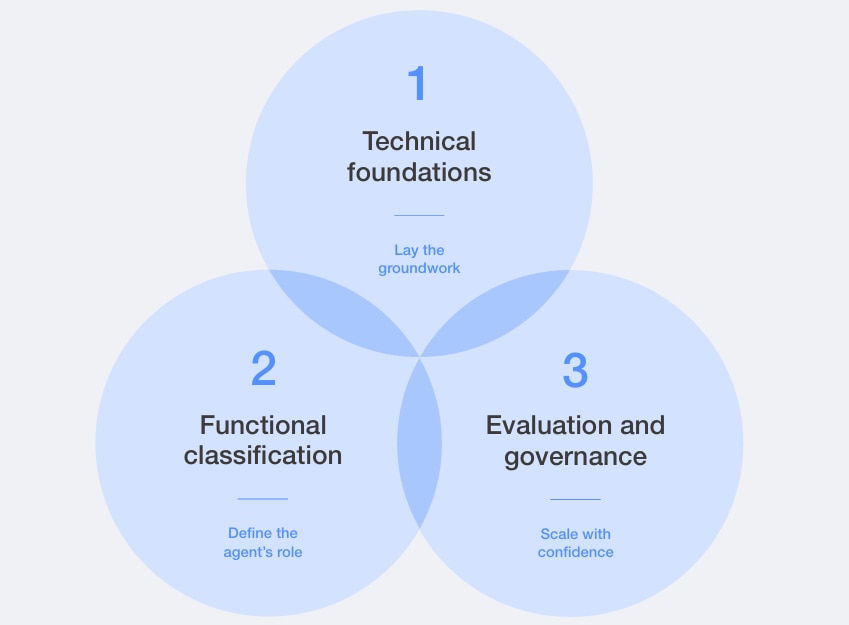
And check out our recent report, AI Agents in Action: Foundations for Evaluation and Governance.
Building a business case for nature
With climate shocks intensifying and biodiversity loss accelerating, nature-based solutions are no longer a “nice to have” – they’re essential. Restoring degraded land, protecting ecosystems, and investing in natural infrastructure can deliver real returns – with every $1 invested generating an estimated $7–$30 in economic benefits.
But as budgets tighten and priorities compete, the pressure is on to show results. What does a meaningful return on nature really look like – for the climate, for communities, and for the economy?
For André Hoffmann, Vice-Chairman, Roche Holding and Interim Co-Chair, World Economic Forum, the case for action is already clear. Forum research shows that “53%” of global GDP depends on nature – and in reality, he says, it’s much higher. “If you have no nature, you have no humanity, you have no business, you have no dividend, you have no shareholders.”
So how do we fix it?
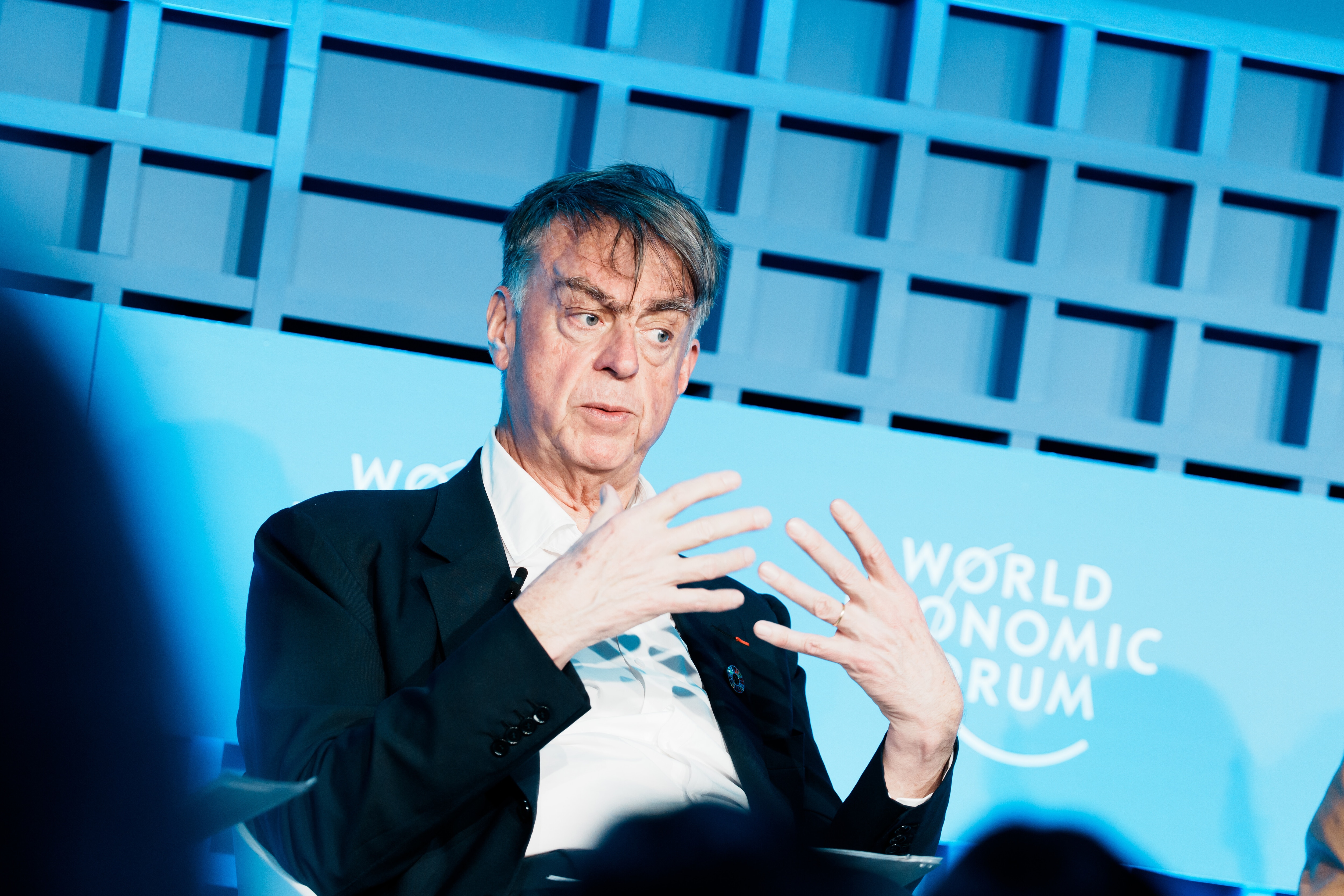
Hoffmann points to these urgent priorities: innovation, the responsible use of AI, investing in people, and addressing geopolitics. The goal, he says, is to “resolve these strategic emergencies within planetary boundaries,” because “you cannot use something that you don't have.”
Do businesses really understand how dependent they are on nature?
Kirsten Schuijt, Director-General, WWF International, says awareness is growing – but not fast enough. “There’s an increased understanding in the role that biodiversity and nature more generally plays in business decisions and supply chains,” she explains. What used to be a narrow focus on climate and energy has expanded. “It has definitely now also become a conversation with corporates on fresh water, on forests, on food.”
One of the biggest areas of action is agriculture and sustainable food systems, where companies are beginning to move. Still, Schuijt stresses there is a “long way to go”.
For Rohini Nilekani, Founder and Chairperson, Rohini Nilekani Philanthropies, the business case for sustainability is straightforward. Companies like Infosys (which was co-founded by her husband) act “not just because they love nature,” she says, “it just makes common business good sense.” By optimising existing buildings, the company avoided around 2.3 billion kilowatt-hours of energy use between 2008 and 2020 – saving roughly $225 million in electricity costs.
But the stakes go far beyond efficiency.
“There is no way companies are going to be water secure. There’s no way they’re going to be supply chains secure unless they themselves go greener.” Without collective action, she adds, “there’s just not enough nature to go around.”
The message from the panel is clear: protecting ecosystems isn’t just about conservation – it’s about resilience, competitiveness, and long-term prosperity. Nature-based solutions aren’t a luxury. They’re the foundation for a stable economy in an unstable world.
Watch the full session live here.
A rupture, not a transition: Mark Carney on a world that has changed
Canada’s Prime Minister Mark Carney delivered a stark assessment of the global moment in a special address at the Congress Hall, which was met with a standing ovation in the room.
“For decades, countries like Canada prospered under what we called the rules-based international order,” he said. “We joined its institutions, we praised its principles, we benefited from its predictability… this bargain no longer works.”
But Carney cautioned that the response could not be retreat. “A world of fortresses will be poorer, more fragile, and less sustainable.” Instead, he outlined Canada’s new approach, drawing on what Finnish President Alexander Stubb has termed value-based realism.
“To put it another way, we aim to be both principled and pragmatic… We actively take on the world as it is, not wait around for the world we wish to be.”
This, Carney stressed, was not “naive multilateralism”, but a middle-power strategy focused on action. It meant “building coalitions that work, issue by issue, with partners who share enough common ground to act together.”
He closed by turning inward to capacity and confidence at home, positioning Canada as stable and investable in an unstable world. “We are building that strength at home… Canada has what the world wants. We have capital, talent… and a government with immense fiscal capacity to act decisively.”
Watch the full address here.
Prosperity's sovereign allies
In this session, Canada’s Minister of Finance François-Philippe Champagne, US Secretary of Commerce Howard W. Lutnick, UK Chancellor of the Exchequer Rachel Reeves, Director of the European Institute at Columbia University Adam Tooze, Bank of America Chair and CEO Brian Moynihan and EY Global Chair and Chief Executive Officer Janet Truncale discussed whether countries can protect their interests without fragmenting the global economy, as economic nationalism replaces laissez-faire.
Volume was up in the room as Secretary Lutnick made clear that the US delegation is in Davos for a reason: “We are here to make a very clear point: globalization has failed the West and the United States of America.” Criticism of US tariffs as unnecessarily protectionist were widespread, he noted, yet “the world’s stock markets are up.”
“Globalization’s not going away, its just becoming more complex,” Truncale said.
Chancellor Reeves pleaded for a focus on “mutual interests.” She described the UK’s need to lean into its potential strengths like wind energy and nuclear power.
“We’ll all benefit if we’re more resilient, if we’re more coordinated in what we’re doing,” said Minister Champagne.
On the notion of a coordinated European response to the most recent US tariffs, Secretary Lutnick was confident one would not emerge. “What I see happening is diplomacy and talking,” he said.
“You can start with a kerfuffle,” he added, but at the end of the day “these are great allies.”
Watch the full, lively session here:
Finding solutions to the health cost-investment paradox
Healthcare systems worldwide face an inescapable paradox: spending rises while quality often declines.
The session, ‘Healthcare: Cost or Investment’, explored what it will take to break this cycle worldwide.
Tackling the question of whether healthcare is a cost or an investment, Nina Warken, Federal Minister of Health, Federal Ministry of Health of Germany, stressed the need for trust and suggested that investment into healthcare, is an investment into democracy.
For Stefanie Stantcheva, Nathaniel Ropes Professor of Political Economy and Founder, Social Economics Lab, Harvard University, costs and investments into healthcare are unique. She argued for “the big role of public policies for this,” because the private market struggles to support healthcare systems because of a range of externalities.
Framing healthcare solely as cost obscures a critical reframe: investment in prevention, efficiency, and innovation yields returns – healthier workforces, reduced emergency burdens, economic productivity.
Addressing rising cost is a considerable challenge, and one that Bernd Montag, Chief Executive Officer, Siemens Healthineers, suggested can be tackled with technology. He called for “personalization at scale”, suggesting that “this only works if we really smartly deploy technology from prevention to the right diagnosis to the therapy without multiplying the human factor in this process.”
Considering solutions, Michel Demaré, Chair of the Board, AstraZeneca, argued for a long-term vision, conceding this was difficult when dealing with governments that are in power for four-year terms. He stressed, however, that taking a holistic and long-term approach would prove the only way.
Suneeta Reddy, Managing Director, Apollo Hospitals Enterprise, focused on the strategic. Looking at the Indian market, she stressed the need to triangulate who is paying for healthcare, clinical outcomes and networks of care. Once this is in place, this needs connecting with the digital system.
Catch up here.
Conversation with Sheikh Mohammed bin Abdulrahman Al Thani, Prime Minister and Minister of Foreign Affairs of Qatar
Sheikh Mohammed bin Abdulrahman Al Thani, Prime Minister and Minister of Foreign Affairs of Qatar, spoke with World Economic Forum President and CEO Børge Brende on the evolving security landscape in the Middle East ranging from Syria to Gaza.
Addressing the broader regional context, Sheikh Mohammed stressed that lasting stability requires confronting underlying challenges. “We need to address those root causes,” he says, adding that “the moment has come for the region to come together and to think about how we can reshape our security architecture so that at least we ensure that we are not representing a threat for each other.” At the same time, he underscored the principle of national security, noting that “every country in our region needs to protect itself and they have the right to protect itself.”
On Gaza, Sheikh Mohammed highlighted the importance of coordinated international efforts to support governance and humanitarian needs. He explains that Qatar is “working together very closely with our colleagues in the United States, Egypt, and Türkiye in order to ensure that there is a mechanism that supports the technocratic government that has been just established for Gaza in order to enable them to help the people.”
Sheikh Mohammed also touted efforts to grow and diversify the Qatari economy, noting "we believe that diversification is our resilience."
Restoring the planet is not just a moral imperative – it's also good for business
Climate change is already reshaping infrastructure, food systems and access to natural resources. At the same time, nature loss is showing up as an economic risk – disrupting supply chains, straining public finances and threatening long-term competitiveness.
But what if the green transition isn’t just damage control? What if it’s also a growth opportunity worth trillions?
Johan Rockström, Director, Potsdam Institute for Climate Impact Research opens this session with a stark “primer from science”. “We now have overwhelming evidence of the need to transition the global economy within prosperity, within planetary boundaries,” he says.
The good news? “We’re in a yellow warning zone,” Rockström says – not fully in the red. Yet. But the economic costs are already mounting. At 1.5–2°C of warming, “we are at risk of having a 5% on average loss of income in the local economy. We’re talking trillions, not billions.”
That’s why innovation, technology and science matter.
André Hoffmann, Vice-Chairman, Roche Holding, and Interim Co-Chair, World Economic Forum, agrees the mindset must shift. “Do no harm” is no longer enough. Now, he says, we must regenerate.
Alicia Bárcena Ibarra, Secretary of Environment and Natural Resources of Mexico, agrees: “We need to enter the ‘Age of Restoration’. The earth needs to be restored.” And restoration can be good business. “We need to make business with nature,” she says, pushing solutions that work for climate, biodiversity and economic growth.
For Sumant Sinha, Chair and Chief Executive Officer, ReNew, the transition requires serious investment. “If you want to electrify things and decarbonize that electrification, you need to be able to carry those electrons around.” That means upgrading grids – and investing in “green molecules” for hard-to-abate sectors. This isn’t just a moral imperative, it’s a commercial one.
Ramon Laguarta, Chairman and Chief Executive Officer, PepsiCo, reframes the green premium debate. “This is not about sustainability or profitability,” he says. “This is about short term or long term.” Growth only works if it doesn’t deplete the resources that future growth depends on.
Andrew Forrest, Executive Chairman and Founder, Fortescue, issues a warning – and a challenge. “We risk being those business and political leaders who knew of the planet's limits and elected to cross them anyway.” But change can pay. His company is cutting emissions and costs, proving “we can save up to $1 billion per year in operating costs” by removing diesel from supply chains.
To scale this, competition must give way to collaboration. “Sometimes we are too selfish as companies,” Laguarta admits. “There are things that we just need to eliminate the competitive nature and put it out.”
Sinha is optimistic about where technology leads. Clean energy will become so cheap, he says, that fossil fuels will lose their appeal – and those still investing in them will be left with stranded assets.
The message is clear: the green transition isn’t just about avoiding collapse. It’s about building the next engine of growth – within the limits of the planet we all depend on.
Catch the full session here.
How Ventures are Creating New Opportunities
The session, ‘What it takes to build’, explored the ingredients needed for a new venture to thrive and the types of problems that curtail growth.
AI, and the swift and cutting edge uses it’s being put to, dominated the discussion. For Steven Bartlett, Founder, FlightStory, and host of podcast, Diary of a CEO, the remit he gives his innovator team is to kill what his main business does now.
For Bret Taylor, Chief Executive Officer, Sierra, AI is “fundamentally about automating what we’re doing manually today”.
As a result, both are striving to create opportunities where they didn't exist previously.
Asked about the biggest determinants of success, Bret Taylor suggested the removal of gate keepers, which is really important for innovation. He also cautioned about the need for and “value in teams and camaraderie, in people challenging your assumptions”.
Catch up here.
Rebuilding trust in Latin America
Trust across Latin America is under strain: according to recent OECD research, 48% of people in Latin America and the Caribbean have low or no trust in their national government. At the same time, polarization, security and other social pressures are testing the region’s resilience and reshaping its international relations.
Against this backdrop, a diverse group of leaders from across sectors came together in Davos to discuss a path forward, in a session moderated by Enrique Acevedo, Anchor and Managing Editor, Televisa-Univision.
For Daniel Noboa Azín, President of Ecuador, the challenge is that many of the issues leaders in the region face can be hard to tackle using traditional institutions, since these same institutions are so often weaponized. “We are at war against narco-terrorism … and it’s very difficult to fight this in a traditional way,” he told participants. “These criminal organizations have adapted to our systems.”
As Ngaire Woods, Dean, Blavatnik School of Government, University of Oxford, pointed out, “coercion is tempting in the face of some of the atrocities that narco-terrorists deploy…but the problem for any society is that if you make enemies of the people within your society, where does that take you?”
Of course, another topic at the top of the regional agenda is Venezuela. For José Raúl Mulino Quintero, President of Panama, the events are somewhat reminiscent of what happened in his own country almost 40 years ago: “As most of you may know, my country suffered an invasion because of another dictator in 1989,” he reminded participants. “That situation, as in Venezuela, was provoked by one single person and his entourage because they forgot about democracy and about human rights.”
For Ilan Goldfajn, President, Inter-American Development Bank, it’s precisely these moments of change that offer opportunities to do things better and regain lost trust: “We are in the business of trying to improve the lives of people in the region,” he told participants, referring to the finance institution he leads, which provides development financing for countries in Latin America and the Caribbean. “But you need the right conditions to do so. We’ve been following Venezuela for decades and we continue to do so. We’re preparing ourselves for when the conditions arise.”
Watch the full session here.
Special Address by Emmanuel Macron, President of France
In a special address in the Congress Hall, French President Emmanuel Macron offers a stark assessment of a world he describes as 'reaching a time of instability'.
“A shift towards autocracy against democracy, more violence, more than 60 wars in 2024, an absolute record.” He points to a surge in state-based conflicts, the erosion of international law and intensifying competition from both the United States and China — arguing that Europe can no longer treat stability as a given.
Against that backdrop, Macron defends what he calls an effective multilateralism. "With the brutalization of the world, France and Europe must defend an effective multilateralism — because it serves our interests.”
Turning to Europe's economic position, Macron frames competitiveness as urgent, not optional. His prescription rests on three priorities: protection, simplification and investment. "Restoring European competitiveness is an absolute priority — and it requires swift and decisive action." He calls for tougher trade defence measures, faster regulatory simplification, and greater mobilisation of Europe's own capital, particularly in strategic sectors such as AI, quantum and space.
Macron closes with a direct appeal to investors, positioning France as a source of stability in a volatile world. "Having a place like Europe… which is predictable, loyal and one where the rule of the game is the rule of law is a good place for today, and tomorrow."
Larry Fink, Chair and CEO, BlackRock; Interim Co-Chair, World Economic Forum, joined the session.
Here's the full session if you missed it:
Conversation with Scott Bessent, US Secretary of the Treasury
US Secretary of the Treasury Scott Bessent sits down for an in-depth conversation about the path forward with Maria Bartiromo, Fox Business Network anchor.
An Honest Conversation on AI and Humanity
Artificial intelligence demands urgent choices about innovation's relationship to human flourishing.
This session with Yuval Noah Harari, Distinguished Research Fellow, Centre for the Study of Existential Risk and Irene Tracey, Vice-Chancellor, University of Oxford, explored how historical lessons about technological transformation can guide us toward a future where progress and humanity coexist.
What decisions must we make today to ensure AI serves humanity's deepest values?
Catch up with the session on demand here.
What matters on the road to AGI
The pathway to artificial general intelligence (AGI) is becoming clearer as advances in various technologies converge. But there are still some "missing ingredients", said big tech CEO, Demis Hassabis of Google DeepMind.
Hassabis was joined in this session by Dario Amodei, CEO, Anthropic, with Zanny Minton Beddoes, Editor-in-Chief, The Economist, moderating the discussion, which explored the breakthroughs which matter most on the road to AGI.
Amodei expressed excitement for this journey, arguing that we're "knocking on the door of incredible capabilities", but that the next few years will be critical for how we regulate and govern these technologies.
AI's impact on jobs was highlighted by both participants, with concerns expressed about disruption to entry-level roles by Hassabis: "If I was to talk to a class of undergrads right now, I would be telling them to get really unbelievably proficient with these tools."
For some additional context, read this paper from the Forum and Capgemini, which clarifies how organizations can align AI agent adoption with proportionate safeguards.
Watch the session back here.
Special Address by He Lifeng, Vice-Premier of China
He Lifeng, Vice-Premier of the People's Republic of China, took centre stage in the Davos Congress Centre to deliver a special address. The remarks come as China continues to be a key player in shaping global trends and developments with its immense economic power, trade dominance and leadership role in international finance and technology development.
In his address, He called for increased cooperation and dialogue in the global economy, noting that “while economic globalisation is not perfect,” countries “can not completely reject it and retreat to self isolation.”
Tariffs and trade wars have no winners.
”He also detailed economic progress in China, noting that the country has put domestic demand on the top of its economic agenda in 2026 in an effort to boost consumption while maintaining its production prowess.
“China will open its door wider to the world,” He said, adding that the country plans to expand its market particularly in the services sector.
Special Address by Ursula von der Leyen, President of the European Commission
Ursula Von der Leyen's remarks came as the European Union faces historic geopolitical challenges and questions about its economic future.
The bloc recently signed a landmark trade deal with the South American members of Mercosur, and is grappling with a deterioration of the traditional trans-Atlantic alliance.
President Von der Leyen described the many trade deals the EU is pursuing in addition to the Mercosur agreement, in a new era of US tariffs and protectionism. "Europe will always choose the world, and the world is ready to choose Europe," she said.
The region also, she said, clearly "needs to adjust to a new security architecture.”
Read the full address here.
Making the right decisions is key to energy security
Energy security is no longer a background condition – it’s a strategy question.
The session 'Who is winning on energy security?' tested a blunt question: who looks better positioned, and why?
Fatih Birol, Executive Director, International Energy Agency, said there were "three golden rules" for energy security: diversification ("don't put all your eggs in one basket"), predictability for investment and cooperation and partnership. "Choose your partner right... The countries who might the right decisions are the winners."
“We are entering the age of electricity,” he also told the session. AI and data centres are driving growing demand, as well as air conditioners and electric cars, he added. This demand will be met by: renewables, natural gas and nuclear power.
“I have never seen the energy security risks multiplying (like this)... energy security should be elevated to the level of national security.” Countries should generate their own energy which will give a boost to renewables.
Mike Henry, CEO, BHP, said to electrify the iron ore business alone, it would require five times the energy that they use now.
Rather than winners or losers, energy security is not a zero-sum game, said Andrés Gluski, CEO, AES. The more secure a region is in its energy, it will free up resources for another region. He believes there’s “too much of a politicization rather than technical talk”. There are a lot of technical solutions today including using the existing infrastructure smarter. But time is an issue. AI is part of the problem but also part of the solution, as it might increase the productivity of developing countries. It’s going to be a decade before we have small modular reactors, but we need to think about the pipeline, resources and manufacturing capacity: “It’s not a game-changer today.”
China’s energy strategy has diversified said Meghan O'Sullivan, Director, Belfer Center for Science and International Affairs, Harvard University, who looked back at historical analogies. Producing countries have more agency now, she added, but it opens the door to more resource competition.
In the past, diversification was about moving away from energy, now there’s a diversification based on energy because AI needs energy in huge amounts, said Majid Jafar, CEO, Crescent Petroleum. A one-minute video is an hour’s use of electricity for an average Western household. One data centre uses the same amount of energy as an average town.
For the Middle East as a region, having the energy resources, the capital, the leadership and the agile policymaking bodes well for the nexus between energy and AI. “It’s playing to its strengths as a region, through partnerships rather than competition.” Resilience needs to come from responsible investment that’s not ideological, he added.
On the US’ energy dominance strategy, O'Sullivan explained the difference between the first and second Trump administrations. In the first, energy became intertwined with trade deals, but now there are new elements emerging, including an aggressive approach against renewables and a focus on price and using foreign policy tools to enhance its influence over global energy markets. She said this would quell rather than enhance investment.
Sir Robin Niblett, Distinguished Fellow, Chatham House moderated.
Forum research like From Minerals to Megawatts (2025) is a useful lens here: it underlines how grids, critical minerals and infrastructure bottlenecks increasingly shape what “secure energy” even means.
Catch up on the session here.
For more background reading, check out these blogs:
Dialogue and courage are vital for progress
“We are standing at the start of a new reality, the contours of which are still to be defined,” said Børge Brende, President and CEO of the World Economic Forum, during his Welcoming Remarks.
Whereas last year at Davos, there were fears of a decade of slow growth, we are seeing sustained economic growth and trade is growing - and one of the reasons for this growth is technology: “If we get it right, the new technologies can be the new driver of growth for decades to come.”
But the foundation of moving forward has to be built on cooperation and dialogue.
Picking up the theme of dialogue, Larry Fink, Interim Co-Chair of the Forum, said dialogue is "the only way a room like this can earn the legitimacy to shape ideas for people who aren't in the room".
He spoke about the need for transparency and trust to enable equitable progress.
Prosperity is not just GDP, he said. "It can't be measured by GDP or market caps of companies. It has to be judged by many people who see it, who can touch it, can feel it, and can build their own future on it."
At a moment when the world confronts profound questions about growth, innovation, technological transformation and our planet's future, we need spaces where diverse voices can be heard. This is why the World Economic Forum exists, said Interim Co-Chair André Hoffmann.
But dialogue only works if we truly listen to each other.
These opening remarks were followed by a special address from Guy Parmelin, President of the Swiss Confederation 2026.
In a wide-ranging speech, Parmelin touched on economic policy, the importance of free trade and the impact of AI on everything from cybersecurity to healthcare - as well as the need to keep moving forward with courage.
"For humans, standing still is not an option - or, to quote philosopher Henri Bergson, 'to exist is to change'."
It takes courage to innovate, "to remain true to one's values, to ask for assistance or advice when necessary. The courage to make a long-term commitment as wine growers do when faced with a slow and relentless pace of nature".
Watch the session here.
Davos on Air: When the podcasts take centre stage
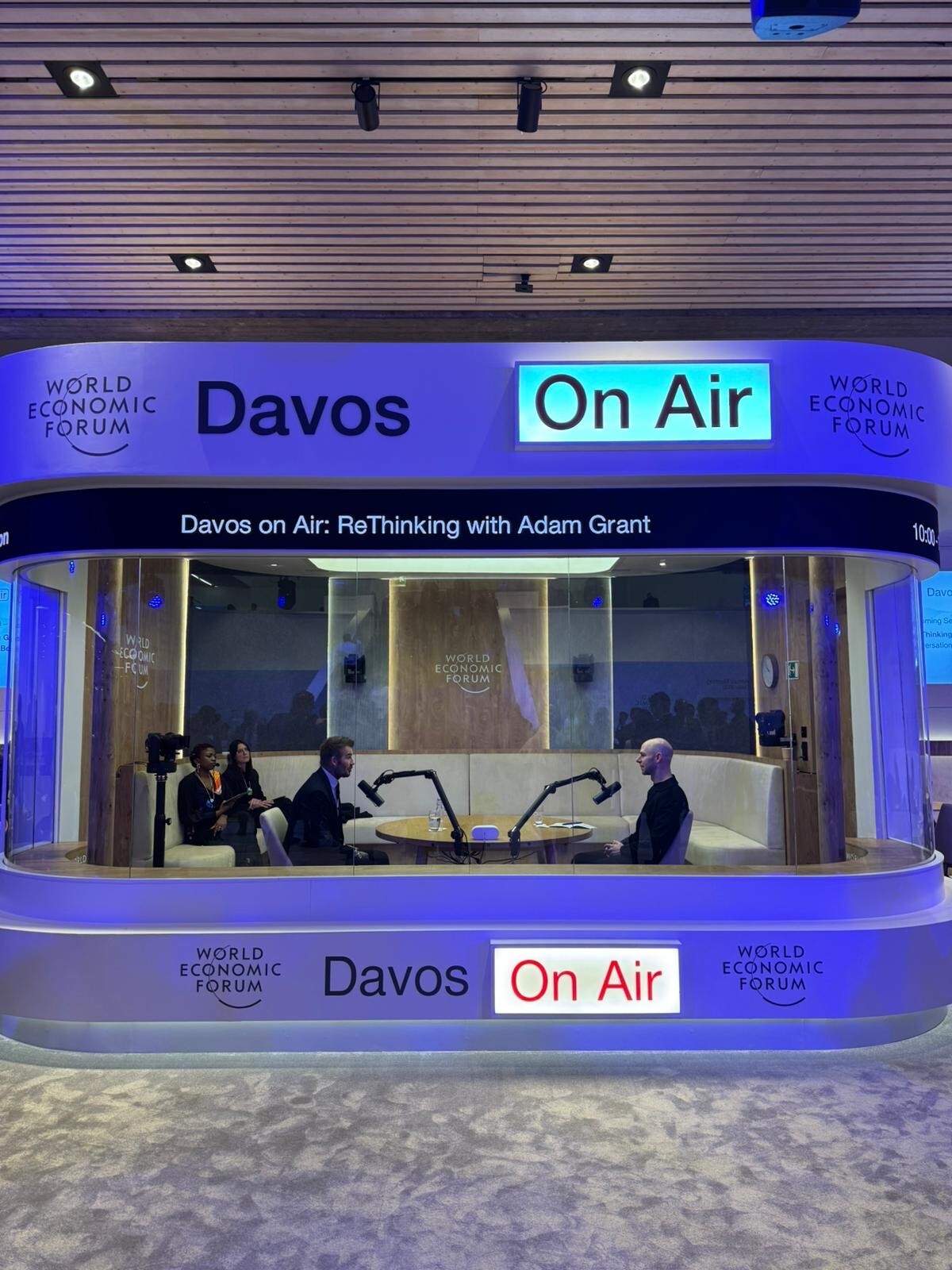
Through the glass walls of our ‘Davos on Air’ studio, a different kind of conversation is unfolding.
Here's Adam Grant recording an episode of ReThinking with Adam Grant, joined by David Beckham.
It’s a reminder that some of the most influential conversations in Davos don’t always happen in formal sessions. Podcasts, interviews and side conversations increasingly shape how ideas travel beyond the mountain.
A conversation with Aziz Akhannouch, Morocco’s head of government
In the final year of his term, Aziz Akhannouch, Head of Government of Morocco, joined leaders in Davos for a conversation about the progress his country has made in the past few years — along with a roadmap for 2026 and beyond.
Thanks to a range of economic and social welfare reforms that have been carried out since 2023 — the last time Akhannouch was in Davos — Morocco has seen progress when it comes to inflation rates, GDP growth and debt levels.
He was joined by André Hoffmann, Vice-Chairman of Roche Holding and Interim Co-Chair at the World Economic Forum, and discussed everything from the important role football plays in Morocco to the reforms his government has been putting in place.
Watch the conversation in full below.
Why protecting the world's glaciers can't wait
Glaciers cover just 10% of the Earth’s surface, but they help sustain half of humanity. They provide freshwater, regulate climate systems, support ecosystems and even supply communities with power. The problem? They’re disappearing fast – and the ripple effects are already being felt far beyond the mountains.
In response, mountain regions are becoming hubs of climate innovation. Scientists, policy-makers and local communities are working side by side to protect ice, water supplies and the billions of people who depend on them. The big question put to the Davos panel in this session, 'The Snow Factor', is: how can we scale what’s working – and how quickly can we do it?
AI has a role to play, says Dana Shukirbayeva, a Global Shaper and scientist Astana. These tools can help close monitoring gaps in Central Asia, a region warming faster than the global average. But “AI is nothing without the proper data,” she says. “Central Asia faces a data paradox. We are a very important glacier system, but at the same time we are among the least least monitored ecosystems in the world.” Collaboration between governments and research institutes will be essential, alongside digital tools that make data accessible to the public.
Legal protections are also needed, says Johan Rockström of the Potsdam Institute. “Why? Well, because if you're a citizen in Davos or in Beijing or in Berlin, you're equally dependent on these systems being stable, so national jurisdictions don’t count any more. We all depend on their functioning.” Still, he adds, “We haven’t lost the game yet…but the window is closing. There is still time to turn things around.”
One answer lies in restoring the natural systems that surround glaciers, says Zoë Balmforth, Co-founder of Pivotal. Degraded ecosystems can no longer absorb shocks, turning natural variability into volatility – with consequences for supply chains, prices and access to key inputs. “When businesses invest in the ecosystems they depend on, they’re not just protecting their profits – they’re helping to rebuild the systems we all rely on,” she says.
Legal frameworks can reinforce this shift. Belén Páez, President of Fundación Pachamama, points to the growing global movement to recognise the rights of nature. “This is no longer isolated,” she says. “It’s becoming a worldwide movement.” Indigenous communities, particularly in the Amazon, are using these tools to protect some of the planet’s most biodiverse regions.
Rockström believes the cryosphere itself can help drive change. Scientists are defining measurable boundaries for Arctic ice, Greenland’s ice mass and alpine glaciers to guide policy and create a “safe space” for development. “You can’t just hand the science to business,” he says. “You need regulation – red lines in the sand – to show how far is too far.”
Change also depends on people. “If it’s all theoretical, it’s not tangible,” says Balmforth. “People need information they can act on today.” Rockström agrees – leadership and awareness must go hand in hand. “Economics itself points toward safety,” he says. “Now we need the conditions – and the leadership – to make it happen.”
If you missed it, you can catch the full session here.
Conversation with Satya Nadella, CEO of Microsoft
Microsoft’s role in shaping enterprise adoption of AI has emerged as an important part of the global economy’s ongoing technological transformation.
In a conversation with Larry Fink, Chair and CEO of BlackRock and Interim Co-Chair of the World Economic Forum, Microsoft Chairman and CEO Satya Nadella examined how AI and other advanced technologies are increasing productivity and changing the way we work. The power of AI, Nadella stressed, needs to be focused on improving the outcomes of everything ranging from health to education.
“We as a global community have to get to a point where we are using [AI] to do something useful that changes the outcomes of people and communities and countries and industries,” Nadella said.
Nadella and Fink also discussed the need for public-private cooperation to ensure that the AI revolution is supported by adequate energy infrastructure and examined data sovereignty and the risk of a so-called AI bubble.
Have you read?
Why workers need to be included in AI design
As the global economy undergoes a seismic shift, how can employers ensure workers stay relevant for jobs of the future?
This was the key theme explored in the Workers in the Driver's Seat session.
Humans know how to manage linear progression, we’re not used to exponential progression and that’s what we’re seeing today, said Denis Machuel, CEO, Adecco Group.
“If we want peaceful societies, we have to ensure social cohesion... We don’t see any place where people are immune from these forces that are happening.”
We have to ensure AI "does not happen to people" - they want to get involved in their upskilling, with 83% of workers wanting to take control of their skills development. "Companies underestimate the appetite to go with the flow for many workers."
Luc Triangle, General Secretary, International Trade Union Confederation (ITUC), said workers want to be part of the process of design of AI, but that it also needs regulation: "If you don’t regulate AI... workers may feel threatened."
Working in the textile industry, multiskilling is key, said Dipali Goenka, CEO and Managing Director, Welspun Living Ltd, as the company upskills people for smart factories.
There’s a tension between economic and geopolitical policies and worker’s rights, explained Roxana Mînzatu, Executive Vice-President for Social Rights and Skills, Quality Jobs and Preparedness, European Commission: “How do we stay human-centric as AI is introduced to our production processes?”
She said we need to think about what it means to have a quality job in the context of a human working with an AI agent: "AI is a tool for now, but it depends on how each organization deploys it."
We also need to talk about trust and upskilling. The Commission is trying to boost social dialogue across Europe, but "we need a skills revolution". In a labour market of 220 million workers, they are all “feeling the fear”, they need to feel empowered.
It’s about changing the mindset of how skills are needed, she added. In the same way you go to the doctor, we need to update our skills every year to be resilient in a transforming societal model.
Triangle agreed: The time of starting and retiring in the same job is over, he said. There is a "full understanding among workers that they need to pick up skills to be ready for the jobs of tomorrow".
Employers have to be intentional about upskilling their workers, said Machuel.
Goenka said it's a different situation in emerging markets such as India. Literacy rates are a key challenge, so an entire ecosystem approach is needed, which involves empowering women.

The panel was moderated by Mina Al-Oraibi, Editor-in-Chief, The National.
Watch the session back here.
Banking Accelerated
The Banking Accelerated session brought together finance leaders, banking executives and monetary policymakers to explore how the banking sector is adapting to seismic shifts in the global economy.
The session examined how banks are navigating rapid technological change, evolving regulatory landscapes and the shifting expectations of customers and markets in an era of uncertainty.
“Part of our digitisation is to digitise the physical services that we've been delivering for hundreds of years,” said David McKay, President and CEO of RBC (Royal Bank of Canada).
The panellists also examined how regulators can work with the financial sector to ensure that regulations maintain stability and foster innovation. Regulators, the experts noted, must also engage in multistakeholder collaboration with technology partners.
“In our industry, there is a very important line about regulated versus unregulated,” said André Esteves, Chairman and Senior Partner at Banco BTG Pactual. “We need to be sure that people that provide the same service, with the same risk should have the same regulation.”
Sheikh Bandar Bin Mohammed Bin Saoud Al-Thani, Governor of the Qatar Central Bank, added that “one of the rules that Central Banks are playing these days is to help the banking sector and fintech companies be able to test their product in a very safe environment, such as sandbox,” adding that Central Banks have a “big role in keeping the market safe.”
The sessions underscored that banks and the larger financial sector sit at the centre of global economic stability, uniquely positioned to influence both growth and resilience.
In the thick of it: Tuesday’s Davos media roundup
It’s full speed ahead on the ground in Davos, as high-profile sessions and special addresses get underway. Media coverage anticipates a window into how troublesome trans-Atlantic issues are likely to play out, and zeroes in on novel aspects of the global economy to be debated inside and outside of the Congress Centre.
Speeches by European leaders slated for Tuesday will signal “how hard they are willing to push back” on expansionist overtures from the US. (Politico)
Does “a very good phone call” bode well? US President Trump says he had a constructive chat with NATO’s secretary general ahead of meeting with “various parties” to hash out issues in Davos. (Bloomberg)
A taste of the people one is liable to run into in the halls of the Congress Centre, including the head of the World Bank. (CNN)
As many of these participants prepare to discuss the global economy’s tariff era, new research on who really foots the bill for the protectionist measures. (The Wall Street Journal)
“Humans in the lead”: what it takes to scale AI in practice
Scaling AI emerges here as a systems challenge as much as a technology one - touching people, data, and infrastructure.
Roy Jakobs (President and Chief Executive Officer, Royal Philips), Ryan McInerney (Chief Executive Officer, Visa), Amin Nasser (President and Chief Executive Officer, Saudi Aramco) and Julie Sweet (Chair and Chief Executive Officer, Accenture) focus on what it takes to move AI beyond pilots and into everyday operations.
Across sectors, speakers point to the less visible work that shapes whether AI delivers value at scale: building reliable data foundations, investing in infrastructure and ensuring people understand how the technology functions in practice.
“If you don’t have the data quality, you cannot scale. People think they can just buy GPUs and create value, but it doesn’t work that way.”
- Amin Nasser, President and Chief Executive Officer, Saudi Aramco
Jakobs describes healthcare as a case where urgency meets constraint: AI is advancing quickly, but impact depends on reworking care pathways, automating the right tasks and upskilling clinicians to work confidently alongside new systems.
“Spend at least as much time on adoption as on the technology development. Adoption is ultimately where success is measured.”
- Roy Jakobs, President and Chief Executive Officer, Royal Philips
Sweet returns repeatedly to the idea that scale does not mean sidelining people. Instead, organisations need leaders, regulators and frontline teams who understand the technology well enough to guide it.
“It’s human in the lead, not human in the loop.”
- Julie Sweet, Chair and Chief Executive Officer, Accenture
You can dive into the full session here.
Hear Adam Grant's take on what's coming up today
Adam Grant, organisational psychologist, best-selling author and podcaster, joins Radio Davos to look at the day's highlights.
Listen wherever you get podcasts or on the Forum Live app.
Welcome to Day 2 of Davos 2026
Welcome to the second day of the World Economic Forum's Annual Meeting in Davos.
We're bringing you a rundown of what's happening on the ground, key sessions to watch, live snapshots, essential reading, and an inside track on the conversations that matter.
Here's a recap of what you may have missed yesterday.
Have you read?
Today's programme includes opening remarks from our President and CEO Børge Brende, special addresses from global leaders, and high-level conversations on resilience, growth and technology. Here are some of the top sessions:
Welcome Address at 10:30 CET
Data and insights on Day 2 of Davos 2026
Rethinking AI Sovereignty: Pathways to Competitiveness through Strategic Investments
Global investment in AI is fast accelerating, with annual investment expected to increase to $1.5 billion for AI applications and $400 billion for AI infrastructure by 2030. Yet many economies risk falling behind as AI sovereignty becomes increasingly conflated with infrastructure ownership.
Women’s Health Investment Outlook: 6% of Funding for Nearly 50% of the Population – Not Just a Gap, but Untapped White Space
Stay up-to-date with Davos 2026 daily live blogs
License and Republishing
World Economic Forum articles may be republished in accordance with the Creative Commons Attribution-NonCommercial-NoDerivatives 4.0 International Public License, and in accordance with our Terms of Use.
The views expressed in this article are those of the author alone and not the World Economic Forum.

Forum Stories newsletter
Bringing you weekly curated insights and analysis on the global issues that matter.
More on Forum in FocusSee all

World Economic Forum
September 21, 2026