As power systems enter their ‘internet moment’, how is innovation redefining the future of energy?
What will the power systems of the future look like? Image: Shutterstock/MatteoFes
- Digital intelligence, connectivity and AI-driven insights are increasingly shaping the performance of power systems.
- Innovation across energy technologies, markets and financing is accelerating the transformation of how electricity is generated, managed and delivered.
- Leaders gathering at the World Economic Forum Annual Meeting 2026 will explore how emerging technologies could help to solve real-world challenges.
Electricity is becoming the defining infrastructure of the 21st century. As industry, digital services and emerging technologies electrify, power systems are entering their "internet moment" – like the early internet they are transitioning from centralized, one-directional structures to dynamic, decentralized networks. This shift will see intelligence and connectivity matter as much as physical infrastructure in creating system value.
This shift also brings both urgency and opportunity. Global electricity demand is rising twice as fast as overall energy demand, according to the International Energy Agency (IEA), driven by industry, transport, cooling and rapidly expanding digital infrastructure. But today’s infrastructure was not built for this scale or complexity.
Meeting future demand will require major grid expansion – the IEA says capacity must double by 2040. Power systems must also integrate more renewables, accommodate increasingly distributed and bidirectional power flows, and manage volatile demand. Innovation is no longer optional because it will determine whether societies can meet rising electricity demand while keeping power reliable and affordable.
Deploying energy innovation effectively
"Electricity is the beating heart of modern economies," says Gianni Vittorio Armani, Head of Enel Grids and Innovation at multinational energy company Enel.
"Demand growth, driven by the development of digital economies, greater use of renewable energy and extreme weather events will add complexity to the challenge of ensuring reliability and resilience of power systems," Armani explains. And he believes that this challenge calls for a systemic approach that integrates generation and distribution into a flexible, digitalized and sustainable architecture.
"To succeed, power systems must combine resilience and efficiency with asset profitability, while embedding sustainability, biodiversity and community engagement," he says. "Innovation will be pivotal, requiring a balanced portfolio of incremental improvements, disruptive technologies and new business models. Technology alone is not enough – progress depends on supportive regulation, strong partnerships and integrated funding mechanisms blending public and private resources."
Solving the energy trilemma
Waisheng Zheng, President of China Southern Power Grid's Electric Power Research Institute, agrees that technology alone cannot solve the current challenges facing the energy sector. "It should be combined with market innovation to achieve dynamic balance among security, equity and sustainability," he says.
Managing this "energy trilemma" in power systems – security, affordability and sustainability – is becoming an increasingly prominent energy innovation issue, Zheng adds. To achieve low-carbon goals, renewables and storage are being integrated into grids on a large scale. Zheng says this is restructuring the foundation for the safety and stability of power systems.
"From the perspective of the grid, infrastructure is the ultimate foundation for accommodating booming renewable generation and demand," he explains. "Technological innovation in grid infrastructure has gone from 'breakthrough and demonstration' to 'deepening and scaling up' to meet the emerging challenges and balance these three often-conflicting goals."
Speeding up energy innovation
It takes time to develop and deploy new transmission infrastructure, however. "As large load customers and AI-focused data centres ask for huge amounts of increasingly flexible and clean energy from the electric system, incumbent utilities propose [massive] transmission projects that [could] take a decade to unfold," says Aaron Zubaty, CEO of US-based renewable energy company Eolian.
"Maintaining reliability in a growth-on world requires solutions with the incredible speed and real-time monitoring of the digital age, improving power flows and creating new capacity by using existing wires more efficiently," Zubaty adds.
He believes that future power systems must create regulatory value that rewards innovative assets using ready-to-scale technologies, such as battery energy storage or flexible loads. "Customers will pay for supply growth and those costs can be minimized by more efficient use of existing infrastructure," Zubaty explains. "Let the markets innovate and deploy solutions."
Uruguay’s system-level energy innovation
In Uruguay, power system transformation is treated as a national priority. It is underpinned by coordinated technology deployment, policy design and risk-sharing mechanisms that have unlocked private capital and scaled renewable generation. In 2024, it generated around 98% of its electricity from renewable sources – primarily hydro and wind, but also solar and biomass.
"This energy transition reduced the country's generation costs by half and insulated its economy from fluctuations in global energy commodity prices," says Ramón Méndez Galain, President of REN21, Executive Director of Fundacion Ivy and former Energy Secretary of Uruguay. The energy transition also created around 50,000 jobs – equivalent to 3% of the country’s entire labour force – and enabled Uruguay to reach 99.9% household electrification.
"This transformation was grounded in a long-term energy policy endorsed by all political parties, which enabled the implementation of the required regulatory and market reforms," Galain says. "A disruptive methodology for planning and operating systems with high shares of variable renewables, combined with an innovative market remuneration scheme, attracted $6 billion in renewable energy investment over several years."
How to build the power systems of the future
Innovation scales when finance, markets, business models and regulation align.
Policies and regulations designed for this new age of electricity will unlock innovation and attract capital. Markets that value flexibility, efficiency and resilience – supported by long-term contracts, blended finance and incentives for system services – can turn proven solutions into the backbone of future power systems.
But this requires coordinated leadership across the ecosystem:
- Policy-makers and regulators must align frameworks with system needs.
- Utilities and system operators should modernize infrastructure and operations.
- Technology providers can scale digital and AI capabilities.
- Major energy consumers need to participate actively in flexible, data-driven markets.
Although regions differ, the overarching challenge is the same: scale what works, adapt to local realities and accelerate deployment.
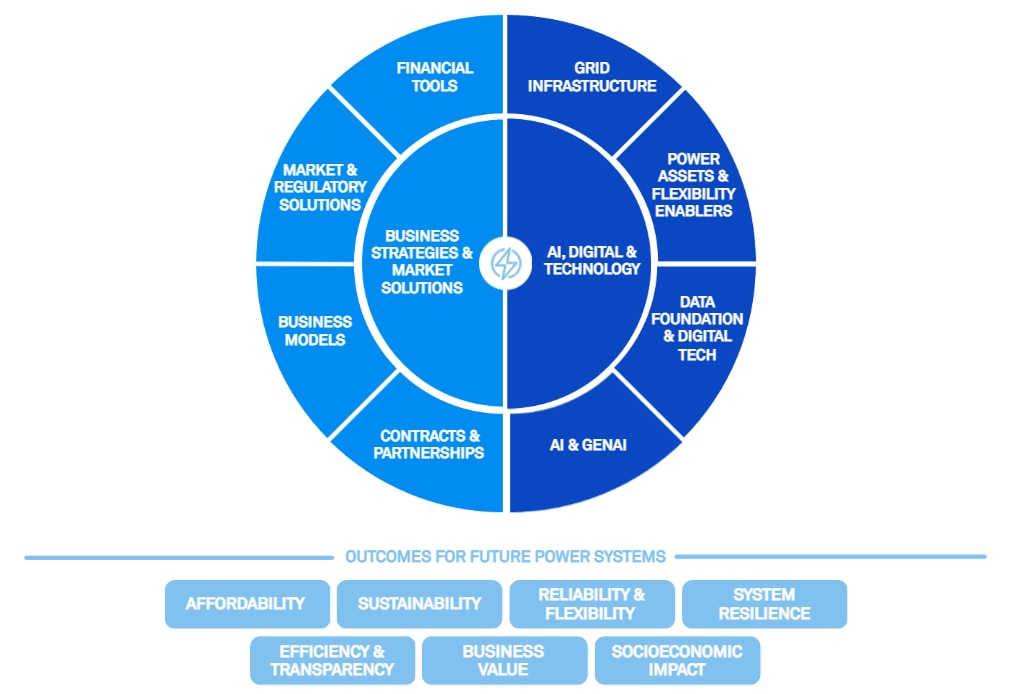
The World Economic Forum’s Innovation Playbook for Future Power Systems, developed with Accenture, outlines real-world solutions that are already being deployed – from digital twin grids and advanced forecasting, to storage orchestration and flexible contracting.
The playbook highlights both the technical and digital advances shaping performance, and the commercial and regulatory innovations enabling deployment at scale. It is designed to help leaders identify effective solutions, understand enabling conditions and accelerate adoption.
Ultimately, as power systems progress through and beyond their "internet moment", their future will not be shaped by technology alone, but by the ability of governments, companies and communities to innovate together – intelligently, collaboratively and at scale.
Don't miss any update on this topic
Create a free account and access your personalized content collection with our latest publications and analyses.
License and Republishing
World Economic Forum articles may be republished in accordance with the Creative Commons Attribution-NonCommercial-NoDerivatives 4.0 International Public License, and in accordance with our Terms of Use.
The views expressed in this article are those of the author alone and not the World Economic Forum.
Stay up to date:
Future of Electricity
Related topics:


Forum Stories newsletter
Bringing you weekly curated insights and analysis on the global issues that matter.
More on Energy TransitionSee all

Samaila Zubairu
March 3, 2026


