Why gender-balanced leadership matters in uncertain times
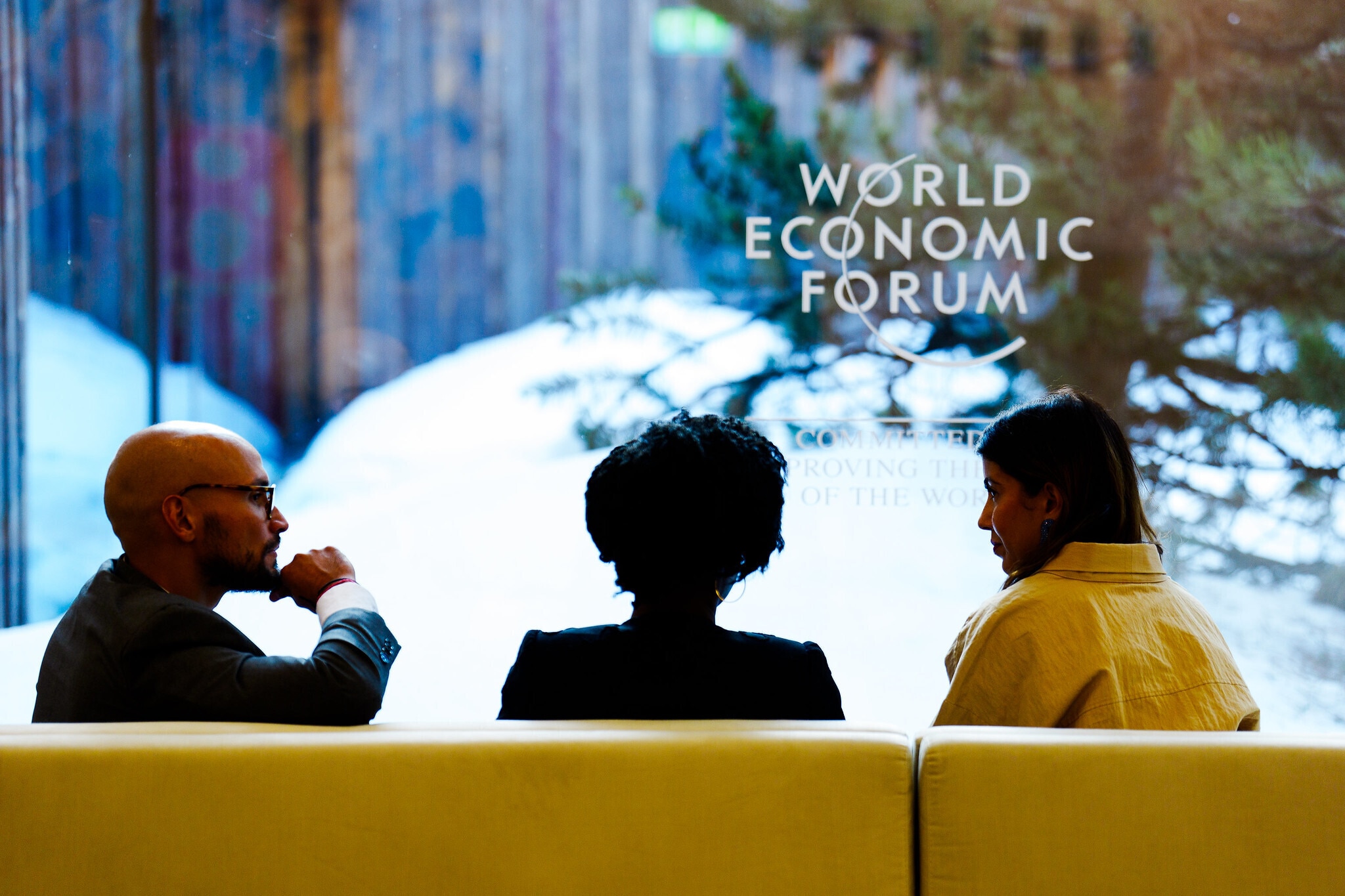
As part of the World Economic Forum’s Global Gender Parity Sprint, a growing coalition of leaders is taking decisive action to accelerate progress toward gender-balanced leadership. Image: World Economic Forum / Boris Bal
Gary Barker
President and Chief Executive Officer, Equimundo: Center for Masculinities and Social Justice- While diverse leadership is essential for navigating complexity, women's representation in senior roles has peaked and begun to decline, falling to 32.8% in 2025.
- A lack of gender balance undermines organizational resilience; industries with equitable workforces show a superior ability to navigate shocks, retain talent and maintain performance during downturns.
- As part of the World Economic Forum’s Global Gender Parity Sprint, a growing coalition of leaders is taking decisive action to accelerate progress toward gender-balanced leadership.
As highlighted by the latest World Economic Forum Global Risks Report, in 2026 business leaders and policy-makers are operating in an environment defined by competition and uncertainty.
The convergence of accelerating technological change, geopolitical instability, demographic shifts and increasing societal and political polarization has multiplied the pressures on decision-makers. Navigating this complexity requires leadership teams capable of managing uncertainty and drawing on diverse perspectives with agility.
Yet, despite progress in education and workforce participation, women remain significantly underrepresented at the top.
Globally, women make up 41.2% of workers but only 28.1% of leaders – a persistent "drop-to-the-top" that reflects systemic barriers rather than a lack of capability. This gap is most visible in high-growth, high-influence fields: while women constitute nearly one-third of STEM graduates, they represent just 14% of STEM leaders.
Recent trends indicate a regression in leadership parity. The share of women in new senior leadership appointments peaked in 2022 at 34.8% and has since fallen for three consecutive years, reaching 32.8% in the first quarter of 2025.
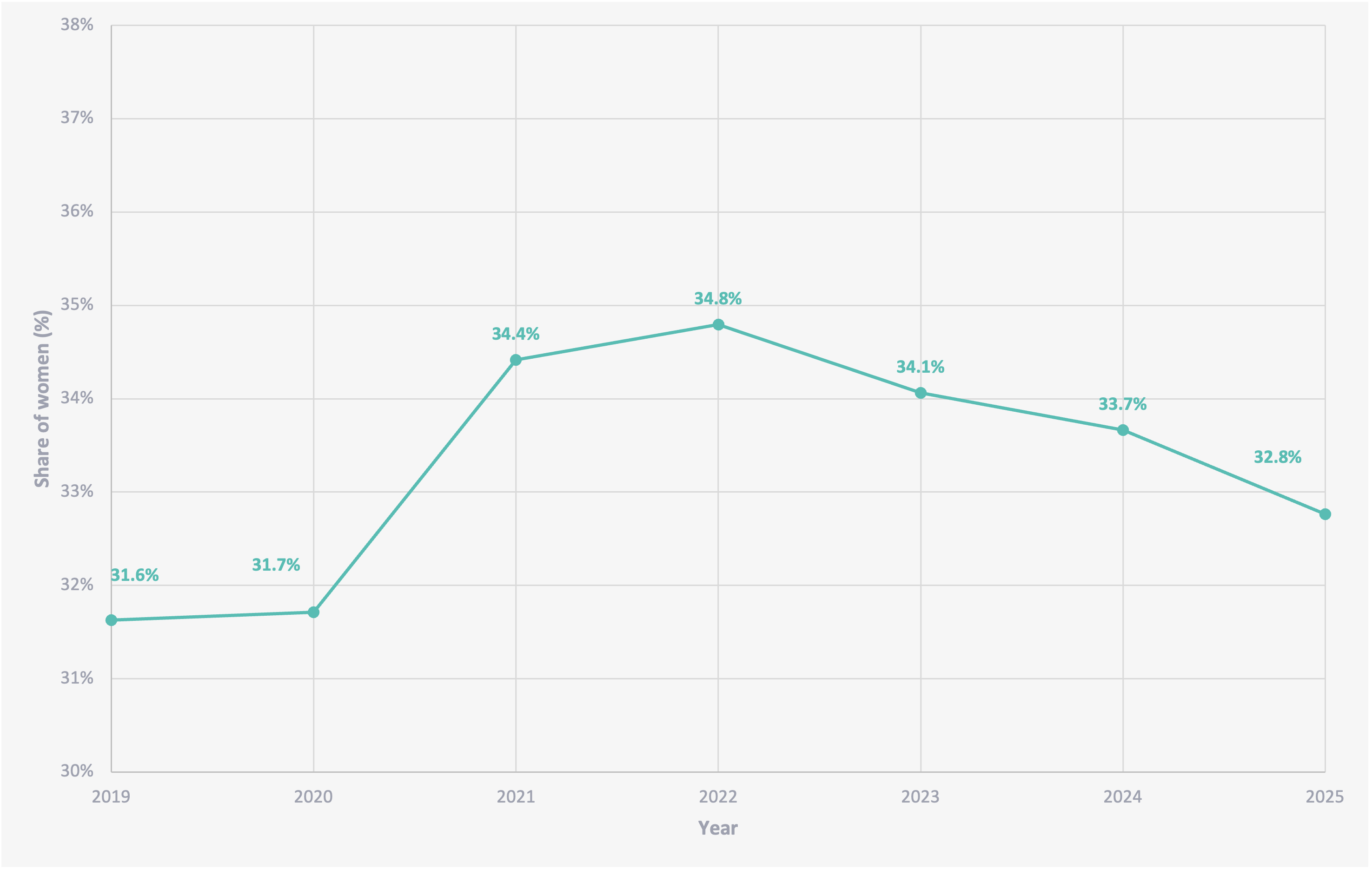
Board appointments show a similar decline, dropping from 17.2% in 2020 to 14.2% in 2024. Evidence suggests that when labour markets tighten, women’s leadership hiring declines disproportionately, particularly in industries where women are already a minority.
Addressing these patterns is more than a matter of fairness; it is a strategic and economic necessity. Industries with more gender-balanced workforces demonstrate greater resilience during downturns, showing an improved ability to navigate shocks, stronger continuity in leadership parity, and better talent retention. Diverse leadership teams bring broader perspectives, stronger risk management and greater responsiveness to shifting consumer expectations.
At a time when disruption is the norm rather than the exception, organizations cannot afford to overlook half of the leadership talent pool. As part of the World Economic Forum’s Global Gender Parity Sprint, a growing coalition of leaders is advancing action, evidence and innovation to accelerate progress.
The leaders featured here – representing business, civil society and academia – share their perspectives on why gender-balanced leadership is a foundational requirement for competitiveness and long-term resilience.
Alex Liu, Chairman Emeritus and Partner, Kearney
Especially in volatile and disruptive times, we must refocus on core principles and business logic. Gender-balanced leadership isn't just about fairness or social good; it’s about building stronger, more resilient organizations and adaptive cultures that withstand constant change. As complexity rises, we need reflective leaders and teammates who bring diverse perspectives and instincts to de-risk solutions. Versatility can defeat volatility.
Balanced teams make more aligned, sensible decisions, especially when the way forward is unclear. They challenge assumptions, anticipate unintended consequences, and build trust across a broader range of stakeholders.
But leadership is more than strategy; it’s culture. Throughout my career, the most successful organizations have been those where women feel they truly belong. Fostering allyship and everyday respect is essential. When people feel seen, heard and valued, they contribute with conviction. That’s when culture flourishes, innovation accelerates, and teams find the courage needed to navigate disruption.
Gender-balanced leadership also models the inclusive behaviour and values we expect across the organization. It signals that everyone has a seat at the table and that every voice matters. Every business needs an empowering environment where people lift one another up and bring out their best, not compete for space.
In this global storm of disruption, sustaining this holistic focus can be a lighthouse for meaningful progress.
Fatoumata Ba, Founder and Executive Chair, Janngo Capital
In a world shaped by cascading uncertainty – climate shocks, geopolitical fragmentation, inflation, supply-chain instability and the disruptive rise of AI – gender-balanced leadership is not only a fairness imperative; it is a performance multiplier. The evidence is consistent across markets: diverse leadership teams expand the range of risks identified, improve governance and strengthen innovation capacity.
McKinsey finds companies in the top quartile for gender diversity are up to 25% more likely to outperform financially, and BCG shows women-founded startups generate more revenue per dollar invested while maintaining greater capital efficiency.
Resilience begins with who is in the room. In times of disruption, this doesn’t just shape which risks are seen, it determines which companies endure and outperform.
”The macro case is equally compelling. Closing gender gaps in Africa could unlock 10% of the continent’s GDP by 2025 – more than ten times the GDP of my home country, Senegal. In a decade defined by volatility, no region can afford to ignore that growth engine.
At Janngo Capital, where 56% of our portfolio is women-led, we see this resilience in practice every day. Women-led teams in our portfolio are enabling over 200,000 women to generate income through digital commerce, supporting more than 6,000 women-led micro-enterprises in logistics, and helping nearly 90,000 women access preventive healthcare.
These outcomes are not anecdotal: they show how gender-balanced leadership builds models that are capital-efficient, adaptive and deeply aligned with real user needs.
Michael Ensser, Global Chair, Egon Zehnder
The world’s most effective leaders are united by a shared belief: Diverse perspectives lead to better business outcomes.
We have heard this from 450 board directors as part of Egon Zehnder’s Global Board Inclusion Study: more than nine out of ten respondents worldwide regard embracing different viewpoints as a strategic priority for their boards, with 90% saying it strengthens decision making. Notably, 69% of boards have added minority-gender directors over the last five years – a clear signal that there is movement.
The case for inclusion goes beyond fairness and representation. It's a business imperative. Inclusive teams are more innovative, make better decisions and are better equipped to navigate disruption. They draw on a range of perspectives, unlock deeper insight and anticipate risk more effectively. In a world defined by deep complexity, uncertainty and rapid change, this fosters the kind of long-term resilience organizations need to adapt, grow and endure uncertainty while staying true to their purpose.
At Egon Zehnder, we see this firsthand. Our own global board reflects a balanced composition across gender and culture. This is critical because authentically guiding leaders begins with embracing these principles ourselves.
Championing inclusion demands sustained effort, honest reflection and a willingness to lead differently. But this is precisely what sets exceptional leaders apart. Striving for gender parity, always in accordance with applicable laws, is not just a moral goal, it is a powerful driver of economic resilience, growth and innovation.
Championing inclusion demands sustained effort, honest reflection and a willingness to lead differently. But this is precisely what sets exceptional leaders apart.
”Gary Barker, President and CEO, Equimundo: Center for Masculinities and Social Justice
Study after study finds that more diverse boards, senior leadership and staff – in addition to being the morally right thing – are more efficient, creative and often more profitable. In moments of uncertainty and disruption, it is leaders who pay attention to gender balance and all kinds of diversity who also have the skills to get us through challenging times.
For years in the field of male allyship for gender equality we have used the slogan: "Men of quality are not afraid of equality." It is male leaders who know the political imperative of equality and diversity who are those most attuned to sustainability and bold leadership for challenging times. Indeed, male leaders who support equity and gender-balanced leadership have seen the virtuous cycles that promoting equitable leadership brings.
Heejung Chung, Director of the King's Global Institute for Women's Leadership
As Iceland’s President Halla Tómasdóttir warned at our recent event: "We’re at the cusp of creating the world we want and need, but we’re also at the cusp of losing it." This is not rhetoric; it is a defining moment. In an era shaped by climate breakdown, geopolitical instability, and rapid advances in AI and automation, the decisions taken now will determine which world our children inherit.
Periods of disruption tend to push societies toward zero-sum thinking: heightened competition, polarisation, and a winner-takes-all mentality. Yet history shows that such approaches often amplify risk, inequality and instability, undermining collective resilience.
This is why gender-balanced leadership matters. The scale and complexity of today’s global challenges demand leadership that draws on diverse lived experiences and ways of thinking. The greater the challenge, the greater the need for multiple perspectives and approaches.
Gender-balanced leadership is more likely to integrate different viewpoints, anticipate unintended consequences, and weigh social impacts alongside economic gains. Traits often undervalued in times of crisis – such as collaboration, empathy, reflexivity and ethical courage, are not gender-exclusive, but they are more likely to be recognized, exercised and sustained when leadership is balanced.
In a world facing multiple crises, these are not "soft" qualities. They are core capabilities for navigating uncertainty, governing powerful technologies responsibly, and safeguarding social cohesion and a better future. Gender-balanced leadership is not a fairness add-on; it is a strategic necessity for survival and shared prosperity of this planet.
License and Republishing
World Economic Forum articles may be republished in accordance with the Creative Commons Attribution-NonCommercial-NoDerivatives 4.0 International Public License, and in accordance with our Terms of Use.
The views expressed in this article are those of the author alone and not the World Economic Forum.
Related topics:

Forum Stories newsletter
Bringing you weekly curated insights and analysis on the global issues that matter.
More on LeadershipSee all

Niklas Mortensen
August 27, 2026


