How the world's energy and finance leaders are learning to power the future
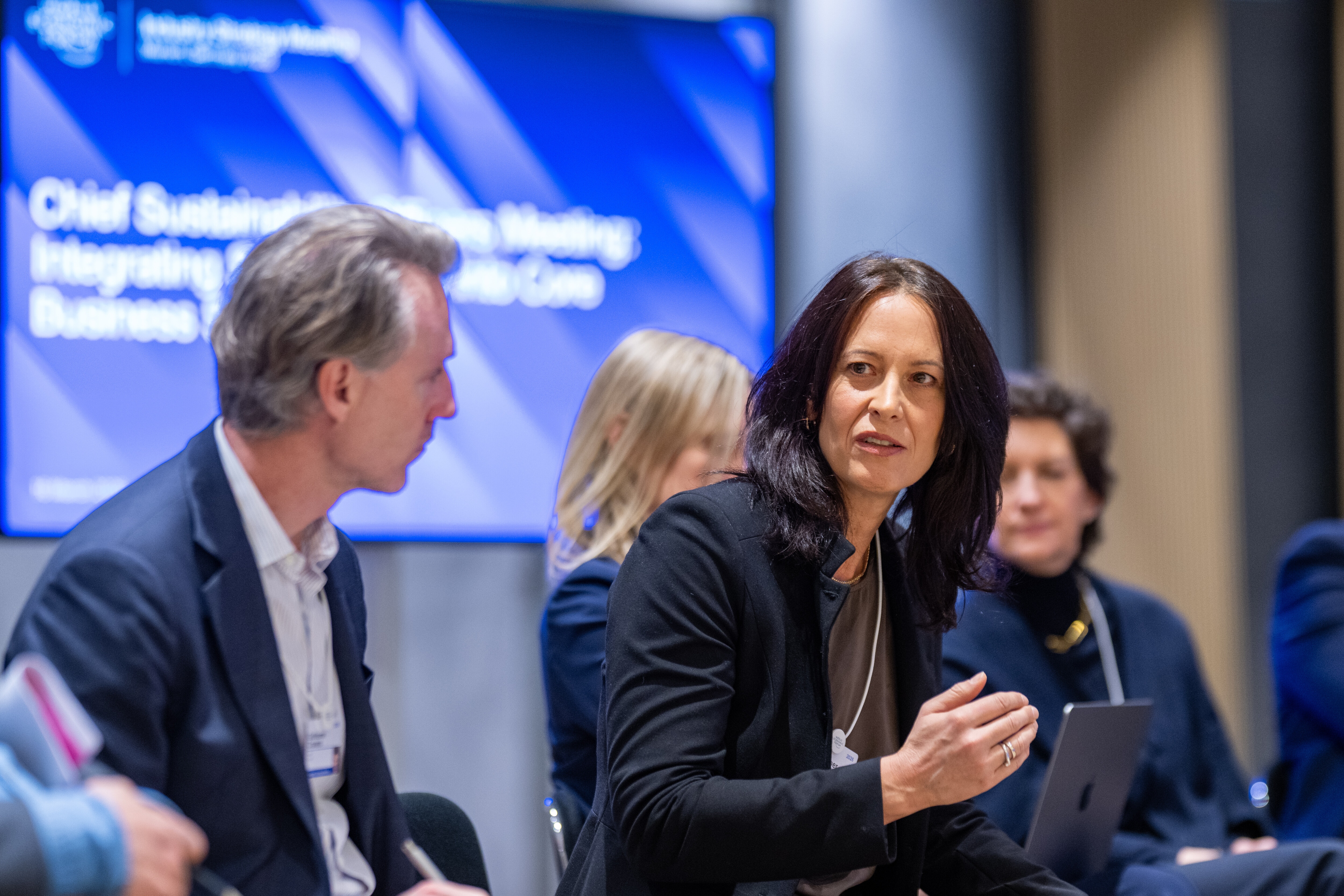
Energy and finance leaders at the World Economic Forum's Industry Strategy Meeting.
Francisco Betti
Head, Global Industries Team; Member of the Executive Committee, World Economic Forum- The World Economic Forum’s Industry Strategy Meeting took place in Munich in March, as the Strait of Hormuz closure entered its third week and energy markets faced their most severe disruption since the 1973 oil crisis.
- Industry leaders shared what it means to treat energy not as a cost to manage but as infrastructure to secure, and where the gap between intention and execution remains most exposed.
- From grid bottlenecks to repriced risk and accelerating demand, they set out what it takes to make energy investment resilient.
The World Economic Forum’s Industry Strategy Meeting opened on 16 March, just days after Iran closed the Strait of Hormuz and the International Energy Agency triggered the largest emergency oil stock release in its over 50-year history. Brent crude had already surged past $120 a barrel. Gas rationing was under discussion across parts of Asia. It was, by any measure, an extraordinary moment to convene the world’s energy and finance leaders.
What was striking was not that the disruption dominated the conversation. It was that the most important discussions were already underway before the crisis hit and that the crisis had simply made the stakes undeniable.
In effect, the companies that arrived in Munich were those that had already restructured their thinking about energy: no longer a line item to be optimised, but a strategic variable to be planned around, controlled where possible, and built into the architecture of business strategies.
Here is the conversation that emerged across the two days.
1. Energy is no longer a cost line
Energy is no longer a utility bill but a competitive lever, participants said during meetings mostly conducted under Chatham House rules, which guarantee speakers’ anonymity, allowing them to speak more freely. The companies pulling ahead understand that energy discussions and decisions have moved to the C-suite, shaping where businesses locate, how they invest and how their operating models are built.
A session titled 'Meeting the Needs of a Power-Hungry World' put it plainly: energy now shapes competitiveness, resilience, trade exposure, industrial location and geopolitical positioning. In the weeks before the Meeting, those dynamics had been playing out in real time.
Asian economies were scrambling to reroute LNG cargoes as the flow of ships in the Strait of Hormuz dropped. Across Southeast Asia, governments were taking emergency measures to stave off energy shortages. And with Qatar's helium plants offline alongside its LNG facilities, South Korean and Taiwanese chipmakers were on high alert: helium, the irreplaceable cooling agent used to etch silicon wafers at the heart of every AI chip, had an estimated six weeks of inventory, with around 200 specialised containers stranded near the closed Strait.
For companies that had been building multi-energy portfolios, maintaining optionality across fuels, technologies and regional supply pathways, the disruption validated a costly but necessary hedge. For those that hadn’t, it exposed a structural vulnerability. As leaders from the supply chain and transport sector observed, the main barriers to energy resilience are not technology supply but infrastructure rollout, weak demand signals and fragmented policy. Building that resilience is expensive but the cost of not building it has just been repriced.
Nowhere is that more visible than in infrastructure. Investment has flowed into generation while transmission and distribution have not kept pace. A session focusing on the future of energy systems was unequivocal: ageing grids, permitting bottlenecks and rising capital costs are now the binding constraint on deployment, precisely when demand is accelerating, largely driven by population growth, industrialisation, digital infrastructure and the energy-intensive materials needed for the transition itself.
Grid congestion, transformer shortages and underdeveloped interconnection are the ceiling that the clean energy buildout keeps hitting. Until capital flows as urgently into networks as it does into generation assets, that ceiling will hold.
2. Disciplined balance
For Norway-based energy company Equinor, the central question is how to keep investing in the oil and gas business that still generates the bulk of its revenues today while reconciling growth ambitions with the energy transition. That balance is framed as a matter about of discipline, which holds when the cycle turns and when it doesn’t.
The company expects around 3% oil and gas production growth, supported by a high-grade portfolio on the Norwegian Continental Shelf and internationally, with a strong focus on low break‑even projects and operational efficiency.
Henriette Undrum, Senior Vice President and Head of Corporate Strategy, is direct: “This growth is positioned as compatible with our long-term energy objectives by prioritizing assets with low upstream emissions intensity.”
On renewables, the logic is the same. “Rather than pursuing volume growth,” says Undrum, “the strategy emphasises value-adding growth, cash-flow resilience, portfolio robustness and carbon efficiency, while preserving long-term optionality across markets with differing transition dynamics.”
The company remains committed to its scope 1 and 2 target of a 50% emissions reduction by 2030, which continues to guide operational and investment decisions.
The financing architecture reflects this. “Climate-related investments are protected through stricter return thresholds, selective capital allocation, and a strong focus on execution,” Undrum explains. “Spending on power and low‑carbon solutions is prioritized toward projects already sanctioned, ensuring disciplined delivery and reduced risk. Financing structures increasingly limit balance-sheet exposure through project-level debt, supported by operating cash flow, government incentives and ongoing portfolio optimisation — safeguarding financial resilience while maintaining strategic exposure to the energy transition.”
This is a meaningful framing shift. What Equinor describes, and what was echoed in the Oil and Gas industry session, is energy systems transformation being recast through the lens of sovereignty and resilience rather than compliance. Established energy companies are positioning themselves not as managed-down assets but as architects of long-term energy stability. In a world where the IEA has just triggered its biggest-ever emergency stock release and Gulf spare production capacity is locked behind a closed strait, that positioning has acquired new force.
3. Powering a country in transition
The energy transition looks different when you can't afford to get the sequencing wrong.
South Africa still generates around 74% of its electricity from coal, an industry that supports more than 100,000 jobs, directly and indirectly. Its main power utility, Eskom Holdings, has committed R320 billion over five years to grid expansion and clean energy generation. Nontokozo Hadebe, Group Executive Strategy and Sustainability, is direct about why the grid comes first: the pipeline of renewable projects is large and ready. The constraint is not ambition. It is infrastructure.
But Hadebe's most important observation is about sequencing. When Eskom closed the Komati power station in 2022, the communities built around it — schools, small businesses, livelihoods — were left without a transition plan.
The lesson reshaped Eskom's approach entirely. Its Just Energy Transition strategy now mandates that the socio-economic plan comes before the decommissioning date is set, not after.
"We're not going to decommission, then afterwards come with the socio-economic strategies. That must go first and then the decommissions can come later so that you don't leave the communities destitute."
4. When insurability becomes a capital constraint
Energy projects need to be financeable. Whether they are financeable increasingly depends on whether they can be insured. And insurance is being repriced by physical risk, quietly but consequentially, turning what was once a procurement question into a strategic one.
Linda Freiner, Chief Sustainability Officer at Zurich Insurance Group, sees this playing out directly in how energy infrastructure gets funded. Physical risk is now a pricing variable not a tail risk. “Climate risk is now a more active factor in how organizations think about long-term growth and the conditions needed to sustain it. Companies and governments are placing greater emphasis on the stability of the systems that support economic activity.”
And that stability, she argues, increasingly depends on how well new energy assets are designed to absorb stress from day one.
“Stronger design standards, credible local adaptation measures, and better hazard data all contribute to this by improving how assets perform under stress. If deployed effectively, these actions will reduce volatility, limit damage, avoid business interruption and protect cashflow — making investments more secure over the longer term and supporting competitiveness in a more unpredictable operating landscape.”
Amy Barnes, Head of Climate and Sustainability Strategy at Marsh, sees the same repricing playing out at the level of individual energy projects. “Insurance is increasingly functioning as a capital constraint,” she says. Her clearest example is wind: lenders are now requiring standalone wind coverage as a condition precedent to closing deals. The premium may be manageable but the signal is that insurability has become a precondition for capital access, not a line item negotiated after the fact.
“For long-duration assets with fixed refinancing calendars, the critical financing risk is discontinuity — sudden changes in capacity, exclusions, or deductibles that alter debt structure or investor returns. Projects need to contemplate their resilience to future physical impacts as part of their investment thesis.”
The honest assessment
Progress on the energy transition is real. But it is unevenly distributed, and the gap between leaders and laggards is widening. A telling signal came from the Financial Services industry session, where participants described the transformation of energy systems as “embedded, not differentiating.” What that phrase captures is important: for the firms moving fastest, energy strategy is no longer a separate agenda. It is inside the financial architecture of the business in how capital is allocated, how risk is priced, how executives are incentivised and how operating models are designed.
It is also the conversation that connects most directly to what the Gulf crisis has just demonstrated: that energy autonomy is not a long-term aspiration but a near-term competitive variable.
That has direct implications for the evolving role of energy and strategy leaders. The job is no longer about stewarding separate functions. It is about working alongside the Chief Strategy Officer to co-create the business strategies that drive long-term value and increasingly, to ensure those strategies are built on a realistic picture of how energy is produced, secured and priced.
At the project level, the same logic applies. Financing viability is not simply a function of available capital – it depends on coordination. Projects need policy stability, infrastructure alignment and revenue visibility to scale. Too many viable energy investments are stalling not because the economics don’t work but because the surrounding conditions of permitting, grid access and offtake certainty haven’t been assembled.
Underlying all of this is a question that the Gulf crisis has sharpened considerably. The challenge is not simply to replace one set of fuels with another within the same systems. It requires rethinking what kinds of infrastructure and industrial systems should be built at all, and designing them from the outset to work within the physical and resource limits of the systems that sustain them. Forum Co-Chair André Hoffmann put it directly at the close of the Industry Strategy Meeting, speaking about the physical conditions required for economies to function: “Successful companies going forward… will be the companies which are going to understand what planetary boundaries actually mean.”
The rethink of energy systems is not a single story. It is dozens, moving at different speeds, shaped by geography, policy and the capacity of communities to absorb change from oil majors protecting their balance sheet while funding the transition to insurers repricing the risk that underpins every project on earth. What connects them is a shared recognition that the systems powering the world need to be redesigned, not just refuelled.
The organisations that thrive will be those that decided, early enough, to build as if the new energy era had already begun.
Quotes have been lightly edited for length and clarity.
License and Republishing
World Economic Forum articles may be republished in accordance with the Creative Commons Attribution-NonCommercial-NoDerivatives 4.0 International Public License, and in accordance with our Terms of Use.
The views expressed in this article are those of the author alone and not the World Economic Forum.
Related topics:

Forum Stories newsletter
Bringing you weekly curated insights and analysis on the global issues that matter.
More on BusinessSee all

Filip Koprčina
August 27, 2026


