How AI protects critical infrastructure from emerging global threats

AI can be used to defend critical infrastructure by helping stay ahead of attackers. Image: Getty Images
- Nation-state bad actors now use digital weapons to actively sabotage critical infrastructure such as hospitals, power grids and transit networks.
- The burden of defending such infrastructure often falls on local authorities and community-level services, with limited resources and small teams.
- Deploying AI for defence can close the gap between physical operational technology and digital IT networks by matching the speed of attackers.
Digital warfare has spilled into the physical world. Nation-state bad actors now actively sabotage the vital systems holding society together, by pointing their digital weapons at critical infrastructure, such as local hospitals, power grids, schools, utilities and transit networks. And the threat is escalating rapidly across the globe.
We think of critical infrastructure as large electrical or water companies, but in reality, the burden of defence often falls on local municipalities and community-level service providers. Such bodies are on the front line against the most advanced adversaries with limited resources and small teams.
Have you read?
These facilities increasingly connect physical operational technology (OT) to digital IT networks, and this convergence creates a massive new attack surface. Human security professionals cannot physically move fast enough to monitor this expanded landscape, especially when adversaries are using artificial intelligence (AI) to stay ahead.
Only deploying AI for defence can close this gap and, accordingly, organizations must use automated systems on their networks to secure this vulnerable environment.
Defend the bridge between digital and physical
Critical infrastructure is becoming heavily digitalized. Facilities now rely on a variety of sensors and smart meters and use internet-connected programmable logic controllers (PLCs), which act as a digital brain to control and automate physical machinery. This massive scale of infrastructure networks makes manual monitoring impossible.
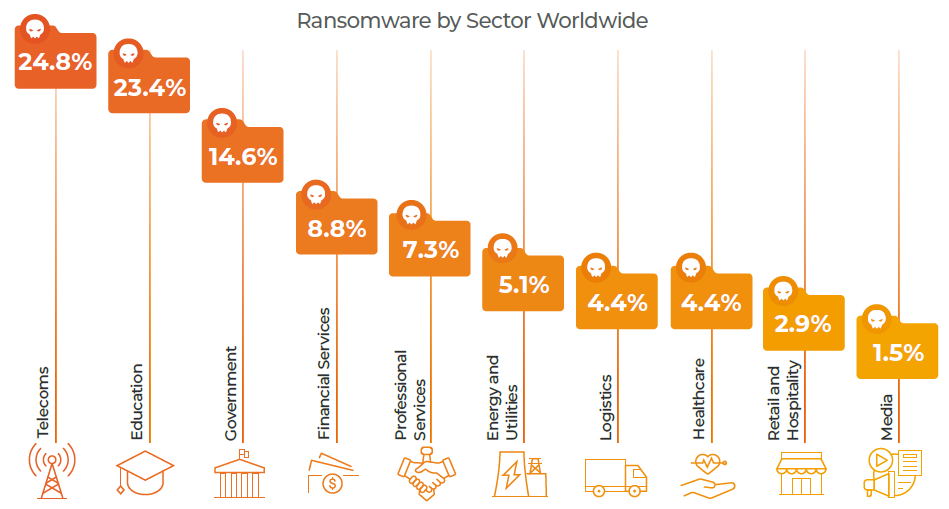
Ransomware gangs are aware of this and heavily target this digital-physical infrastructure. Recent data confirms this trend with telecommunications and education currently topping global targets, accounting for 24.8% and 23.4% of attacks respectively.
A successful breach causes devastating downtime for these vital services. An IBM report shows that 76% of organizations take more than 100 days to fully recover from an incident.
We are already seeing these devastating impacts in the real world. Recent attacks on the US water and wastewater sector prove this vulnerability.
In late 2023, Iranian state-sponsored hackers successfully targeted Israeli-made PLCs at municipal water facilities in the US. They exploited internet-connected devices and locked facility operators out of the systems. The affected water authorities had to immediately take systems offline and switch to manual operations.
Why you should fight AI with AI
Attacks on critical infrastructure are becoming faster and more effective with AI. Securing this bridge requires matching the speed of the enemy.
Attackers use AI to move much faster than human teams can deploy patches. Because of this speed advantage, one in six successful data breaches now involves attacker-driven AI. Given this threat, 87% of organizations identify AI-related vulnerabilities as the fastest-growing cyber risk.
One may assume that AI means speed, but that is not always the case. Adversaries often use this technology to prioritize stealth over immediate destruction. Recent threat intelligence shows defence evasion is the most dominant attack tactic today. Cybercriminals deploy stealthy campaigns that avoid triggering alarms by moving quietly over long periods – meaningb that when they attack, they cause maximum impact.
Defending critical infrastructure requires a comparable automated response and human teams cannot secure this environment alone. Adopting AI-driven network security remains the only practical way to manage this massive influx of automated risks.
Blind spot of critical infrastructure is endpoint-only security
One of the most significant blind spots in critical infrastructure is the over-reliance on endpoint-only security. In a traditional corporate environment, installing security agents on every laptop is standard practice. However, critical infrastructure operates under a different set of rules.
Modern critical infrastructure facilities rely on unmanaged physical devices. Security teams cannot install traditional software agents on these internet-connected digital switches, medical equipment, water valves or many other physical assets. This leaves an undefended attack surface for attackers to exploit.
Hardware limitations further complicate this defence strategy. Utility companies often cannot install advanced AI defences on even their traditional endpoints. Industrial equipment has a notoriously long lifespan and, consequently, much of this operational infrastructure still runs on outdated systems like Windows 95, NT, or Windows XP.
The network provides the only viable answer. Cyber resilience across an OT landscape requires continuous monitoring at the network layer. The network sees every connection, so AI applied to network traffic catches the evasive behaviors that local endpoint tools completely miss.
AI can instantly read millions of data points and analyse traffic patterns across both digital and physical landscapes, rapidly recognizing malicious anomalies. It then severs harmful connections before an advanced threat jumps into physical control systems.
The future of automated defence of critical infrastructure providers
Many critical infrastructure providers face a severe cyber talent shortage and this deficit leaves security teams at state and local levels heavily overburdened.
AI bridges this dangerous gap by acting as a vital force multiplier. The technology automates labour-intensive tasks like alert triage and log analysis. As AI brings accurate network intelligence to the surface at machine speed, human experts gain the freedom to confidently guide final operational decisions.
The attack surface continues to expand across digital and physical environments. AI-driven network defence provides the only scalable answer to this threat. Organizations can no longer rely on partial visibility provided from endpoints, so the network remains the only absolute truth in a compromised environment.
Deploying AI in network defences is not just about stopping hackers; it is about building digital trust. This trust is necessary to safely embrace the current industrial modernizations and ensure the uninterrupted delivery of vital services.
Don't miss any update on this topic
Create a free account and access your personalized content collection with our latest publications and analyses.
License and Republishing
World Economic Forum articles may be republished in accordance with the Creative Commons Attribution-NonCommercial-NoDerivatives 4.0 International Public License, and in accordance with our Terms of Use.
The views expressed in this article are those of the author alone and not the World Economic Forum.
Stay up to date:
Cybersecurity
Related topics:


Forum Stories newsletter
Bringing you weekly curated insights and analysis on the global issues that matter.
More on Artificial IntelligenceSee all

Jacob Nathan
September 25, 2026


