How ASEAN has turned resilience into a strategy and cooperation into a strength
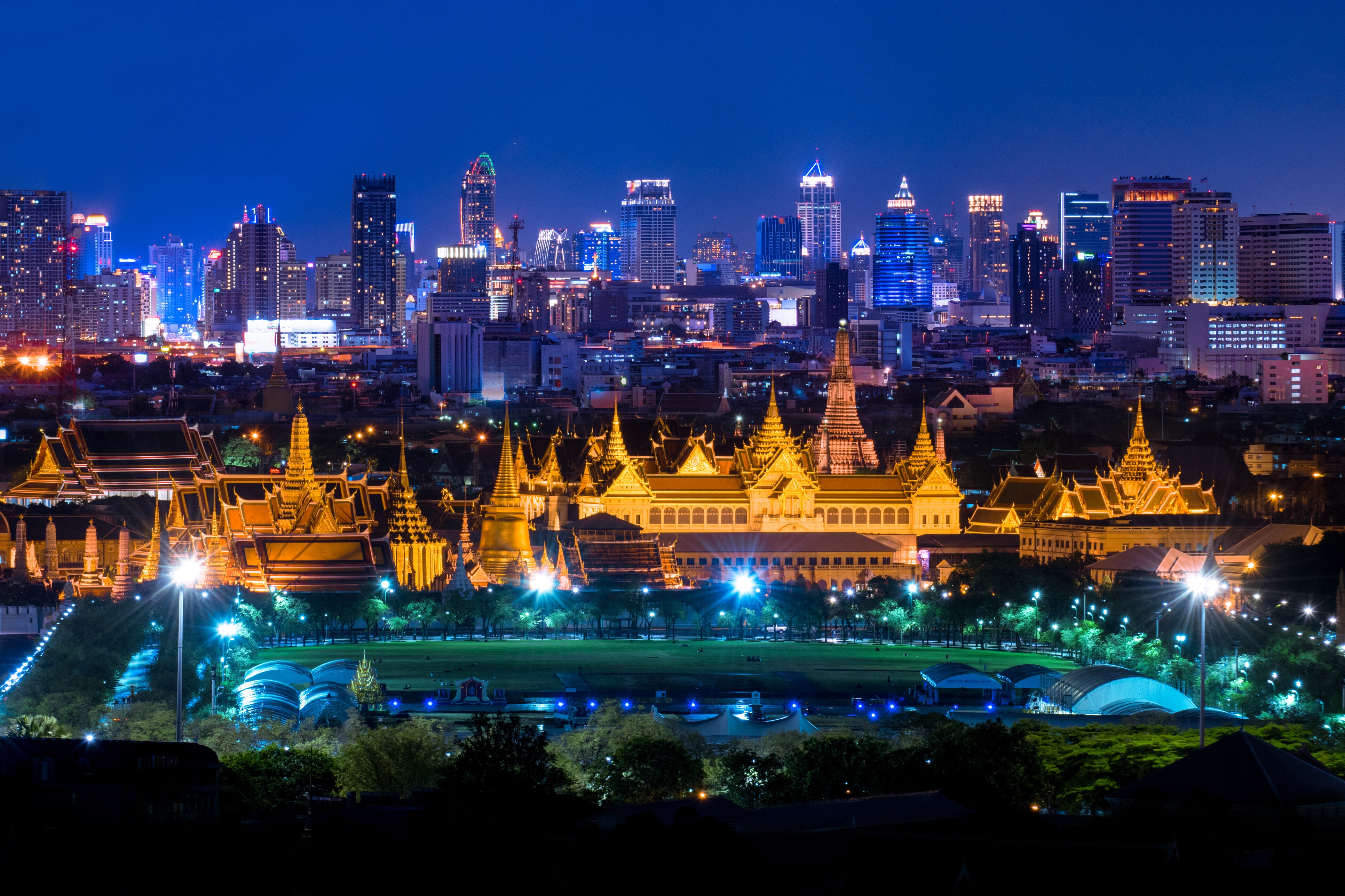
The Grand Palace, Bangkok, Thailand, with the city's business district in the background. ASEAN's resilience has been built on dialogue, institution-building and restraint. Image: iStockphoto/prachanart
- Current conflict will create higher commodity prices, tighter financial conditions, infrastructure damage and transport disruptions, according to the International Monetary Fund.
- The resilience of the Association of Southeast Asian Nations (ASEAN) lies in weathering such shocks and in using them to deepen integration, widen cooperation and strengthen growth.
- And as ASEAN continues to prioritise dialogue, institution-building and restraint over escalation, energy transformation and technology will fuel its future growth.
In a world increasingly defined by conflict and disruption, the history of the Association of Southeast Asian Nations (ASEAN) proves that resilience is not simply about enduring shocks, but about turning them into opportunities for cooperation, reform and growth.
Founded in Bangkok, Thailand in 1967 amid political distrust, strategic uncertainty and underdeveloped markets, over time, ASEAN has transformed cooperation into a more predictable economic space.
The launch of the ASEAN Free Trade Area in 1992 was another decisive moment, helping move Southeast Asia from relative fragility toward deeper economic integration. That momentum later fed into the broader project of the ASEAN Economic Community, which aims to strengthen trade, cross-border production and investor confidence across the region.
ASEAN has shown a recurring ability to adapt to volatility while steadily deepening trust, expanding cooperation and strengthening its economic foundations. That record does not guarantee the future, but it does provide an important clue about how Southeast Asia may navigate the current era of growing geopolitical and economic strain – and how it will write its next chapter of economic growth.
Building collective strength
This pattern of turning challenge into opportunity has repeated itself across decades.
In the aftermath of the Asian financial crisis, ASEAN strengthened regional economic monitoring with the ASEAN Surveillance Process in 1998. It then built more durable financial safeguards such as the Chiang Mai Initiative, established in 2000 with its ASEAN+3 partners.
The same instinct was visible during the COVID-19 pandemic, when ASEAN adopted the Hanoi Plan of Action to support supply-chain connectivity and economic cooperation under stress.
More recently, amid energy and trade disruptions linked to conflict in the Middle East and the effective closure of the Strait of Hormuz, ASEAN leaders meeting in Cebu, Philippines at the 48th ASEAN Summit called for the swift renewal of the ASEAN Petroleum Security Agreement (APSA). This uses various measures to enhance the petroleum security of ASEAN Member States.
The ability to respond quickly to immediate shocks, while also applying foresight to strengthen the region’s longer-term architecture, has become one of ASEAN’s defining features.
Economic integration in ASEAN
Throughout ASEAN’s history, crisis has often served as a catalyst for stronger cooperation and economic integration. Indeed, ASEAN’s resilience is not accidental. It’s the result of decades of steady integration, cooperation and adaptation.
As a result and according to soon to be released figures from ASEANStats, the region's combined GDP grew from $2.5 trillion in 2015 to $4.3 trillion in 2025, while the value of its merchandise trade nearly doubled from $2.3 trillion to $4.4 trillion. Foreign direct investment surged from $115.4 billion to $241.9 billion during the same period.
This reflects the growing confidence in Southeast Asia as a dynamic centre of production, innovation and opportunity – a region increasingly woven into global supply chains that is also strengthening its own internal market.
It also demonstrates ASEAN’s ability to navigate repeated shocks without losing momentum. Even in the current environment, the Asian Development Bank projects developing Southeast Asia will grow by 4.6% in 2026, driven by strong domestic demand and continued infrastructure investment.
Navigating current geopolitical shifts
The number of armed conflicts worldwide has risen sharply in recent years. The International Monetary Fund (IMF) believes war and conflict will "darken the global economic outlook" through higher commodity prices, tighter financial conditions, damaged infrastructure and disruptions to shipping and air traffic.
In such a world, resilience is a basic condition for growth. This environment is also accelerating geoeconomic fragmentation.
ASEAN has had to navigate these external pressures while also dealing with regional tests closer to home. In Myanmar, ASEAN has supported humanitarian assistance and continued to call for a reduction in violence within the country, as well as more inclusive dialogue.
And on the issue of territorial disputes in the South China Sea, ASEAN has consistently stressed peace, stability, self-restraint and continued work toward an effective and substantive Code of Conduct, in line with international law.
These efforts will not eliminate disagreement, but they do demonstrate ASEAN’s enduring preference for dialogue, institution-building and restraint over escalation.
This commitment was further reaffirmed in October 2025, when ASEAN admitted Timor-Leste as its 11th member after a 14-year process, under the Cebu Protocol. This highlighted the bloc’s flexibility, inclusiveness and ability to evolve. Timor-Leste’s accession also showed how a difficult past with Indonesia could give way to reconciliation and wider regional cooperation.
Energy and technology as engines of growth
ASEAN’s resilience can no longer be understood in narrow economic terms alone.
Over the last decade, Southeast Asia’s energy demand has risen by more than 35%, while electricity demand has grown by more than 60%, according to the International Energy Agency (IEA). At the same time, the region is approaching an inflection point in the energy transition. Clean energy investment reached $47 billion in 2025, IEA figures show, nearly matching fossil-fuel investment.
ASEAN's resilience is increasingly based on building economies that are not only open and competitive, but also energy-secure, climate-ready and better positioned for the green transition.
This is why cooperative energy policy matters so much. Under the ASEAN Plan of Action for Energy Cooperation, the region has advanced initiatives aimed at connectivity and resilience, from the ASEAN Power Grid to the Laos-Thailand-Malaysia-Singapore Power Integration Project.
At the same time, ASEAN’s discussion of civilian nuclear energy reflects a recognition that some member states see nuclear power as a possible low-carbon complement to renewables, provided it is pursued safely and in line with international standards.
A similar shift is under way in the digital economy. The Digital Economy Framework Agreement (DEFA) is intended to create a more coherent regional approach to digital trade, data and innovation. ASEAN’s own studies suggest that DEFA could help lift the region’s digital economy from $1 trillion to as much as $2 trillion by 2030.
For a region with a growing middle class, a young population and rapid technology adoption, digital cooperation is becoming a central pillar of ASEAN's resilience.
Building ASEAN's resilience further
ASEAN’s next chapter will be defined by how well the region continues to turn uncertainty into cooperation, and cooperation into capability.
This has been the pattern since 1967 – from regional fragility to economic integration, from crisis to stronger safeguards, from political tension to an expanding community that still believes in dialogue and multilateralism.
In a fragmented global landscape, this approach may prove to be ASEAN’s greatest strategic advantage.
Don't miss any update on this topic
Create a free account and access your personalized content collection with our latest publications and analyses.
License and Republishing
World Economic Forum articles may be republished in accordance with the Creative Commons Attribution-NonCommercial-NoDerivatives 4.0 International Public License, and in accordance with our Terms of Use.
The views expressed in this article are those of the author alone and not the World Economic Forum.
Stay up to date:
ASEAN
Related topics:


Forum Stories newsletter
Bringing you weekly curated insights and analysis on the global issues that matter.
More on Economic GrowthSee all

Ramya Krishnaswamy and Tony Simpson
October 1, 2026


