UN predicts a dip in trade volumes, and other international trade stories to know this month

Geopolitical risks are the dominant source of instability for the global economy, finds a report from UNCTAD. Image: REUTERS/Stringer
- This monthly round-up brings you a selection of the latest news and updates on global trade.
- Top international trade stories: Trade momentum weakening, UNCTAD finds; US-China Beijing summit outcomes; UK agrees landmark trade deal with Gulf states.
1. Global growth and trade decelerating, warns UNCTAD
The global economy is moving from an initial phase of supply disruptions and inflation into a "more fragile period, where prolonged uncertainty could trigger shortages and wider financial stress", according to UN Trade and Development (UNCTAD).
In its newly released Trade and Development Foresights 2026 report, the intergovernmental body warns that geopolitical risks have definitively replaced trade policy disputes as the dominant source of instability for the global economy.
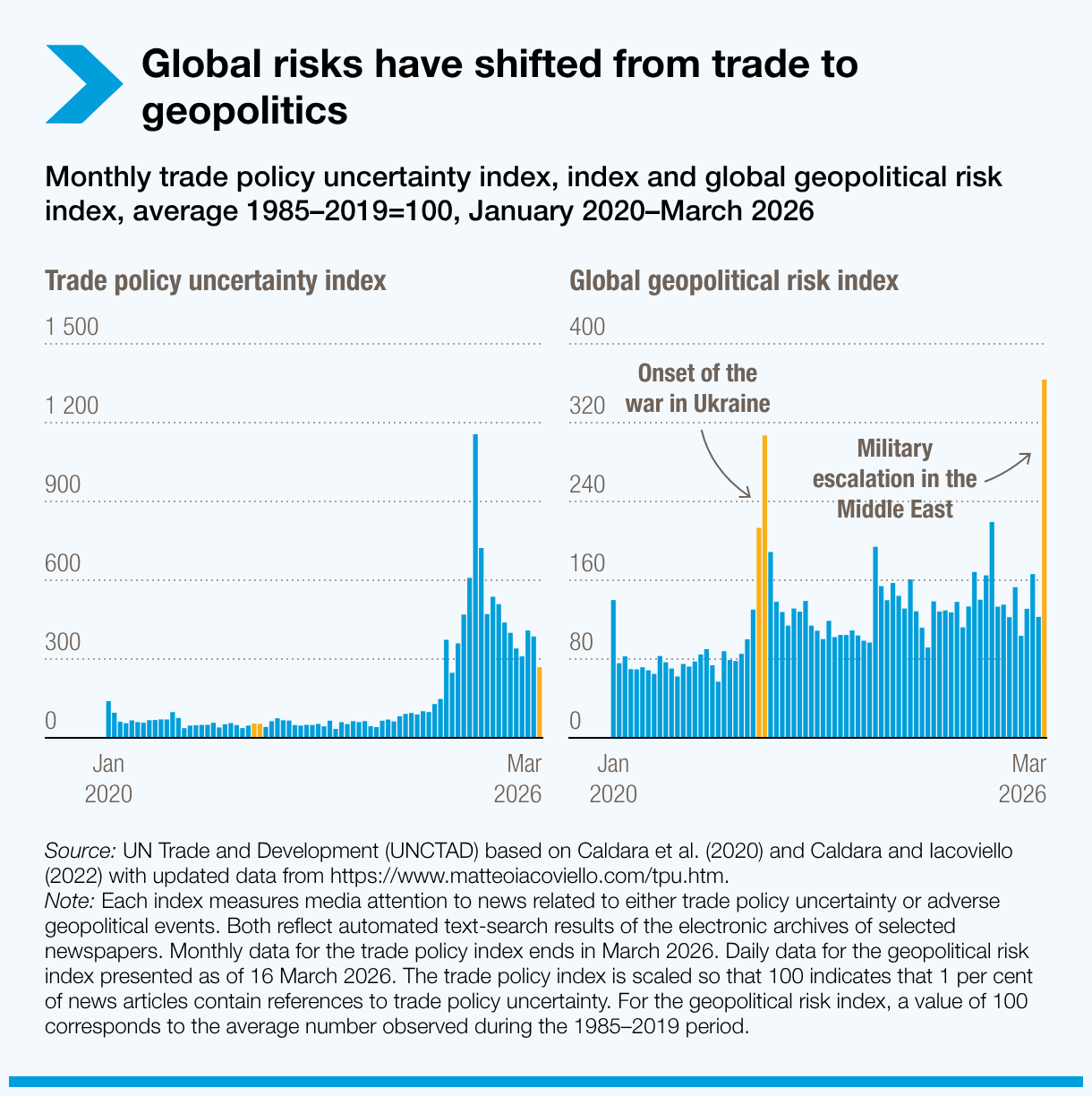
Driven by transport disruptions, market volatility, and a spike in shipping costs following the late-February military escalation in the Middle East, UNCTAD projects a broad deceleration in both global economic growth and merchandise trade volumes for the year.
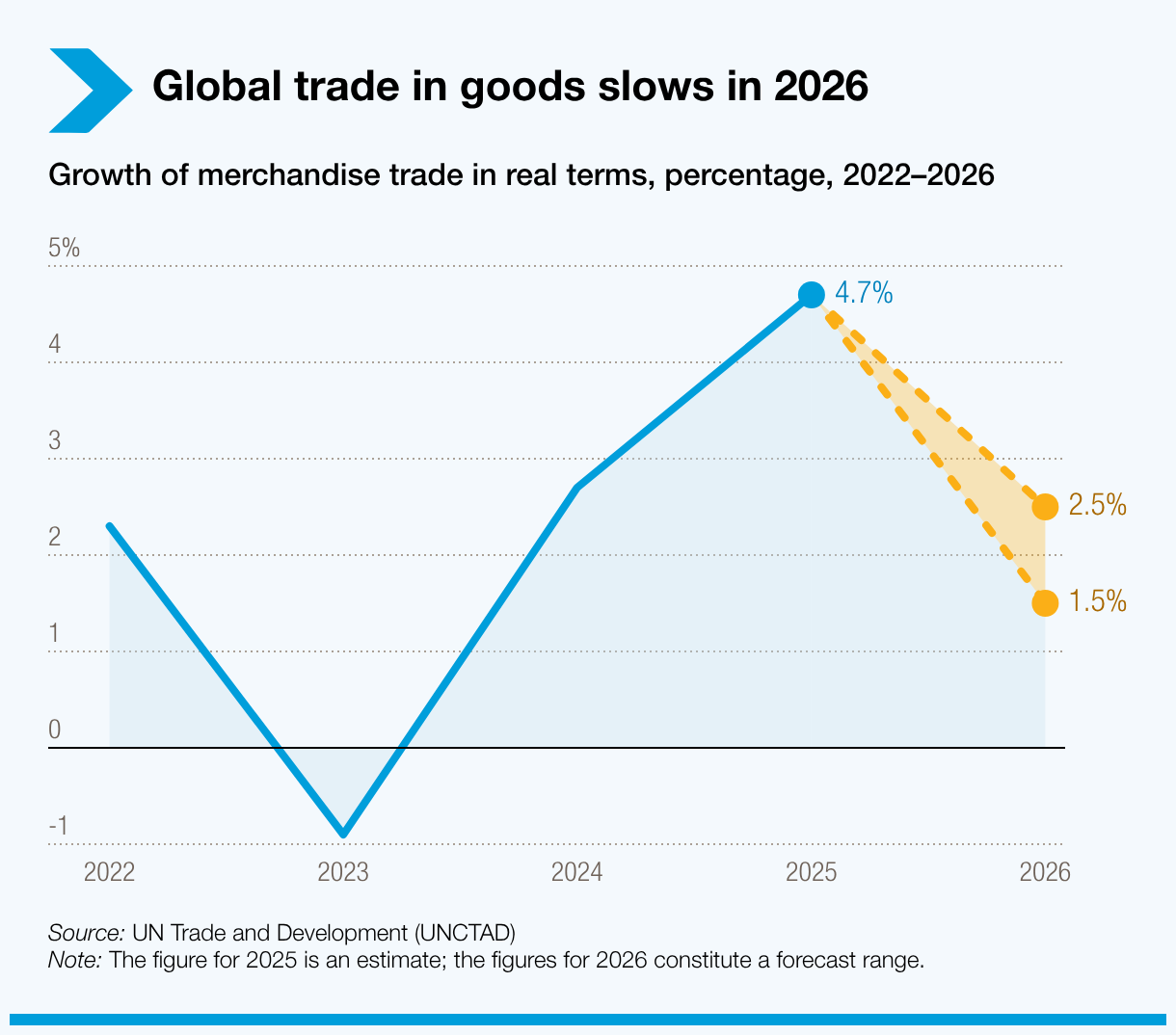
The report highlights that while nominal merchandise trade values remained resilient through early 2026, the underlying momentum is unevenly distributed and exposed to logistical shocks:
- Slowing global growth: UNCTAD forecasts growth slowing to 2.6% in 2026 as geopolitical tensions disrupt energy, trade and financial markets.
- Weakening trade momentum: Merchandise trade growth is expected to slow sharply amid supply chain disruption and uncertainty.
- AI masking broader weakness: Strong demand for AI-related goods is obscuring weaker momentum across traditional manufacturing and commodity sectors.
- Pressure on developing economies: Higher fuel, food and fertilizer costs are increasing inflation, financing pressures and external vulnerabilities.
- Food security as a financial risk: UNCTAD warns food security is increasingly becoming a financial stability concern.
- Shipping and energy disruption: Conflict-linked disruption to the Strait of Hormuz and other trade routes is increasing transport and energy costs globally.
Looking ahead, UNCTAD sees a more uneven global economy, with structurally slower growth, tighter financial conditions and continued vulnerability in developing economies to trade, energy and financing shocks - reinforcing the case for greater policy coordination and stability.
2. US-China summit shifts economic ties
While multilateral trade frameworks face mounting strain, US President Donald Trump and Chinese President Xi Jinping used their 14-15 May summit in Beijing to pledge continued dialogue around deeper economic ties, with Trump later hailing the talks as “very successful”.
Meanwhile, Xi set out what he called a “new positioning” for ties between the two countries, built around a “constructive, strategically stable” relationship that combines areas of cooperation with ongoing differences.
Independent analysts, however, were more measured in their assessments, noting that the summit produced no explicit extension of the trade truce and that several of the headline commercial commitments fell short of pre-summit expectations
Moreover, rather than a broad rollback of systemic tariffs, the state visit focused on establishing commercial guardrails to stabilize volatile global supply lines. US Treasury Secretary Scott Bessent later clarified to Reuters that the US is "not in a rush" to extend the existing trade ceasefire, expecting Beijing to accept the ultimate restoration of prior Section 301 tariffs.
According to official state comms and international news sources, key outcomes include:
- Chartering new trade dialogue mechanisms: The primary outcome of the summit is the creation of a permanent 'US-China Board of Trade' and a parallel 'US-China Board of Investment'. The first is intended to manage bilateral commerce in certain non-sensitive goods outside traditional multilateral channels and explore potential tariff reductions.
- Multi-year agricultural purchase commitments: China has agreed to expand purchases of US goods, including at least $17 billion per year of US agricultural products across 2026 (prorated), 2027 and 2028. Bessent noted these purchasing commitments are treated as entirely separate from the overarching tariff truce negotiations.
- Aviation orders and market evaluation: The summit included a commitment from Chinese commercial airlines to purchase 200 Boeing aircraft, with deliveries expected through 2030. Analysts said the order was below expectations for a larger deal, leading to a decline in Boeing shares.
- Technology export and AI baselines: US export controls on advanced technology remain tight, while discussions are shifting toward AI risk management. Bessent confirmed the US and China would begin talks within weeks to establish a protocol on best practices aimed at preventing non-state actors from gaining access to advanced models.
- Supply chain and maritime logistics: The talks included discussion of global energy security, with both sides referencing the importance of keeping the Strait of Hormuz open and maintaining the free flow of shipping through key energy routes, amid ongoing regional tensions affecting trade and oil flows.
This initial stabilization is expected to be followed by further high-level meetings, including a planned reciprocal visit by President Xi to Washington in September. However, Bessent described China's current compliance on critical minerals as "satisfactory, but not excellent," marking a key checkpoint before the trade truce officially expires in November.

3. News in brief: Trade stories from around the world
The UK has agreed to a trade deal with six Gulf states – Bahrain, Kuwait, Oman, Qatar, Saudi Arabia and the UAE – the first between a G7 country and the Gulf Co-operation Council. The government expects the deal to remove around $779 million a year in tariffs on UK exports and make trade easier between the UK and the Gulf region, according to the BBC. The deal is projected to add £3.7 billion a year to the UK economy. Key UK exports set to benefit include food and drink products, as well as manufactured goods, medical supplies and technology. The deal follows earlier UK trade agreements with India and South Korea, and existing agreements with the US and the EU.
Meanwhile, the European Union (EU) has cleared a key hurdle towards implementing its trade pact with the US, CNBC reports, after EU lawmakers reached a provisional agreement on legislation to remove import duties on American goods. The agreement includes safeguard mechanisms allowing the bloc to suspend tariff reductions if US imports threaten European industry. It also allows Brussels to withdraw tariff preferences if US duties on EU steel and aluminium derivatives remain above 15% beyond 2026.
The Wall Street Journal reports that "oil is likely to trade meaningfully lower later this year" should the current crisis, as Julius Bauer predicts, follow the typical pattern of a "short, sharp price shock". Traffic through the Strait of Hormuz is recovering, easing supply pressures, even though flows remain well below pre-conflict levels. And the global economy is also holding up, the Journal says, helped by resumed trade, lower logistics and refining mark-ups, and easing fuel prices outside the US.
Russia and China said they will assess risks and ensure safety as they seek to expand Russian meat exports to China, according to a joint statement following talks between Vladimir Putin and Xi Jinping in Beijing. The statement comes after recent disease outbreaks in Siberia raised concerns over cattle health and export controls, and no agricultural deals were signed during the visit.
The EU-Mercosur Interim Trade Agreement began provisional application on 1 May, marking a milestone in one of the longest-running trade negotiations in modern history, after more than 25 years of intermittent talks. The deal creates a trading zone of around 700 million people across the EU and Argentina, Brazil, Paraguay and Uruguay, with immediate tariff cuts on a range of products. Provisional application proceeds despite a European Parliament referral to the Court of Justice of the EU questioning the agreement's legal structure. Full entry into force still requires ratification by all 27 member states, a process not expected before 2027.
4. More on trade on Forum Stories
Can AfCFTA deliver on its promise of deeper integration and stronger intra-African trade? A new World Economic Forum white paper says the agreement has strong potential to boost value chains and regional commerce, but stresses that outcomes will depend on implementation. AfCFTA Implementation: Learnings from Value Chains and Regional Blocs highlights lessons from regional blocs and a private-sector case study showing that progress hinges on reducing friction at borders, along transport corridors and within domestic regulatory systems.

The EU’s Industrial Accelerator Act marks a major shift towards domestic manufacturing, but success will ultimately depend on secure, affordable energy and large-scale infrastructure investment needed to support industrial expansion, explains Ayla Majid, Founder and Chief Executive Officer of Planetive. Read more on how Europe’s industrial future hinges on energy security, infrastructure modernization and massive investment.
License and Republishing
World Economic Forum articles may be republished in accordance with the Creative Commons Attribution-NonCommercial-NoDerivatives 4.0 International Public License, and in accordance with our Terms of Use.
The views expressed in this article are those of the author alone and not the World Economic Forum.

Forum Stories newsletter
Bringing you weekly curated insights and analysis on the global issues that matter.
More on Trade and InvestmentSee all

E. Richard Gold
September 30, 2026