Latest Energy Transition Index shows the global energy transition is fragmenting, and more top energy stories
Global energy transition progress has lost momentum, according to the latest Energy Transition Index. Image: Unsplash/Jason Mavrommatis
Roberto Bocca
Head, Centre for Energy and Materials; Member of the Executive Committee, World Economic Forum- This round-up brings you the key stories from the energy sector over recent weeks.
- Top energy news: Energy transition fragmenting; energy security is reshaping country pathways; Hormuz reopening hopes and Gulf pipeline talks.
- For more on the World Economic Forum’s work in the energy space, visit the Centre for Energy and Materials.
1. Energy transition progress fragments
The energy transition is not reversing, but it is fracturing and becoming more uneven, the latest World Economic Forum Energy Transition Index (ETI) finds.
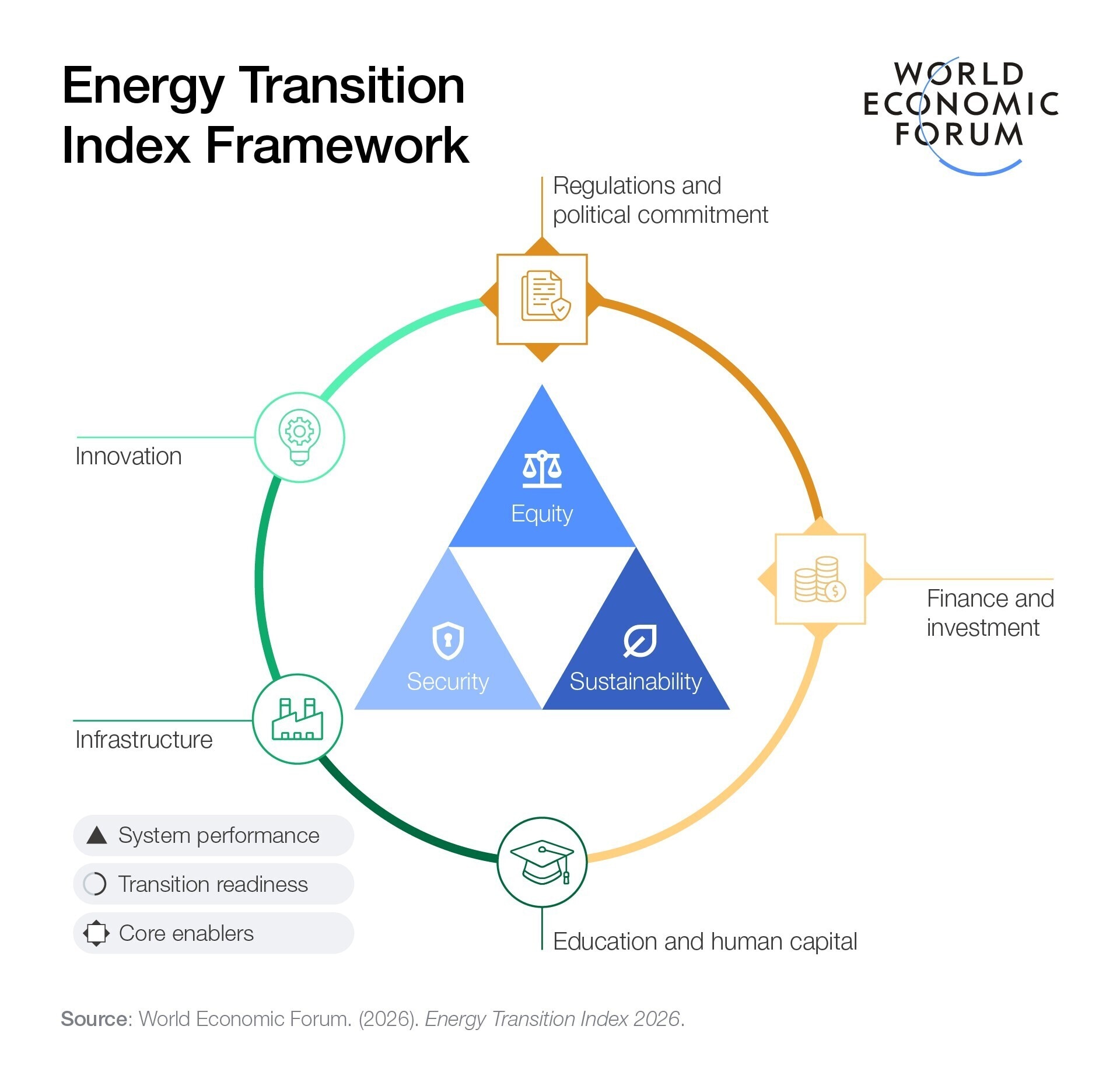
The ETI tracks energy systems across 120 countries using 44 indicators, assessing current system performance in terms of energy security, sustainability and equity, as well as transition readiness — the foundations that enable progress over time, including policy, infrastructure, finance, innovation and human capital.
In 2026, the ETI’s sixteenth year, the report comes against a backdrop of impressive numbers. Global energy investment reached $3.3 trillion in 2025, with renewables and nuclear generating 42% of global electricity, and renewable energy capacity increased by nearly 800 gigawatts (GW).
But these gains face mounting constraints, including grid congestion, permitting delays and chronic underinvestment in emerging economies. Newer pressures, including trade restrictions and conflict-based disruption, are compounding these challenges.
System performance continues to advance, with security the only dimension to decline (-0.9%) as weaker reliability and supply conditions hit.
And on transition readiness – which shows where the transition is heading and is emerging as the main constraint on future progress – the trajectory has turned downward for the first time in over a decade. Finance and investment have fallen, while regulation and political commitment and innovation have also declined. This has widened the gap between what is being built and what systems can absorb.
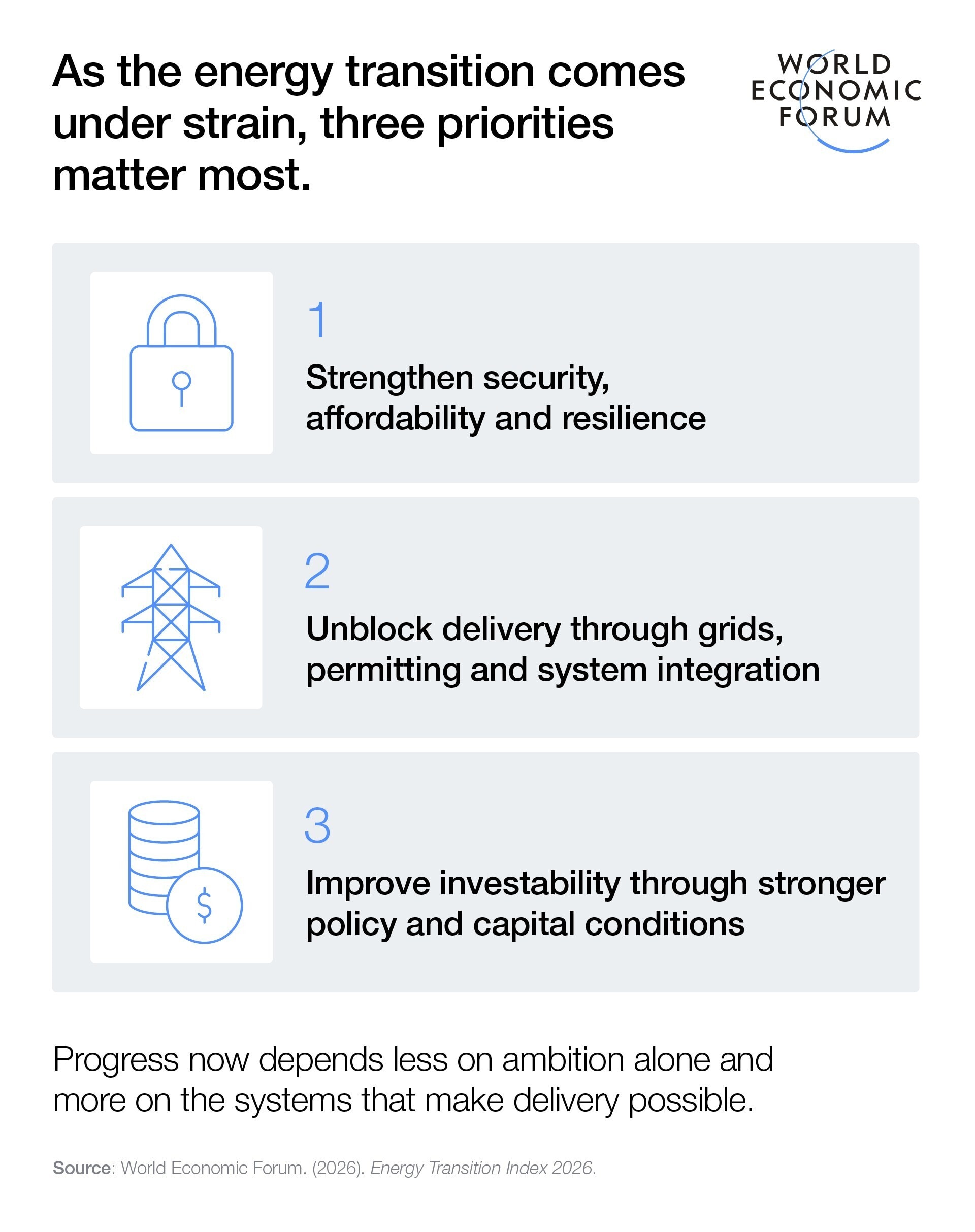
Overall, this means global energy transition progress has lost momentum, with average scores broadly unchanged. The report suggests three priorities that will define the path forward:
1. Strengthening security, affordability and resilience
2. Unblocking delivery by expanding infrastructure
3. Increasing investability through stable policy, credible regulation and better risk-sharing
Urgency and uncertainty are high – and the decisions made by government and business leaders will be vital to closing gaps between ambition and delivery.
2. Energy security is reshaping country pathways
The ETI shows that country performance is becoming more varied as energy security, affordability and resilience move higher on national agendas.
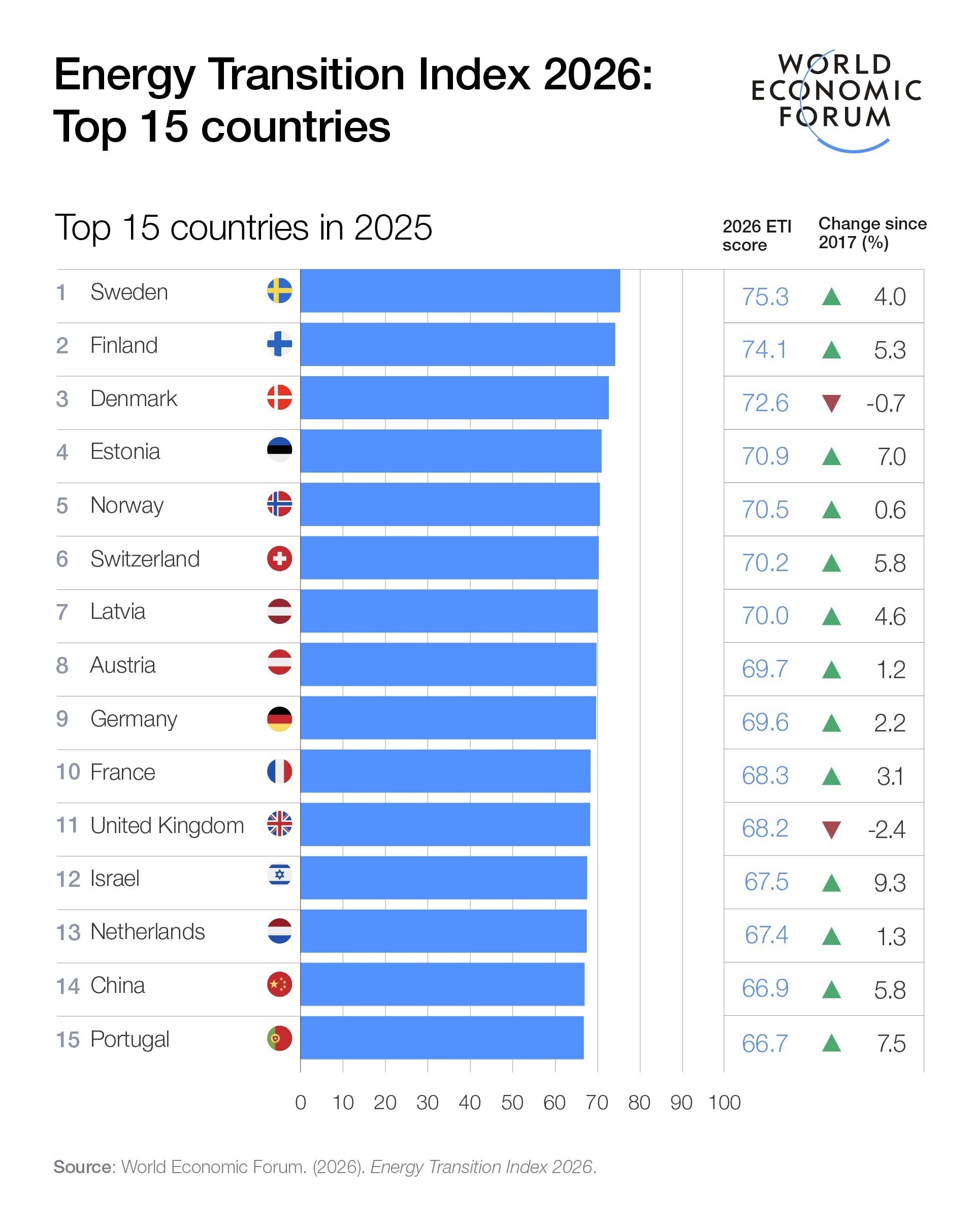
Nordic and advanced European economies continue to hold many of the top positions, with Sweden leading the Index, while large economies such as China, the US and Brazil remain central because of their impact on global demand, investment and emissions.
At the same time, the rankings point to a more fragmented transition landscape. Countries are progressing at different speeds, shaped by their exposure to imports, infrastructure readiness, investment conditions, policy frameworks and ability to manage supply and reliability risks.
In 2026, 56% of countries improved their ETI scores, but only 24% improved across security, sustainability and equity at the same time, from across different regions, income level, and starting points, suggesting that a balanced transition is not the preserve of any single type of economy. However, very few advanced across all five transition readiness parameters.
There isn't a single global energy transition. There are multiple transitions. Each country will find its own way to do it.
”
3. News in brief: More energy stories from around the world
US President Donald Trump has said that the Strait of Hormuz shipping channel would reopen under a deal to end the conflict with Iran. Experts have said that, once open, it could still take weeks or months for oil to fully flow. The disruption of oil and gas flows through the strait is reshaping energy markets across several dimensions.
Gulf countries that export oil through the Strait of Hormuz are discussing plans for pipelines that would allow them to bypass the waterway in the event it remains largely closed.
The Iran war is creating a "super squeeze" in markets for metals, including copper and aluminium, the Financial Times reports. Demand for the metals is rising, but higher diesel prices due to the conflict have hit supply by increasing the costs of operating mines.
Malaysian state energy firm Petronas will supply JERA, the biggest power generator in Japan, with 2 million tons of liquefied natural gas under a 20-year agreement set to begin in 2028.
Malaysia has also said it is looking for new fuel sources as energy disruption caused by the war in Iran continues. The country’s refineries are largely dependent on crude oil from the Middle East.
The European Union will mobilize up to €25 billion ($29 billion) to accelerate the development of renewable energy, hydrogen, clean technology manufacturing and modern electricity networks across the Mediterranean region, it has said.
The next phase of the energy transition will be led by electrification, the International Renewable Energy Agency has said in a new report. The transition must focus on electrifying transport, industry buildings and digitalization as demand rapidly increases, it says.
Development of geothermal power is rising as big technology companies, including Google, move to secure energy supplies for data centres, Reuters reports.
4. More on energy from Forum Stories
The US-Iran war could, in the long term, strengthen the case for cleaner, more secure energy systems – energy shocks remind policymakers that dependence on imported fossil fuels creates vulnerability, while local energy supply, including domestic renewables, provides resilience. And the countries best insulated from such shocks today put in the groundwork long before the current crisis hit.
With the push to phase out coal-fired power plants, particularly in emerging economies, artificial intelligence is set to reshape global energy production, helping grid operators predict demand and balance renewable supply in real time, speeding up clean energy deployment and more. But there are some persistent barriers to overcome.
Geopolitical volatility is exposing the structural vulnerabilities of fossil fuel-dependent economies. In Indonesia, where air pollution and rising fuel costs mean a more resilient energy ecosystem is needed, a new blueprint is being created, with EV infrastructure at its heart.
To learn more about the work of the Centre for Energy and Materials, contact Ella Yutong Lin: ellayutong.lin@weforum.org
License and Republishing
World Economic Forum articles may be republished in accordance with the Creative Commons Attribution-NonCommercial-NoDerivatives 4.0 International Public License, and in accordance with our Terms of Use.
The views expressed in this article are those of the author alone and not the World Economic Forum.

Forum Stories newsletter
Bringing you weekly curated insights and analysis on the global issues that matter.
More on Energy TransitionSee all

Cheukai Makari
September 16, 2026


