How faster permitting and policy certainty can increase energy security while cutting costs
Energy investment relies on faster permitting and greater policy certainty. Image: Getty Images/serts
- The accelerating pace and magnitude of geopolitical shifts have left many governments, industries and consumers facing rising energy costs.
- As countries attempt to diversify their supply options in response, global energy investment is expected to reach $3.4 trillion this year.
- But governments must re-examine permitting times and ensure policy stability to make the most of these expected energy investments.
The recent effective closure of the Strait of Hormuz has been characterised as more severe than the oil crisis of 1973, which caused prices to quadruple over a matter of months.
In response, energy importers and exporters, producers and consumers, are increasing the number of energy options available to them. This means diversifying supply routes and sources, and broadening energy technology choices. Several governments are also pivoting to nuclear power to secure large-scale, local sources of low-carbon electricity.
More options equals less dependence on any given fuel, supplier, supply chain, trade route or technology.
Decreasing import dependence is another way to limit exposure to similar crises in the future. It would drive increased interest in domestic resources, creating opportunities to bring energy production home.
Many countries and industries are also keen to bring manufacturing and supply chains – for everything from wind turbines to electrolysers – closer to home. Localizing them would boost security and resilience, job creation and competitiveness.
These actions are projected to drive global energy investment to a record $3.4 trillion in 2026, according to the International Energy Agency (IEA).
Energy investment: Time is money
But it will take time to construct these new energy supply sources, assets and the associated supply chains.
On average, it takes at least the same amount of time for permitting as for construction of virtually any type of energy project, according to the IEA. If a project requires an electrical grid connection, this doubles the time needed to get it up and running.
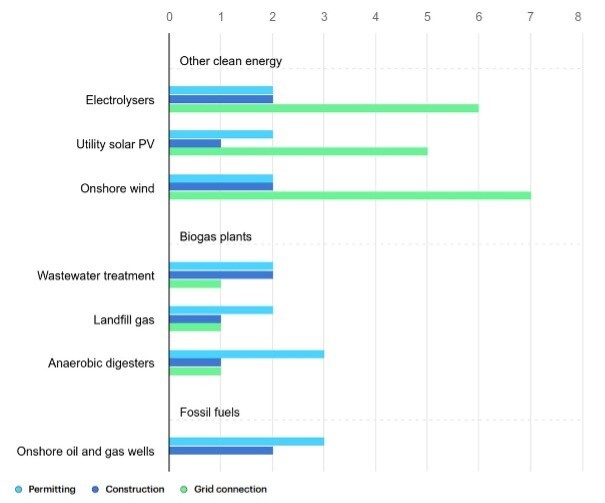
Longer permitting, approvals and grid connections increase costs and raise prices for consumers and taxpayers, through higher bills or taxes when projects are subsidized.
"Often, the most immediate way to unlock that speed is permitting," says Kivanc Zaimler, CEO of Sabanci Holding and Co-Chair of the World Economic Forum's Advanced Energy Solutions community. "It is not the hardest problem to solve, but it is often the most impactful. If we want to deliver at the scale and cost required, time cannot be an afterthought. We need to treat time as a design principle."
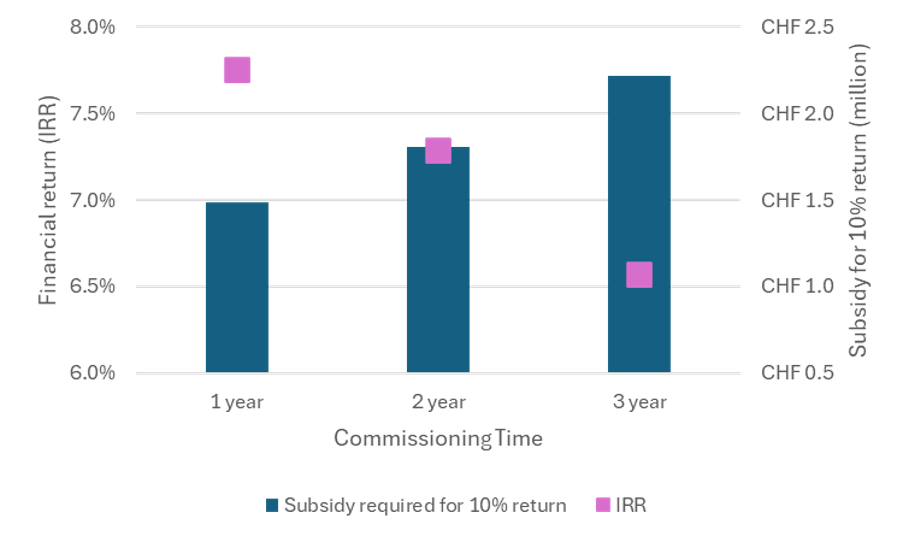
The internal rate of return (IRR) of an energy project varies greatly, depending on how long it takes to build, according to an analysis by academics at ETH Zurich. A hypothetical new project that costs CHF10 million and generates an annual return of CHF1 million over 20 years once constructed, will achieve 7.75% IRR if built within one year. If it takes two years the return drops to 7.3% and to 6.9% if it takes 3 years.
If these investments are subsidized, whether for energy security or decarbonization reasons, this will affect public budgets. To give an investor a return of 10%, the subsidy itself would cost the government 50% more for a project that takes three years to become operational instead of one. These higher prices will be passed on to the consumers – as taxes, if projects are subsidized, or as higher energy charges.
Türkiye is responding to this challenge with a recently introduced “super-permitting” framework. The initiative seeks to significantly reduce approval timelines by consolidating fragmented processes, increasing inter-agency coordination and creating a more predictable pathway for investors.
Energy policy uncertainty
Another barrier to attracting investment is that energy projects often need 10–15 year investment horizons, but policy often shifts because political cycles tend to be shorter. This makes investors and customers hesitant to commit capital due to a lack of confidence that today’s rules will remain stable.
From shifting national politics, trade and tariff barriers, and state interventions, to shifting energy policies, local content requirements and environmental rules, this makes a complex mix of interrelated, external factors. And these factors are largely beyond the control of individual organizations.
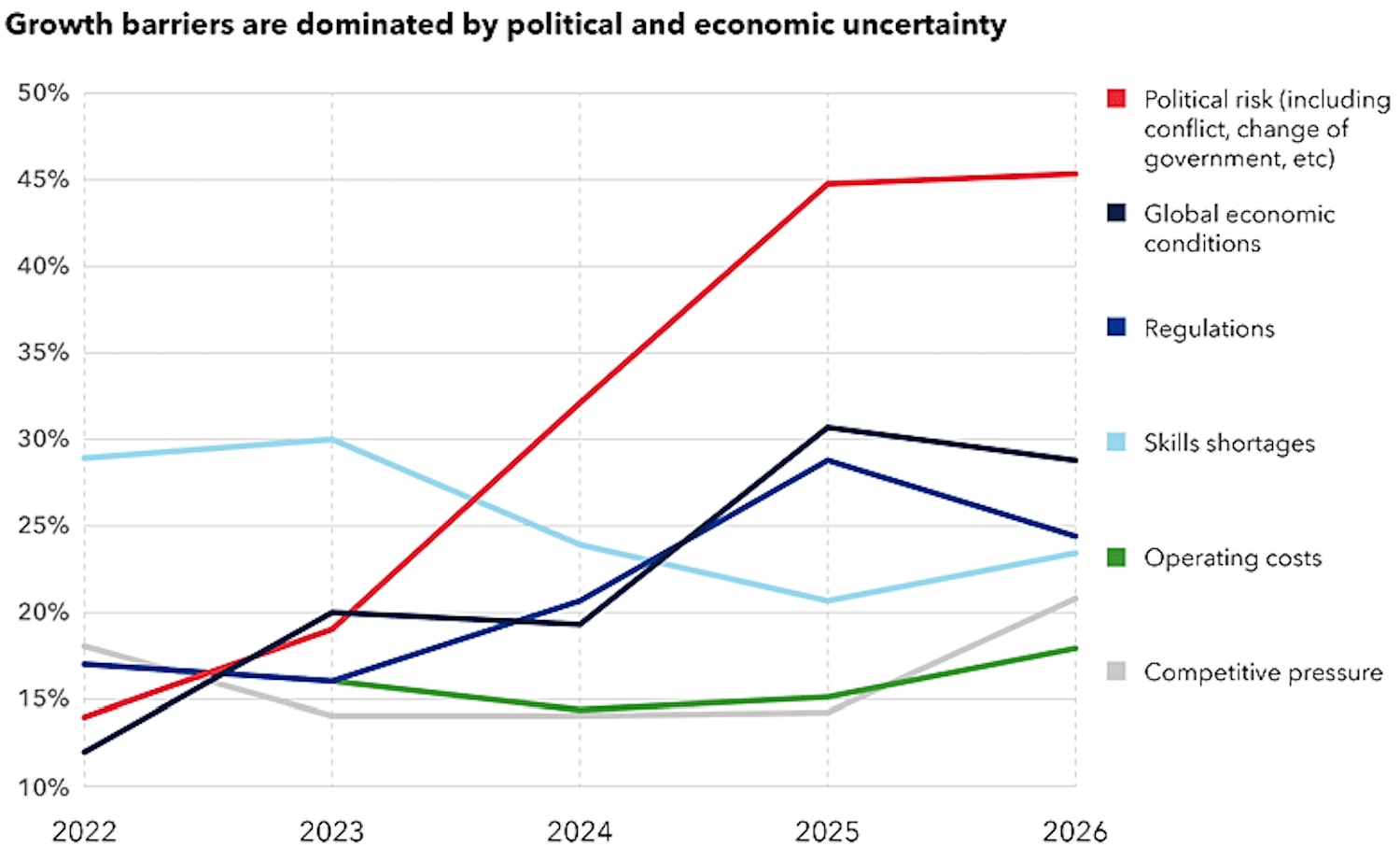
Indeed, political risk and regulations are the first and third greatest barriers to investment in the energy sector, according to a survey of more than 1,000 global energy leaders for DNV’s Energy Industry Insights 2026 report. That’s why balance and predictability are so important – the energy industry benefits from long periods of stability, prioritization and policy certainty.
However, transition readiness has recently declined for the first time in 10 years, according to the World Economic Forum's latest Energy Transition Index. Both finance and investment, and regulation and political commitment, have fallen – measuring -1.8% and -1.2% respectively in the 2026 index. Infrastructure readiness has also declined slightly (-0.2%) in 2026 – and this may continue to worsen because despite record capacity additions, grid investment is lagging, with more than 2,500 GW of projects worldwide currently stalled in connection queues.
Energy mandates and incentives
With this in mind, governments have two key policy levers that can help them pursue energy-related goals.
Mandates can be central to driving adoption by creating market signals. Incentives such as tax credits, subsidies and low-interest financing, reward the positive impact beyond “electrons and molecules”, and improve the financial viability of investment projects.
But, while often necessary in the initial phase, incentives and subsidies merely shift the cost from consumer to taxpayer. They are unlikely to decrease the overall economic cost of development and deployment of energy solutions.
Instead, in the times of budget constraints, increasing the speed of permitting, approval and regulatory processes can significantly reduce the need for incentives for energy producers, and could also cut costs for energy consumers.
Taking action on energy investment
As the response to the COVID-19 pandemic demonstrated, systems can move faster when there is urgency. The energy transition could also accelerate with the right impetus.
Meanwhile, businesses cannot – and are not – waiting for perfect policy clarity. Many are already adapting through new models, diversification and innovation. These companies are often progressing despite uncertainty. They also realise that no single technology will solve the energy crisis on its own. It will take a mix of solutions, including nuclear, renewables, energy storage and clean fuels.
Governments will take different paths at different speeds. But ensuring a durable and inclusive transformation requires alignment between ambition, finance and delivery. This must be guided by market signals, grounded in local realities and supported by international cooperation.
Don't miss any update on this topic
Create a free account and access your personalized content collection with our latest publications and analyses.
License and Republishing
World Economic Forum articles may be republished in accordance with the Creative Commons Attribution-NonCommercial-NoDerivatives 4.0 International Public License, and in accordance with our Terms of Use.
The views expressed in this article are those of the author alone and not the World Economic Forum.
Stay up to date:
Energy Infrastructure
Related topics:

Forum Stories newsletter
Bringing you weekly curated insights and analysis on the global issues that matter.
More on Energy TransitionSee all

Anders Johannes Enghild, Juan Llobell and Pelayo Gonzalez Escalada Mena
October 7, 2026


