Why initiatives to tackle non-communicable diseases stall and how local coalitions can help

Tackling NCDs means organizing action locally around the places where disease risk accumulates and where prevention either succeeds or fails. Image: Getty Images/zeljkosantrac
- Non-communicable diseases (NCDs) are the leading cause of death globally – responsible for at least 43 million deaths in 2021, according to the latest World Health Organization (WHO) figures.
- Local place-based initiatives could help, but they must be structured sustainably, visible enough for learning and connected so that they can inform broader system change.
- How promising ideas become scalable impact is a key focus at the World Economic Forum’s Annual Meeting of the New Champions, also known as 'Summer Davos', in China from 23–25 June.
Non-communicable diseases (NCDs) such as cancer, diabetes and respiratory and cardiovascular conditions are shaped as much by place as by medicine. Where people live, work, learn and move influences exposure, access to prevention and the ability of systems to identify risk early and respond effectively.
This matters because NCDs remain the leading cause of death globally, according to 2025 figures from the World Health Organization (WHO). In 2021, they accounted for at least 43 million deaths, equivalent to 75% of all non-pandemic-related deaths worldwide. Around 18 million of those deaths occurred before age 70, and 82% of premature NCD deaths occur in low- and middle-income countries.
The problem is not only clinical. Much of the NCD burden is driven by factors outside healthcare, such as food, housing, transport, education, employment, air quality, social infrastructure and access to community-based support.
These non-medical drivers shape whether people can prevent disease, manage risk and stay engaged with care over time.
Saving millions of lives
The case for action is strong. WHO’s recent investment case shows that full implementation of cost-effective NCD measures could save 12 million lives by 2030, prevent 28 million heart attacks and strokes, and generate more than $1 trillion in economic benefits.
Implementation is challenging, however. Health systems increasingly recognise the importance of prevention and the wider drivers of health, but delivery often remains fragmented across institutions, funding streams and sectors. Communities experience risk as one interconnected reality, while systems often respond through disconnected programmes.
This is why place-based change matters. It's not simply a framing for collaboration, it's a practical mechanism for addressing up to 80% of health outcomes. These outcomes stem from non-medical drivers of health that reflect the real experiences of places and communities.
By organizing around a defined geography, population and problem, place-based approaches make it easier for health and non-health partners to work around a shared goal – connecting prevention, care, community trust, delivery infrastructure and public-system support.
Local coalitions to tackle NCDs
In addition to the 2024 World Economic Forum white paper, Closing Health Gaps: A Guide to Impactful Place-Based Change, a Deloitte report, Building coalitions for better health: Advancing place-based change in communities, translates broad principles into a practical action guide. This could help leaders seeking to build coalitions for NCD prevention, early detection and long-term condition management.
The report’s central argument is that place-based coalitions can act as the integration layer between strategy and delivery by aligning actors, capabilities and resources around one place, one population and one set of outcomes.
At the heart of the report is a five-step guide for building effective place-based coalitions.
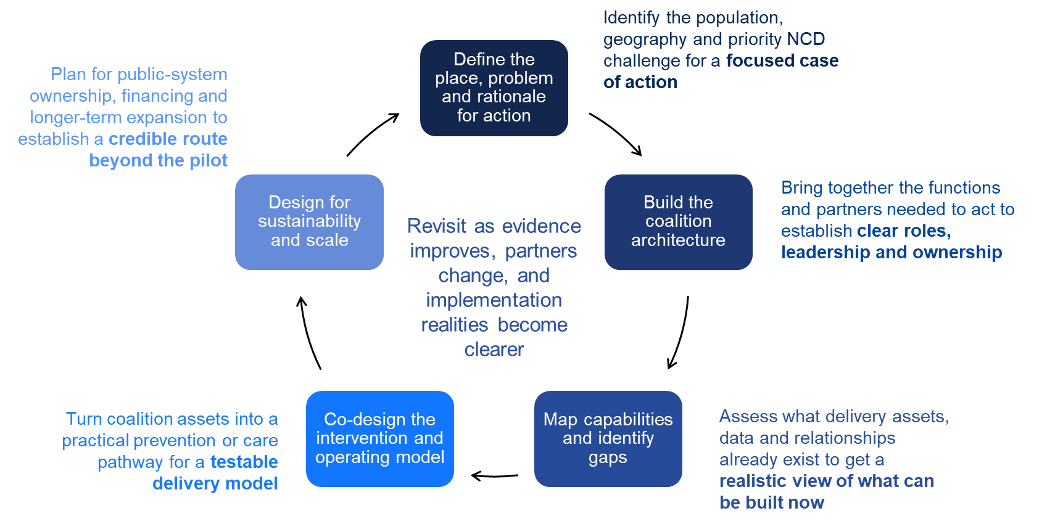
This process asks leaders to define the place and problem clearly, build the right coalition architecture, map capabilities honestly, co-design an intervention and operating model, and plan for sustainability and scale from the outset.
The message is simple: Effective coalitions do not emerge through goodwill alone, they are built through a series of practical design choices.
And this is an iterative cycle rather than a one-way sequence. Leaders often need to revisit earlier decisions as evidence improves, partners change and implementation realities become clearer. This is especially true in NCD work, where prevention, early detection, treatment, follow-up and wider determinants often cut across multiple institutions.
The report is also grounded in practice. It includes real-world case studies from Brazil and Nigeria, which illustrate two different routes into coalition-building – one building on existing infrastructure and one building on a clearly defined delivery problem. Across both cases, the coalitions draw on different combinations of government, public health and care delivery actors, community-based organizations, philanthropical and private sector partners to build more coordinated local responses.
Rather than laying out a single model to copy, this shows how coalition design choices play out in real settings and why initial conditions matter.
Tracking local NCD programmes
The report also draws on a broader evidence base through a review of more than 150 place-based health programmes, which are also captured in a new programme database called the Health For All Initiative – Place-Based Change Programme Explorer. This will make the field more visible and more learnable by mapping programmes by geography, NCD focus, intervention type, leading anchor organization and sector.
Looking through the database, a few patterns stand out. Firstly, place-based health action is no longer niche, with programmes being implemented across regions, sectors and institutional settings. The database also shows that NCDs are a major focus of this landscape, including cardiometabolic health, obesity, respiratory disease, cancer, mental health and wider prevention agendas.
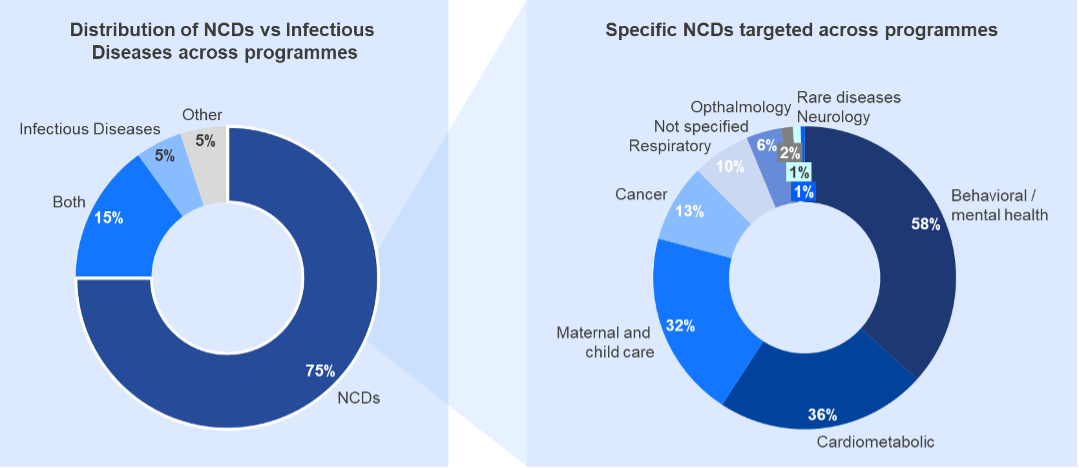
Finally, many initiatives are clearer on ambition than on operating model, financing and long-term sustainability. This matters because the next phase of progress on tackling NCDs is about making local initiatives more coordinated, more evidence-based and more likely to endure
From commitment to coordinated delivery
The report and the database are designed to work together. The report provides the practical design guide to what leaders need to get right if place-based coalitions are to deliver. The database provides the wider field view of where these programmes are emerging, how they are being structured and what kinds of models are taking shape across contexts.
The adoption of the 2025 UN political declaration on NCDs and mental health reinforces the need to accelerate prevention, strengthen health systems and mobilise whole-of-government and whole-of-society responses.
The challenge now is to move from commitment to coordinated local delivery. If NCDs are shaped by place, then implementation must be organized by place too.
Deloitte's Elizabeth Hampson, UK Life Sciences and Health Innovation Partner, and David Rabinowitz, US Consulting Principal, also contributed to this article.
The Forum is spotlighting how innovation moves from breakthrough to scale to impact ahead of 'Summer Davos' in China, 23–25 June 2026. Follow the latest.
Don't miss any update on this topic
Create a free account and access your personalized content collection with our latest publications and analyses.
License and Republishing
World Economic Forum articles may be republished in accordance with the Creative Commons Attribution-NonCommercial-NoDerivatives 4.0 International Public License, and in accordance with our Terms of Use.
The views expressed in this article are those of the author alone and not the World Economic Forum.
Stay up to date:
Global Health
Related topics:


Forum Stories newsletter
Bringing you weekly curated insights and analysis on the global issues that matter.
More on Health and Healthcare SystemsSee all

Daniel Mora Brito and Lora du Moulin
September 21, 2026