The Middle Corridor: a new China-Europe route for greater global trade resilience
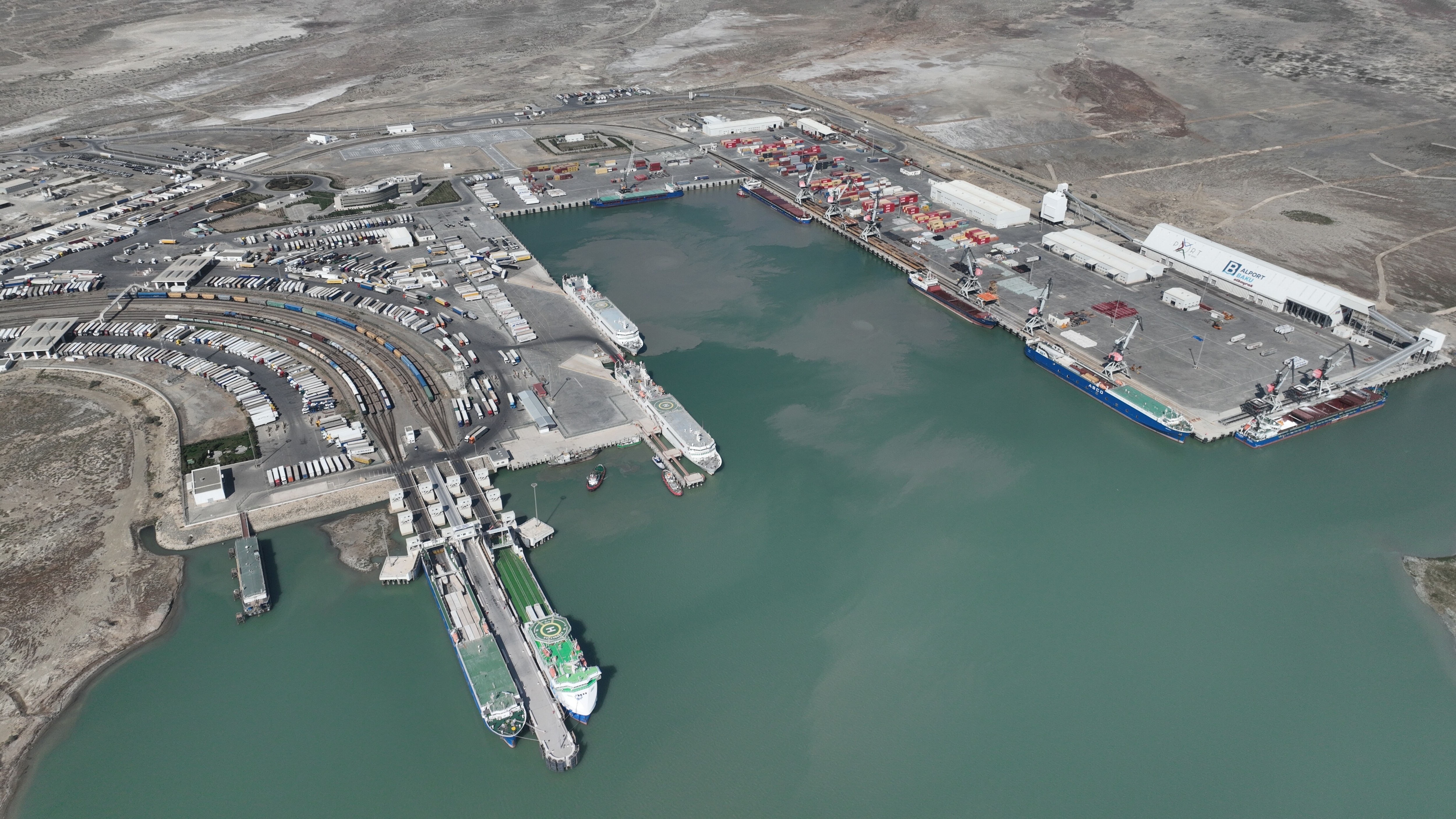
A Middle Corridor hub … the port at Azerbaijani capital, Baku. Image: Baku International Sea Trade Port
- Linking China and Europe via the Caucasus, the Middle Corridor trade route is gaining in geopolitical and economic importance.
- Not only does it reduce freight transport times compared to sea routes, it is also proving an indispensable conduit for energy flows.
- Beyond transit revenues, the Middle Corridor creates significant physical and digital infrastructure opportunities.
As geopolitical tensions, sanctions and shipping disruptions make the world’s traditional trade routes look increasingly fragile, governments and businesses have started seeking alternatives. One of them has gained significant attention: the Middle Corridor, the land-and-sea trade route connecting China to Europe via Central Asia, the Caspian Sea and the Caucasus.
The Middle Corridor has demonstrated its effectiveness as an alternative to other transport corridors. Its growing utilization reflects its ability to ensure the continuity of
trade flows amid geopolitical and logistical challenges affecting other routes. By
strengthening transport connections and diversifying transport options between Asia
and Europe, the corridor has enhanced the resilience of regional and global supply
chains. As it gains in strategic importance, the countries along the route are accelerating investments in infrastructure and logistics capacity to accommodate growing demand.
What makes the Middle Corridor more than just another trade route is that it is becoming a strategic artery for both trade and energy flows. The same geography that moves containers from China to Europe also moves oil, gas and increasingly electricity from the Caspian region to European markets. That dual role is what gives the corridor its strategic weight.
Azerbaijan’s strategic position
The corridor’s appeal is partly speed. Goods moving from China to Europe overland through the Middle Corridor can arrive in roughly two to three weeks, as opposed to a month and a half sea voyage. But its deeper value is resilience: It provides Europe and Asia with an additional trade route that enhances flexibility and offers diversified transport options.
Azerbaijan is a useful case study in how a country positions itself along such a route. Sitting on the western shore of the Caspian Sea at the crossroads of Europe and Asia, it occupies a stretch of the corridor that trade and energy flows must cross. Since independence, it has invested heavily in railways, ports and pipelines to turn that geography into leverage – joining early regional transport initiatives and building links such as the Baku-Tbilisi-Kars railway, which since 2017 has connected the Caspian region to the European rail network through Georgia and Türkiye.
The same logic shaped the development of its energy infrastructure. The Baku-Tbilisi-Ceyhan oil pipeline and, more recently, the Southern Gas Corridor carry Caspian hydrocarbons to Western markets, bypassing traditional transit routes. Azerbaijani gas now reaches 16 countries, 10 of them in the EU, and deliveries to Europe in 2025 were roughly 60% higher than in 2021. The point is not the engineering; it is that the same corridor carrying containers westward is also rewiring where Europe gets its energy.
The next pieces: South Caucasus and green energy
The corridor is further evolving, and the most consequential development is a new connection through the South Caucasus. A developing peace agenda in the region is helping to advance plans for a new route, called TRIPP, that will connect the main part of Azerbaijan with its autonomous enclave, the Nakhchivan Autonomous Republic, through Armenia, stretching onwards via Türkiye to Europe.
This connection would become a part of the broader Middle Corridor, further strengthening regional linkages and enhancing route diversification and connectivity across the network. Why it matters is straightforward: Today, goods crossing Azerbaijan toward Europe funnel through a single path via Georgia. The second route adds capacity and removes a bottleneck; because it is designed to carry energy and electricity alongside freight, it would reinforce the corridor’s dual trade and energy character.
The corridor is also becoming a conduit for green energy. Alongside oil and gas, the region is developing renewable power and the long-distance cables to export it, including projects to carry Caspian electricity toward Europe. This extends the same idea that defines the Middle Corridor: a single strategic axis that can move goods, fuel and increasingly clean power between two continents.
Beyond transport
The Middle Corridor is increasingly contributing to economic integration and industrial development across the wider Caspian region. Beyond transit revenues, the corridor creates opportunities for logistics services, warehousing, customs operations, industrial production and cross-border investment. The development of ports, railways and logistics infrastructure is also expected to generate significant employment opportunities while supporting broader economic diversification.
For countries historically dependent on raw material exports, the corridor provides opportunities to strengthen integration into global value chains and develop higher value-added sectors. The corridor is also creating new opportunities for economic cooperation by improving connectivity between industrial zones, logistics hubs and transport infrastructure.
Increasingly, the corridor’s competitiveness rests on more than physical track and port capacity. Moving freight quickly across half a dozen borders requires digital plumbing: automated customs, shared freight-management systems, real-time cargo tracking. So the countries along the route have been investing in this, including a planned fibre-optic link across the Caspian and broader “digital Silk Road” efforts to connect European and Asian networks.
How the Forum helps leaders make sense of regional, trade and geopolitical shifts
The Middle Corridor’s rise is less about any one pipeline, port or railway than about what they add up to. In a decade when the reliability of global trade routes can no longer be taken for granted, the corridor offers something genuinely scarce: a diversified, multi-use path between Asia and Europe that does not hinge on a single choke point. That is why a route once considered as an alternative now commands the attention of governments, investors and other international actors.
Don't miss any update on this topic
Create a free account and access your personalized content collection with our latest publications and analyses.
License and Republishing
World Economic Forum articles may be republished in accordance with the Creative Commons Attribution-NonCommercial-NoDerivatives 4.0 International Public License, and in accordance with our Terms of Use.
The views expressed in this article are those of the author alone and not the World Economic Forum.
Stay up to date:
Middle East and North Africa


Forum Stories newsletter
Bringing you weekly curated insights and analysis on the global issues that matter.