The climate finance framework overlooks the services that underpin the decarbonization economy.
Climate finance services such as micro-insurance and micro-banking strengthen the capability, accessibility and inclusiveness of climate finance.
A recent assessment in South Africa shows how trade-in-services policy and regulation affect inclusive access to the financing necessary for climate development.
The decarbonization economy is underwritten by services: for circularity, technology adoption, carbon accounting, monitoring, climate data analytics, loss and damage recovery, and climate finance.
Services are seemingly everywhere – but yet, nowhere in the implementation of the Paris Climate Agreement. Article 6 establishes the framework for international carbon markets, but its implementation remains incomplete without commensurate services trade and the regulatory frameworks needed to underpin climate finance and carbon market transactions.
Discussions about climate finance tend to overlook the role that services trade policy can play in enabling the climate finance services that support the climate transition, and the structural transformation of developing countries. According to UNEP's Adaptation Gap Report 2024, developing countries face an adaptation finance gap estimated at between $187 billion and $359 billion annually, highlighting the need for more effective and accessible climate finance services.
The lack of recognition for climate finance as a service matters, because it blocks meaningful, durable, cross-cutting and multilateral solution-building. The UNFCCC’s Work Programme on climate finance, which facilitates negotiations to scale up financial flows, does not include a trade-in-services perspective (such as the exchange of financial services across borders, as covered under the WTO’s General Agreement on Trade in Services) This comes despite the role that services play in strengthening the capability, accessibility and inclusiveness of climate finance.
Micro-insurance, mobile banking and credit services are crucial for channelling climate capital to vulnerable populations. They transform macro-level climate funds into localized resilience solutions, lower transaction costs for green investments and empower individuals to manage environmental risks. Climate finance flows nationally, regionally and globally through services and a network of enabling regulations. Capital is mobilized by banking, insurance, advisory and digital services, and constraints in these areas affect how finance is delivered and accessed.
This year, the World Economic Forum's Streamlining Services Initiative supported South Africa's Department of Trade, Industry and Competition in examining how climate finance services regulation operates in practice and how these services can be made easier to supply, scale and trade across borders. The assessment not only identified decarbonization barriers embedded in climate finance services regulation, but also reframed climate finance through a trade-in-services lens.
This interconnection between climate policy and services trade policy revealed the structural relevance of services economy and trade for pursuing climate action and realizing an inclusive transition. It helped show where our trade-in-services policy must be adjusted to be effective, impactful and interoperable across the WTO, UNFCCC and AfCFTA. And that a diversified services economy can support the de-risking of climate finance by enabling access to the specialized knowledge, skills and services needed to execute green projects, build investor confidence and minimize commercial and regulatory exposure.
Climate finance as a service should be a shared opportunity. It can support green industrialization aspirations at home, in the region and across the continent. Inclusive trade in climate-finance services can support the wider continent’s green transition, climate resilience and industrial readiness. This is where much of the value of climate finance lies, in facilitating capability and access to services that enable countries to finance and deliver their own transition. Climate finance is a tradable and investable services sector. Banks and other non-banking financial institutions, including fintechs and mobile money providers, are key to improving accessibility to this type of investment.

The assessment showed that many barriers are not formal market-access restrictions, but implementation challenges linked to fragmentation, duplication, unclear processes and limited regulatory coordination. In terms of the spectrum of South African climate finance services – including licensing, payments, data and cross-border rules – friction often appears where these systems intersect. This can impede interconnectivity and trade capability in such services. It also helped us understand how regulations, especially their administration in one sector, can indirectly affect other sectors, creating compliance friction, lock-ins and technical bottlenecks.
Making finance flows consistent with the pathways towards low greenhouse gas emissions and climate-resilient development requires deeper transformation and participation of developing-country service firms and MSMEs in the climate finance value chains. Provisions in the AfCFTA Regulatory Framework for Financial Services pursues this by establishing financial sector development and cooperation among AfCFTA parties, including an agreement to remove regulatory impediments and the development of common regulatory approaches to climate finance to boost services trade and opportunities for investment in Africa.
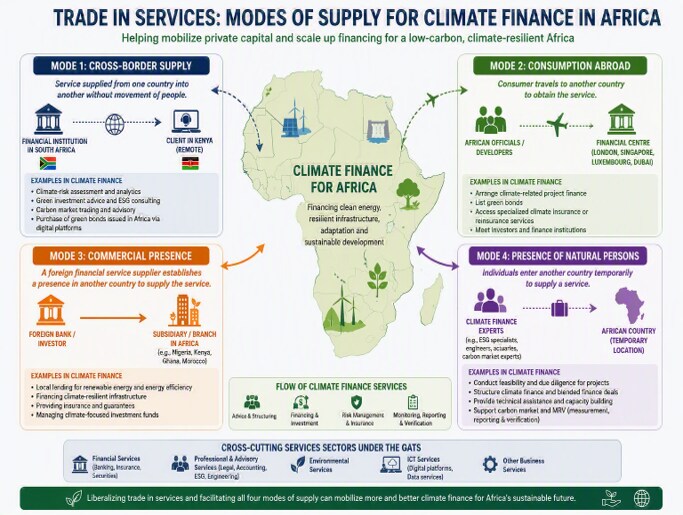
Given the limitations of existing multilateral climate finance arrangements, it is important to identify policy interventions that enable trade in services to close the climate finance gap – which continues to constrain countries’ ability to implement their climate action plans and nationally determined contributions.
Climate-finance services interact simultaneously with multiple regulatory systems, including financial supervision, exchange control, payments regulation, data governance, environmental regulation and sector-specific frameworks. Because these systems govern how climate finance is structured, transferred, verified and reported, building national and regional capability in climate finance services is essential for turning climate commitments into implementable projects and pathways.
For African countries, strengthening this capability is especially important. That's because the energy transition will only scale up if countries can mobilize, adapt and deliver finance through services systems that are fit for local needs, while remaining connected to regional and global markets.
Diversifying and deepening African countries’ participation in financial services trade can help realise the bottom-up nature of the Paris Agreement, by ensuring that efforts to make finance flows consistent with a pathway towards low greenhouse gas emissions and climate-resilient development are nationally determined.
That could enable country-driven decarbonization and services strategies that produce and mutually support enhancements and benefits that deliver effective climate finance.