AI data centres are generating their own power. How does that affect the wider grid?
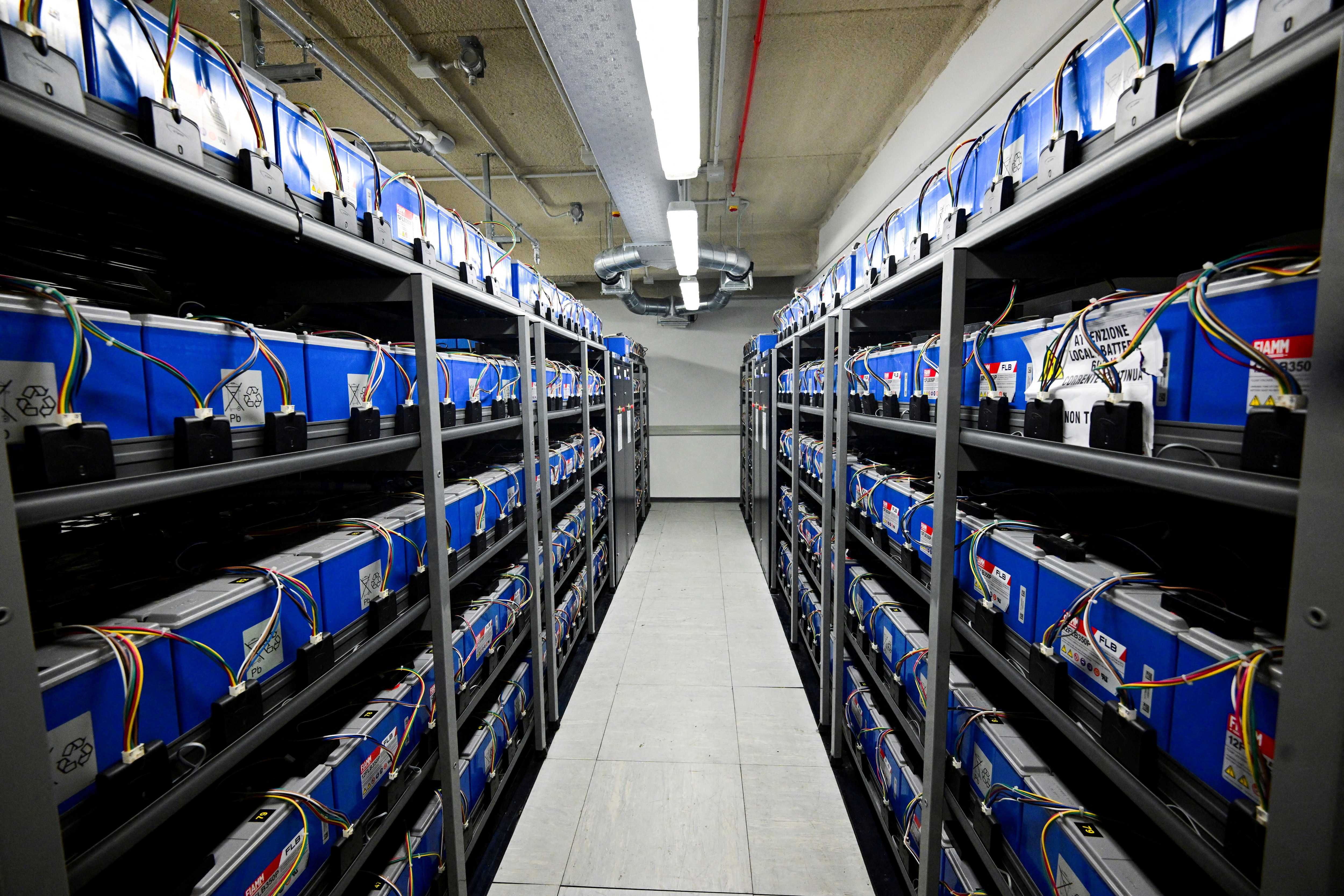
Battery backup systems inside a data centre in Milan, Italy. Image: Reuters/Daniele Mascolo/File Photo
- AI developers are increasingly pursuing dedicated on-site or adjacent power supplies for data-centre campuses.
- Self-supply can relieve local interconnection and grid-capacity constraints, but it may shift costs, reliability obligations and bottlenecks elsewhere.
- The emerging policy challenge is to define the terms of connection, such as who pays for shared network capacity, and what flexibility large users should provide.
With the IEA expecting global data-centre electricity demand to roughly double from 485 terawatt-hours in 2025 to around 950 by 2030, a growing number of AI campuses are exploring how much of their power needs should sit on their side of the grid connection. For most of the past century, that connection marked where a customer’s responsibility ended and a utility’s began. It is now becoming a design choice, with more settings than simply on or off: temporary bridging supply, partial self-supply, or full independence.
One sign of this shift came on 2 September, when Vertiv agreed to acquire UtilityInnovation Group (UIG) for roughly $1.45 billion in cash, with up to $1.15 billion more tied to earnings targets. UIG provides microgrid controls, on-site generation and storage orchestration, and microgrid switchgear that help data centres integrate their own power supply with grid connections. Vertiv’s traditional portfolio largely covered infrastructure between the grid connection and the computing equipment. It describes the acquisition as extending that reach further upstream, creating what it calls a “grid-to-chip” portfolio.
Self-supply is not the same as leaving the grid
Going off-grid can mean different things. Physical islanding is not new: hospitals and industrial facilities have used on-site generation for decades. Commercial self-supply is also familiar, with large users generating or storing some of their own electricity while remaining connected to the wider system.
For AI data centres, that distinction matters. A campus may supply much of its own electricity without becoming fully independent of the grid. It may still rely on the grid for back-up, balancing, emergency support or periods when on-site generation is unavailable.
The key question is therefore not simply who owns the generation, but what relationship remains between the data centre and the wider power system. Self-supply, in other words, does not have to mean leaving the system.
Bypassing the grid has a queue of its own
The main argument for building your own power supply can be faster than waiting for a grid connection. But leaving the interconnection queue does not eliminate the wait.
GE Vernova ended the second quarter of 2026 with 116 GW of gas-turbine backlog and slot reservations and is already taking reservations for 2031 deliveries. Siemens Energy's gas-turbine backlog has reached 69 GW, with lead times of three years or more, while Mitsubishi has a 35 GW large-frame turbine backlog. Together, the three companies control about two-thirds of global gas-turbine manufacturing capacity. Bringing your own power may ease one constraint, but it creates another: the queue for generation equipment.
The costs of the shared grid do not disappear
Self-supply creates another question: Who pays for the grid that remains? A campus that never connects does not necessarily impose costs on other customers. The problem arises when networks have already invested for expected demand, or when a large customer still relies on the grid for backup and reliability while buying less electricity from it.
Unless market rules reflect that continued reliance, some fixed network and reliability costs could shift to other consumers.
That concern is already shaping regulation. In December 2025, the US Federal Energy Regulatory Commission directed the country’s largest grid operator PJM to rewrite its rules for large loads co-located with generation, including new transmission-service arrangements intended to reflect actual grid use while protecting other customers from unjustified cost shifts.
In July 2026, Texas regulators ruled that a data centre sharing a grid connection with a power plant may have to shut down during an emergency, allowing the plant’s full available output to flow to the grid.
Bringing your own power, in other words, does not necessarily mean leaving behind the costs or obligations of the shared system.
The emerging answer is a conditional connection
The more promising response is not to resist self-supply, but to define the terms on which large loads remain connected to the wider system.
Ireland has adopted a notably stringent approach. Under a policy issued in December 2025, new data centres must provide on-site or nearby generation and/or storage equal to their requested maximum import capacity, with this generation participating in the wholesale electricity market. They must also meet at least 80% of annual demand through additional renewable generation in Ireland. The principle is straightforward: Bring your own power capacity, but make it available to support the wider electricity system.
The EU is moving in a similar direction. Its European Grids Package and associated guidance encourage “first-ready, first-served” connection queues and flexible connection agreements, which can allow projects – including large electricity users – to connect sooner in return for limits on grid use when networks are constrained.
This demand-side flexibility could be valuable. Duke University researchers estimate that US power systems could accommodate 76 GW of additional large loads if those customers were willing to reduce demand by just 0.25% of annual electricity use on average. Batteries and on-site generation built for data-centre reliability could therefore also help relieve pressure on the wider grid.
Questions for the future of electricity
None of this argues for blocking private power. Grid expansion and connection reform have not kept pace with the new demand in many markets, and asking a multibillion-dollar investment to wait years for electricity is not a solution either.
Who pays for the grid capacity that self-supplying campuses still rely on when their own plants are down? What new power should a campus be required to add – and how should regulators ensure that supply is genuinely additional, low-carbon and reliable? And what flexibility or reliability services should it provide in return for grid access?
These questions matter well beyond the United States and Europe. India’s 2026-27 budget proposed a tax holiday through 2047 for eligible foreign companies providing global cloud services using India-based data-centre services, while Indonesia is actively courting data-centre investment alongside a major expansion of renewable power. As emerging markets compete for AI infrastructure, they still have an opportunity to establish clear rules on grid-upgrade cost-sharing, additional low-carbon power and demand flexibility before gigawatt-scale loads become locked in.
How the Forum helps leaders make sense of AI and collaborate on responsible innovation
The grid is more than a machine for moving electrons. It is a shared system of costs, responsibilities and reliability. As AI campuses bring their own power, the question is not whether they are on or off the grid, but what they owe it when they still depend on it.
Don't miss any update on this topic
Create a free account and access your personalized content collection with our latest publications and analyses.
License and Republishing
World Economic Forum articles may be republished in accordance with the Creative Commons Attribution-NonCommercial-NoDerivatives 4.0 International Public License, and in accordance with our Terms of Use.
The views expressed in this article are those of the author alone and not the World Economic Forum.
Stay up to date:
AI and Energy Use
Related topics:

Forum Stories newsletter
Bringing you weekly curated insights and analysis on the global issues that matter.
More on Artificial IntelligenceSee all

E. Richard Gold
September 30, 2026


