Throwaway economics: Can AI monetize our waste?
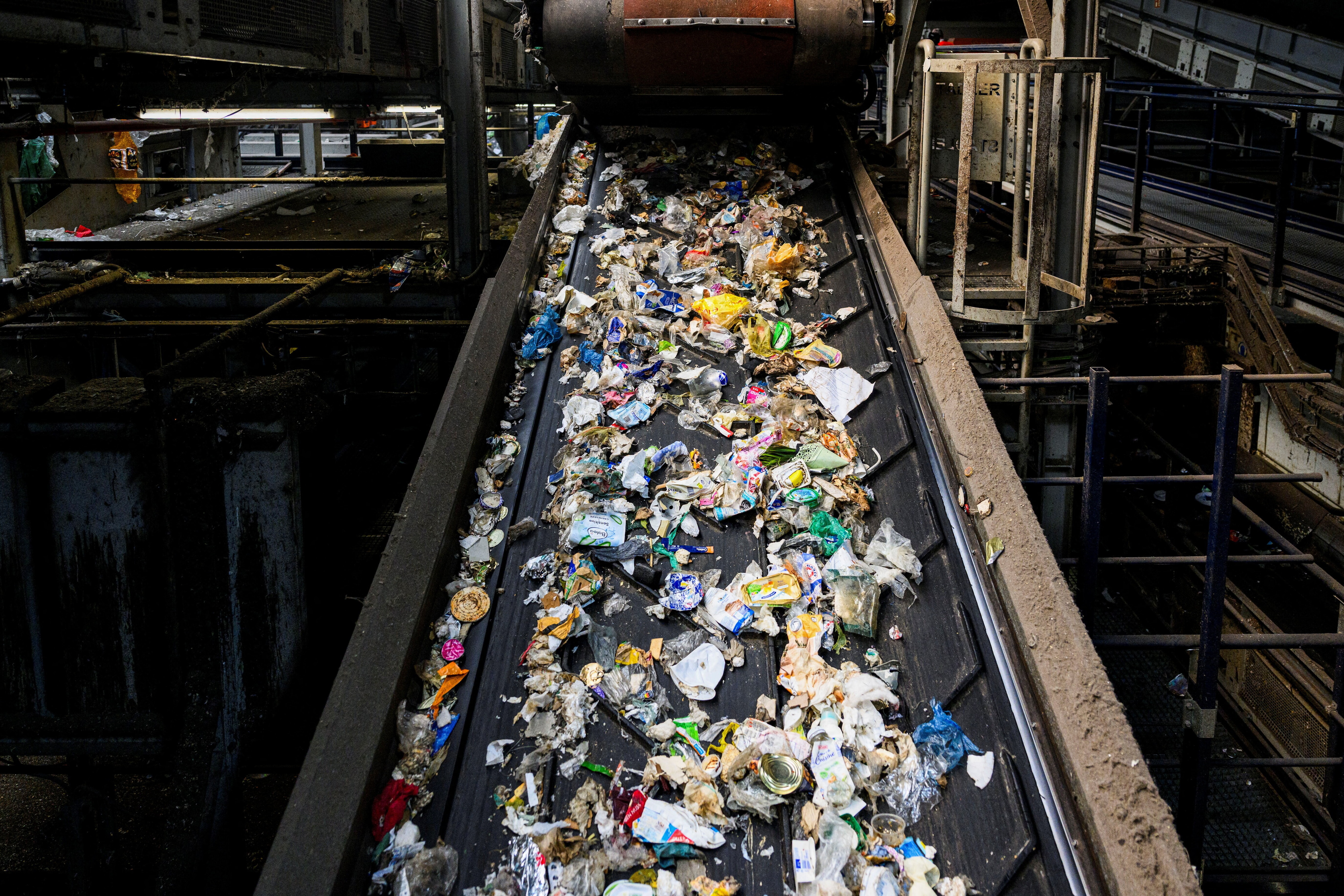
A circular economy could generate $4.5 trillion in additional economic output by 2030. Image: Reuters/Jana Rodenbusch
- One of the nature-positive, return-generating investment opportunities that could contribute to a circular economy, AI-enabled waste sorting is ready to scale.
- From bin-level sensors to molecular-level scanners, AI is now embedded across the entire waste chain.
- Each stage draws on different capital, from start-up equity to municipal bonds, but nearly all of it hinges on long-term offtake agreements.
Every day, the average person generates roughly 0.88 kilograms of waste. In the United States and Canada, it’s more than double that, with daily rates running above 2.2kg. Only around 9% of the world's plastic waste is recycled, and only 8% of textile fibres in 2023 were made from recycled sources; the rest is landfilled, incinerated or lost to the environment.
On the other side of this loss sits an economic opportunity: Accenture has estimated the transition away from linear “take-make-waste” to a circular system could generate $4.5 trillion in additional economic output by 2030, rising to $25 trillion by 2050.
That gap between what's currently lost and what could be recovered is addressed in the World Economic Forum's 50 Investible Opportunities for a New Nature Economy report, which argues that nature loss is an environmental cost as well as potential economic value that businesses and investors can capture while supporting sustainability.
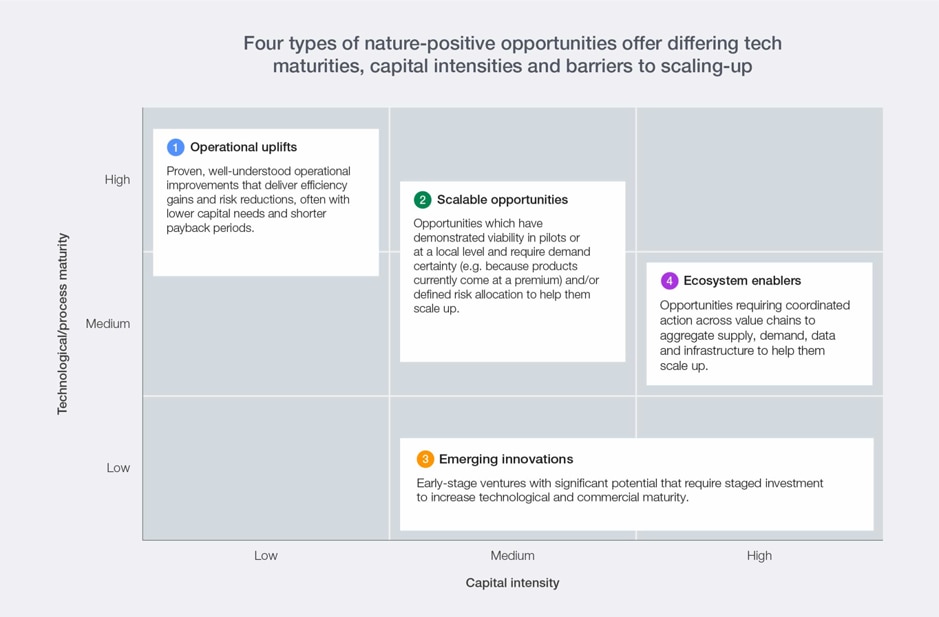
The report outlines 50 already investible nature-positive business activities across 13 sectors, categorized by technical readiness and financial maturity. To demonstrate how in-value chain business operations that contribute to nature-positive goals can also be return-generating and investible, here we examine one of the activities detailed in the report: AI-enabled (plastic) waste sorting,
Advanced and AI-enabled waste sorting
Advanced and AI-enhanced plastic sorting in the chemicals, plastics and circular materials sector is identified as a ready-to-scale opportunity: The underlying technology is mature, the financing instruments already exist, and demand for it is guided by regulatory requirements and geopolitical dynamics.
Recycling facilities have historically depended on workers sorting recyclables off a moving conveyor belt by hand, at roughly 30 to 40 picks a minute, with inconsistent accuracy, in a job known for high turnover and health hazards. Computer-vision systems are transforming this environment by removing humans from high-risk conditions and augmenting these jobs to be more efficient, rather than displacing labour altogether. Companies, including Greyparrot, AMP Robotics and TOMRA, use cameras and machine learning to characterize waste at up to 98% accuracy, directing robotic arms and optical sorters that pick 80 or more items a minute.
AI-powered sortation can automate material identification, improve sorting accuracy, reduce labour costs and maximize resource recovery as waste volumes and diversity grow. However, its effectiveness depends on the maturity of the country’s waste management system. These technologies are most effective where core infrastructure, including collection, aggregation and basic sorting, is already in place. Where these foundations are still developing, strengthening the system must come first.
—Jean-Loup Masson, Chief Advisor, Circular Solutions Center, Alliance to End Plastic Waste”Where AI fits along the waste chain
Waste moves through five distinct stages: from bin to collection truck, materials recovery facility, reprocessor, and then back to a consumer brand or packaging providers as usable feedstock. AI tools now sit at several points along that value chain, each solving a different part of the problem while also connecting the upstream and downstream outcomes to make smarter decisions.
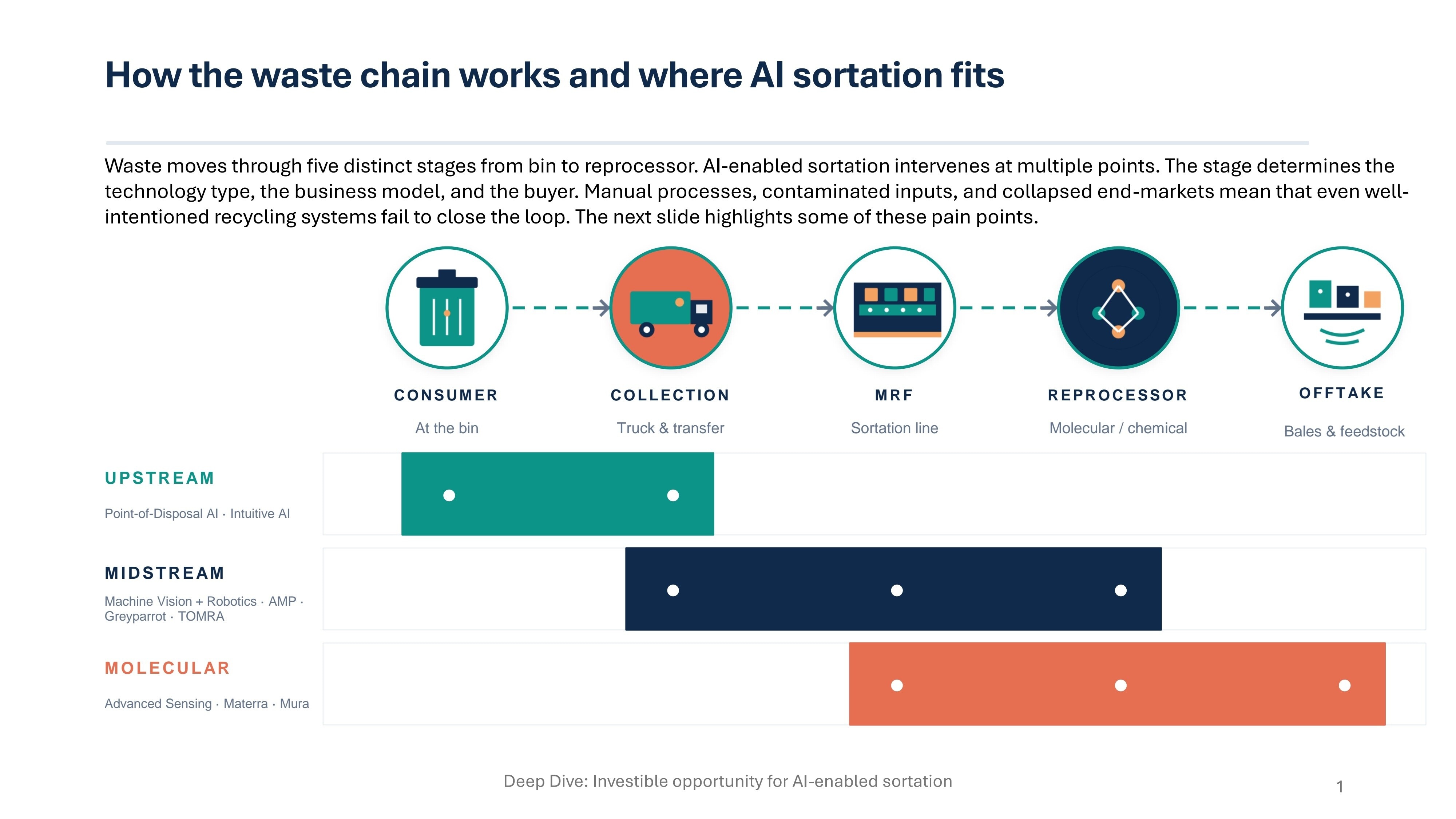
At the collection stage, single-stream systems mix recyclables with food and organic waste, degrading material quality before sorting even begins. Smart waste technologies, such as bin-level AI systems from companies like Intuitive AI, catch contamination directly at the point of disposal.
Further down the chain, conventional sorting plants still struggle, often recovering only a quarter of incoming material because standard optical sensors fail to detect hard-to-sort formats like multi-layer films, black plastics and flexible packaging, forcing facilities to default to landfilling or incineration.
Advanced computer-vision systems bridge these gaps by replacing manual picking and identifying complex materials that older sensors miss. Emerging technologies are taking this further: Google X’s Materra project, for example, leverages molecular-level identification to determine exact chemical composition, opening up previously unrecyclable polymers as high-quality feedstock for advanced chemical recycling.
Improving collection and efficiencies along each step can provide great economic, environmental and social outcomes, and accelerate the transition towards a circular plastics economy.
Sorting well only pays off, however, if the material coming out the other end can be trusted. A facility selling bales with even a small gap in quality can lose hundreds of thousands of dollars a year, and markets for recycled material can sometimes vanish overnight, as they did when China stopped importing mixed recyclables in 2018. Brands facing recycled-content targets also have no way to prove how much of their packaging is actually recycled without a verifiable record of what's inside each bale; exactly the gap AI sorting data fills.
Beyond quality control, item-level data gathered on the line provides packaging producers with actionable insights to design safer, more recyclable products, while giving governments and Producer Responsibility Organizations (PROs) the precise metrics needed to optimize policy, funding and infrastructure investment.
What's driving demand
Two forces are increasing the willingness to pay for this proof:
- Recycled-content mandates are now live or imminent across most major markets: the European Union's Packaging & Packaging Waste Regulation begins requiring minimum recycled content in plastic packaging from 2030, Indian guidelines require 40% recycled content in rigid plastic packaging from April 2026, and several US states have introduced producer-responsibility fees over a similar timeframe. None of which manual sorting can meet at the purity or volume required.
- At the same time, virgin material has become more expensive and less reliable: After conflict broke out in the Middle East in early 2026, virgin-material supply chains are concentrated, volatile and increasingly expensive. Recycled material doesn't carry that exposure.
Since the disruption in the Middle East hit virgin supply chains, we've fielded more inbound interest in our portfolio's recycled-material capacity, indicating investor appetite is shifting toward circularity as a hedge, not just a sustainability play.
—Amandine Joly, Head of Partnerships and External Affairs, Circulate Capital”The economics of augmented waste
Financing here works in layers: Software companies building the AI itself are still mostly funded through early-stage venture equity, such as Greyparrot, which recently secured a $27 million Series B. Hardware manufacturers that need to scale up production raise growth equity instead, as seen with companies like AMP Robotics. Facility operators retrofitting their sorting lines with this technology can turn to project finance or sustainability-linked loans, since it's a proven upgrade to an existing, cash-generating business.
Collection is different: It doesn't generate profit on its own, so it depends on public and blended finance, usually channelled through development banks and municipalities. The World Bank's $100 million Plastic Waste Reduction-Linked Bond, financing collection and recycling projects in Ghana and Indonesia, is one example.
What ties these financing routes together is a buyer willing to pay for verified material. Without offtake agreements and recycled-content mandates compelling that demand, procurement teams keep benchmarking against the price of virgin plastic instead. Overcoming this barrier requires shifting from spot-market buying to long-term Advance Market Commitments (AMCs) and structured offtake agreements. By guaranteeing fixed-floor pricing for verified recycled resin, corporate buyers provide the revenue certainty that lenders need to de-risk and fund major recycling infrastructure.
How the Forum helps leaders make sense of AI and collaborate on responsible innovation
Stricter regulations are transforming recycled content from a preference into a legal mandate, while virgin materials face rising costs and supply chain volatility. Together, these market drivers are attracting institutional capital rather than mere speculative interest, with current sector deals offering clear evidence for nature-positive investment strategies. However, while AI-driven sorting delivers vital downstream efficiencies, achieving a fully circular plastics economy still requires cross-value-chain solutions and broad systemic buy-in to drive complete infrastructure transformation.
This piece is part of the World Economic Forum's 50 Investible Opportunities for a New Nature Economy deep dive series, covering advanced and AI-based plastic sorting. Explore the report here and more information on this opportunity here.
For more information on the World Economic Forum’s work on how AI can transform the plastics value chain, explore our latest briefing paper here.
Don't miss any update on this topic
Create a free account and access your personalized content collection with our latest publications and analyses.
License and Republishing
World Economic Forum articles may be republished in accordance with the Creative Commons Attribution-NonCommercial-NoDerivatives 4.0 International Public License, and in accordance with our Terms of Use.
The views expressed in this article are those of the author alone and not the World Economic Forum.
Stay up to date:
Circular Economy


Forum Stories newsletter
Bringing you weekly curated insights and analysis on the global issues that matter.