From ambition to action: What chief sustainability officers see from the business frontline
Sustainability is more durable when the decisions underlying it are commercially grounded. Image: Getty Images
Akanksha Khatri
Head of Strategic Insight & Impact, Member of the Executive Committee, World Economic Forum- 63% of CSOs expect global progress on sustainability to hold steady or accelerate in the short-term, though pathways to implementation diverge.
- AI and adaptation show why execution matters when evidence, risks and returns continue to evolve.
- The inaugural Chief Sustainability Officers Outlook brings the collective insights of sustainability leaders on how the transition is unfolding in practice.
The most consequential sustainability decisions are often not labelled as “sustainability decisions”. They are choices about where to build, what to source, which technologies to deploy, how to design products and which risks to price. A factory, data centre, building, supply contract or product platform can outlast the strategy cycle that approved it. Once made, these choices shape costs, resource use, resilience and room to manoeuvre for years – if not decades.
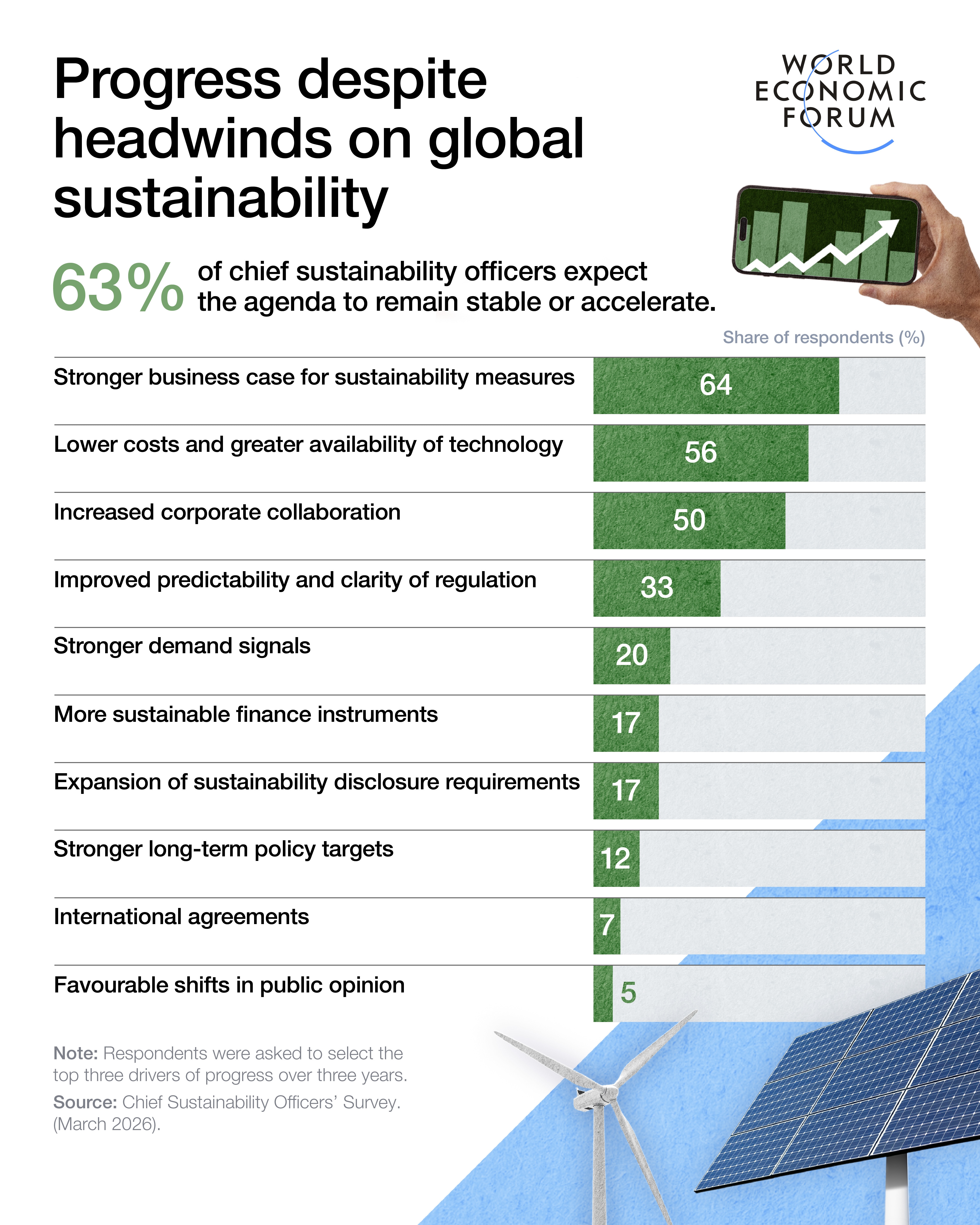
This is why execution matters. Drawing on responses from 103 chief sustainability officers (CSOs), the inaugural Chief Sustainability Officers Outlook finds that 63% expect global sustainability progress to hold steady or accelerate over the next year. The Outlook draws on the Forum’s global CSO Community to understand how business leaders are navigating and executing the transition. The message is clear: Progress is continuing, but the forces driving it are evolving. For CSOs, the priority is turning ambition into action, and sustaining momentum in a more complex environment.
The changing forces driving global sustainability
Over the next three years, CSOs identify a stronger business case for sustainability measures (64%) and cheaper, more applicable technologies (56%) as the two leading accelerators of progress. Sustainability can be more durable when the decisions that determine what is financed, built and scaled are commercially grounded.
Yet markets and technology do not operate in a vacuum. Policy uncertainty is the leading expected constraint on progress, cited by 68% of respondents, followed by short-term business pressures (61%) and international tensions (54%). Policy remains essential to create the conditions for investment and deployment, but its role is becoming less consistent across jurisdictions.
The result is “green divergence”: sectors and markets moving at different speeds, through different combinations of competitiveness, resilience, energy security and industrial priorities. Emerging markets are expected to play a growing leadership role.
Commercial and sustainability goals will not always align automatically. Durable value depends on understanding the resources, infrastructure and supply chains on which a company relies. Decisions that improve productivity or open markets while strengthening resilience are more likely to endure; those that lock in resource exposure or physical risk can narrow future options.
The CSO’s role is strategic integration
Inside businesses, the perception of sustainability is evolving. Compliance remains a prominent lens, identified by 65% of respondents, while 41% say it is already viewed as a source of business growth or value. The opportunity is to widen that recognition and translate it into routine commercial decisions, particularly as two-thirds expect corporate decision-making to shift further towards shorter-term performance priorities.
This is central to the CSO role. The task extends beyond setting ambition or defending a sustainability programme. It is to connect environmental realities to the mechanisms through which a company creates value.
In a bank, that can mean better lending decisions, sector strategies, client engagement and portfolio allocation. In manufacturing, it can reshape product design, materials, procurement and supplier relationships. Across sectors, it means working with finance, technology, operations, risk and business leaders so that sustainability informs investment choices and operating discipline.
This is why the CSO’s role is linked to innovation, productivity and new business models. CSOs do not own every decision that shapes sustainability outcomes. Their influence comes from improving the quality of decisions across the enterprise – helping colleagues see where environmental dependencies create risk, where efficiency creates margin, and where innovation can open new sources of value.
Technology and adaptation rise as key priorities
Artificial intelligence (AI) makes this challenge visible. Nearly three-quarters of CSOs expect AI and other digital technologies to support sustainability progress through risk-modelling, process and resource efficiency, measurement and reporting. Yet 77% identify the energy and resource intensity of AI infrastructure as its most significant negative sustainability impact.
A case study from the World Economic Forum’s MINDS programme shows what implementation can look like. Schneider Electric reports that its AI-enabled microgrid systems reduced energy consumption by 14% and CO₂ emissions by 28% per site per year across 97 locations. AI was applied to an operational challenge, with sustainability gains emerging through better management of energy and resources.
The survey insights do not resolve AI’s wider trade-offs. Technology amplifies the strategies, capabilities and systems around it. Capturing its benefits while managing its footprint requires CSOs to work with technology, finance and risk leaders on use cases, data quality, governance, infrastructure and measurable outcomes.
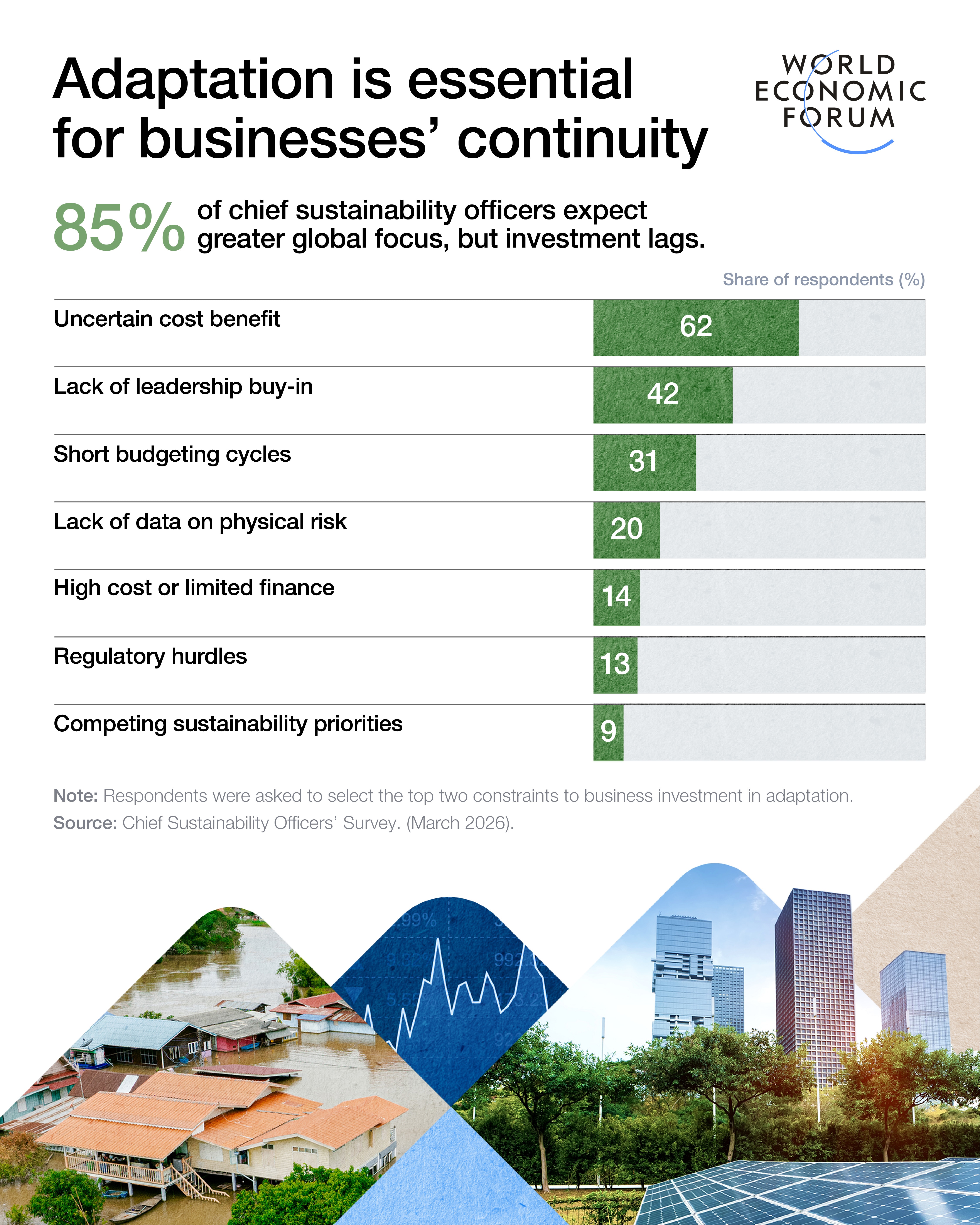
AI presents one example of a wider leadership challenge: making investment decisions today when the long-term costs and benefits remain uncertain. Adaptation provides another: How should businesses value resilience before disruption occurs? Eighty-five per cent of CSOs expect adaptation to become a greater global focus, and 77% say private investment will be decisive. Yet 62% identify uncertain cost-benefit assessments as a major constraint. Resilience often creates value through losses that never materialize, making it harder to compete for capital against projects with visible near-term revenues.
Making resilience investable will require better risk modelling, credible business cases, clearer revenue or repayment models and mechanisms that share risk. It will also require leaders to treat resilience as an input into present-day strategy, rather than insurance against a distant future.
Today’s choices define tomorrow’s pathways
The next phase of the sustainability transition will be shaped by the assets, systems, products and incentives businesses choose now.
Companies can lock in exposure to scarce resources, physical risks and outdated business models – or use the same investment decisions to build productivity, innovation, resilience and enduring value. The strongest CSOs will help their organizations make the second choice, not by owning the transition alone, but by embedding ecological reality into the decisions that define the future of the business.
The Forum will continue learning from its global CSO Community through the annual Chief Sustainability Officers Outlook, supported by a recurring survey to track how the transition, its drivers and the role of sustainability leaders evolve over time.
Don't miss any update on this topic
Create a free account and access your personalized content collection with our latest publications and analyses.
License and Republishing
World Economic Forum articles may be republished in accordance with the Creative Commons Attribution-NonCommercial-NoDerivatives 4.0 International Public License, and in accordance with our Terms of Use.
The views expressed in this article are those of the author alone and not the World Economic Forum.
Stay up to date:
Sustainability Reporting
Related topics:


Forum Stories newsletter
Bringing you weekly curated insights and analysis on the global issues that matter.
More on BusinessSee all

Reese Wong
September 15, 2026