20 years of gender parity data is in. Here's what the trajectory reveals

Learning from both the front runners and the fastest movers can help convert progress on gender parity into sustained momentum. Image: Kirill Fokin/Unsplash
- Since the Global Gender Gap Index was launched in 2006, economies made faster collective progress in the first decade than the second.
- Economies at every income level have made progress towards gender parity through coordinated action across institutions, markets and society.
- The 20-year trajectories of front runners and fast movers offer practical lessons for turning progress into sustained momentum: from implementing legal reforms and protecting gains to anticipating new gender gaps as the world continues to evolve.
For 20 years, the World Economic Forum’s Global Gender Gap Index has tracked progress towards gender parity across four subindexes: Economic Opportunities and Participation, Educational Attainment, Health and Survival, and Political Empowerment. Every year, its rankings offer a snapshot of where economies stand with regards to one another. A fuller picture, however, emerges from tracing their two-decade journey.
Economies ranked in the index have all had different starting points. In 2026, the index sought to understand who was gaining momentum, losing steam or standing still. While nearly every economy tracked since 2006 has moved forward, as a group they made quicker gains in the first decade than the second.
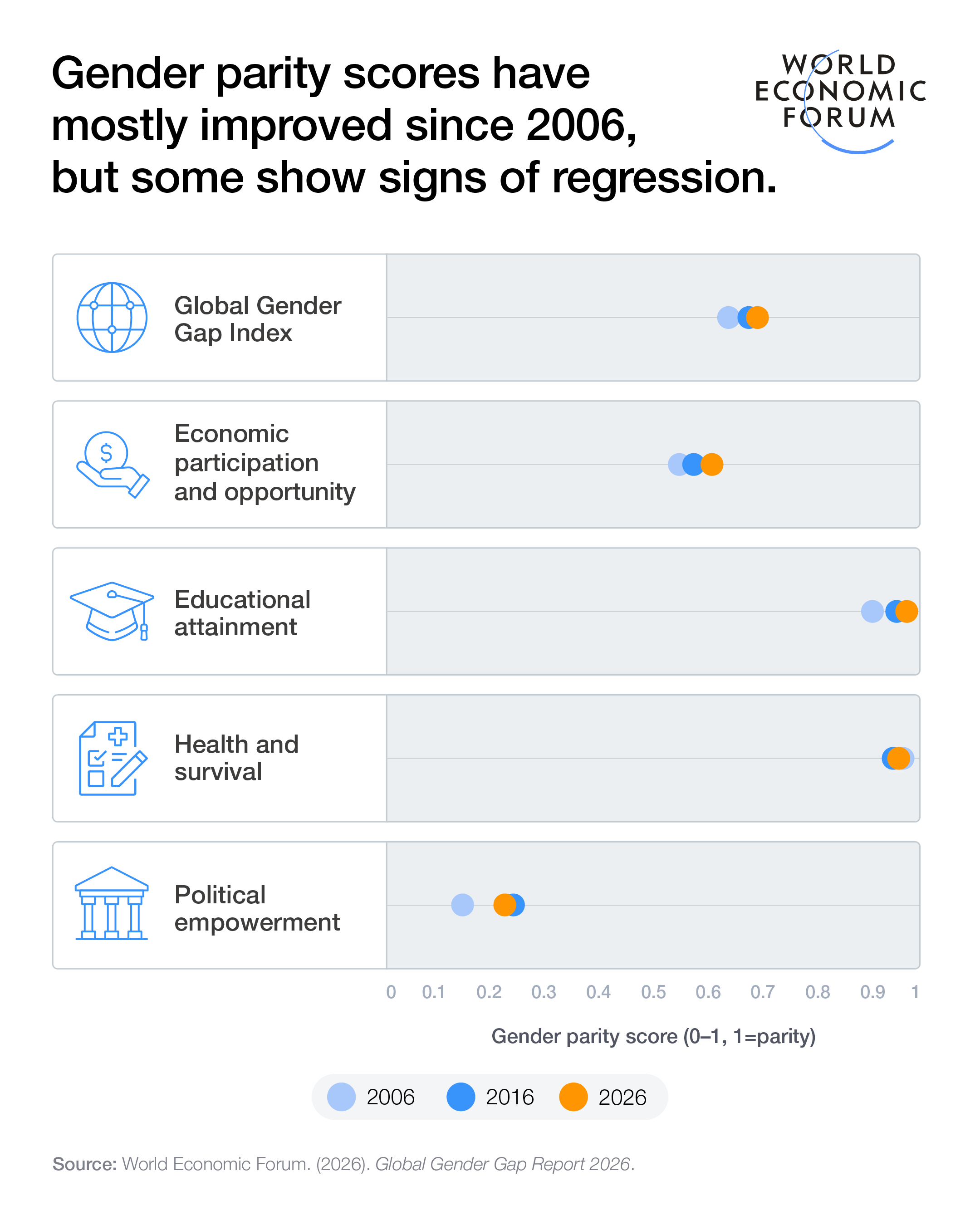
Some economies have sustained relatively high levels of parity over time – but made no substantive advances. Others have narrowed their gap quite quickly, despite having a lower starting point. Each trajectory offers different lessons for policymakers, businesses and stakeholders seeking to close the gap.
Have you read?
How the Global Gender Gap Index tracks progress
The Index measures gender gaps as relative, and not absolute levels of parity between men and women. This means it can assess progress across economies with different income levels, institutional constellations and development pathways over time.
Every time an economy features in the Index, it records a point on a longer continuum. In charting a trajectory, the report captures the interactions of public policy, business strategy, legal reform, changing social attitudes and even unexpected large-scale events as they move the needle towards parity – or away from it.
Analysis of the Index’s 20-year-old dataset tells us that global progress towards parity is neither linear nor evenly distributed among the economies measured. Not only that, but progress across index dimensions is also differentiated.
In Educational Attainment for example, nearly every economy started with at least 70% of the gender gap closed. Collectively, the global education gender gap has narrowed by 6.5 percentage points over the past two decades. If every economy continues to advance at its current pace, we would reach parity in eight years.
In Economic Participation and Opportunity, around 57% of economies had closed at least 60% of their gender gap in 2006; by 2026, that share had risen to 84%. Collectively, the global economic gender gap has narrowed by 6.1 percentage points over the past two decades. At the current pace, however, full economic parity remains 129 years away.
Fewer than 15% of economies had a Political Empowerment score higher than 30% in 2006. By 2026, that share had risen to 40%, and remains the dimension with the widest gender gap to close worldwide and furthest away from closing at 192 years.
Converting movement into momentum
Two decades of results tell us that progress is achieved through cumulative and coordinated action across institutions, markets and society. As 2026 data from the World Bank’s Women, Business, and the Law project shows, early gender parity reforms have substantially expanded women’s economic rights over time.
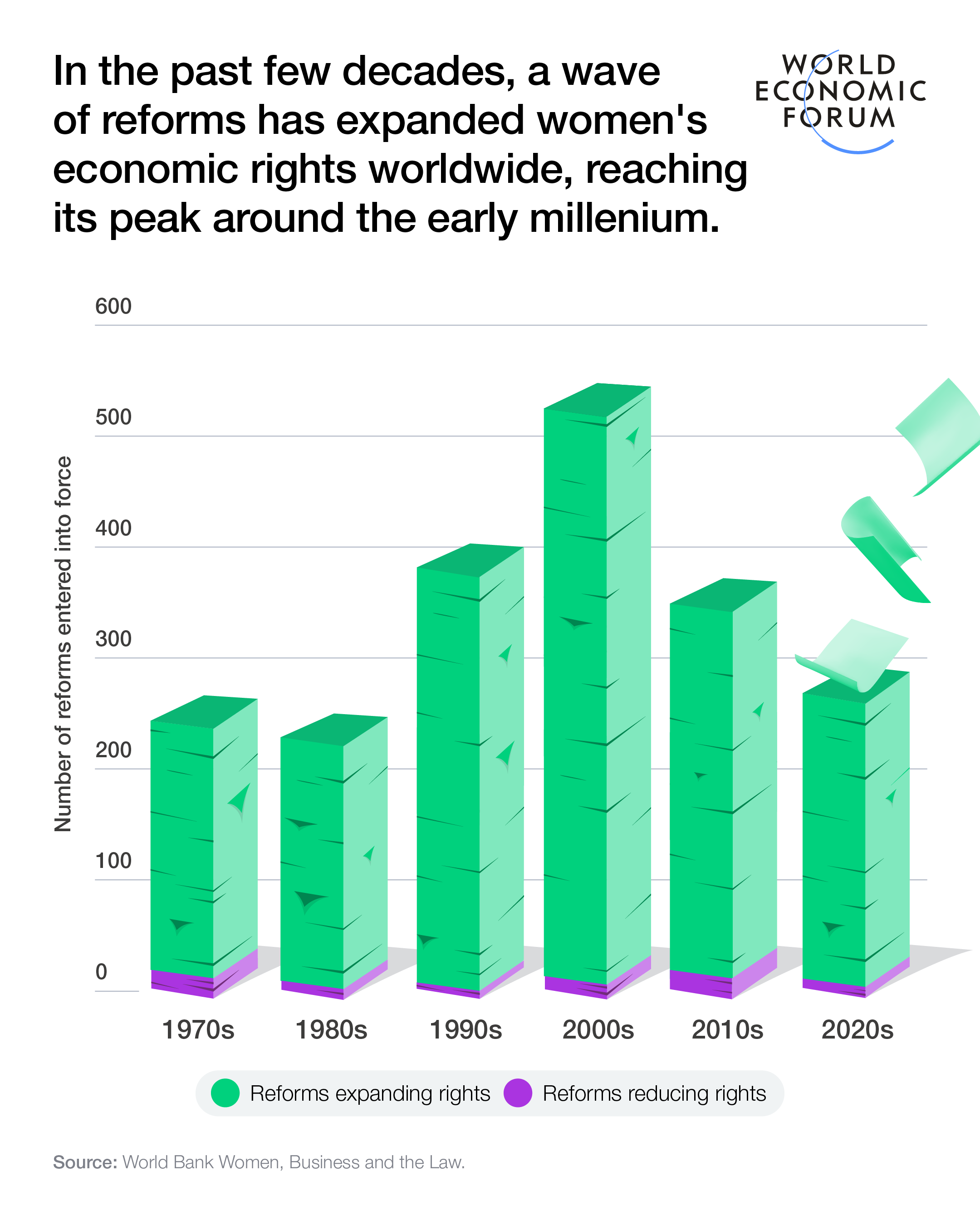
Over the past two decades, several middle-income economies including Ecuador, Guatemala, Mexico, Namibia and Nepal recorded a speed of progress faster than that of best-performing higher-income economies, as measured by their average annual rate of improvement relative to their initial parity levels. This advance is strictly reflecting increased parity scores across subindexes, and yet those scores are informed by the progressive evolution of conditions leading to better educational, economic and political outcomes. This progress reflects higher parity scores across subindexes, alongside legal reforms that expand economic opportunity for women.
In the last six decades, Mexico, Ecuador and Namibia advanced a series of gender parity reforms predominantly focused on economic access rights, removing restrictions that limited women from working, opening bank accounts, registering businesses, signing contracts and inheriting and managing property. They also introduced reforms that strengthened workplace protections by prohibiting gender discrimination, addressing sexual harassment and protecting pregnant workers from dismissal. Ecuador, Namibia and Nepal further extended social protection through pension provisions, recognition of childcare-related absences and expanded maternity or paternity leave.
These examples are illustrative of how small movements in a coordinated direction can transform into momentum when reforms, institutions and leadership align. However, as findings from last year’s edition further suggest, the effectiveness of these frameworks depends on having robust, well-aligned mechanisms that put them into practice. Without them, trajectories can slow, plateau or reverse, undoing the foundations for parity while other economies speed ahead.
Getting there faster matters to economies incurring economic and social costs on account of delays, and those on this trajectory may need to consolidate reforms and broaden progress across sectors all while thinking about outcomes in terms of generations. Progress made in education, for example, may not yet be reflected in employment, income or decision-making power.
Other economies that already benefit from an advantageous position are likely to still need to address structural barriers that remain after initial gains were achieved. The economies that find themselves in a standstill are challenged to examine the constraints, old and new, that keep them from advancing. This will not only be critical for their own economic development, but to global progress itself, since we can only go as fast as those with the slowest rate of advancement.
Two decades of evidence show that being closest to parity is not the same as advancing towards it the fastest, whether across economies or dimensions of the index. Looking ahead, each trajectory offers a different path to progress: translating legal reforms into practice, protecting hard-won gains, and addressing persistent and emerging gaps across segments.
As a new economic era takes shape, learning from both the front runners and the fastest movers can help convert progress into sustained momentum, and build more inclusive economies that draw on the talents of all people.
Don't miss any update on this topic
Create a free account and access your personalized content collection with our latest publications and analyses.
License and Republishing
World Economic Forum articles may be republished in accordance with the Creative Commons Attribution-NonCommercial-NoDerivatives 4.0 International Public License, and in accordance with our Terms of Use.
The views expressed in this article are those of the author alone and not the World Economic Forum.
Stay up to date:
Gender Parity


Forum Stories newsletter
Bringing you weekly curated insights and analysis on the global issues that matter.