Charted: How the Wimbledon prize money has changed for men's and women's winners over the years
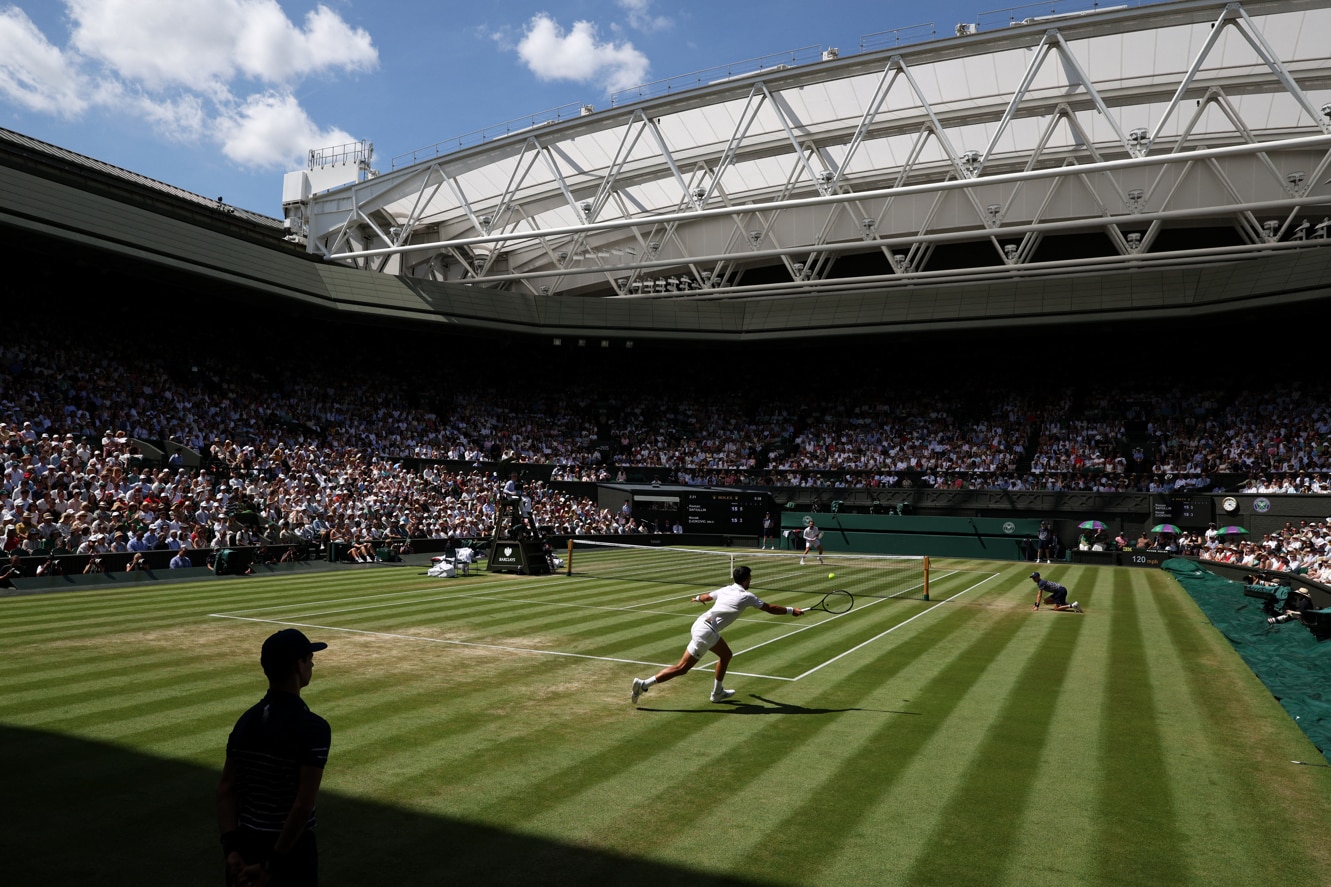
Wimbledon 2026 boasts the tournament's biggest-ever prize pot. Image: REUTERS/Marko Djurica
This article has been updated.
- The prize pot for Wimbledon 2026 is a record £64.2 million (~$85.9 million), up 20% on last year.
- This chart puts the focus on how progress to parity can drive change, from the changing room to the board room.
- Parity in sport is still uneven, and the World Economic Forum's Global Gender Gap Report 2025 finds it will take another 123 years to reach gender parity in all areas.
From its strict all-white dress code for players to the 250,000 portions of strawberries and cream eaten each year by its crowd, Wimbledon is a sports tournament built on long-standing traditions.
One aspect of the event that has changed over the years, however, is the prize money. As one of tennis's four 'Grand Slam' tournaments, it is among the most prestigious individual competitions in the sport.
The prize money for The Championships – Wimbledon's official name – in 2026 is a record £64.2 million (~$85.9 million). This Saturday and Sunday, the ladies' and men's singles champions will each be awarded £3.6 million (~$4.8 million), up from £3 million in 2025.
The chart below shows how Wimbledon prize money for both men and women has changed since 1968, the year in which professional players were first allowed to compete in tennis tournaments sanctioned by the International Tennis Federation. The timeline includes, in 2007, the year in which the tournament's prize money for men and women reached parity.
A short history of pay parity in tennis
Tennis led the way towards equal prize money in sport, with the 1973 US Open becoming the first sporting event to offer this. This was after the winner of the women's draw in 1972, Billie Jean King, threatened that she and other women players would not participate the following year unless the prizes awarded were equal.
Wimbledon was the last of the Grand Slams to offer equal prize money, with the Australian Open reaching that milestone in 2001 and the French Open in 2006.
Outside of these 'major' tournaments, though, disparity still exists in tennis. A host of big events on the men's and women's tours still offer lower prize money for women. In 2025, the UK's Lawn Tennis Association committed to closing the gap between men's and women's prize pots for ATP (the governing body for men's tennis) and WTA (the equivalent for women's tennis) events by 2029.
And while tennis has also now introduced the first-ever paid maternity leave programme for professional players, such policies remain the exception, not the rule.
The case for parity in women's sport
Similar issues are reflected across the wider sporting world. Women's sports are today capturing unprecedented attention and recognition, according to UN Women, but "major gaps remain", it says. Women athletes face issues including fewer professional opportunities, a gulf in pay – there were no women among the world's 50 highest-paid athletes in 2025 – fewer sponsorships and unequal playing conditions.
While some argue that this is in part because women's sports can attract smaller crowds and generate less money, others say that the perpetuation of long-held biases and stereotypes around women's sport is holding back progress.
"Equal pay for equal play is gaining long-overdue momentum - not only in tennis, but across the sporting world," says Kim Piaget, Insights Lead, Diversity, Equity, Inclusion and Social Justice at the World Economic Forum.
"With advocacy meeting strategic investments from sponsors and governing bodies, women’s sport is making its case and winning it too. Global revenues for women’s sport have increased 240% in the past four years," she says, "but while prize money may finally be catching up, equity in sport goes far beyond the winners’ podium."
How women are driving the sports economy
The global sports economy is now valued at $2.3 trillion and is projected to grow to $8.8 trillion by 2050. The mainstreaming of women's sport is one of the key drivers of that growth, according to Sports for People and Planet, a report by the Forum in collaboration with Oliver Wyman.
Research shows that investments in parity – in sport and elsewhere – help to build more resilient, prosperous and productive economies. But based on the current speed of progress, it will take 123 years to reach full parity globally, according to the Forum's 2025 Global Gender Gap Report.
Sport is a "great enabler", UN Women says, and women that play tend to stay in school longer and get better jobs – illustrating how progress to parity can drive change, from the changing room to the board room.
"With increasing recognition, better data and smarter financial backers stepping up, there is a rare opportunity to level the playing field – and reshape the entire system," says Piaget.
Don't miss any update on this topic
Create a free account and access your personalized content collection with our latest publications and analyses.
License and Republishing
World Economic Forum articles may be republished in accordance with the Creative Commons Attribution-NonCommercial-NoDerivatives 4.0 International Public License, and in accordance with our Terms of Use.
The views expressed in this article are those of the author alone and not the World Economic Forum.
Stay up to date:
Gender Parity


Forum Stories newsletter
Bringing you weekly curated insights and analysis on the global issues that matter.
More on Equity, Diversity and InclusionSee all

Aarushi Singhania and Sharmishtha Biswas
October 1, 2026