Geopolitics is rewriting the rules of investment. Here's how

Financial institutions need to reconsider how disruptions such as the Strait of Hormuz crisis affect risk, investability and capital allocation. Image: via Reuters
Anastasiia Rudkovska
ECP Spring 2026 – Centre for Energy and Materials, Transition Financing, World Economic Forum- Governments worldwide are prioritizing economic security, strategic autonomy and access to critical infrastructure.
- This means that financial institutions need to reassess how factors such as geopolitical dependencies affect risk, investability and capital allocation.
- Governments, companies and financial institutions will need to work together to turn strategic priorities into commercially viable opportunities.
Geopolitical fragmentation is reshaping the investment equation across the real economy. As governments place greater emphasis on economic security, strategic autonomy and access to critical infrastructure, financial institutions are having to reassess how geopolitical dependencies, supply-chain concentration and strategic importance affect risk, investability and capital allocation.
This shift is particularly visible in infrastructure systems, including energy networks, communications infrastructure and critical supply chains. Disruption to Russian gas supplies in Europe, exposure to chokepoints such as the Strait of Hormuz and Ukraine’s reliance on privately operated communications infrastructure such as Starlink show how geopolitical shocks can rapidly change the value placed on access, security and diversification.
For financial institutions, this creates a more complex investment equation. Governments may identify infrastructure as strategically essential, but investors still require predictable revenues, manageable risks and credible long-term returns.
The challenge is therefore twofold: first, to understand how geopolitical priorities are changing investment decisions, risk and capital allocation; and second, to determine what is needed to turn strategically important infrastructure into bankable opportunities.
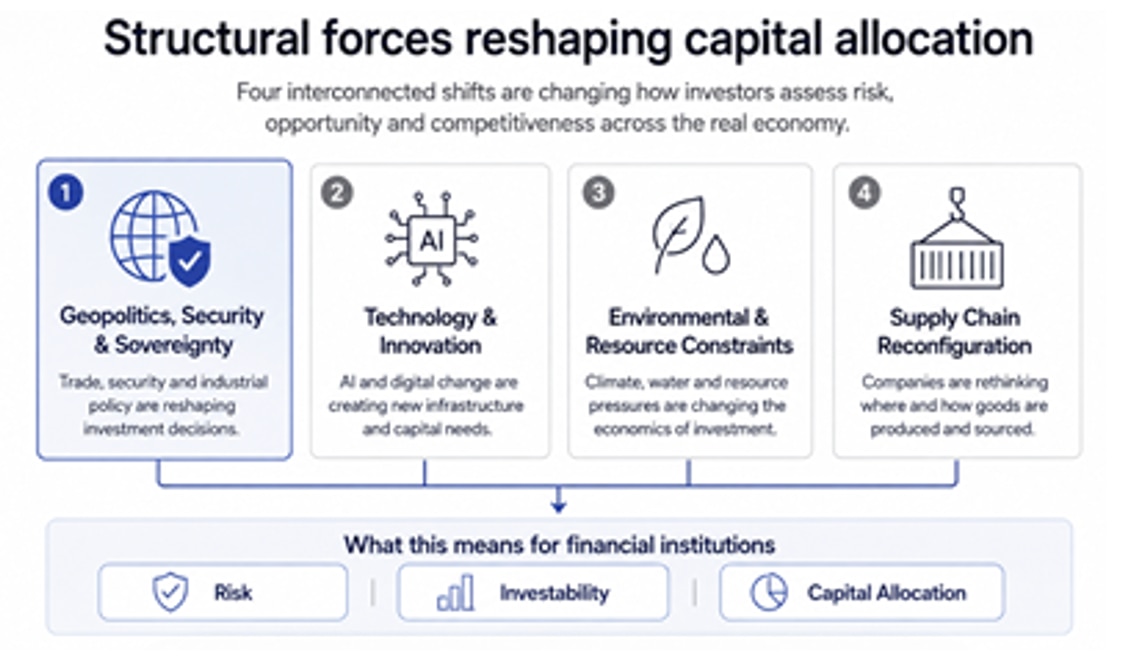
How geopolitics is reshaping investment in infrastructure
The pressures differ across regions, but the pattern is increasingly clear. In Europe, disruption to Russian gas supplies accelerated efforts to strengthen energy security and diversify supply. China’s dominant position in rare-earth processing has elevated critical minerals from an industrial input to a strategic concern. In North America, rapid growth in artificial intelligence (AI) is making reliable access to power, grids and digital infrastructure an increasingly important question of national competitiveness.
These dependencies are especially visible where infrastructure is highly concentrated. Around one-quarter of global seaborne oil trade passed through the Strait of Hormuz in 2025, while alternative export capacity remained limited. Disruption at strategic chokepoints can therefore affect energy prices, industrial competitiveness and investment decisions far beyond the countries directly involved.
Geopolitical change is also reshaping the relationship between governments and private companies. In Ukraine, damage to terrestrial communications infrastructure increased reliance on SpaceX’s Starlink network for critical communications and military operations. This raises a broader question for infrastructure finance: what happens when assets governments regard as strategically essential are owned or operated by private actors? The answer has implications for risk allocation, revenue models, and the responsibilities of the public and private sectors.
AI and data-centre growth illustrate how these pressures increasingly converge. Rising compute demand is creating major new requirements for generation, grids, cooling and storage, while these systems depend on transformers, semiconductors and critical minerals sourced through concentrated global value chains. What begins as a technology story quickly becomes a question of power availability, supply chain security and national competitiveness.
These competing objectives create a financing challenge: the infrastructure that governments increasingly regard as strategically essential is not always the infrastructure that conventional investment models find easiest to finance.
Why strategic importance does not guarantee investability
Infrastructure designed around security and strategic priorities does not always fit conventional investment models. Traditional project assessment tends to favour predictable demand, stable cash flows and manageable risks. Yet infrastructure built for security or economic sovereignty may require spare capacity, multiple suppliers, strategic inventories, alternative transport routes, or stronger cyber and physical protection. These features may create significant system value while increasing costs or generating benefits that are difficult for an individual asset to monetize.
The key question is not simply whether an asset is strategically important, but who will pay that strategic value and how the associated risks and revenues will be structured.
Power systems illustrate the problem. The International Energy Agency (IEA) estimates that meeting national energy and climate goals will require adding or replacing 80 million kilometres of power lines by 2040, while annual grid investment needs to more than double to over $600 billion by 2030. Yet investments in redundancy, flexibility and reliability often generate benefits that extend beyond the revenues of a single asset, making their full strategic value difficult to capture through traditional project economics.
Critical minerals present a similar challenge. Diversifying extraction and processing capacity may reduce concentrated supply chain exposure, but alternative sources can be more expensive and commercially harder to justify. Strategic demand therefore needs to become bankable demand, supported by credible offtake, policy certainty, or other mechanisms that give investors confidence in future revenues.
Turning strategic needs into investable opportunities
The financing challenge is not simply to mobilize more capital, but to translate strategic value into credible revenues and allocate risks to the parties best placed to manage them.
Public support can help where the benefits of strategic infrastructure are not fully captured by individual projects. Long-term offtake agreements can reduce demand risk; regulated returns and availability payments can recognize broader system value, while targeted guarantees and public procurement can create greater certainty for strategically important investments.
Corporate buyers can also convert future demand into financeable infrastructure. Microsoft’s 20-year power-purchase agreement with Constellation, supporting the planned restart of an 835-megawatt nuclear plant in the US state of Pennsylvania, illustrates how long-term corporate demand can underpin investment in strategic generating capacity.
Financial institutions, meanwhile, will need to assess how changing sources of strategic value and geopolitical risk should be reflected in underwriting, valuation and capital allocation. Strategic importance should not replace commercial discipline, but policy certainty, credible demand and well-designed risk-sharing mechanisms can materially change an asset investment case.
These choices still involve trade-offs. Data centres can strengthen technological competitiveness while increasing pressure on power and water systems, and diversifying critical mineral supply chains can improve economic security but raise costs or introduce new environmental and social impacts.
As geopolitics becomes a more important part of the investment equation, governments, companies and financial institutions will need to work together to turn strategic priorities into commercially viable opportunities. Doing so will be critical to financing the infrastructure on which more secure, diversified and ultimately resilient economies depend.
Don't miss any update on this topic
Create a free account and access your personalized content collection with our latest publications and analyses.
License and Republishing
World Economic Forum articles may be republished in accordance with the Creative Commons Attribution-NonCommercial-NoDerivatives 4.0 International Public License, and in accordance with our Terms of Use.
The views expressed in this article are those of the author alone and not the World Economic Forum.
Stay up to date:
Geopolitics
Related topics:


Forum Stories newsletter
Bringing you weekly curated insights and analysis on the global issues that matter.