Global economy stabilizes, but less fiscal breathing room and rising costs threaten growth
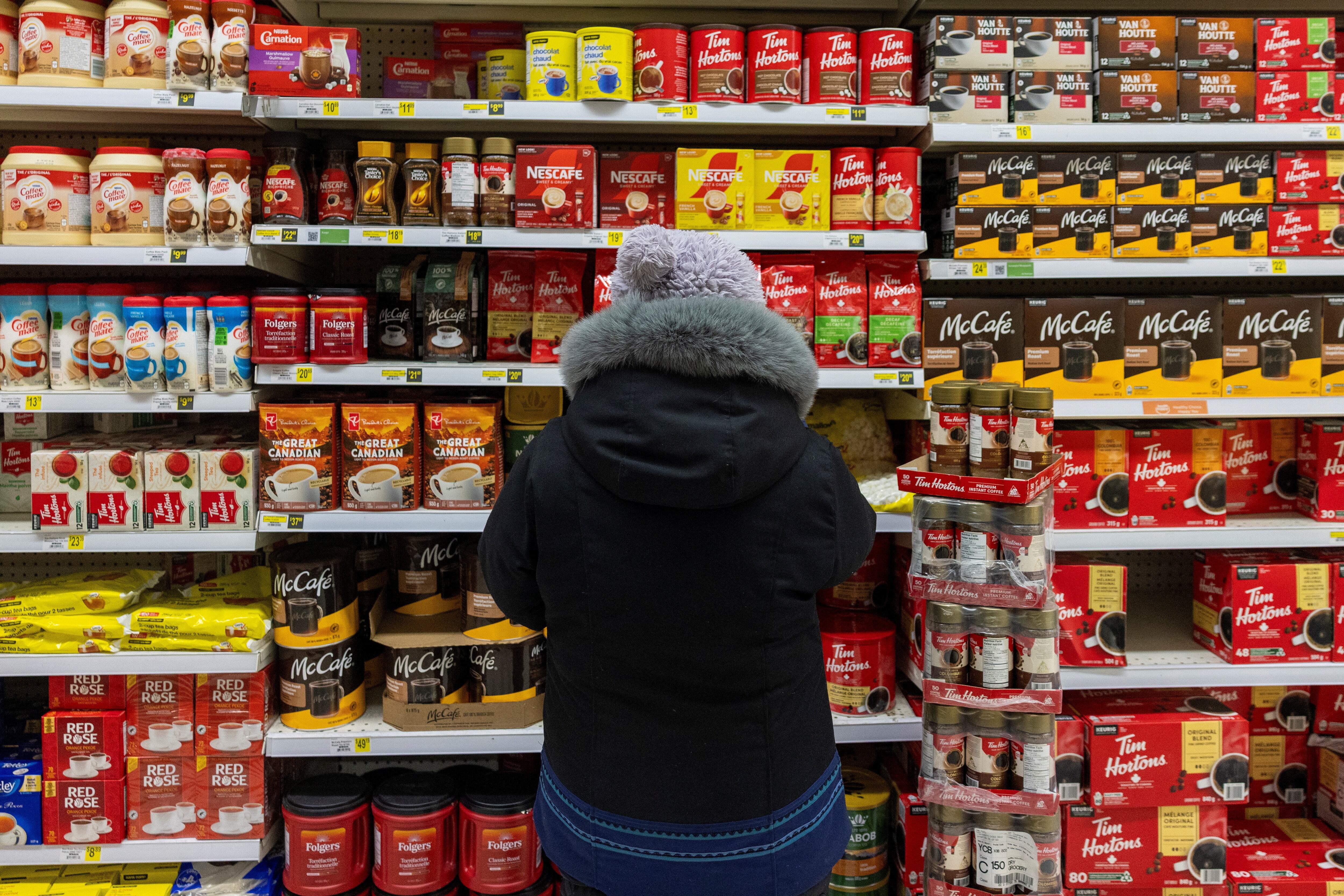
The global economic outlook is stabilizing, chief economists say. But rising foods costs are just one source of lingering concern. Image: REUTERS/Carlos Osorio
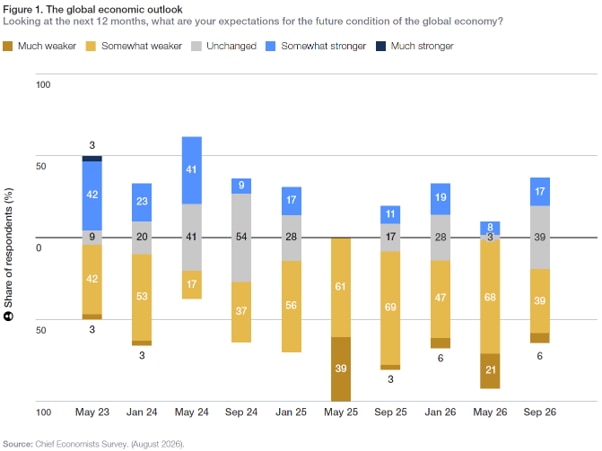
- Global economic prospects have stabilized since May, according to experts surveyed for the latest Chief Economists’ Outlook; more than half now expect conditions to remain unchanged or improve over the next 12 months.
- But the fiscal support from governments that’s helped economies absorb repeated shocks is unlikely to be available at the same scale.
- AI remains the leading source of optimism, though data-centre investment is expected to bring limited job creation, higher utility costs and local opposition.
The World Economic Forum’s September 2026 Chief Economists’ Outlook finds that the global economy is stabilizing.
A majority of the 36 chief economists surveyed for the Outlook, or 56%, expect conditions to remain unchanged or improve over the coming year. Just 45% now expect conditions to weaken, which is a stark decline from the 89% registered in May. Inflation expectations have also moderated significantly – half of the chief economists expect global inflation to rise, compared with 94% four months ago.
Yet, confidence in the durability of this improvement is limited; only 25% expect the global economy to become more resilient over the coming year.
Geopolitical conflict remains the dominant source of uncertainty. Almost all respondents, 97%, include geopolitical conflicts among the most significant sources of economic uncertainty over the next 12 months, while 58% point to the risk of an asset-price correction. 44% cited rapid technological change and policy instability, and 42% selected trade and investment restrictions.
The overall picture that emerges, however, is one of resilience in the face of repeated shocks.
Resilience without the same backstop
Since 2020, the global economy has relied heavily on government support.
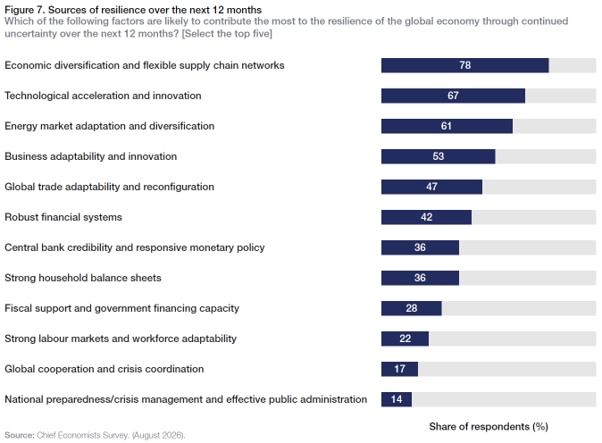
69% of the chief economists cite that support as a primary factor in economic resilience to date. Looking forward, however, only 28% expect fiscal support to play a similar role over the next 12 months. Years of crisis interventions have constrained public finances, making it more difficult for governments to cushion households and businesses against future disruption at the same scale.
Sources of resilience will therefore have to change. 78% of the chief economists see economic diversification and flexible supply-chain networks as a leading source of resilience over the coming year, followed by technological acceleration and innovation at 67%.
In this context, the US and China are viewed as best placed to withstand future shocks. 74% rate the resilience of each as high or very high.
The cost-of-living squeeze persists
Household budgets remain under pressure even as the broader inflation outlook improves.
88% of the chief economists expect food costs to increase over the next 12 months, while 83% anticipate higher electricity costs and 77% expect transport costs to rise. 71% see energy costs for fuel and heating increasing.
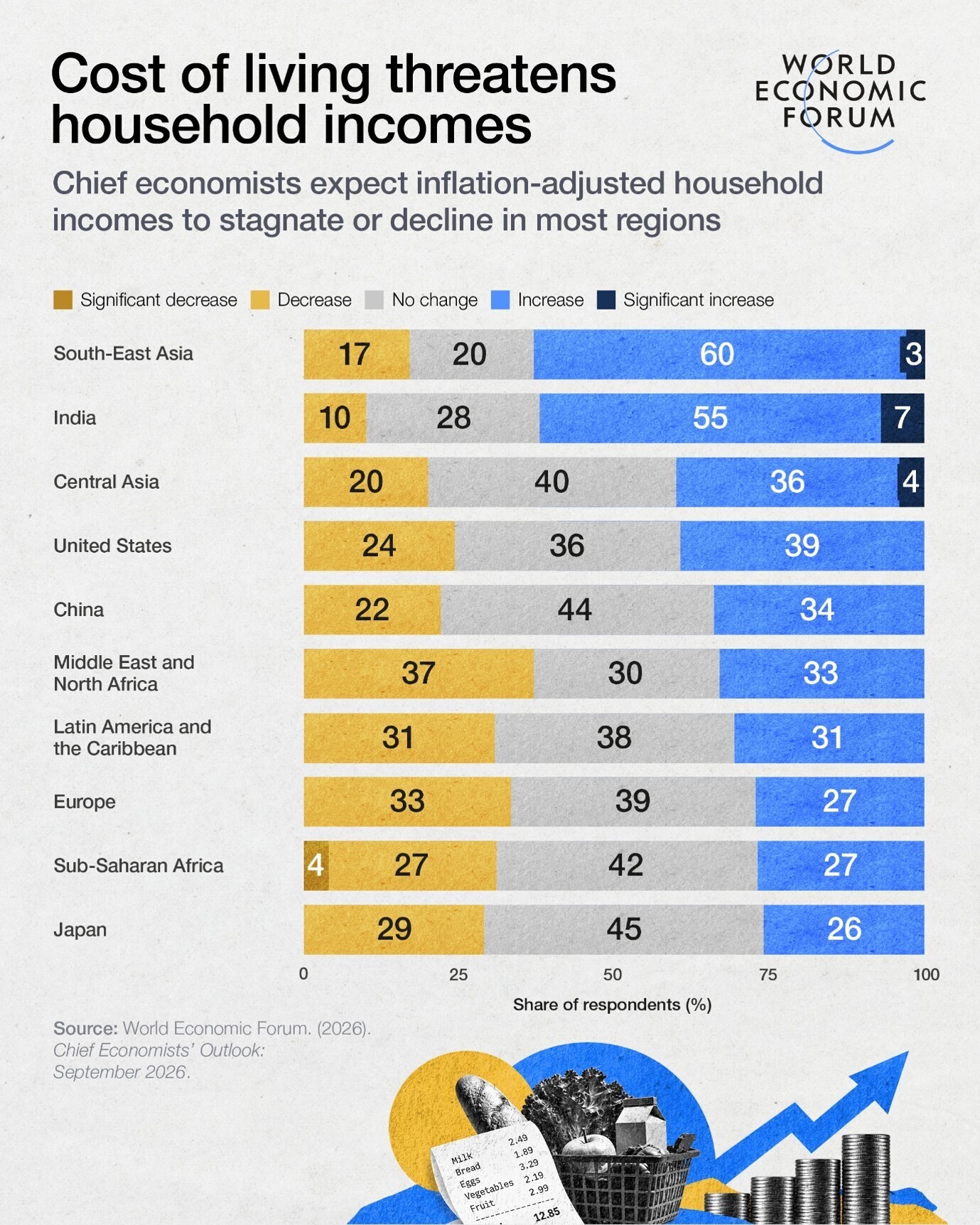
That cost-of-living pressure comes as cumulative price rises in recent years have already eroded household purchasing power. So a moderation of the inflation rate does not dull the sting for many households. Rising costs are expected to translate into stagnant or falling purchasing power across much of the world.
South-East Asia and India stand out as exceptions, as a majority of chief economists anticipate an increase in inflation-adjusted household incomes there. But 37% expect real incomes to fall in the Middle East and North Africa, 33% anticipate it for Europe and 31% see the same in Latin America and the Caribbean. That helps explain why household sentiment remains subdued even as other economic indicators paint a relatively upbeat picture. It also shows why the cost of living remains a central economic and political concern.
Governments may only face growing pressure to shield households from higher living costs, at the same time the tools available to do that are becoming fewer.
AI optimism meets infrastructure pushback
Artificial intelligence remains the strongest source of optimism in the Outlook, as expectations shift from experimentation to economically significant adoption.
Almost all chief economists expect AI adoption to increase over the next 12 months, while 69% expect the technology to unlock “meaningful” productivity gains; this is expected to emerge fastest in information technology and digital communications, followed by financial and professional services and defence. But economists now anticipate gains spreading across all industries within roughly three years.
The technology race is also expected to narrow, with 69% of respondents expecting Chinese large language models to catch up fully with their US counterparts over the next year.
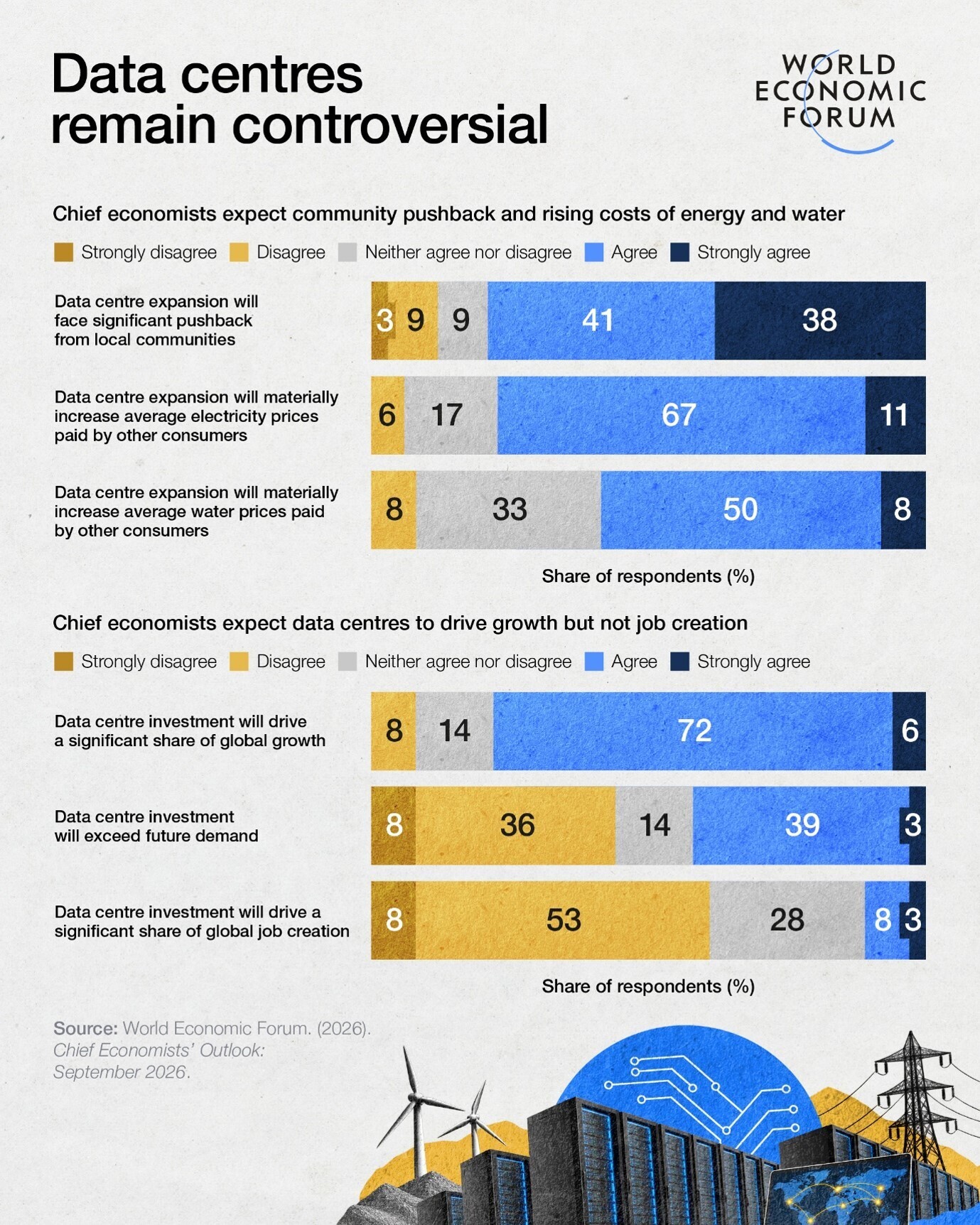
However, the investment required to power AI has become a source of tension. While 78% of the chief economists expect data-centre spending to contribute a significant share of global growth, 61% do not see it generating a similarly significant share of global job creation – and 79% expect data-centre expansion to face “significant” opposition from local communities. Higher anticipated electricity and water prices for communities play a major role in that.
The emerging AI economy’s balance sheet is therefore a complex mix of substantial investment and productivity gains on one side, and limited employment benefits and dampened public sentiment caused by heavy resource use on the other.
That heavy resource use is triggering interest in new energy sources. 83% of the chief economists expect global investment in nuclear power to rise over the next 12 months and 80% see the same for renewables (compared with 70% for fossil fuels). Data centres have become not just sources of potential productivity growth, but also significant drivers of competition for infrastructure, electricity and capital.
There is growing uncertainty about how much AI infrastructure the global economy really needs, however. 42% of the chief economists expect overinvestment.
Fragmentation deepens, but trade keeps adapting
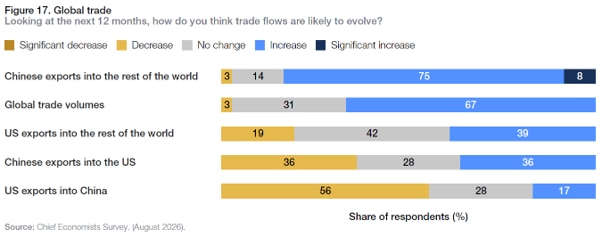
77% of the Outlook respondents expect global fragmentation to increase over the next 12 months. More than half anticipate higher tariffs in the US, and 43% expect increases in Europe. Yet 67% expect global trade volumes to rise, as 83% expect Chinese exports to markets outside the US to increase. That combination points to continued reconfiguration rather than straightforward retreat.
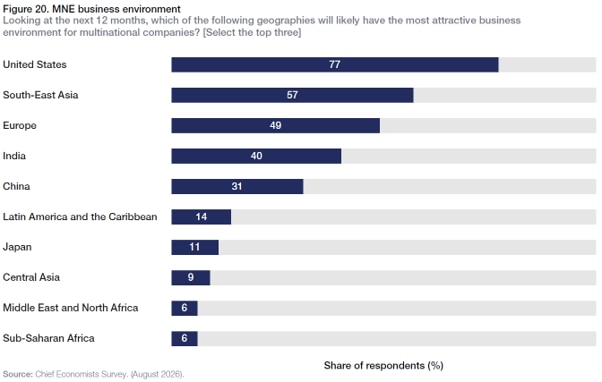
The geography of multinational investment is also shifting. More than half of respondents expect global foreign direct investment to increase over the coming year, and most chief economists still see the US as the most attractive business environment for multinational companies. South-East Asia was second and Europe third, while India fell to fourth place and China remained fifth. Market size still matters, but companies are increasingly weighing supply-chain positioning, infrastructure, policy capacity and strategic flexibility when deciding where to invest.
Regional outlook remains uneven
Overall improvement masks a world economy where the sources and quality of growth continue to diverge significantly across regions.
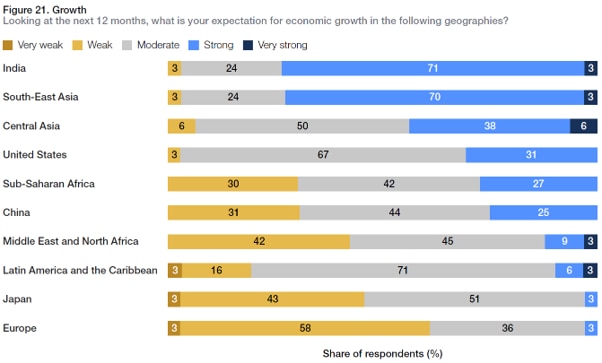
India and South-East Asia stand out as the strongest anticipated growth stories in the latest survey. 74% of the chief economists expect strong or very strong growth in India over the next 12 months, with South-East Asia close behind at 73%. The outlook for the US also anticipates resilience, with a third of respondents expecting strong growth there. However, strong headline growth does not eliminate exposure to higher energy prices, trade tensions or geopolitical shocks.
China and Europe remain the principal weak spots in the regional outlook, though for different reasons. In China, 31% of respondents expect weak growth as resilient exports and high-tech manufacturing contrast with subdued consumption and investment (69% still anticipate moderate or strong growth). Europe has improved modestly since May but once again has the weakest outlook. Expectations have meanwhile recovered for Japan and the Middle East and North Africa, and strengthened for Sub-Saharan Africa and Latin America and the Caribbean.
Monetary policy is diverging alongside differing regional conditions.
70% of respondents expect a tightening in Japan, 53% expect it in the euro area, and 42% see it in the US. Meanwhile 49% expect loosened policy in China, and a majority anticipate broadly unchanged settings in India. This divergence reflects markedly different combinations of growth, inflation and domestic demand. It also complicates the environment for capital flows and exchange rates.
The emerging picture is therefore not simply one of stronger or weaker global growth, but of increasingly distinct regional policy cycles responding to very different economic pressures. The broader message from chief economists: the global economy has moved away from the troubling deterioration of early 2026, but hasn’t yet emerged into a period of secure, broad-based expansion.
Now, the search for greater resilience will have to depend less on government largesse, and more on the ability of economies to adapt before the next big disruption arrives.
Don't miss any update on this topic
Create a free account and access your personalized content collection with our latest publications and analyses.
License and Republishing
World Economic Forum articles may be republished in accordance with the Creative Commons Attribution-NonCommercial-NoDerivatives 4.0 International Public License, and in accordance with our Terms of Use.
The views expressed in this article are those of the author alone and not the World Economic Forum.
Related topics:

Forum Stories newsletter
Bringing you weekly curated insights and analysis on the global issues that matter.
More on Geo-Economics and PoliticsSee all

Manar Alohaly
September 23, 2026


