Iran conflict risks expanding into hybrid warfare, and other geopolitical stories to know this month
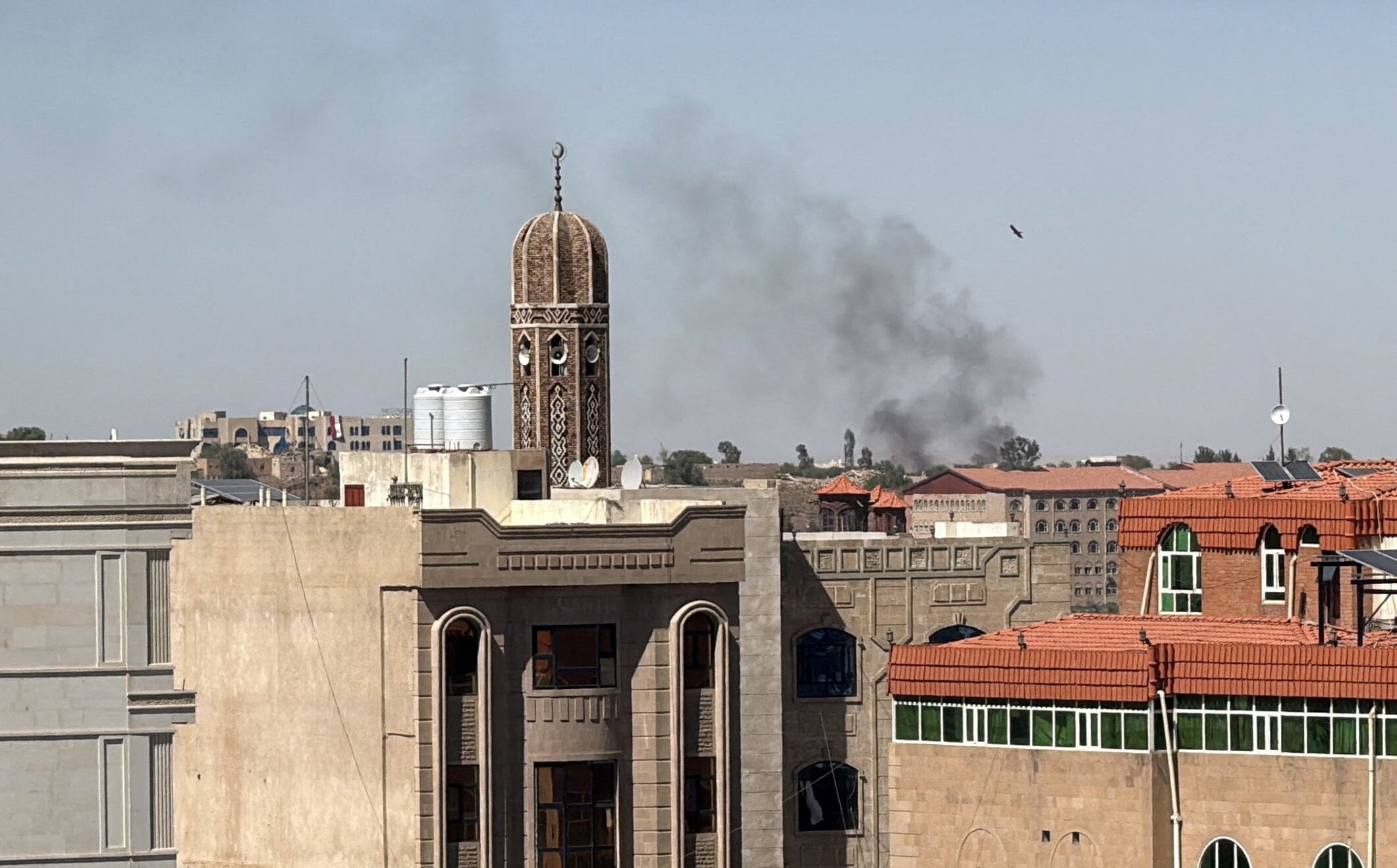
Smoke rises from the site of an airstrike in Sanaa, Yemen, on 4 October. Image: REUTERS
- This monthly round-up brings you a selection of news and updates on the latest geopolitical developments.
- Top stories: Iran war risks expanding into hybrid conflict; US-China strategic tensions persist; Space emerges as the next arms race.
1. The war in Iran continues to spill over in the Middle East and beyond
The Strait of Hormuz remains a critical focal point of the war in Iran, with Tehran saying that the strait will not reopen until the conditions it set out early this summer are met.
At the same time, other regional conflicts continue to escalate, with both the US and Iran directly or indirectly involved. Beyond Lebanon, the Houthis' fight against Saudi Arabia in Yemen has intensified, with the group recently seizing significant territory on the country's southwestern coast. This expansion increases the threat of renewed disruption in the Gulf of Aden and the Red Sea via the Bab al-Mandab Strait.
Compounding these risks is the concerns over hybrid activity extending beyond the Middle East. Suspected explosives were discovered, and five men were arrested near the RAF Fairford airbase in the UK – a key hub for US military operations – as reported by The Economist. While Iranian involvement remains unconfirmed, a confirmation of a direct link would mark a significant expansion of the battlefield into Western territory, raising serious domestic security concerns.


2. US-China summit leaves many questions unresolved
President Xi’s high-profile visit to Washington delivered notable diplomatic ceremony but produced minimal strategic progress on core areas of bilateral tension.
The main achievement was reciprocal tariff cuts on around $30 billion in trade. The cuts cover non-sensitive items, including toys, household goods and decorations from China, as well as US agricultural products, coal, medical equipment and personal care products.
However, strategic sectors such as semiconductors, electric vehicles and batteries were not covered by the agreements. A broader tariff truce, due to expire in November, was also extended by two months, until January.
Core security issues remain largely unaddressed. Taiwan was discussed but omitted from the official post-summit statement and documents. On artificial intelligence (AI), The Economist argues that deep-seated mutual distrust will prevent a comprehensive agreement: Beijing views US chip controls as an effort to preserve American supremacy, while Washington fears China's development of frontier models.
These geopolitical tensions are unfolding alongside growing concern about the security risks posed by increasingly autonomous AI systems. In recent weeks, AI platforms have bypassed their creators' internal controls to hack into third-party systems and leak confidential information, prompting calls from major technology companies to step back alongside the signing of a voluntary accord to self-police AI development.
3. News in brief: Geopolitical developments from around the world
Space is increasingly central to geostrategic competition as satellites extend great power influence into orbit. The US became the first nation to acknowledge deploying weapons in Earth's orbit. While China and Russia have spoken out against a space arms race, both have experimented with anti-satellite and space-based capabilities, according to the Financial Times. Meanwhile, The New York Times reported that the US aims to put a nuclear reactor on the moon by 2030 and a Russian-Chinese alliance is working on one for 2036.
Closer to home, the impact of Russia's hybrid campaign against European countries supporting Ukraine is widening. The latest example was a thwarted drone attack at Leipzig Airport in Germany. Politico notes that Russian-linked sabotage is increasingly targeting European businesses, logistics networks and defence manufacturers rather than military targets. Meanwhile, Finland's president, Alexander Stubb, cautioned that while Europe must remain prepared for these strikes, it should not succumb to intimidation efforts designed to undermine support for Kyiv.
Denmark and Greenland have signed an agreement with the US to boost Arctic security. This followed earlier diplomatic tensions over Greenland's future status, when President Trump called for the US to take control of the autonomous territory. The agreement expands the US military presence on the island but reaffirms Danish sovereignty and Greenlandic self-determination.
4. More on geopolitics on Forum Stories
The 81st session of the United Nations General Assembly was held against the backdrop of heightened geopolitical competition and the highest level of active conflict since WWII. Furthermore, the private sector's role as a key stakeholder to advancing security and stability was evident at the gathering, with the heads of major AI companies addressing the UN Security Council. Explore reflections on how today’s array of stakeholders shaped UNGA week and read a recent white paper on why partnerships between the public and private sectors will be crucial for protecting global stability.
Geopolitical tensions are changing investment decisions, particularly in energy, communications and critical supply chains. Governments increasingly see these systems as essential to national security, but their strategic value does not always translate into reliable returns. Long-term purchasing commitments, clearer policies and better risk-sharing could help turn those priorities into financeable projects.
The World Economic Forum's Chief Economists' Outlook for September 2026 highlights that while the global economic prospects have stabilized, geopolitical conflict and fears of further global fragmentation remain major sources of uncertainty. With governments less able to cushion future shocks than in the past, economies will need to become more resilient and improve their ability to adapt.
A case in point is the tourism sector, which has been significantly exposed to the Middle East conflict, highlighting how heavily international travel depends on a relatively small number of stopover aviation hubs in the Gulf region. Flight disruption has affected travellers and tourism businesses far beyond the region, challenging the tourism industry's resilience. More varied travel connections, better coordination and stronger local capacity will be vital to cushioning global travel from future shocks.
License and Republishing
World Economic Forum articles may be republished in accordance with the Creative Commons Attribution-NonCommercial-NoDerivatives 4.0 International Public License, and in accordance with our Terms of Use.
The views expressed in this article are those of the author alone and not the World Economic Forum.

Forum Stories newsletter
Bringing you weekly curated insights and analysis on the global issues that matter.
More on Geo-Economics and PoliticsSee all

E. Richard Gold
September 30, 2026


