AI Is not replacing jobs. It’s reorganizing work. Here’s how

AI is neither ending work nor offering a panacea. It is forcing a reorganization of it. Image: Israel Andrade/Unsplash
- AI is driving a fundamental reorganization of work rather than simply replacing human roles.
- Success requires hybrid workforce orchestration to combine human capabilities with automated tools.
- Outcomes depend on deliberate choices by leaders to invest in skills and protect worker trust.
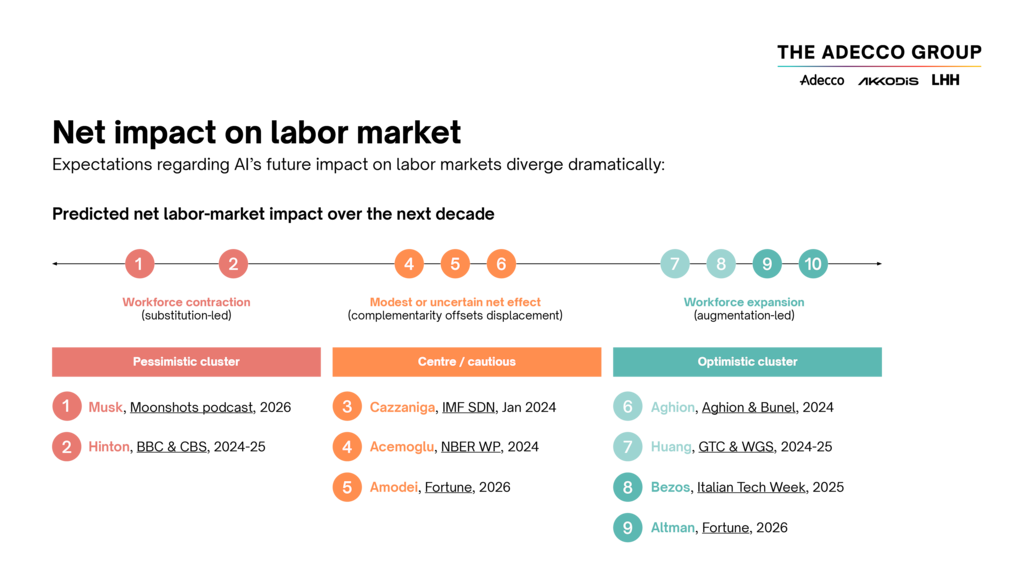
The debate about AI and work is often framed as a choice between two competing narratives: the jobs apocalypse and the accompanying FOBO (fear of becoming obsolete), or a jobs boom that sees the creation of new roles and augmentation of existing ones.
But there’s a third narrative. The evidence now points to something more complex – and more actionable. AI is neither ending work nor offering a panacea. It is forcing a reorganization of it.
The biggest redesign of jobs since the internet
To date, the biggest impact of AI has been on tasks, not entire jobs. But we’re beginning to see that AI is reshaping how work is organized, performed, valued and governed. In other words, how it is “orchestrated”.
AI can analyse data, generate content, automate processes and support decisions. In many roles, this changes what people do inside the job before it changes whether the job exists. That does not mean disruption will be small. Some roles are changing quickly. Some entry-level pathways are already under pressure. Some workers will need far more support than they currently receive. But the central labour-market challenge is not a simple story of humans versus machines.
This is why organizations must move beyond tool adoption. Hybrid workforce orchestration is how organizations redesign work, so people, AI agents, automation and physical AI each contribute where they create the most value. This is becoming a core management capability.
Workforce partners will need to help companies map tasks, redesign roles, identify skills adjacencies, support transitions and connect people to emerging areas of demand.
Four forces for AI and jobs for the next decade
We’ve analysed structural trends across a 10-year horizon in our recently published whitepaper.
AI capability will keep advancing unevenly and non-linearly. Adoption will be fast, but value will depend on whether organizations can redesign workflows. Physical AI will extend automation into more industrial and operational settings. Regulation, demographics and skills shortages will shape labour market outcomes differently across countries and sectors.
Together, these forces point to a labour market that will be more dynamic, more uneven and more dependent on deliberate workforce planning.
![A 2x2 grid plotting workforce models [Digital & autonomous vs. Hybrid] against tech concentration [Distributed vs. Centralized].](https://assets.weforum.org/editor/SHt9l1zVq_r0j0U_1uGNk7CIpW1BVwf_uvQ6_zWj5JU.png)
Why do leaders need to make deliberate choices?
A look at history gives us reason for optimism, but not for complacency.
Earlier general-purpose technologies did not create prosperity simply because they existed. The benefits came when societies made deliberate choices: investing in skills, building institutions, redesigning work, protecting trust and helping people move from declining tasks into growing areas of opportunity.
AI will be no different. Technology creates capability. People turn it into value. Whether AI becomes a driver of inclusive productivity depends less on what technology can do in principle and more on what leaders choose to do in practice.
What would action look like?
This is why we need clearer coordination between governments, employers, tech firms and labour market institutions.
Governments should modernize skills systems, labour-market policies and social protections for a world where tasks change faster than job titles. Employers should involve workers in the redesign of work before displacement happens. Tech firms should build systems that are useful, explainable and accountable. Labour-market institutions should make transitions faster, fairer and more visible.
That is how workforce partners become upstream contributors to productivity and adaptation, not downstream providers of labour alone.
This is a major shift. It is also a major responsibility. The winners of the intelligence era will combine innovation with measurable societal value.
Leadership choices are more important than ever. It’s time to make the right choices. AI needs to happen with people and not to them. The organizations that get this right will build skilled workforces and create measurable productivity gains.
The rise of hybrid labour markets
AI is often discussed as if its impact on work is already decided; machines will advance, jobs will disappear and societies will have to adapt afterwards. That is the wrong starting point. AI will not determine the future of work on its own. The choices we make now will.
The question to ask is therefore not whether AI will replace jobs, but rather how will governments, employers, tech firms and labour-market institutions collaborate and choose to deploy it. If we get this right, AI can become a powerful engine of productivity, resilience and opportunity. If we get it wrong, it could deepen inequality, weaken trust and leave too many people outside the transition.
It is clear that AI must be measured by human and business impact, not technology adoption alone. I look optimistically at the future of hybrid labour markets. It requires a different kind of leadership. We must build skills systems that anticipate change; governance that protects fairness and transparency; and labour-market institutions that help people move into new opportunities.
The future of work is not about AI alone. It will be decided by how leaders redesign work, invest in employees and create the conditions for people and technology to generate value together.
Don't miss any update on this topic
Create a free account and access your personalized content collection with our latest publications and analyses.
License and Republishing
World Economic Forum articles may be republished in accordance with the Creative Commons Attribution-NonCommercial-NoDerivatives 4.0 International Public License, and in accordance with our Terms of Use.
The views expressed in this article are those of the author alone and not the World Economic Forum.
Stay up to date:
Future of Work


Forum Stories newsletter
Bringing you weekly curated insights and analysis on the global issues that matter.
More on Jobs and the Future of WorkSee all

Rohail Iqbal
October 12, 2026


