The ‘experience dividend’: How a location can bolster job satisfaction

The ‘experience dividend’ kicks in when a city or area offers a better experience for residents and workers Image: Unsplash+/Getty Images
- The “experience dividend” is the advantage organizations gain when they locate in places where residents and workers feel the daily experience of using amenities is getting better for them.
- Counterintuitively, it's not the number of amenities in a city that drives job satisfaction; it's whether residents feel amenities have improved over time. Trajectory matters more than inventory.
- A survey of more than 80 cities reveals that the experience dividend boosts job satisfaction across almost every sector, with a 30-percentage-point gap between high- and low-tier experience cities.
The war for talent is changing and companies’ assumed knowledge of what works no longer holds true.
For decades, companies focused on factors in their control: pay, benefits, culture and management. They all still matter; however, a growing part of the talent equation now lies beyond the firm to where it is located and the qualities of that place can help attract and retain the people it needs.
Remote and hybrid work have also heightened the importance of location and given workers more flexibility, choice and the power to decide where they want to build their lives. Leading companies understand that location is a core part of talent strategy.
However, less visibly, cities can gain an edge by offering something the usual world capitals, such as London, Paris and Tokyo, do not. These usual suspects may have the most restaurants, museums, parks, universities, companies and cultural institutions but they do not always offer the easiest or most satisfying experience of using them. Congestion, cost, distance, stress and friction get in the way.
What increasingly matters to people is not the amenities available to people in cities but the experience of using them. We call this the “experience dividend” i.e. the talent advantage companies gain when they locate in cities that offer a richer daily experience for their residents and workers.
To better understand this, we draw on BCG’s Cities of Choice survey of nearly 17,000 professionals across more than 80 cities on five continents. The survey allows us to distinguish between two things that are often confused: the density of amenities a city offers and the actual experience residents have of using them.
How the ‘experience dividend’ works
We compared amenities per head and people’s experience using them with residents' happiness, satisfaction and attachment to their cities and workplaces. We then tested whether cities with the densest concentrations of experiential venues produce the most satisfied workforces.
We found that they do not. In fact, the relationship between experiential density (number of bars, restaurants, concerts, museums etc.) and job satisfaction is negative.
The cities with the most amenities are not necessarily the cities where workers are happiest or most likely to stay. What predicts satisfaction is something else: whether residents feel their city is getting better, especially in entertainment, leisure and the everyday experience of life. That is the signal corporate decision-makers should be reading: not inventory but trajectory.
That signal points to a different group of cities – places many companies have overlooked but where the experience dividend is already taking shape. Cities doing this well include Dubai in the United Arab Emirates, Bengaluru in India, Kuala Lumpur in Malaysia, New York City in the United States, Riyadh in Saudi Arabia and Baku in Azerbaijan.
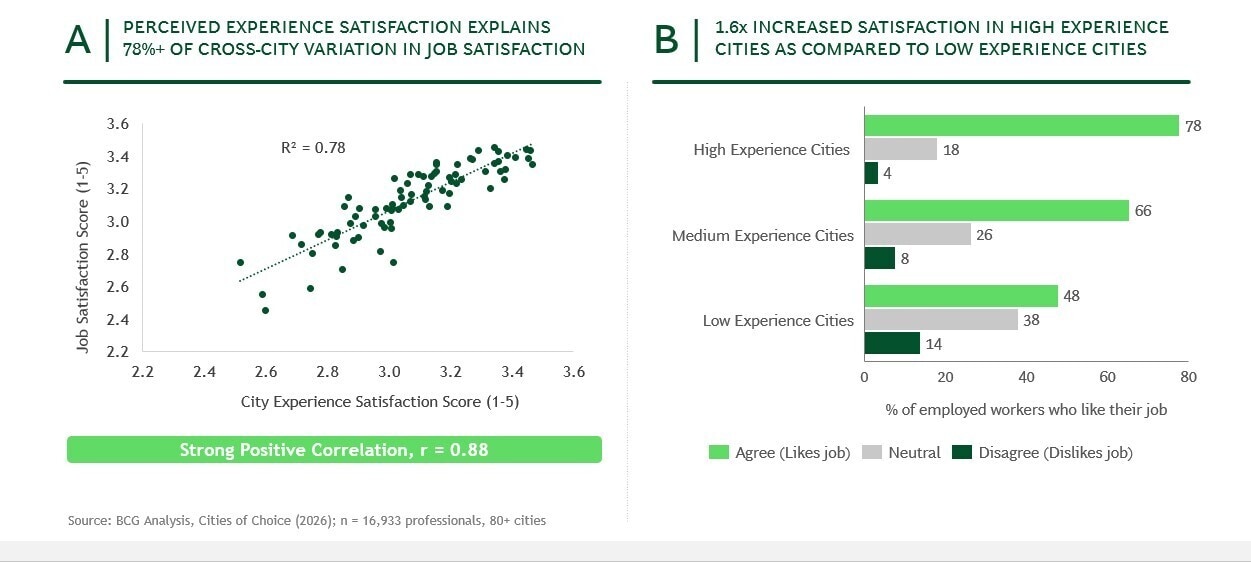
The dividend is large. In cities where residents are satisfied with the experiential quality of daily life, 78% of workers say they like their jobs. In cities where residents are not satisfied, only 48% do – a 30-point gap driven by a dimension of city life that is under almost every company’s radar (see Exhibit A).
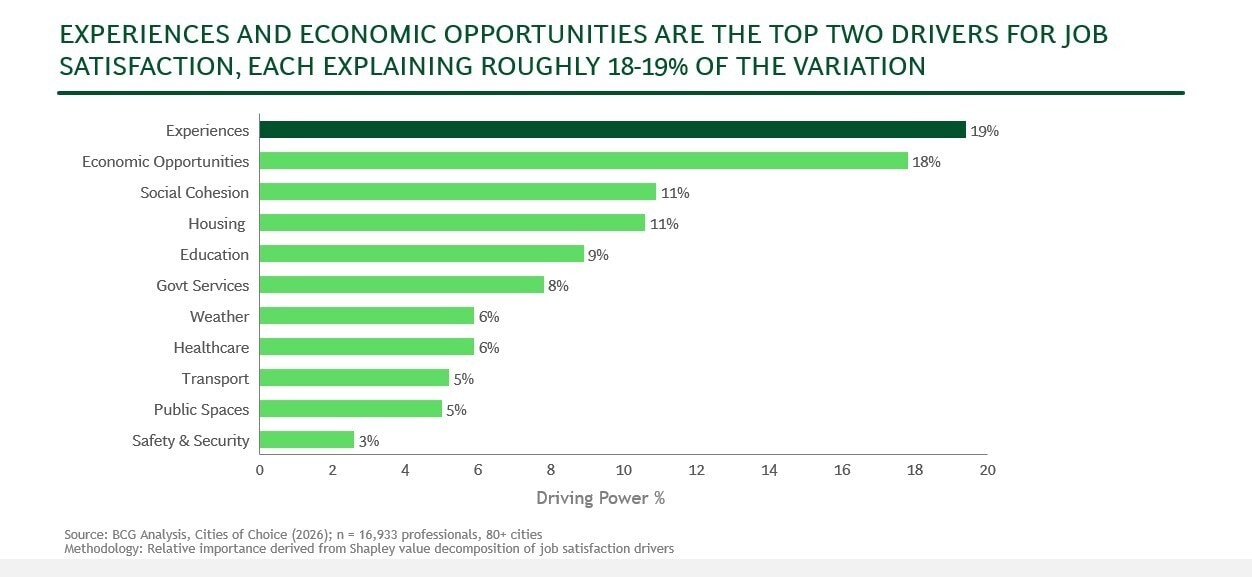
We tested 11 aspects of city life to determine which had the greatest impact on job satisfaction, including economic opportunity, housing, transportation, healthcare, education, public spaces, weather, safety, government services, social cohesion and the experience of daily life.
The experiential dimension came in essentially tied with economic opportunity. It outranked housing, healthcare, transportation and safety. Strikingly, where workers live and how they experience daily life there matters as much as what they do (see Exhibit B).
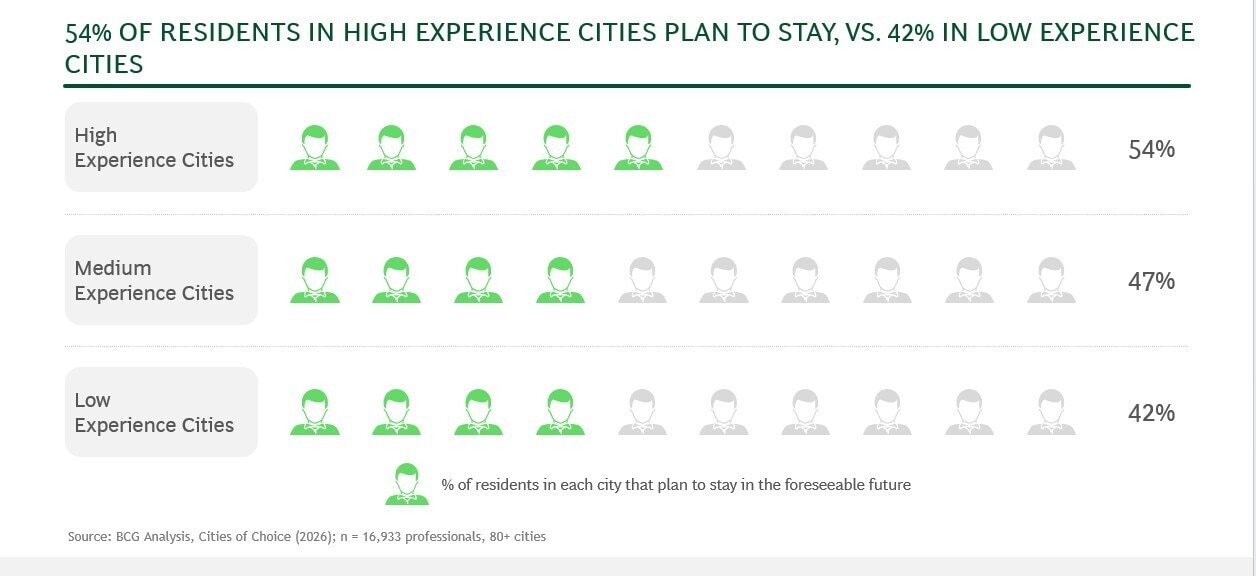
This experience dividend is especially powerful for retention. Workers in high-experience cities are 12 points more likely to say they plan to stay where they are (see Exhibit C). The effect is even larger among younger workers.
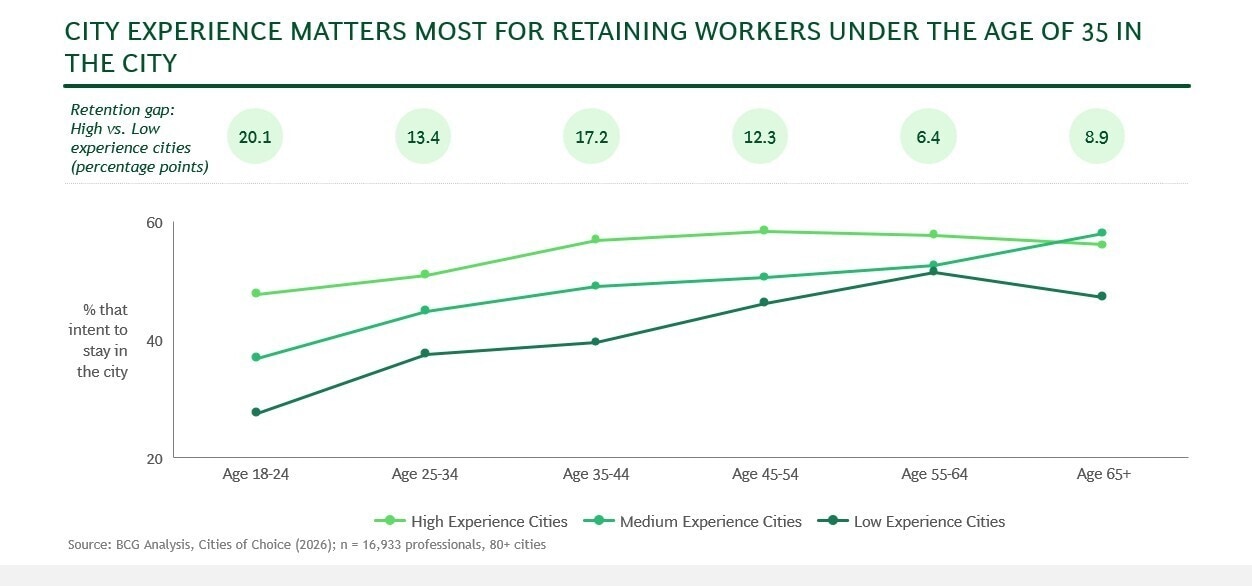
For workers under 25, the retention gap between high- and low-experience cities is 20 points. Among workers in their late 50s, it is just six points. The experience of daily life matters most to the young talent companies increasingly need and compete for (see Exhibit D).
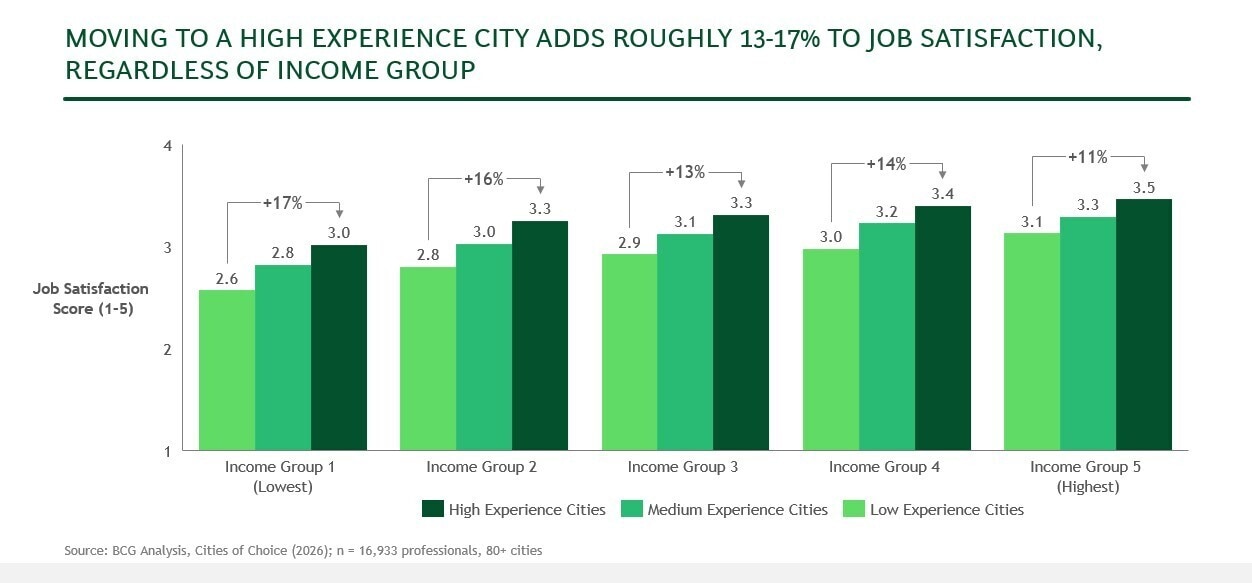
Furthermore, the dividend is broad, holding across every income level. Moving to a higher-performing city has roughly the same effect on job satisfaction as moving up an income bracket, meaning compensation alone cannot close the gap (see Exhibit E). And it is not a story about wealthy cities. When we controlled for gross domestic product per worker, the relationship was unchanged.
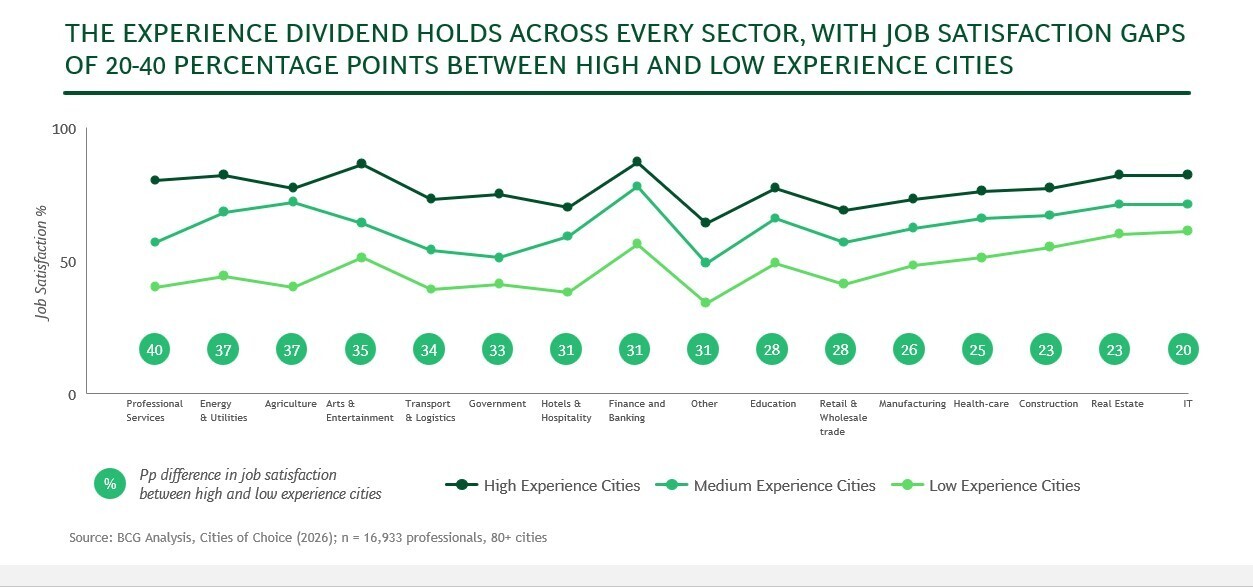
What's more, the dividend runs through every sector, from manufacturing to healthcare to agriculture. In information technology, the gap between high- and low-experience cities for job satisfaction is 20 points, despite IT being the most flexible sector for remote work (see Exhibit F).
The city itself and the experience it offers are increasingly key factors in attracting and retaining talent.
What the ‘experience dividend’ means for business and cities
For companies, the experience dividend changes the location decision. Companies still tend to think of location in terms of cost, logistics, incentives and which cities are already considered great. Those factors matter but do not answer the central question: where will people want to stay?
The answer increasingly lies in the city's experiential quality and in whether that experience is improving. The cities worth competing for are not always the established superstars but often the places on the rise, where daily life feels richer, more connected, more open and full of possibility.
Companies that see this early will gain a real advantage by choosing locations where talent will want to attach for the long term.
For cities, the experience dividend matters even more. The everyday experience of a city – its parks, public spaces, culture, nightlife, walkability, street life – is still too often treated as a lifestyle extra that comes after the real work of economic development is done. However, the experience of the city is what retains talent and a deep, stable pool of talent is what draws companies, investment and capital.
Investing in the experience of daily life is not a luxury. It is a core element of corporate location strategy and urban economic development. The cities and companies that understand this first will win the future.
Don't miss any update on this topic
Create a free account and access your personalized content collection with our latest publications and analyses.
License and Republishing
World Economic Forum articles may be republished in accordance with the Creative Commons Attribution-NonCommercial-NoDerivatives 4.0 International Public License, and in accordance with our Terms of Use.
The views expressed in this article are those of the author alone and not the World Economic Forum.
Stay up to date:
Cities and Urbanization


Forum Stories newsletter
Bringing you weekly curated insights and analysis on the global issues that matter.
More on Jobs and the Future of WorkSee all

John Letzing
September 18, 2026


