Women's leadership is missing in the jobs shaping tomorrow's economy, leaving economic opportunity on the table

Women's leadership is lacking, especially in AI and entrepreneurship Image: LinkedIn
Sue Duke
Managing Director for EMEA & LATAM and LinkedIn’s Head of Global Public Policy & Economic Graph, LinkedIn- Women's progress in leadership has stalled for a fourth consecutive year, almost doubling the time to gender parity.
- Artificial intelligence and entrepreneurship are bright spots of opportunity in a sluggish labour market and women are behind in both, leaving economic opportunity on the table.
- What's needed now is deliberate design: making the path to leadership visible, investing in skills and normalizing non-linear careers.
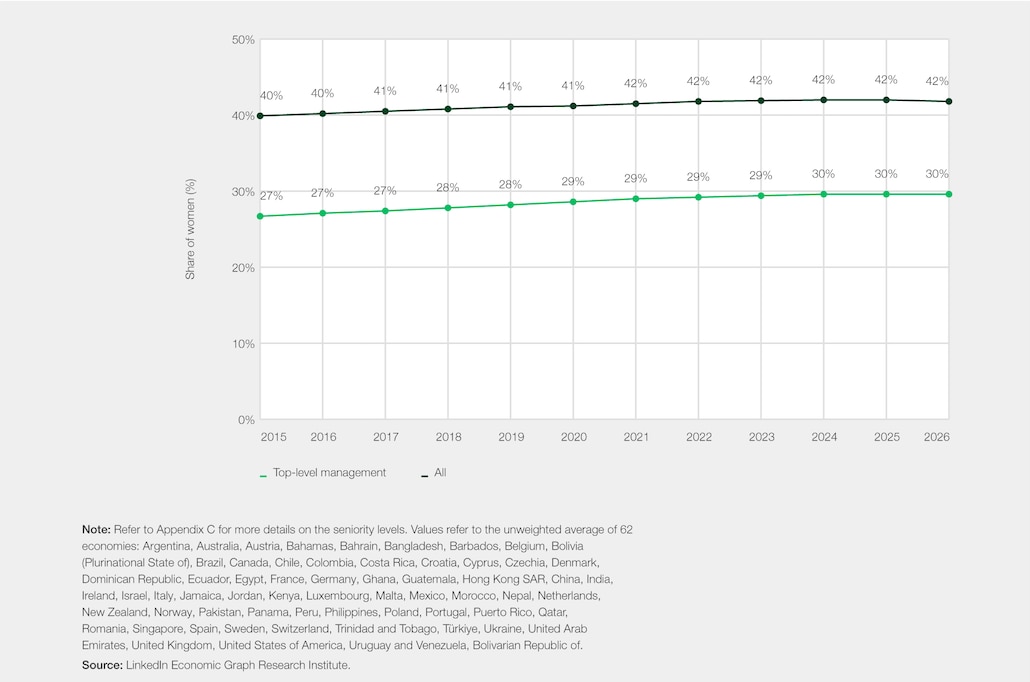
Progress towards gender parity in leadership hasn't just slowed, it’s stopped altogether for a fourth consecutive year.
As the Global Gender Gap Report 2026 reveals, while there are 3% more women in the top jobs today than there were 10 years ago, the arithmetic is sobering.
In the five years to 2020, we were on track to close the leadership gap within 50 years. LinkedIn Economic Graph data used in the report shows that at the rate of progress since, it's 90. Put into perspective, a girl born today may not see equal leadership representation in her lifetime.
The drop to the top is leaving talent on the table
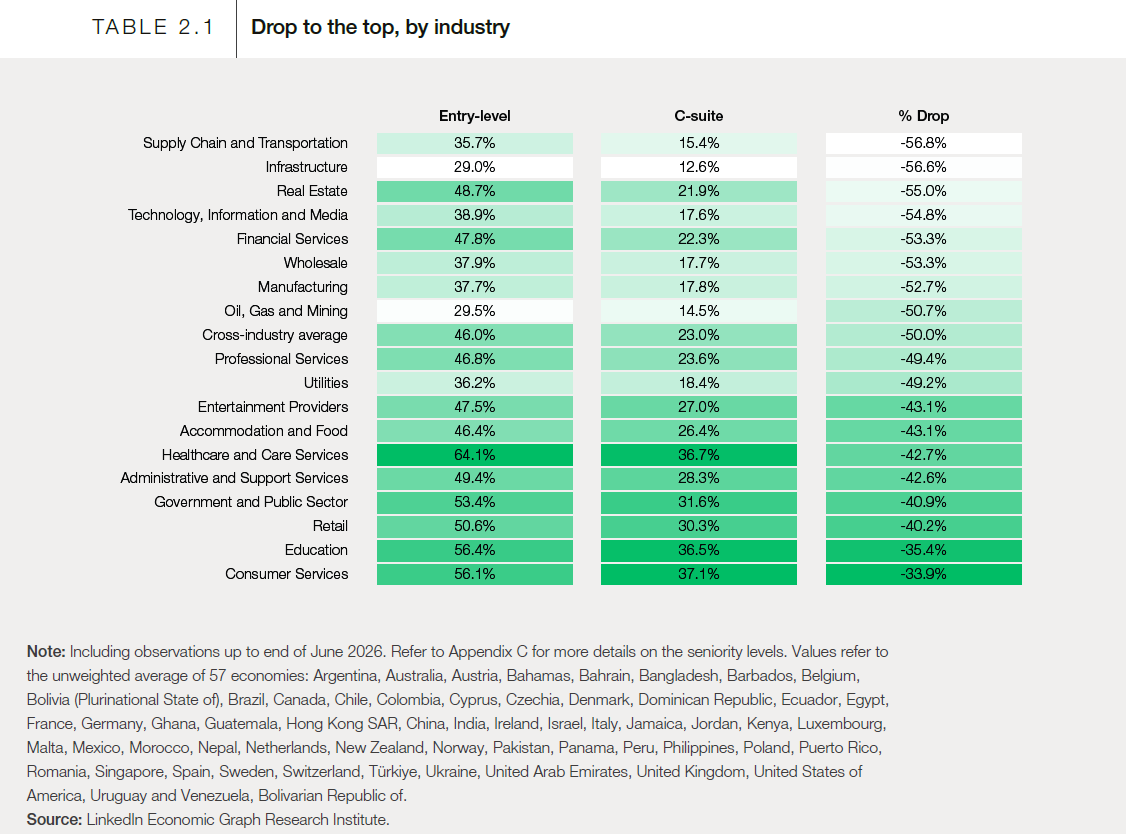
Further data illustrated in the report, shows that women enter the workforce in near-equal numbers to men, making up 46% of workers at entry level. However, we lose them on the journey to the top, with representation halving to 23% in the C-suite. The steepness of this drop to the top reflects structural barriers, not supply.
Career breaks very clearly demonstrate how the gap compounds. The same data indicates women are more than four times as likely as men to take a career break for full-time parenting (26.5% compared to 6.0%), and 55% more likely to take a career break at all.
The penalty comes on the way back. The data found that men who are senior individual contributors in a company and take a full-time parenting break are 44% more likely than women to be promoted in their first year back. Three years on, men remain around 39% more likely to have progressed. It’s the same break with very different consequences.
The variation in industries and roles is telling too. The drop to the top is steepest in industries including transport, construction and technology, where women’s representation more than halves between entry level and the C-suite (Table 2.1). Consumer services and education have the shallowest drops, each around a third.
When women do reach the C-suite, they’re more likely to land in specific roles, making up 65% of chief people officers, 64% of chief HR officers and 45% of chief marketing officers. In contrast, women are underrepresented in roles with the most operating responsibility, making up 27% of chief financial officers, 24% of chief operating officers and just 19% of CEOs.
The engines of new economic value are being built with the old architecture
The ground is moving quickly in how the labour market is structured. Artificial intelligence (AI) and entrepreneurship are redrawing where economic opportunity gets created and women are behind in both.
On AI, the hiring data is stark. LinkedIn Economic Graph data shows that in the United States, women accounted for a quarter (26%) of new hires into AI roles last year, against half (50%) of new hires into non-AI roles – and around the world, women make up just 13% of C-suite AI executives at AI companies.
At the same time, women make up 57% of workers in occupations most likely to be disrupted by generative AI, against 43% for men.
AI is also reducing barriers to entrepreneurship, which is booming against the backdrop of a sluggish labour market. The number of people adding founder titles has more than tripled since 2022 in the United States.
Yet the share of those founders who are women has been flat at around 28% since 2021. And as AI becomes evermore central to starting and scaling a business, a new gap is emerging: 15% of male founders now list AI skills compared with just 9% of women.
Have you read?
We know where the barriers are, so we know where to intervene
Trajectories can change and the data also points to what works.
- Measure for accountability: Understand the representation of women in leadership and AI roles at your company and ensure accountability exists at senior levels.
- Build bridges: Current C-suite leaders should aim to identify and sponsor high-performing women. Make the introductions, provide the coaching and opportunities to learn.
- Future-proof the workforce: Invest in science, technology, engineering and mathematics (STEM) and AI education as well as upskilling programmes for women to build technical capabilities, ensuring female talent is equipped for the AI economy. Access to early-career opportunities fuels the pipeline for leadership and hiring based on skills can increase the proportion of women in candidate pools by 24%.
The business case is straightforward. Failing to address these barriers will overlook experienced, capable women and shrink the pool of talent companies can draw on for future leadership at exactly the moment competition for skills is intensifying.
With the economy being rapidly transformed, we simply cannot afford to leave half of the workforce behind. We have the diagnosis, what's needed now is to act on it.
Don't miss any update on this topic
Create a free account and access your personalized content collection with our latest publications and analyses.
License and Republishing
World Economic Forum articles may be republished in accordance with the Creative Commons Attribution-NonCommercial-NoDerivatives 4.0 International Public License, and in accordance with our Terms of Use.
The views expressed in this article are those of the author alone and not the World Economic Forum.
Stay up to date:
Gender Equality


Forum Stories newsletter
Bringing you weekly curated insights and analysis on the global issues that matter.
More on Equity, Diversity and InclusionSee all

Yanjun Guo and Kim Piaget
September 16, 2026