Which businesses are most affected by Europe’s heatwaves?
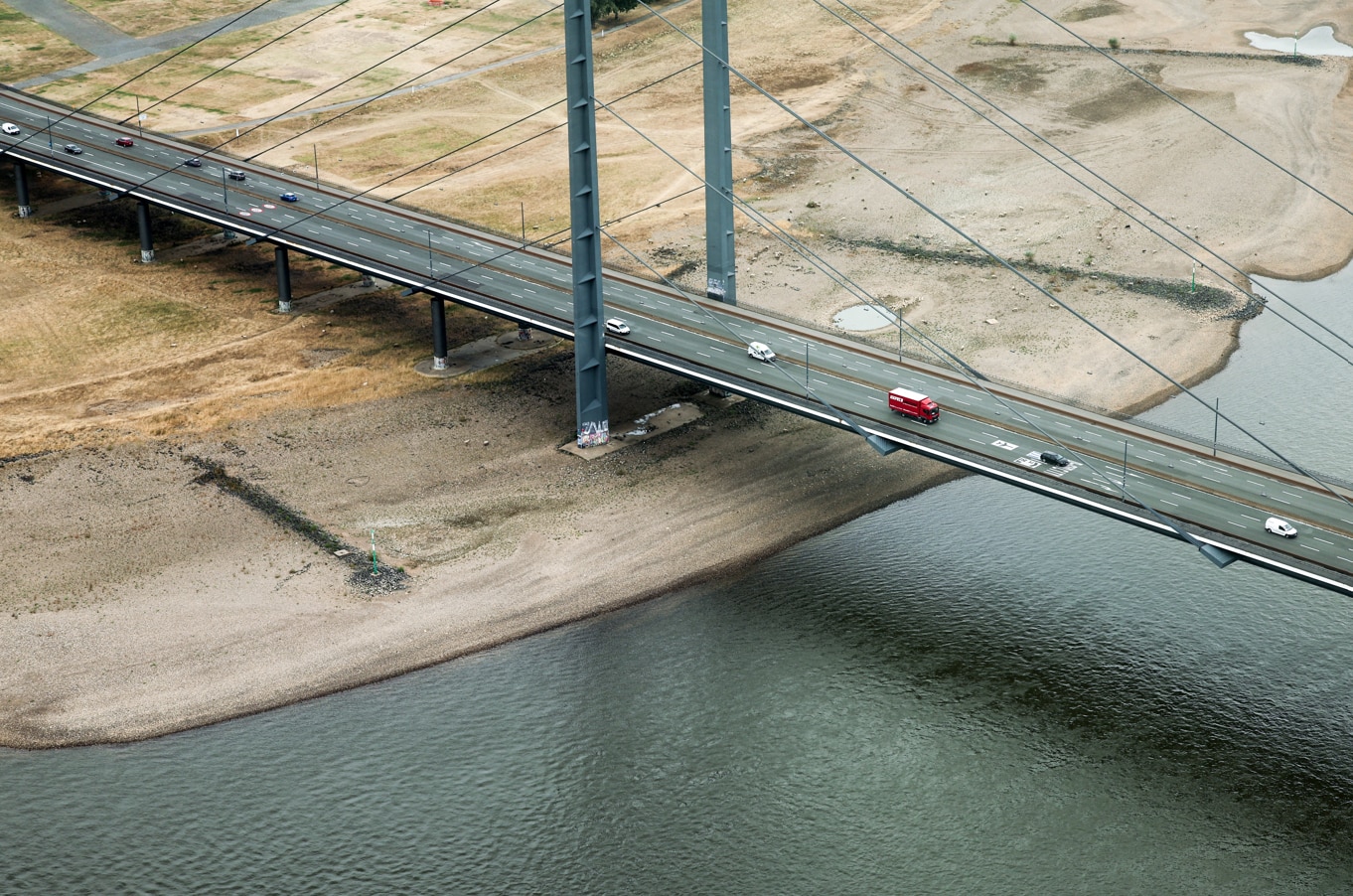
Europe’s waterways are under pressure – Germany’s Rhine has fallen to record-low levels, disrupting logistics, supply chains and services. Image: REUTERS/Leon Kuegeler
- A summer of heatwaves, wildfires and unusually dry weather has left Europe's soils and water supplies depleted, with major rivers at record lows.
- And there are consequences for the economy: heatwaves can disrupt work, power systems and tourism; drought restricts freight, crops and energy generation. Yet many businesses still lack practical climate-risk plans.
- The Forum’s Board Leadership for Growth and Resilience report sets out how leaders can turn growing climate and nature risks into action through stronger oversight, strategy and risk management.
A drying river can halt a factory’s supplies, reduce a power station’s output, strand a cruise ship and leave a farmer without irrigation water – all at the same time.
That is the business reality behind Europe’s increasingly hot, dry summers. In 2026, prolonged low rainfall and repeated heatwaves have left soils unusually dry, reduced river levels and contributed to devastating wildfires across parts of the continent.
Monthly temperatures in many countries soared 5°C to 12°C above seasonal averages – and by late July, around half of EU and UK territory was experiencing drought conditions, according to the European Commission, while the Rhine, Danube, Loire and Po were among rivers reaching record-low levels in August.
The disruption is not confined to companies in the direct path of climate hazards. It can move through freight corridors, electricity grids, agricultural supply chains and tourism economies. So which businesses are most affected – and what does a more resilient response look like?
Freight and logistics
Transport and logistics businesses are among the most directly exposed because Europe’s major rivers serve as both trade routes and water sources.
The Rhine connects industrial regions across Switzerland, France, Germany and the Netherlands. When its level falls, barges must reduce their loads to avoid grounding. The Financial Times (FT) reported in August 2026 that cargo vessels travelling to and from Rotterdam were being loaded to around 30% capacity. This required operators to use approximately 100 extra barges each week, while still failing to carry former volumes of chemicals, oil and other goods.
Inland shipping operators, ports, freight forwarders and barge operators are therefore particularly affected, as are manufacturers that rely on river-borne raw materials. A low river can delay deliveries, raise freight bills and shift more cargo to land transport. The problem is especially acute for firms with highly time-sensitive or bulky supplies, including fuels and agricultural commodities.
Farms and food businesses
Farmers are often the first to experience drought directly, but food companies can feel its effects throughout the value chain. Agricultural workers are on the front lines: 68% of farm workers in the EU report being exposed to high temperatures for a quarter or more of their working hours.
High temperatures and water shortages can damage crops at critical stages of growth, reduce pasture available for livestock and restrict irrigation. Across western and central Europe, lower harvests are likely to put further pressure on food producers and retailers, as reduced crop availability and higher farm costs feed through. The European Commission’s latest crop-monitoring bulletin predicts that EU summer-crop yields could fall by as much as 14% below the five-year average, with local crop failures possible in the hardest-hit areas.
The pressure spreads rapidly downstream – from food processors and commodity traders to supermarkets and hospitality brands. Drought conditions could halve France’s maize crop, analysts project, illustrating how a regional weather shock can quickly become a supply-chain and pricing problem for the wider food economy.
Financially, the burden is compounding. OECD data show global drought losses rising by 3% to 7.5% annually, with agriculture worst affected – an average drought in 2025 was twice as costly as one in 2000, and costs are projected to rise another 35% by 2035.
And these disruptions extend beyond Europe’s consumers and businesses. The EU was the world’s largest agri-food exporter in 2025, selling a record $276.5 billion of products abroad – equivalent to 9% of all EU exports – so weaker harvests can affect global buyers as well as domestic food supplies.
Tourism, work, data and energy
Heatwaves, wildfires and low water levels can quickly disrupt tourism at the height of the season. In August, wildfires in tourist areas of Croatia, France, Germany and Greece prompted evacuations and injuries, while low water on the Rhine and Danube forced some river-cruise operators to cancel or alter itineraries. That leaves cruise companies, hotels, restaurants, event businesses and destination economies exposed – not only to lost bookings, but to transport disruption and changing visitor behaviour.
Businesses that rely on outdoor or non-air-conditioned work also face a direct heat risk. Construction, farming, delivery, transport and hospitality employers, for example, may need to change shifts, increase breaks or reduce activity when conditions become unsafe, according to EU-OSHA guidance.
Lost labour productivity was the largest contributor to the estimated $208 billion economic toll of Europe’s extreme summer heat, according to Triodos Bank analysis widely cited. The impact can be sharp and localized: a single week of extreme heat in June 2026 cost the UK economy an estimated 24 million lost work hours and £1.15 billion in productivity losses.
Data centres face a different constraint: access to water for cooling. Rapid expansion is increasingly intersecting with water scarcity, particularly in southern Europe, where data-centre developments are planned in regions already experiencing high water stress. Local water availability and cooling-system design are therefore material considerations for the sector.
Meanwhile, power generation can hit physical limits during summer heatwaves. Operator EDF regularly cuts nuclear output in France when river temperatures exceed safe discharge limits, while dried-out reservoirs reduce hydropower, according to energy think tank Ember. These constraints force utilities to lower supply precisely as peak summer cooling demand surges.
From exposure to resilience
Businesses depend on water, power, transport, agricultural inputs and workers who can operate safely in the heat – yet many have not converted those dependencies into climate-resilience plans. According to the FT, 42% of EU businesses experienced higher climate-related costs over the past year, while just 15% had completed a formal adaptation plan. Meanwhile, a new Forum report finds that 50% of companies have yet to assess workforce heat risks due to financial, organizational and technical hurdles.
That gap matters because the cost of extreme heat and water stress is not limited to a single lost harvest or delayed shipment. World Economic Forum analysis in Business on the Edge warns that heat hazards threaten fixed assets, with businesses potentially facing annual earnings losses of 6.6%-7.3% by 2035.
To close this gap, the Forum’s Board Leadership for Growth and Resilience report outlines how directors can turn physical climate risks into corporate strategy through stronger oversight, risk management and adaptation. The guidance across both frameworks is clear: companies must decarbonize, protect natural systems and treat water, energy and heat-safe working conditions as core operational dependencies before the next heatwave exposes them.
License and Republishing
World Economic Forum articles may be republished in accordance with the Creative Commons Attribution-NonCommercial-NoDerivatives 4.0 International Public License, and in accordance with our Terms of Use.
The views expressed in this article are those of the author alone and not the World Economic Forum.

Forum Stories newsletter
Bringing you weekly curated insights and analysis on the global issues that matter.