5 actions CEOs can take to shift the dial on mental health at work

Mental health issues in the workplace can impact productivity, staff satisfaction and customer relationships. Image: Curated Lifestyle/Unsplash
- Mental health is as much a business issue as a people one, because it can also negatively impact productivity and overall company performance.
- CEOs need to treat mental health as a leadership priority and consider how to make it part of the working culture of the organization, for everyone's benefit.
- The Mental Health: A CEO Imperative for Sustainable Business Performance toolkit outlines five actions that leaders can take to improve workplace mental health.
Mental health is often discussed as a personal issue, a healthcare issue or an employee-benefits issue. However, it is increasingly also a business issue that sits squarely within the responsibilities of CEOs and senior leaders because it is linked to employee engagement, productivity and sustainable business performance.
Work can be a source of purpose, connection and stability. But poor work design, excessive workloads, limited autonomy, job insecurity, toxic culture and inadequate support can also harm people’s mental health.
These risks affect more than individual employees as they negatively influence productivity, retention, innovation, customer relationships and the resilience of organizations.
Impact of mental health on the workforce
The scale of the challenge is significant. According to the World Health Organization (WHO), an estimated 15% of working-age adults live with a mental disorder, while depression and anxiety are estimated to result in 12 billion lost working days each year, at a cost of approximately $1 trillion in lost productivity.
Yet these figures capture only part of the picture. They do not fully reflect the impact of disengagement, presenteeism, turnover, reduced creativity or the effects on families and communities.
This makes mental health at work an important leadership priority now. Importantly, given the rapid technological disruption, geopolitical uncertainty, economic pressure and persistent talent shortages, a resilient workforce that can adapt, perform and recover is a strategic asset.
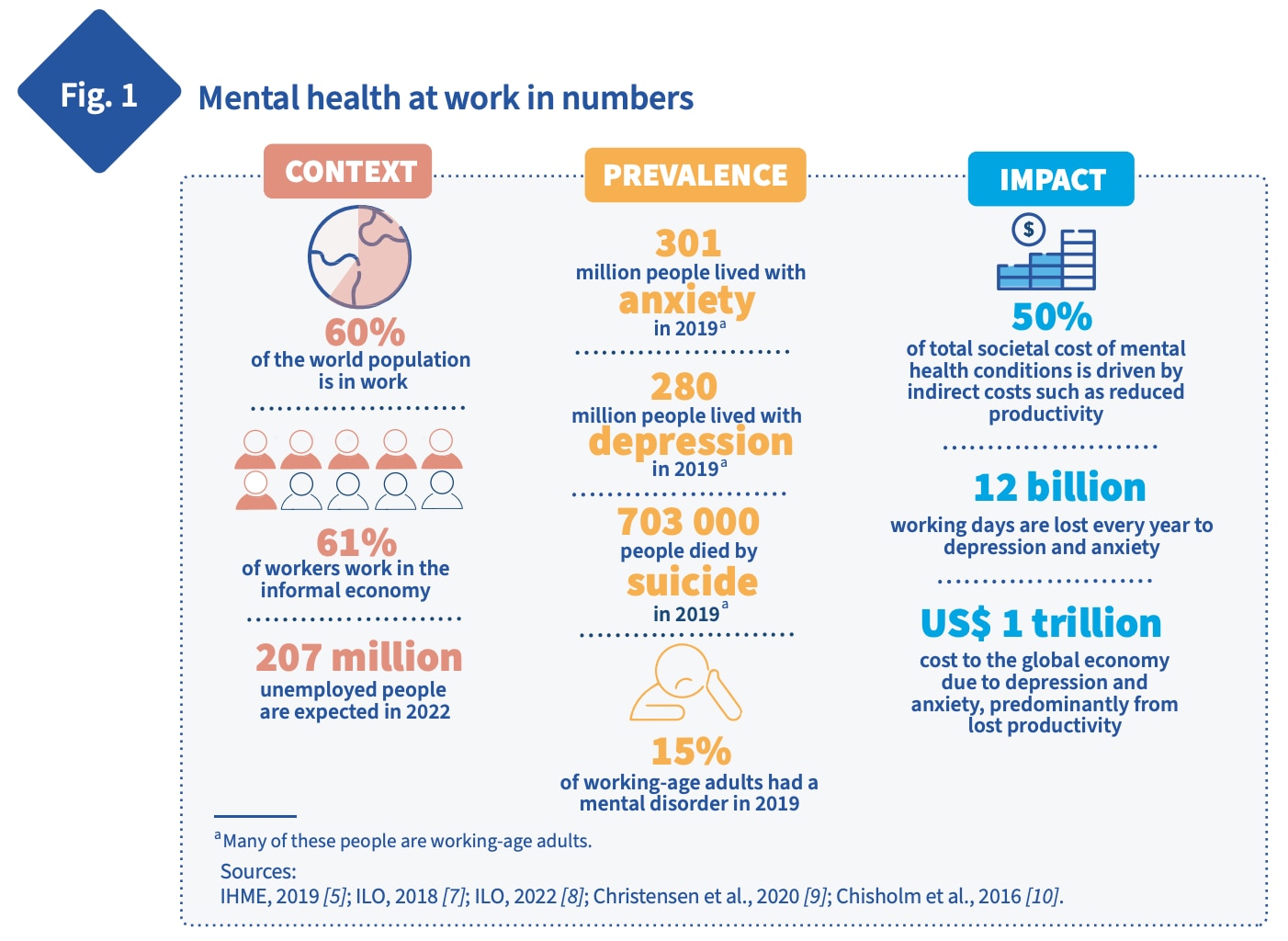
Therefore, the question for CEOs is no longer whether mental health matters. It is how to make it part of the working culture of the organization.
The WHO and International Labour Organization’s (ILO) framework on mental health at work calls on employers to prevent harm, protect and promote mental health, and support people living with mental health conditions.
Translating this framework into action requires more than launching another well-being initiative. It requires changes to governance, work design, leadership capability, access to support and measurement.
5 actions for CEOs to act on mental health at work
The Chief Health Officers Community at the World Economic Forum has developed a practical CEO toolkit, Mental Health: A CEO Imperative for Sustainable Business Performance, to help leaders take those steps.
Its central message is simple: mental health should be treated as an enterprise risk and a foundation of sustainable business performance.
Here are five actions CEOs and C-suite leaders can take.
1. Treat mental health as an enterprise risk
Mental health risks should be identified and managed alongside other material risks facing the organization. CEOs can require the workforce health lead to identify key psychological risks, assign executive ownership and report progress through established risk-governance processes.
This helps move mental health from the margins of the organization into regular leadership discussions. It also creates accountability for addressing foreseeable and manageable risks.
2. Redesign work, not only the support programme
Employee assistance programmes and counselling services can be valuable, but they cannot compensate for work that is structurally harmful.
The most important interventions may involve the fundamentals of work: manageable workloads, role clarity, predictable scheduling, sufficient recovery time, autonomy, inclusion and opportunities for progression.
CEOs should ask leaders in high-attrition or high-pressure functions to identify the structural causes of distress and assess whether changes improve both employee experience and workforce outcomes.
This is consistent with the WHO guidelines on mental health at work, which emphasize preventing psychosocial risks through organizational interventions, rather than relying solely on individual resilience.
3. Equip managers to support people
Managers translate organizational strategy into employees’ daily experience. They do not need to become mental health professionals, but they do need the skills to recognize workplace stressors, manage workloads, respond to distress with compassion and escalate concerns appropriately.
Evidence suggests that training workplace managers can improve their knowledge, attitudes and confidence in supporting employees with mental health needs. CEOs should therefore make evidence-based manager training part of the organization’s leadership expectations and include supportive leadership and responsible workload management in performance and promotion criteria.
4. Build support and recovery routes people trust
Support must be confidential, practical and accessible to all workers, including frontline, shift-based, remote, part-time and contract workers.
Employees need to know who and where to seek support from, what support is available and how their privacy will be protected. Organizations should map mental healthcare pathways, address gaps in access and establish clear standards for confidentiality. They should also ensure that people can seek help without stigma or fear of career consequences.
A trustworthy system is one that supports prevention and early intervention, while also enabling people experiencing mental health conditions to remain in, or return to, work where possible.
5. Measure, learn and close the loop
What gets measured signals what leadership considers important. The purpose of measurement should not be surveillance. It should be to identify where conditions need to improve and whether leadership action is making a difference. CEOs should review progress regularly and require corrective action where results are insufficient.
Research from the World Economic Forum and McKinsey Health Institute also points to the broader value of investing in workforce health. Healthier workplaces can benefit employees and societies while supporting productivity and business performance.
Mental health at work is not a separate initiative owned by one department. It is shaped by the decisions CEOs make about strategy, operating models, leadership, performance and investment.
World Mental Health Day is an opportunity to renew attention to the issue. But meaningful progress will depend on what happens after the awareness campaign ends: whether leaders redesign harmful work, equip managers, improve access to care and hold themselves accountable for results.
The organizations best positioned for the future will be those that understand a healthy workforce is not only an ethical responsibility. It is a prerequisite for sustainable performance.
This article is based on the CEO toolkit, Mental Health: A CEO Imperative for Sustainable Business Performance, developed by the Mental Health at Work Working Group within the World Economic Forum’s Chief Health Officers Community.
Don't miss any update on this topic
Create a free account and access your personalized content collection with our latest publications and analyses.
License and Republishing
World Economic Forum articles may be republished in accordance with the Creative Commons Attribution-NonCommercial-NoDerivatives 4.0 International Public License, and in accordance with our Terms of Use.
The views expressed in this article are those of the author alone and not the World Economic Forum.
Stay up to date:
Mental Health


Forum Stories newsletter
Bringing you weekly curated insights and analysis on the global issues that matter.
More on Wellbeing and Mental HealthSee all

Jan-Willem Scheijgrond and Hervé Balzano
September 28, 2026


