COP30 in Brazil: What is at stake for global collaboration on climate and nature?
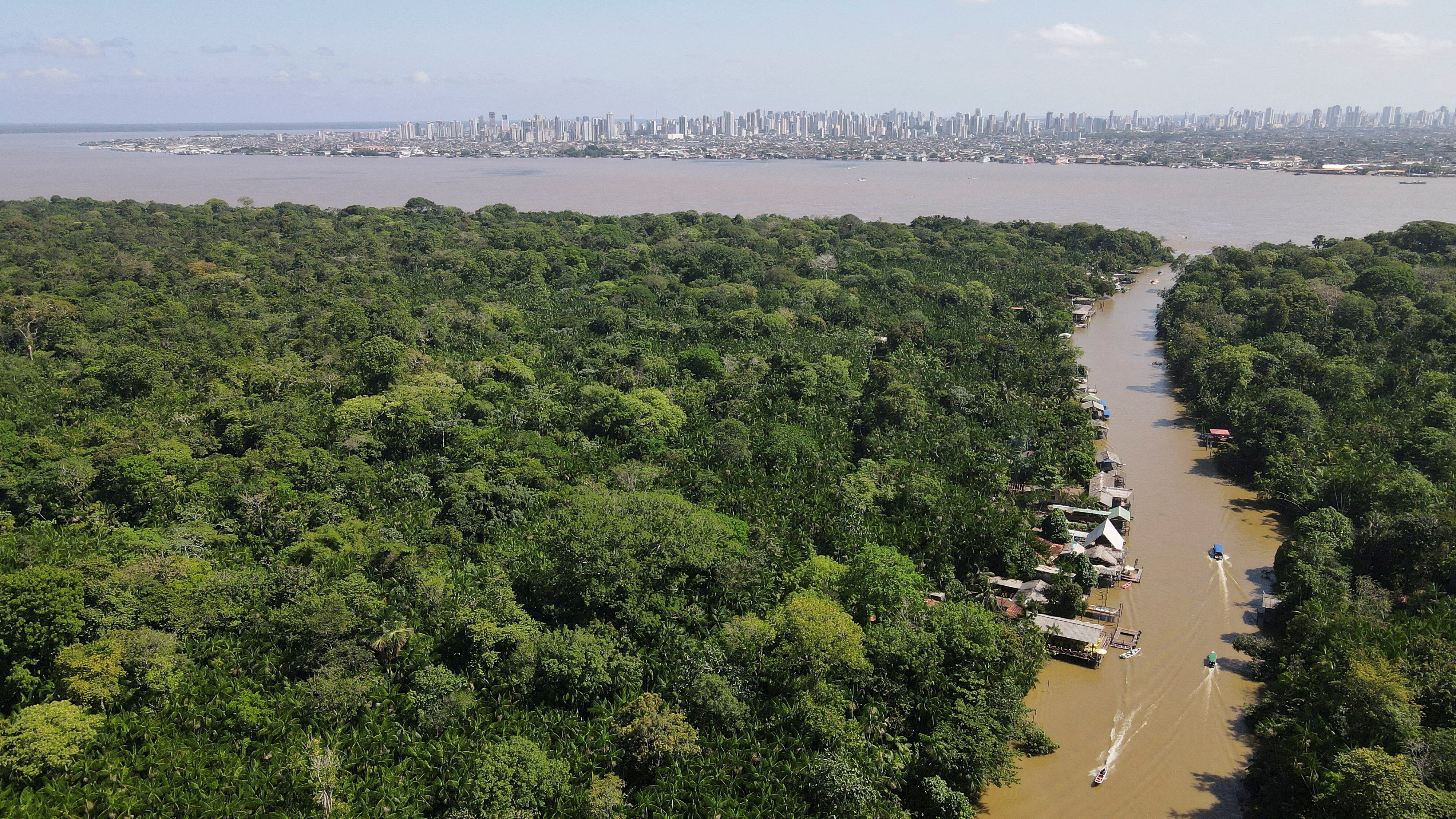
Belém, Brazil, on the horizon above the Amazon rainforest, will host COP30 between 10-21 November. Image: REUTERS/Anderson Coelho/File Photo
- COP30 is the next meeting of the 198 signatories (Parties) to the UN Framework Convention on Climate Change, taking place in Belém at the gateway to the Amazon, Brazil, 10-21 November.
- Countries' new and revised Nationally Determined Contributions (NDCs 3.0), financing resilience and nature, food systems transformation and ensuring a just transition are among the items on the agenda.
- Coming at a critical juncture for multilateralism, the meeting is a moment to reignite global collaboration on climate and to mobilize multistakeholder action to increase systems resilience in a world with increased climate and nature impacts.
As the world gathers in Belém, Brazil, for the 30th UN Climate Change Conference (COP30) from 10-21 November, the stakes are high.
This climate summit marks a pivotal moment – a full decade after the Paris Agreement was adopted in 2015 – when the climate agenda confronts a fundamentally transformed global landscape.
While governments once led the charge on climate action with unprecedented political support, the challenge today is different.

The private sector is now mobilized, green markets are forming and real economy transformation is picking up speed.
Yet, as policy ambition is declining, the gap between what is needed and what governments are committing to do remains perilously wide.
COP30 represents a critical moment for assessing whether the mechanisms established by the Paris Agreement are actually delivering results.
Remarkably, the business case for climate action has become increasingly compelling.
The World Economic Forum's Alliance of CEO Climate Leaders – representing $4 trillion in revenues across 130+ companies – has demonstrated that between 2019 and 2023, members reduced aggregate emissions by 12% while growing revenues by 20%.
The global market for green technologies, including solar photovoltaics, wind turbines, electric vehicles, and batteries, has nearly quadrupled since 2015 to exceed $700 billion annually, a testament to the commercial viability of the climate economy.
Yet this private-sector momentum faces growing headwinds from policy uncertainty, fiscal pressures and geopolitical tensions.
COP30 must reignite the political will necessary to unlock the historic economic opportunity that climate action represents.
Addressing the NDC ambition gap
A critical challenge emerging ahead of COP30 concerns national climate plans.
By 2025, countries were required to submit their third generation of Nationally Determined Contributions – NDCs 3.0 – representing their most ambitious climate pledges yet. These updated NDCs, covering the 2025-2035 period, must demonstrate significant progression and align with the 1.5°C temperature goal.
But progress has been sluggish. At the time of writing, 69 major economies, representing 61% of greenhouse gas emissions (GHG), have submitted these plans, according to the ClimateWatch NDC Tracker, with China submitting on 3 November.
In a pre-COP30 interview with The Guardian, UN Secretary-General António Guterres warned in October: “From those [NDCs] received until now, there is an expectation of a reduction of emissions of 10%. We would need 60% [to stay within 1.5°C]. So overshooting is now inevitable.”
The first Global Stocktake, completed at COP28 in 2023, made clear that current global policies are setting the world toward 3°C of warming – well above safe limits. Without stronger national commitments, the window to prevent catastrophic climate impacts will close.
In its latest synthesis report, published on 28 October, the UN Framework Convention on Climate Change (UNFCC) assessed the impact of the NDCs set by 64 countries recorded between January 2024 and September 2025. It noted countries appear to be "bending their emission curve downward" and asserted:

"The whole-of-economy, whole-of-society approaches evident in NDCs point to strong climate action as an increasingly core pillar of ensuring economic stability and growth, jobs, health, and energy security and affordability, among many other policy imperatives, in countries.
"However, it remains clear that major acceleration is still needed in terms of delivering faster and deeper emission reductions and ensuring that the vast benefits of strong climate action reach all countries and peoples."
Momentum on the NDCs does appear to be growing ahead of COP30. At a Climate Summit hosted by UN Secretary-General António Guterres on the fringes of the UN General Assembly in New York in September, around 100 countries, representing two-thirds of global GHG emissions submitted or unveiled new NDCs. And, for the first time, major economies including China – the world’s largest emitter – and Nigeria announced economy-wide emissions reduction targets covering all GHGs and all sectors.
Action on nature and climate
Nature conservation is firmly embedded on the COP30 agenda. Hosting the summit in Belém, at the gateway to the Amazon rainforest, which holds approximately 60% of the world's largest tropical forest, sends an unmistakable message. Nature is no longer a side issue; it is central to climate survival.
Forests sequester carbon, regulate water and soil systems, and support biodiversity – BCG estimates the value of forests at approximately $150 trillion. But 6.7 million hectares of primary tropical forest were lost in 2024 alone, up 80% from 2023 and largely due to fires.
A landmark initiative taking centre stage at COP30 is the Tropical Forest Forever Facility, designed to provide long-term, predictable financing to countries that conserve and restore tropical forests.
Over the long term, this blended finance fund, composed of sponsor contributions and debt issued as fixed-income bonds, could be worth $125 billion and channel up to $4 billion annually to eligible nations for maintaining their tropical forests.
At least 20% would go directly to Indigenous Peoples and local communities who are proven stewards of forest ecosystems. This mechanism represents a paradigm shift: compensating nations for protecting nature rather than exploiting it.
The Forum's 1t.org aims to mobilize, connect and empower the global reforestation community to conserve, restore and grow a trillion trees by 2030. Designed to accelerate nature-based solutions, it was set up to support the UN Decade on Ecosystem Restoration (2021-2030).
The financing imperative
The COP30 President, Andre Correa do Lago, told Reuters Brazil wants to help developing countries secure more funding for climate mitigation and resilience efforts.
COP29 in Azerbaijan established a new Baku Finance Goal of delivering at least $300 billion annually for developing countries by 2035.

Yet this figure falls dramatically short of the much larger $1.3 trillion annual target needed by vulnerable nations to address climate impacts. Also known as the new collective quantified goal, or NCQG, it calls on countries to mobilize $1.3 trillion in international climate finance by 2035.
While wealthy nations pledged to meet the $300 billion commitment, the pathway to scaling finance to $1.3 trillion remains murky. Most critically, governments acknowledge that private-sector investment must become the primary driver of this scaling, yet concrete mechanisms to mobilize private capital at scale remain underdeveloped.
Meanwhile, the UN Environment Programme's Adaptation Gap Report 2025 estimates the world will need approximately $310 billion annually to adapt to climate impacts – rising sea levels, heat extremes and intensifying storms.
Current adaptation spending stands at only $26 billion annually, roughly 12 times below what is needed.
COP30 must produce breakthrough commitments on adaptation finance and finalize a "Baku to Belém Roadmap" detailing how to bridge this gap through public, private, philanthropic and multilateral development bank sources.
Food systems and agricultural transformation
Agriculture and Food Systems are among the six Thematic Axes on the COP30 Action Agenda – mobilizing voluntary climate action from civil society, businesses, investors, cities, states and countries.
Around a third of global GHG emissions stem from agriculture and land use, and Brazil stands as a global Agri-food powerhouse.
At the World Economic Forum, the First Movers Coalition for Food works with Brazilian and global industry leaders, together with farmers, governments and academia to unlock the power of aggregated procurement and market demand for scaling adoption of resilient food production.
Brazil's Na Mesa da COP30 initiative ensures that at least 30% of food served at the conference originates from family farmers and agro-ecological producers, embedding sustainability into the summit itself.
An agenda of implementation
COP30 is distinctly framed as "the COP of implementation" – a turning point where negotiated commitments finally translate into tangible action.
With private-sector momentum growing, innovative financing mechanisms launching and nature formally integrated into climate strategy, this summit represents an unprecedented opportunity.
Whether governments, business, and civil society can collectively answer that call will determine whether the next decade delivers the transformational change that climate science demands.
License and Republishing
World Economic Forum articles may be republished in accordance with the Creative Commons Attribution-NonCommercial-NoDerivatives 4.0 International Public License, and in accordance with our Terms of Use.
The views expressed in this article are those of the author alone and not the World Economic Forum.

Forum Stories newsletter
Bringing you weekly curated insights and analysis on the global issues that matter.
More on Climate Action and Waste Reduction See all

Johan Falk and Owen Gaffney
September 29, 2026


