3 messages to young people from leaders at Davos on how to grow up with AI
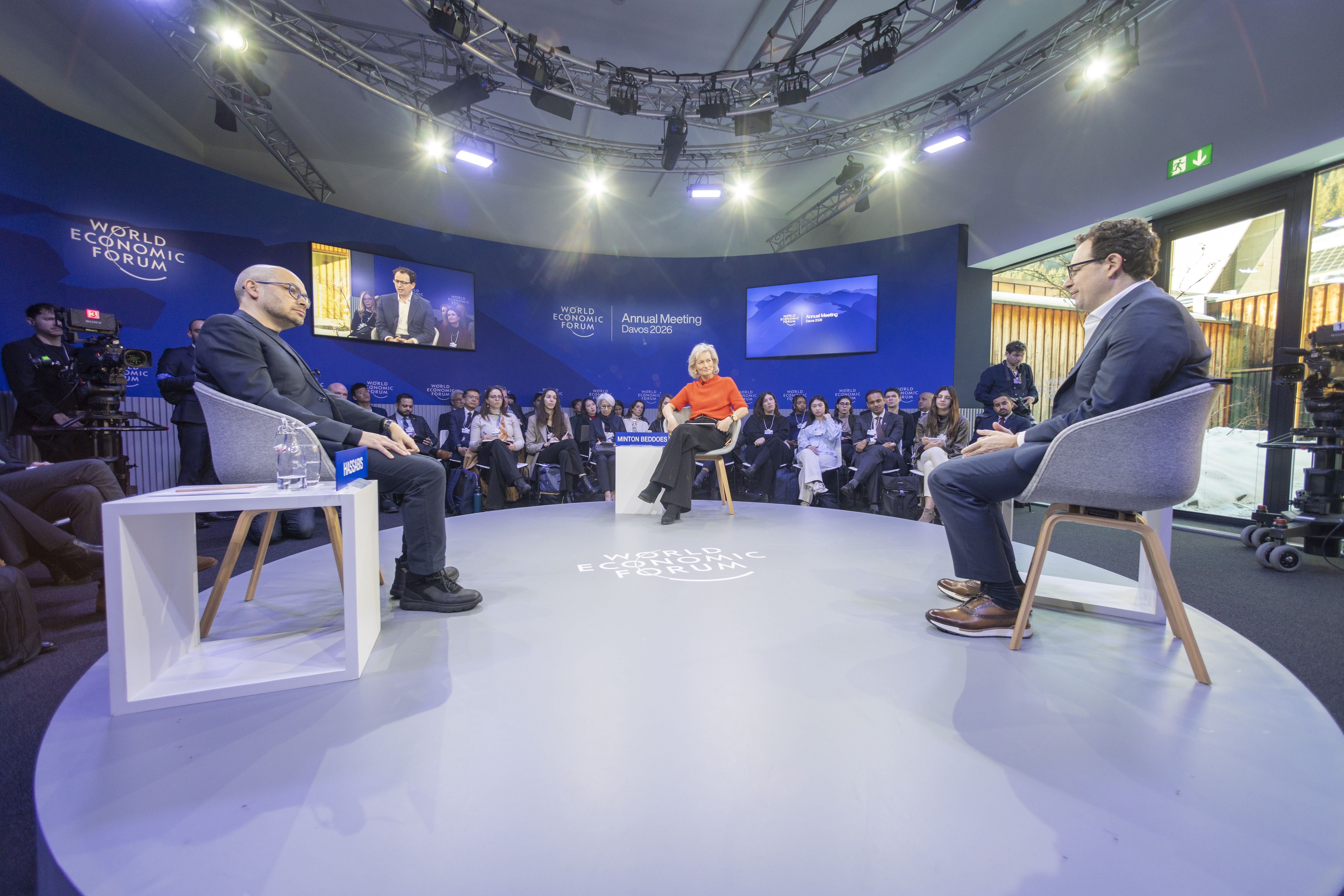
In Davos, AI was one of the most talked-about topics, with participants focusing on what the technology means for young people. Image: World Economic Forum
- In Davos, AI was one of the most talked-about topics, with participants focusing on what the technology means for young people.
- “If I was to talk to a class of undergrads right now, I’d be telling them to get really, unbelievably proficient with these tools,” advised Demis Hassabis, CEO at Google DeepMind.
- Leaders gathered at the World Economic Forum Annual Meeting 2026 to explore how the ethical use of AI and other emerging technologies will translate into solutions for real-world challenges.
One of the most talked-about topics at this year’s meeting in Davos was AI — from conversations with leaders from the field, to debates on whether or not there’s an AI bubble, the transformational technology dominated the agenda.
While much of the focus was on what impact it will have on industries and jobs, another important question came up throughout the week: what does it mean for young people? Here are three messages leaders in Davos were keen to get across on the issue.
1. Beware of AI shortcuts
When adults use AI at work, we’re often trying to automate manual, time-consuming tasks so we can free ourselves up to work on things that really matter. But when it comes to children, those manual, time-consuming tasks are often the building blocks that help them become intelligent, creative, well-rounded adults. The risk, several participants warned, is that when we remove these important foundations, we jeopardize our children’s futures.
“We’re up against evolutionary biology: All species like to conserve energy… Learning takes effort; naturally people will tend to take the easy route,” said Anna Frances Griffiths (Vignoles), Director of the Leverhulme Trust and an expert in education. “As a child, if you don’t get a chance to develop these cognitive skills, to develop the neural pathways, we’re in trouble.”
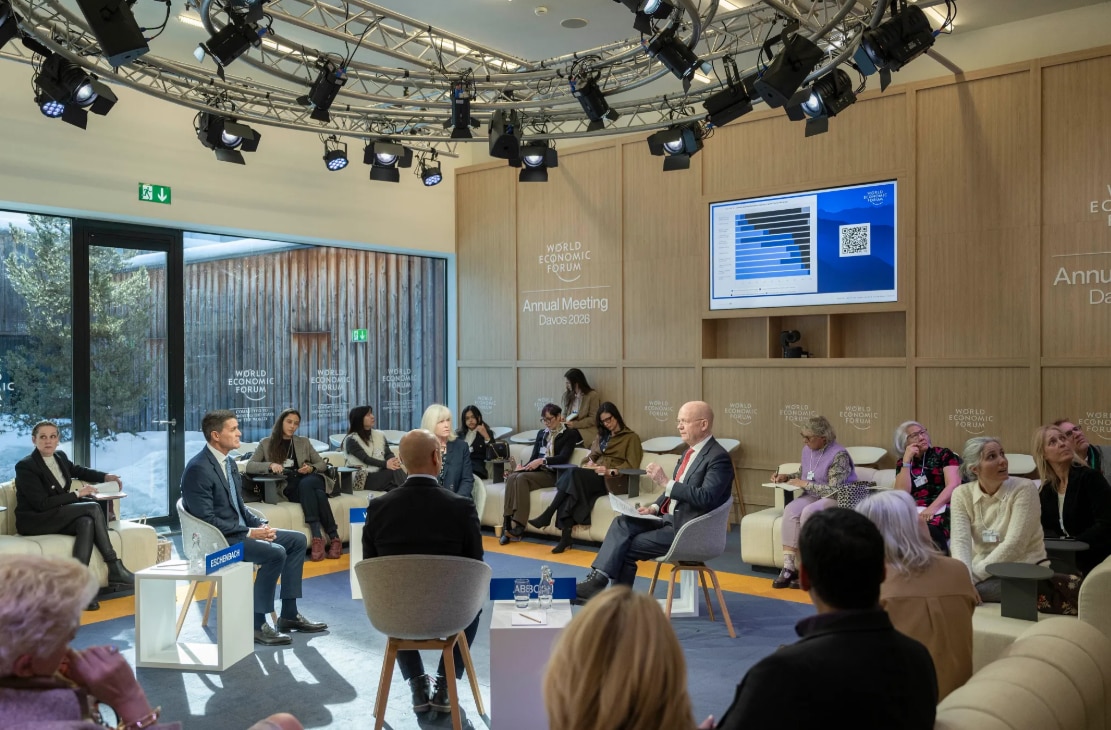
Becky Kennedy, CEO and Founder of Good Inside — better known as Dr Becky to her millions of Instagram followers — broke down the science in more detail, using an interesting metaphor from the world of weightlifting: time under tension, which refers to how long a muscle is held under strain. If you drop a weight quickly, the muscles don’t grow much. But if you hold it for a long time, in a controlled way, the muscle fibres break down and grow back much stronger.

The same applies for how children build emotional resilience, she explained in a session about parenting in the digital age: “It’s the same for thinking about how we deal with human emotions, time under tension, time under friction,” she said. The problem is that AI is designed to remove a lot of that friction. “We’re raising kids in a world where we are always reducing friction. But our ability to tolerate friction is what helps us learn how to talk to other humans, to pick up the phone and make a doctor’s appointment, to be creative.”
This isn’t necessarily about a rejection of AI, but about ensuring that when it comes to young people, we’re not automating away all the steps they must take to grow into happy, resilient grown-ups.
2. Learn how to learn
There’s a good chance that whatever skills we think of as essential in the workforce today will have completely changed by the time young people start entering the labour market.
Take the example of computer sciences. Just over a decade ago, young people everywhere were being encouraged to learn how to code so as to “future proof” their skills. Today, many of those same people are struggling to find jobs. As Anthropic CEO Dario Amodei remarked in a session in Davos, “I have engineers within Anthropic who say ‘I don’t write code anymore, I just let the model write the code, I edit it, I do the things around it.’” He then went on to predict that we’re “maybe only 6 to 12 months away from when the model is doing most, maybe all of what SWEs do end-to-end,” referring to the role of software engineer, which was, until relatively recently, one of the most sought-after in the US labour force.
If it’s not quite clear what precise skills companies will be looking for a decade or more from now — aside from the human-centric skills that we know will always be in demand — the most important thing will be to teach our children how to learn. “Teach not particular knowledge but learning how to learn, how to adapt to a changing environment,” said IMF Managing Director Kristalina Georgiev. This is all the more important, she thinks, because some of the jobs threatened by AI are those that have in the past helped young people get their foot in the door at a company. “Are there risks? Yes, especially for young people because AI tends to eliminate entry-level functions,” Georgiev said.
3. Use the tools — but put in place guardrails
This risk to entry-level jobs is actually something we’re already seeing playing out, warned Demis Hassabis, CEO at Google DeepMind. “I think this year we’ll maybe see the beginnings of it impacting the junior, entry-level side of jobs, internships, this type of thing,” he said. “I think there is some evidence, we can feel that ourselves, maybe like a slowdown in hiring in that area.”
His advice for young people? Start mastering these very same tools.
“If I was to talk to a class of undergrads right now, I’d be telling them to get really, unbelievably proficient with these tools,” he advised. “I think that can be even better, maybe, than a traditional internship would have been in the sense that you’re sort of leapfrogging yourself to be useful in a profession.”
Of course, this advice is aimed at university-aged students, and many experts at Davos were at pains to emphasize the need to tailor our approaches to the technology depending on a child’s age. “A chatbot tutor that responds to what you got wrong, that makes sense, that seems to work,” reflected Jonathan Haidt, Professor of Ethical Leadership at NYU, and a vocal advocate for keeping smartphones out of school. “But keep it out of elementary school … unless a specific application has been proven to be effective and safe.”
This was a point Christine Lagarde made on the final day of the meeting, when she raised questions about the need for regulation — something she heard from tech leaders themselves in Davos. “How is it regulated? I heard it from them, not me. They themselves are saying, let’s watch out,” she said in a session. “The AI experts and actors are saying we must have a discussion and we must understand how we use AI so that we don’t jeopardize social fabrics and youth.”
Don't miss any update on this topic
Create a free account and access your personalized content collection with our latest publications and analyses.
License and Republishing
World Economic Forum articles may be republished in accordance with the Creative Commons Attribution-NonCommercial-NoDerivatives 4.0 International Public License, and in accordance with our Terms of Use.
The views expressed in this article are those of the author alone and not the World Economic Forum.
Related topics:

Forum Stories newsletter
Bringing you weekly curated insights and analysis on the global issues that matter.
More on Artificial IntelligenceSee all

Charlotte Edmond
September 16, 2026


