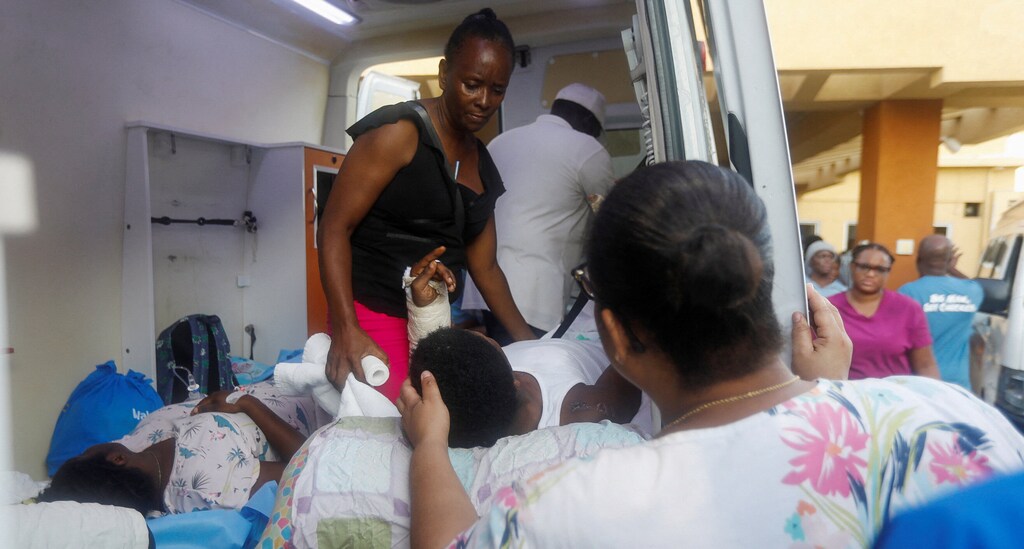
Three hospitals kept functioning when Hurricane Melissa hit Jamaica in October 2025 thanks to the preparedness of the Smart Hospitals initiative.
Climate-smart investments and smart tools will become increasingly vital to keep health systems running amid more frequent extreme weather events.
Solutions to forecast health threats, understand who is most vulnerable, and deliver the resources to respond exist, and we must now use them.
When Hurricane Melissa tore through Jamaica in October 2025, many of the island nation’s health facilities went dark – roofs gone, power cut, water supplies destroyed. But three hospitals stayed open.
This was possible because climate information services had helped identify hurricane-prone communities, and these facilities had been retrofitted years earlier through the Pan American Health Organization’s Smart Hospitals initiative.
Reinforced roofs, solar panels, backup generators and rainwater collection systems kept the hospitals running through the storm and the chaos that followed. Trauma patients were stabilized. Babies could be delivered. Staff kept working.
World not prepared for impacts of extreme weather
Our climate is changing rapidly, and most of the world is not prepared. But with the right tools and climate-smart investments, governments can keep people alive and ensure functioning health systems as these disasters escalate – and they are cheaper than officials may realize.
The consequences of an overheated world are playing out everywhere: in emergency rooms and on factory floors, in the homes of older persons without adequate access to cooling, and in villages where children struggle to find safe drinking water.
People living in poverty are hit hardest: their jobs often leave them no choice but to keep working, whether it's through extreme heat outdoors, or without proper cooling indoors.
Nearly 500,000 people succumb to heat-related causes globally each year, according to the latest modelled estimates.
We also know that warmer temperatures make it easier for vector-borne diseases to spread. Brazil reported more than 10 million dengue cases and over 6,300 deaths due to the mosquito-borne virus in 2024.
Floods and landslides in Kenya, Ethiopia and Tanzania killed hundreds of people within days this March, while heavy monsoon floods caused more than 1,000 deaths and a similar number of injuries in Pakistan and India last year.
The World Meteorological Organization (WMO) recently confirmed that El Niño conditions are likely to develop – estimated at an 80% probability by mid‑2026 – which means extreme weather risks that could impact health are poised to intensify further.
By 2050, climate-related health impacts could cause nearly 16 million deaths and $21 trillion in economic losses across low- and middle-income countries, according to estimates from the World Bank.
Those numbers are staggering, but not a foregone conclusion: we know what’s needed to better anticipate these climate-driven health risks before they turn into emergency room visits.

Climate services for health interventions
These interventions are what specialists call "climate services for health". This refers to using weather and climate information to help health authorities, hospitals and communities anticipate and prepare before a disaster or outbreak hits.
Health systems can use this information to act where and when risks are greatest: reinforcing hospitals’ and health clinics’ resilience to storms, triggering heat-health alerts to adjust hospital staffing before temperatures spike, or anticipating disease risk by tracking seasonal shifts in mosquito activity, water quality, and air pollution.
These efforts can save millions of lives and also deliver major economic returns: up to $68 for every dollar invested, according to the World Resources Institute’s Adapting to Climate-Related Health Risks report. Prevented deaths, lower treatment costs and fewer productivity losses all lead to stronger, more resilient economies and healthier communities.
The solutions are also relatively cheap. For a low- or middle-income country with a population of 25 million, it would take just $18 million per year – 72 cents per person – to fund a full package of climate-informed health services.
These include early warning and integrated disease surveillance systems, public awareness campaigns and resilient health infrastructure. While any upfront costs can be daunting for debt-strapped countries, the returns on these services dwarf the investment many times over.
The problem is that these services are severely underfunded, and coordination between government agencies, city officials, and community organizations is often lacking.
About 83% of WMO member countries provide climate information to the health sector. However, only half of national health ministries incorporate weather and climate information into their systems, according to the World Health Organization’s (WHO) forthcoming 2025 WHO Health and Climate Change Survey Report.
Health ministries acknowledge that funding for collaborative, anticipatory planning actions is difficult. Nevertheless, the countries and cities that have invested in these tools are seeing a profound impact – saving lives and strengthening economies.
In Gujarat, India, a heat early-warning system averted nearly 1,200 deaths in each of its first two years. A similar programme in Pakistan trained healthcare workers on heat-related illnesses and reduced hospital admissions by 38%.
The economic case for these warning systems is clear: every $1 invested can deliver $50 to $100 in benefits. And according to the WHO, advancing similar systems in 57 countries could save up to 100,000 lives every year.
Action on climate adaptation plans for health
These services are being implemented piecemeal today, but political momentum for a more systematic approach is growing.
At COP30, the last UN Climate Conference in Brazil, more than 30 countries and 50 organizations signed onto the Belém Health Action Plan to drive the health sector's adaptation to climate change.
The WMO Commons financing mechanism, for example, aims to mobilize at least $100 million to modernize the underpinning weather and climate data systems that power early warnings worldwide, protecting trillions of dollars in economic value and supporting global security.
And more governments are bringing climate-health priorities into their national planning: more than 90% of countries' national adaptation plans include at least one health action.
The families who received lifesaving care at the three disaster-resilient hospitals in Jamaica last October benefited from climate-smart investments their government made years in advance. This should be the rule rather than the exception.
The cost of further inaction will be measured not only in economic losses, but in lives. The solutions exist for governments to know when health threats are coming, understand who is most vulnerable, and deliver the resources to respond. It's time to use them.