Billions rely on glaciers as a water source. So why aren't they in our climate agreements?
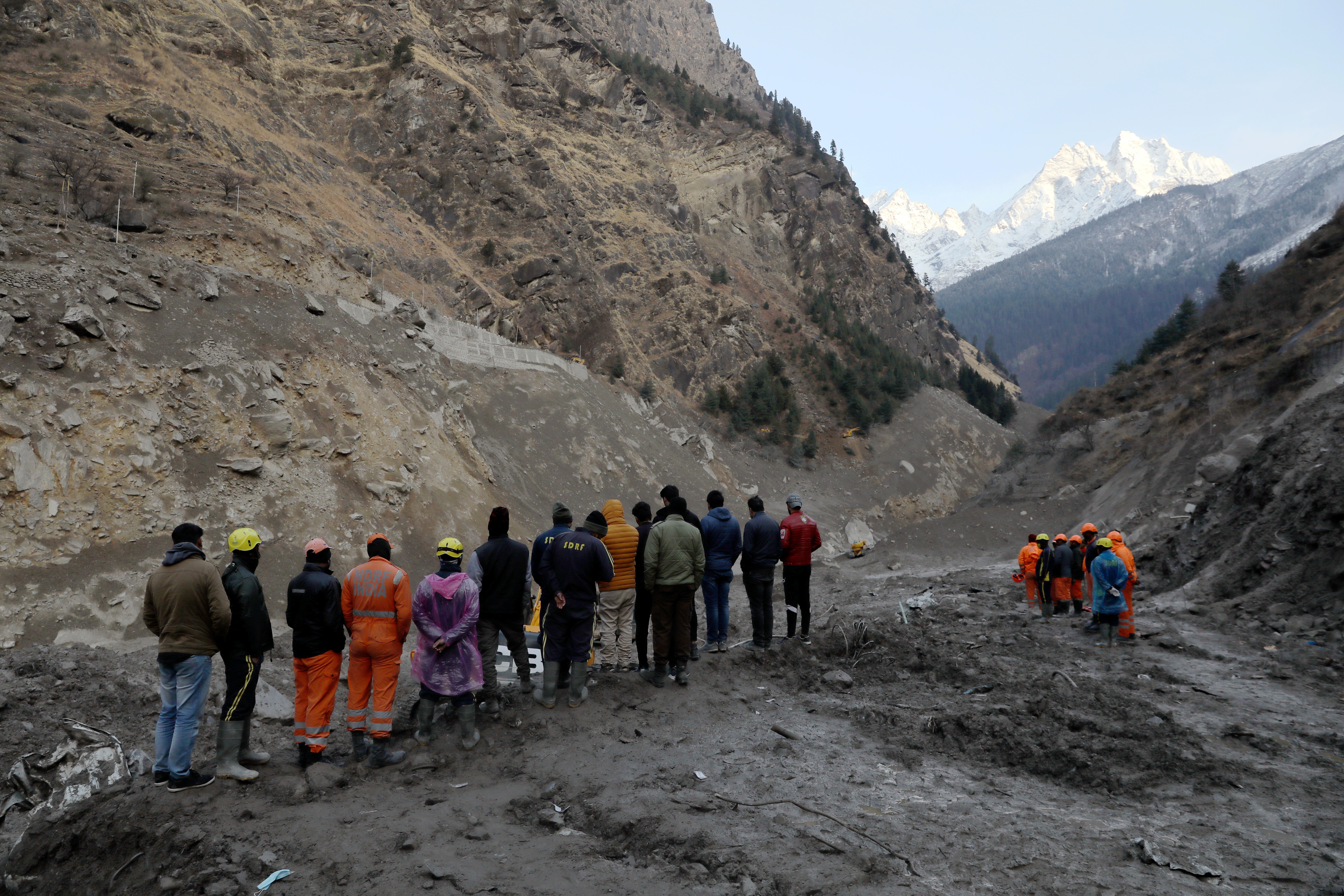
A rescue and relief operation at the site of a destroyed hydroelectric power station after a flash flood caused by a glacier break-off swept down a mountain valley destroying dams and bridges, in Raini village in the northern state of Uttarakhand, India, February 10, 2021. Image: Reuters/Anshree Fadnavis
- Glaciers of the Hindu Kush Himalaya supply water to over two billion people, but their ice is receding as the region warms at twice the global average.
- This melting is the consequence of emissions from other parts of the world, yet glaciers remain largely absent from global climate finance talks.
- Policy-makers across the world must rectify this climate injustice by acting now to protect glaciers and the communities that rely on them.
Her name is Stanzin. She is 53 and she lives in a village above the Indus valley in Ladakh, northern India, at an altitude where the air in winter makes your lungs work for every breath.
I met her in 2021, on a trek through the Markha valley. When I asked about the stream near her village – glacier-fed, seasonal, essential – she pointed up at the slope above us.
“It used to come in April,” she said. “Now sometimes March. Sometimes it does not come at all.”
She was not talking about inconvenience. Stanzin was talking about the water her family drinks, the water that irrigates the barley, that sustains the livestock that are their only margin against a hard winter. Two sentences communicated what climate scientists fill entire reports trying to convey.
She had no idea that the forces dismantling her water supply had been set in motion by emissions produced largely on the other side of the planet.
Stanzin is not alone. Based on International Centre for Integrated Mountain Development (ICIMOD) 2026 reports, the Hindu Kush Himalaya – known as the ‘Third Pole’ – holds roughly 63,700 glaciers spanning eight countries and nearly 56,000 square kilometres.
The rivers that begin in that ice — the Indus, the Ganga, the Brahmaputra — travel through some of the most densely populated landscapes on Earth. More than two billion people depend on water from these glaciers for agriculture, energy and survival.
Yet when world leaders negotiate climate finance, glaciers are almost entirely absent. Forests have frameworks, oceans have protocols, but the cryosphere – the Earth’s ice in all its forms – has a paragraph, sometimes, in the footnotes.
This is not an oversight; it is a structural injustice. And it is one of the most consequential failures in global climate governance today.

Glaciers are infrastructure that is disappearing
Glaciers are not simply climate indicators and evidence that warming is happening.
They are infrastructure and function like a savings account: accumulating snow in winter, releasing meltwater through the dry season, keeping rivers running when rain does not arrive. For generations, that bank was reliable enough to build civilizations around, but that reliability is now gone.
The Hindu Kush Himalaya is warming at roughly twice the global average. Glacier mass loss has nearly doubled since 2000 compared to the preceding decades and the region has already lost more than 40% of its glacial mass in four decades. If warming exceeds 1.5ºC, up to two-thirds of remaining Himalayan glacier volume could disappear by 2100. These are mid-range projections, not worst-case.
This produces a two-phase water crisis. Until roughly 2050, accelerating melt means more water, faster, in the wrong places: floods, glacial lake bursts, hydropower systems overwhelmed. After 2050, as glaciers deplete, the meltwater contribution drops sharply. Rivers that billions depend on will run lower and less predictably, in ways that existing infrastructure cannot absorb.
Why climate justice fails on glaciers
Climate justice – the principle that those who contributed least to warming should not bear the heaviest costs – fails at the glacier.
The communities closest to Himalayan ice did not produce the emissions driving its loss. The per-capita carbon footprint of a Ladakhi farmer is a fraction of the global average. Yet it is their springs drying first, their agricultural cycles collapsing, their valley floors flooding when a glacial lake gives way.
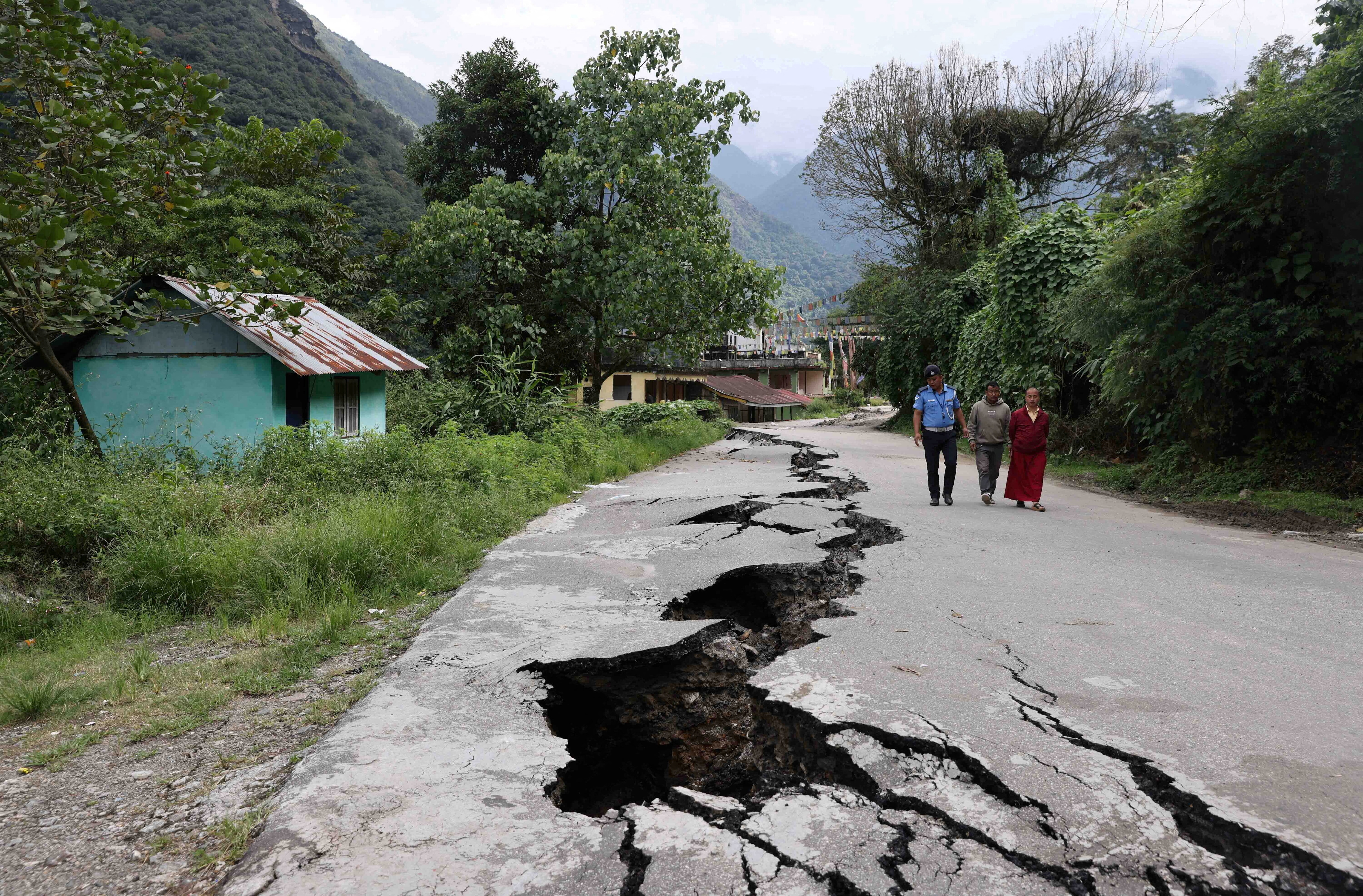
When South Lhonak lake breached in Sikkim, India, in 2023, roughly 50 million cubic metres of water mobilized five times that volume in sediment downstream. Scientists had identified the lake as high-risk years earlier, but regulatory action did not follow. More than 400 dangerous glacial lakes have been identified across the Hindu Kush Himalaya, and outburst floods per decade are nearly five times more frequent than before 1950.
Global climate finance flows overwhelmingly towards mitigation – renewable energy, carbon markets, technology – but adaptation receives a fraction. India’s entire National GLOF Risk Mitigation Programme operates on roughly $20 million — less than half of what Indian corporations spent on animal welfare through corporate social responsibility in a single year.
The cryosphere is the orphaned crisis of South Asia’s climate architecture: falling between disaster response, climate mitigation and development finance, and belonging to none.
Three shifts for climate justice equity on glaciers
Closing this climate justice gap demands three shifts.
1. Make glaciers visible in climate finance
Loss and damage frameworks, adaptation funds and national climate strategies must explicitly name cryospheric communities as priority beneficiaries. They carry a risk they did not create. Financing that ignores them is not climate finance, it is climate-themed investment.
2. Treat community knowledge as infrastructure
Mountain communities across the Hindu Kush Himalaya have been observing these systems for generations. They know when a lake is behaving strangely or when a slope that has held for a century is beginning to move.
In the South Lhonak disaster, 36% of early warnings came through WhatsApp – relatives alerting relatives, observers upstream texting downstream. A shepherd in Gilgit-Baltistan read something wrong in a glacial lake, raised the alarm and his community evacuated. Hundreds survived.
The people closest to the hazard hold knowledge that formal systems do not capture. Any serious adaptation strategy must build this knowledge into its architecture.
3. Stop building in known risk zones and calling it development
The Dharali floods of 2025 swept through hotels on old landslide fans. The Chamoli disaster destroyed hydropower infrastructure placed in high glacial lake outburst corridors. In Nepal, a glacial lake outburst flood (GLOF) destroyed the Friendship Bridge and crippled hydropower facilities. Nepal needs an estimated $1 billion for GLOF preparedness by 2030. It has received $7 million.
Urgent need for global action on glaciers
Last year was designated the United Nations’ International Year of Glaciers’ Preservation. The Dushanbe Declaration was signed by 80 nations, committed to coordinated glacier protection.
India’s National Glacier Risk Mitigation Programme (NGRMP) – backed by a $20 million outlay from the National Disaster Management Authority (NDMA), now expanded to cover 195 high-risk glacial lakes across Ladakh, Jammu and Kashmir, Himachal Pradesh, Uttarakhand, Sikkim and Arunachal Pradesh, has visited 40 high-risk lakes and installed 10-minute satellite sensors. Real beginnings but still islands, without a common architecture connecting them to the lives of people most at risk.
India has demonstrated before that it can transform a crisis into a competence over a generation. India transformed cyclone preparedness after the 1999 Odisha disaster that killed thousands with almost no early warning, sustained institutional investment produced the forecasting systems that now enable district magistrates to evacuate coastal villages before a storm makes landfall.
Two decades of sustained investment produced forecasting systems that now save lives and the same trajectory is available for glacier hazards. The question is whether glaciers receive the same commitment, before the next flood forces the answer.
I think about Stanzin often. About the stream that arrives in March instead of April, when it arrives at all. About the barley crop that depends on timing she cannot control. About the fact that no international climate agreement has her water supply in its targets.
Two billion people drink from ice that is disappearing. Getting their safety into our climate agreements is not a technical problem. It is a choice — about what justice means when the bill for a century of emissions arrives, and who we decide must pay it.
Don't miss any update on this topic
Create a free account and access your personalized content collection with our latest publications and analyses.
License and Republishing
World Economic Forum articles may be republished in accordance with the Creative Commons Attribution-NonCommercial-NoDerivatives 4.0 International Public License, and in accordance with our Terms of Use.
The views expressed in this article are those of the author alone and not the World Economic Forum.
Stay up to date:
SDG 13: Climate Action


Forum Stories newsletter
Bringing you weekly curated insights and analysis on the global issues that matter.
More on Climate Action and Waste Reduction See all

Lucas Gobatti
September 4, 2026