The technologies poised to win the materials race against extreme heat - and why they need to scale up

Adapting to extreme heat will depend on resilient building design. Image: Unsplash/Nils Huenerfuerst
- With the effects of extreme heat projected to rise, the answer is not more air conditioning, but constructing heat-resilient buildings.
- Frontier passive cooling technologies combined with active energy management systems work to reduce heat exposure in the built environment.
- Durability, practical operations and creating a verifiable market will decide whether passive cooling materials can effectively scale up.
A routine day in a city under extreme heat is becoming all too familiar: A school’s top floor becomes unbearable by mid-afternoon, outdoor workers slow down or stop, emergency rooms fill, and the power system strains as millions of air conditioners switch on at once. Some homes stay safe. Others, often elderly or low-income households, endure dangerous indoor temperatures in buildings that were never designed for extreme heat.
Heat is already a cause of mass casualties and an economic drag. The World Health Organization cites studies estimating ~489,000 heat‑related deaths each year (2000-2019). The International Labour Organization projects that by 2030, heat stress could cut 2.2% of global working hours; equivalent to 80 million full-time jobs.
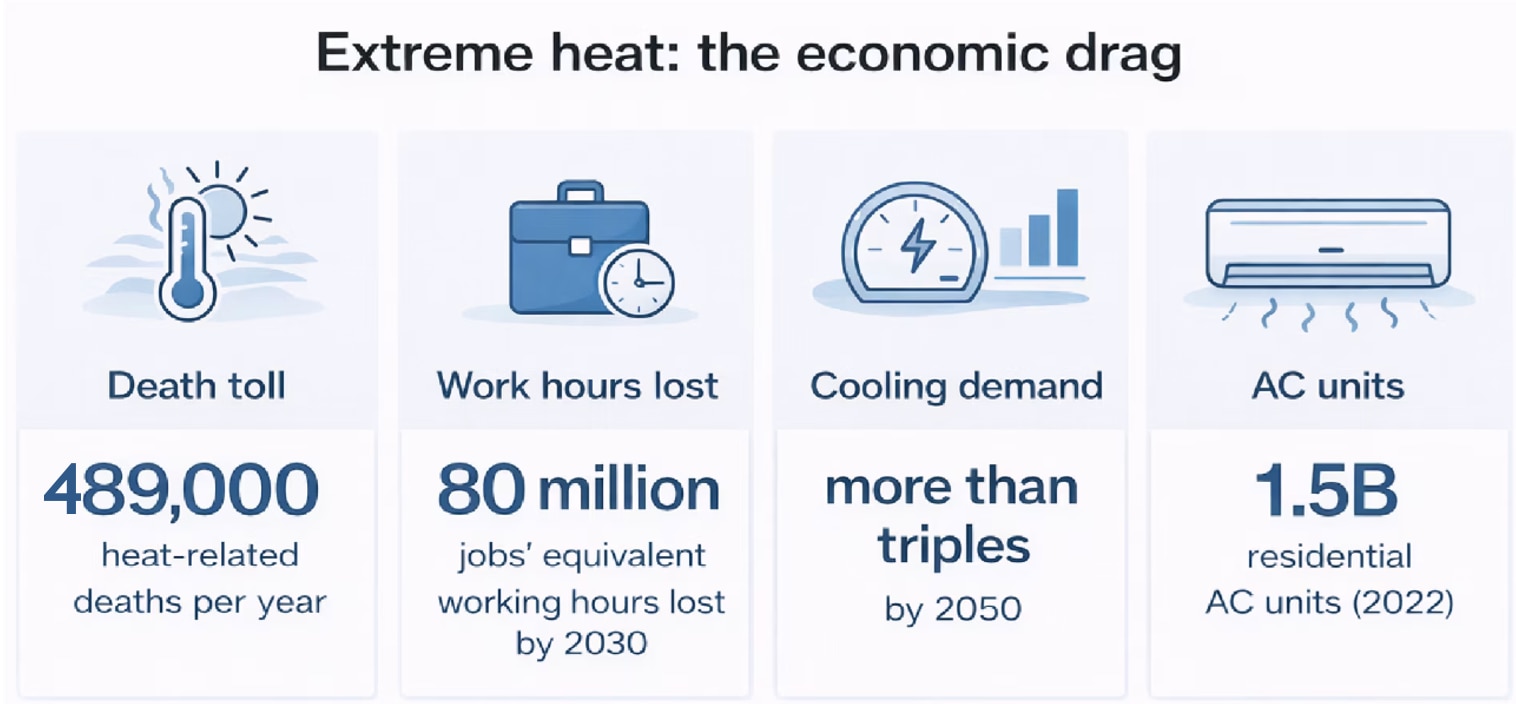
The instinctive response is more cooling. UNEP’s Global Cooling Watch finds global cooling demand could more than triple by 2050 under the business as usual scenario. The IEA notes residential AC units in operation have tripled since 2000 to more than 1.5 billion in 2022, raising peak demand and outage risks. But in extreme heat, “more AC” often means cooling huge volumes of air, which is expensive, energy-intensive, and creates a “doom loop” for city dwellers; the increased exhaust heat of more AC worsens an urban heat island effect that in turn leads to a need for more AC.
A heat-resilience “stack” tries to reduce heat at the point of impact, verify that reduction over time and act when it falls short. It combines two interdependent layers: a passive layer, where advanced materials reflect and shed heat without consuming energy; and an active layer, with building management systems monitoring indoor conditions, adjusting cooling in real time, and generating the performance data the passive layer needs to become verifiable and financeable.
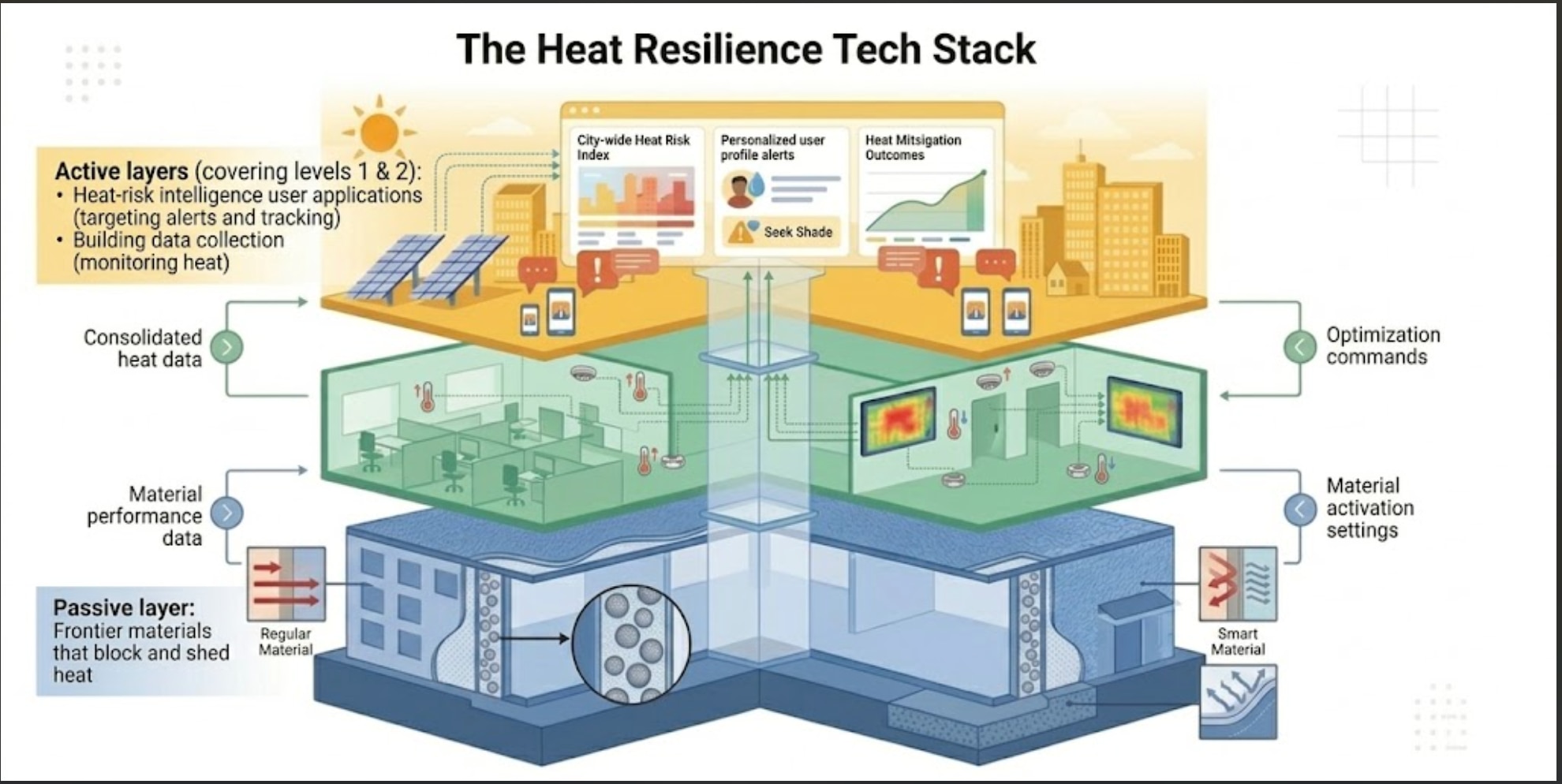
In the passive layer, new materials are pushing the boundaries of passive cooling:
- Daytime radiative cooling surfaces are engineered to reflect sunlight while also emitting heat through an atmospheric “window” toward cold space, enabling below ambient air cooling even under direct sunlight in recent demonstrations.
- Cool wall technologies that reflect solar energy in the visible and infrared light spectrums.
- Phase‑change materials act like a thermal battery inside walls and ceilings, absorbing heat during peak hours and releasing it later when temperatures drop.
In the active layer, building energy management systems monitor indoor temperatures, occupancy and grid load in real time, adjusting HVAC continuously and making heat stress visible at the room level. In school buildings in Stockholm, AI-driven HVAC management reduced peak cooling demand by over 20%, while maintaining indoor comfort through continuous monitoring and real-time load adjustment.
Private-sector development is accelerating on both layers, from material specialists like SkyCool Systems, i2Cool, and Tex-Cote on the passive side, to HVAC and building controls players like Danfoss, Trane, Johnson Controls, Schneider Electric and Siemens on the active side.
Making the heat resilience stack scale
Lab performance alone will not be enough to scale either layer. What drives scale is simpler: Cities and building owners need to trust that these solutions work in real applications to be willing to buy them again.
First, both layers must hold their performance beyond installation. Some “cool” surfaces lose effectiveness through dirt accumulation, humidity, UV and wear. That’s why rating ecosystems like the Cool Roof Rating Council exist that show data for aged ratings of materials like cool roofs and walls. For buyers and for financing projects, the practical test is simple: Does heat reduction hold after a season in my climate, or only on day one?
Second, operations decide whether protection lasts. A cool roof on a school helps, but the school’s energy systems and operations can still fail when maintenance is absent, ventilation is mismanaged, or the grid can’t serve peak demand. The material technology only works when owners have a clear playbook for what to monitor, how to monitor, and what to do when conditions deteriorate; the heat resilience “tech stack” should be set up to provide the answers.
Third, the main market failure is that “safe indoor heat” is still hard to price. Benefits are split across tenants, owners, utilities, insurers and healthcare systems. Meanwhile, voluntary labels like LEED do a lot to raise the baseline for energy efficiency, water use, indoor air quality and sustainable materials in buildings, awarding owners and developers who meet defined standards. But they don’t always translate or prioritize the “heatwave performance” of a building.
So the practical fix is a “proof package” that travels: simple, comparable evidence that turns passive cooling materials into bankable, repeatable building upgrades. Evidence from managed buildings shows that the combination of room-level temperature sensors, AI-assisted HVAC control and a defined maintenance protocol can reliably sustain performance across seasons, turning a one-time installation into a measurable, repeatable outcome. Translating measured performance into financeable outcomes also requires a shared reporting standard that does not yet exist at scale; placing building energy management systems (BMS/EMS) in the loop not just at commissioning, but on an ongoing basis, can evolve demand reduction into a live operational metric rather than a one-time snapshot.
What is the World Economic Forum doing to promote sustainable urban development?
For utilities, public asset owners and large real-estate players, the mindset shift is to treat passive cooling as a demand-side resilience resource: not only “does it cool?” but “how many kilowatts does it shave when the grid is most stressed?” Once that’s measured, incentives, financing and portfolio roll-outs become easier to justify. And this is where the Forum’s Yes/Cities initiative can help: making the evidence travel faster by publishing comparable results and operating playbooks across multiple cities.
Don't miss any update on this topic
Create a free account and access your personalized content collection with our latest publications and analyses.
License and Republishing
World Economic Forum articles may be republished in accordance with the Creative Commons Attribution-NonCommercial-NoDerivatives 4.0 International Public License, and in accordance with our Terms of Use.
The views expressed in this article are those of the author alone and not the World Economic Forum.
Stay up to date:
Buildings
Related topics:

Forum Stories newsletter
Bringing you weekly curated insights and analysis on the global issues that matter.
More on Built Environment and InfrastructureSee all

Cheukai Makari
September 16, 2026


