How the built environment strengthens belonging, quality of life: Lessons from Saudi Arabia
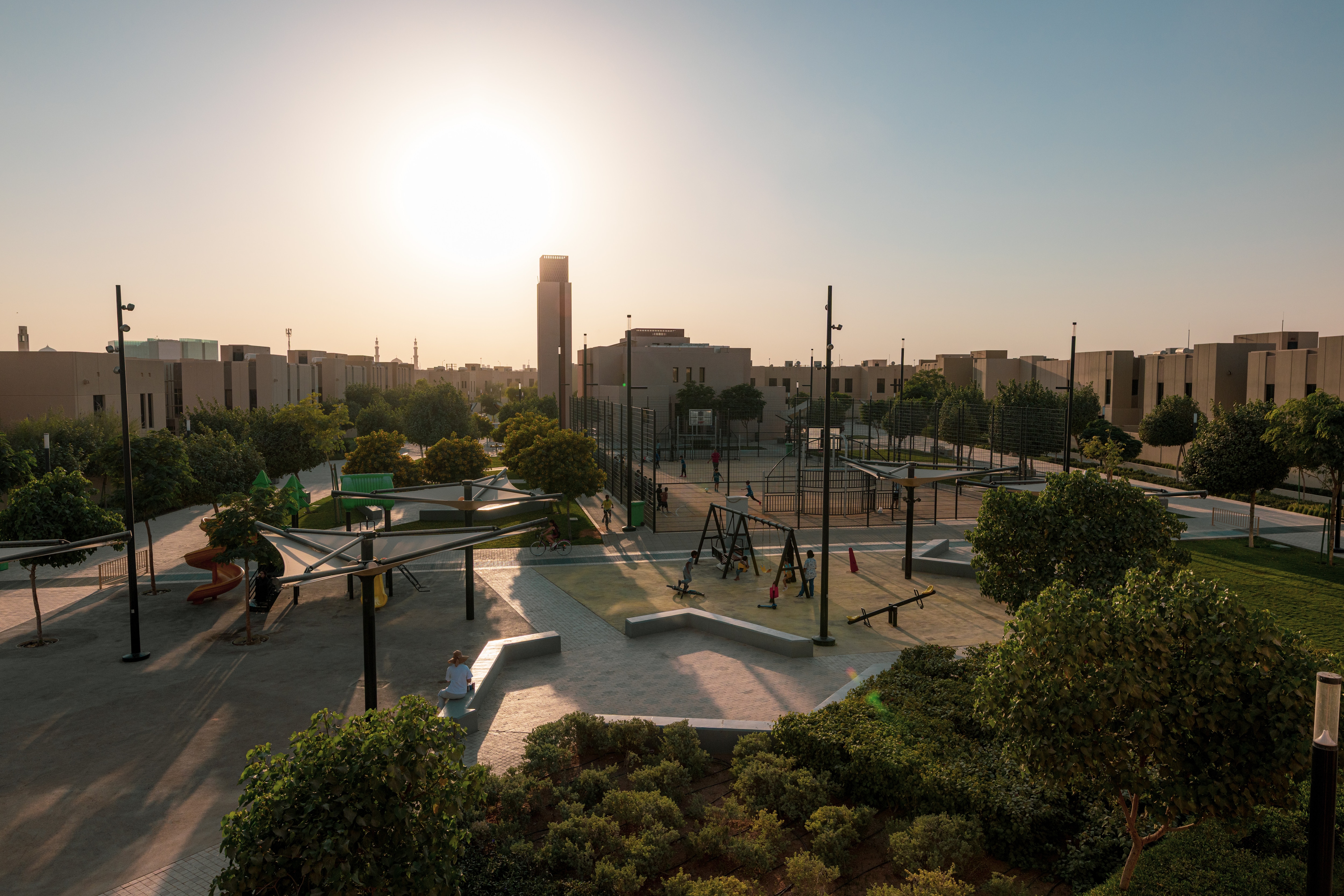
Riyadh's SEDRA community is conceived according to the habits of its residents. Image: ROSHN Group
- With social isolation a growing issue worldwide, Saudi Arabia is factoring in human connection into urban planning.
- The integrated community model prioritizes accessible public spaces, walkable neighbourhoods and community hubs.
- Driven by the Vision 2030 agenda, national policy supports the aim of making Saudi cities livable and attractive human ecosystems.
By nearly all measures, quality of life has improved in Saudi Arabia. Access to housing has expanded, infrastructure has scaled, and cities have become more efficient in how they function with enhanced connectivity. Homeownership has reached 66.24%, life expectancy has climbed to 79.7, and both children and adults are engaging in daily physical activity at rates much higher than the current targets.
It is a clear indication of how once-aspirational nationwide goals are becoming reality, driven by the Kingdom’s Vision 2030 agenda. The human-centric and integrated approach in Saudi Arabia acknowledges that quality of life is not defined by material ownership alone.
But this aspiration runs in parallel with other, less positive global trends. OECD studies show that people are spending less time meeting friends and family in person, with younger generations seeing some of the sharpest declines in social connection. Meanwhile, the World Health Organization estimates that one in six people globally is affected by loneliness.
Taken together, this suggests something more structural. Across the world, societies may have improved how people live by our current definition of quality of life. But have we inadvertently neglected the effects that the built environment may have on how life is really experienced?
Human-centric master planning
For a long time, quality of life has been closely tied to the extent of individual accumulation and material expansion. The built environment has reflected that logic. Development models have prioritized scale, efficiency and, in many cases, consumer aspirations expressed through private space and exclusivity.
While these approaches have delivered real benefits, they have often also reduced the density of everyday interaction that underpins a sense of belonging. We may have overlooked the importance of shared patterns of life, spaces and experiences that shape human connection, and ultimately shape how people feel about where they live.
There is great value in human-centric master planning, which connects people and places more holistically. A growing body of research shows that the social fabric of a neighborhood has a direct impact on the inhabitants: one six-year longitudinal study found that access to local amenities and cohesive neighborhoods led to higher levels of social support, and better well-being over time.
In the SEDRA community in Riyadh, studies have revealed that residents spend more than 75% of their time away from home participating in lifestyle and retail activities. When these activities are offered within proximity to home, there are significant benefits for reducing traffic, building connectivity, and enhancing quality of life.
Other studies reinforce the importance of belonging itself. This is a complex concept: Research involving more than 5,500 adults found that feeling part of a community was a stronger predictor of life satisfaction than actual participation in programmed, collective activities. But that doesn’t mean such opportunities for connection aren’t important when planning the future of built environments. Quality of life is shaped as much by relationships, connections and shared patterns of experience as it is by individual circumstance.
This has important implications. Cities have long been designed, or have grown, around physical infrastructure such as transport systems, utilities and housing supply. These remain fundamental. But until recently there has been far less consistent emphasis on the social infrastructure that enables people to connect: This includes accessible public spaces, walkable neighbourhoods, community hubs and environments that curate patterns of daily life that bring people into contact with one another. ROSHN Group’s integrated community model emphasizes this social infrastructure within all masterplans, ensuring that homes are not just isolated dwellings, but anchors within a vibrant, connected human ecosystem.
Where these elements are present, the benefits compound over time. Where they are absent, even convenient, objectively well-designed, aesthetically attractive environments can feel disconnected.
Designing for belonging is not a question of adding amenities. It is about how places are structured from the outset. Proximity matters, but so does the quality of shared space, the ease of movement and the extent to which our routines naturally intersect. Small, repeated interactions on streets, in parks, around schools and local shopping centers are what build familiarity and trust. Over time, these interactions become the foundation of community and social support that we rely on emotionally, if not practically in a strictly tangible sense.
Policies for public space
The built environment clearly has a part to play, and so urban policy is also evolving in step. UN-Habitat continues to emphasize the role of public space as essential infrastructure for inclusion, health and resilience, noting that many cities still fall short in allocating sufficient space for shared public life.
In Saudi Arabia, the conversation is moving in a similar direction. Alongside substantial progress in housing provision to meet growing demand, national strategic priorities in urban development are explicitly linked to livability goals and overall quality of life. The Kingdom’s ambition is not simply to accelerate the growth of urban areas, but to ensure its cities feature among the world’s most livable and attractive for visitors and investors
This shift is beginning to influence how large-scale residential developments are conceived. Housing is meticulously planned and interwoven with schools, retail, mosques, green space, health and recreation facilities, establishing integrated communities that foster greater social connection and more healthy, active lifestyles with less reliance on driving. By minimizing friction between different aspects and needs of life and enhancing connectivity, we can create more opportunities for meaningful interaction and shared experiences.
In Saudi Arabia, projects such as SEDRA community reflect this approach, combining high-quality residential neighborhoods with public spaces, amenities and managed community infrastructure in a way that encourages connection over time. As thousands of families have moved into SEDRA, the masterplans have evolved with the usage patterns of its residents, ensuring that upcoming phases respond to the need for greater connectivity and sustainability.
What is the World Economic Forum doing to promote sustainable urban development?
Perspective will drive policy. If quality of life is defined primarily by isolated assets, then the environments we create will continue to reflect that priority. Instead, if we consider connection, participation, belonging and the subsequent benefits for long-term health and environmental sustainability, development will reflect a deeper commitment to quality of life. That includes not just comfort and convenience and a personal sense of attainment, but the ability to form relationships, to participate in community life, and to feel part of something larger than the boundaries and structure of the building we call home.
Ultimately, we must ask this question to decide what shapes quality of life. Does a place make us feel alive and like we belong, or does it simply provide access to something that stops at the front door?
Don't miss any update on this topic
Create a free account and access your personalized content collection with our latest publications and analyses.
License and Republishing
World Economic Forum articles may be republished in accordance with the Creative Commons Attribution-NonCommercial-NoDerivatives 4.0 International Public License, and in accordance with our Terms of Use.
The views expressed in this article are those of the author alone and not the World Economic Forum.
Stay up to date:
Cities and Urbanization
Related topics:


Forum Stories newsletter
Bringing you weekly curated insights and analysis on the global issues that matter.
More on Built Environment and InfrastructureSee all

Inge Delobelle and Mina Guli
September 22, 2026


