How Malaysia is building its clean energy future
Image: Chander Mohan/Unsplash
Amar Haji Fadillah Bin Haji Yusof
Deputy Prime Minister and Minister of Energy Transition and Water Transformation (PETRA), Malaysia Government- Malaysia has committed to shifting away from coal with an energy transition that balances affordability, energy security and sustainability.
- The challenge now lies in the execution to ensure that the transition achieves those aims while also creating jobs and supporting growth.
- The World Economic Forum's Beyond Coal: Building a Flexible, Resilient and Clean Power System for Malaysia insight report aims to support decision-makers and stakeholders in advancing Malaysia’s energy transition.
Malaysia’s energy future became the focus of multistakeholder dialogue when the country’s Ministry of Energy Transition and Water Transformation (PETRA) launched a new collaboration with the World Economic Forum, supported by KPMG, in October 2025.
At the initiative’s heart was a critical question: how can Malaysia transition away from coal power while delivering a more secure, resilient and affordable energy system for our people and businesses?
The launch of the Beyond Coal: Building a Flexible, Resilient and Clean Power System for Malaysia insight report marks the culmination of this intensive dialogue process.
Stakeholders from across the government, industry and finance have come together in a collaborative effort to produce this important document. It will serve as a valuable reference point and source of ideas for our government in shaping Malaysia’s shift away from coal and broader energy transition agenda.
Clear policy direction for Malaysia’s energy future
Malaysia’s coal transition commitments are long-standing. Our National Energy Transition Roadmap (NETR) provides clear policy direction, including a goal to reach 70% renewables penetration by 2050.
We also have a national commitment not to build any new coal-fired power plants and in 2024 we set a target to completely transition away from coal by 2044. This dialogue series and report provide a strong foundation for accelerating the implementation of these ambitions.
In Malaysia, we have always emphasized that the energy transition must address all aspects of the energy trilemma – balancing affordability, energy security and sustainability. Against a backdrop of global uncertainty and energy supply shocks, and with our own power demand rising rapidly at 4.5% year-on-year, this requirement is more important than ever.
Gas will continue to play an important transitional role as Malaysia transitions away from coal. However, recent liquefied natural gas (LNG) market volatility underscores the importance of accelerating renewable deployment rather than replacing one source of import dependence with another.
One of the most important messages emphasized by this dialogue series is the central importance of renewables deployment leading coal retirements, enabling Malaysia to harness the benefits of low-cost, abundant clean power, rather than continued reliance on fossil fuels.
The Malaysian government and industry have made significant progress in recent years in advancing renewable energy deployment. We are developing 6GW of solar capacity through successive large-scale solar (LSS) auctions, while our new MyBEST programme has already awarded four 100MW/400MWh projects.
A MYR43 billion ($10.8 billion) Tenaga Nasional Berhad (TNB) investment to 2028, announced last year, is massively overhauling the grid, building flexibility and resilience, while our Corporate Renewable Energy Supply Scheme (CRESS) has established a new mechanism for businesses to procure clean power directly and mobilize private finance for Malaysia’s clean energy future.
Reimagining coal assets for a new future
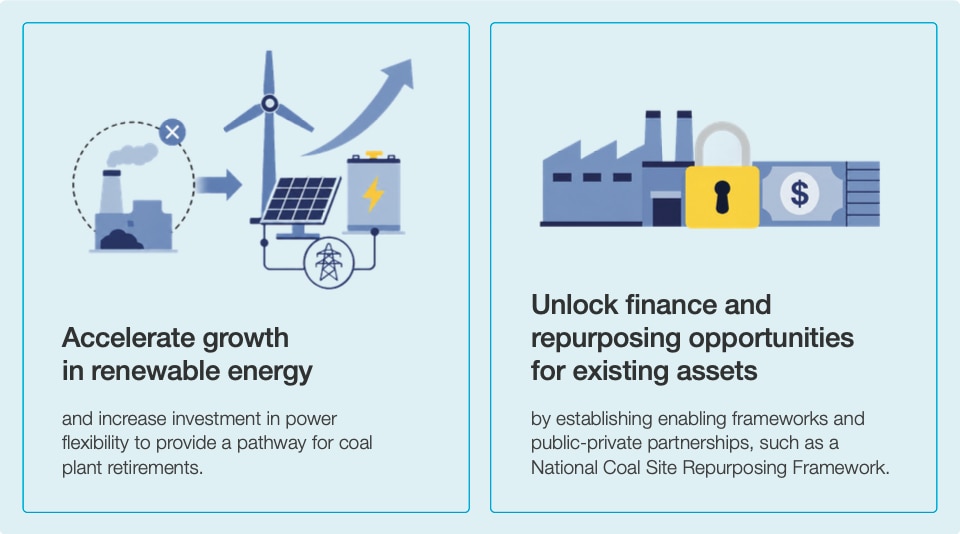
One of the most compelling themes to emerge from the dialogue series is the opportunity to view retiring coal assets not simply as liabilities, but as strategic assets to unlock value and accelerate clean energy build out. International examples – from South Africa’s efforts to repurpose coal power stations for renewable energy and battery storage, to European initiatives transforming legacy coal assets into clean energy and data centre hubs – provide us with options as to how retiring coal assets can be used to accelerate the transition while delivering system value.
A proposed National Coal Site Repurposing Framework, outlined in the report, offers a compelling, no-regrets pathway to operationalize these opportunities. By creating a standardized process to redevelop coal sites with clean alternatives – renewables, battery storage, small modular reactors (SMRs) – as their power purchase agreements (PPAs) near expiry, such a framework could help unlock new investment in clean energy technologies, capture value from existing infrastructure and provide a clear pathway for reinvestment in strategic energy assets.
Building the energy system of tomorrow
Ultimately, Malaysia’s energy transition will require more than simply replacement of coal, but a systems approach which transforms the entire power ecosystem. Achieving our 2050 renewables target will be central, but building flexibility and resilience necessitates drawing on a diverse portfolio of technologies and regional partnerships to deliver affordable and secure electricity for generations to come.
For this reason, the dialogue series placed an explicit focus on two themes that will shape the evolution of Malaysia’s power system in the decades ahead: the ASEAN Power Grid (APG) and nuclear.
Advancing the APG will unlock access to a far wider pool of renewables and balancing resources as coal gradually exits, as well as presenting substantial economic opportunities through regional collaboration. As ASEAN chair in 2025, Malaysia played a lead role in advancing this initiative through development of a memorandum of understanding (MoU) to enhance collaboration on electricity trading and regulations and efforts to unlock investment for cross-border infrastructure.
Malaysia remains committed to this important project and sustaining this momentum under current and future ASEAN chairs will be key to advancing both Malaysia and the region’s power transition.
Similarly, the dialogue series validates the Malaysian government’s decision to formally explore nuclear power under its 13th Malaysia Plan. This is not a new conversation in Malaysia, meaning we are not starting from scratch.
At a time when many countries are revisiting nuclear in response to rising electricity demand, energy security concerns and climate commitments, modern nuclear technologies offer safe, firm and clean power that can complement renewable energy, diversify Malaysia’s future energy mix and progressively reduce reliance on fossil fuels.
Turning energy ambition into action
This dialogue series may be concluding, but the work is only beginning. The coming decade will be decisive in driving Malaysia’s energy transition and ensuring affordability and security for the Malaysian people.
Malaysia enters this next phase of its energy transition from a position of strength, but success will depend on sustained action across government, industry, financiers and regional partners.
Together, we must accelerate renewable energy deployment, invest in the grid and flexibility solutions needed to support a cleaner power system, advance the repurposing of retiring coal assets, and deepen regional cooperation through the ASEAN Power Grid.
Through continued collaboration, innovation and commitment, Malaysia can build a power system that is cleaner, more resilient and more secure, while creating new opportunities for growth and prosperity.
I would like to thank the World Economic Forum, KPMG and all participants who contributed their expertise and insights throughout this process. Together, we have laid the foundation for the next chapter of Malaysia’s energy transition.
Don't miss any update on this topic
Create a free account and access your personalized content collection with our latest publications and analyses.
License and Republishing
World Economic Forum articles may be republished in accordance with the Creative Commons Attribution-NonCommercial-NoDerivatives 4.0 International Public License, and in accordance with our Terms of Use.
The views expressed in this article are those of the author alone and not the World Economic Forum.
Stay up to date:
The Net Zero Transition


Forum Stories newsletter
Bringing you weekly curated insights and analysis on the global issues that matter.
More on Energy TransitionSee all

Piyush Verma
September 30, 2026


