How community-led tourism can strengthen culture and local economies in India
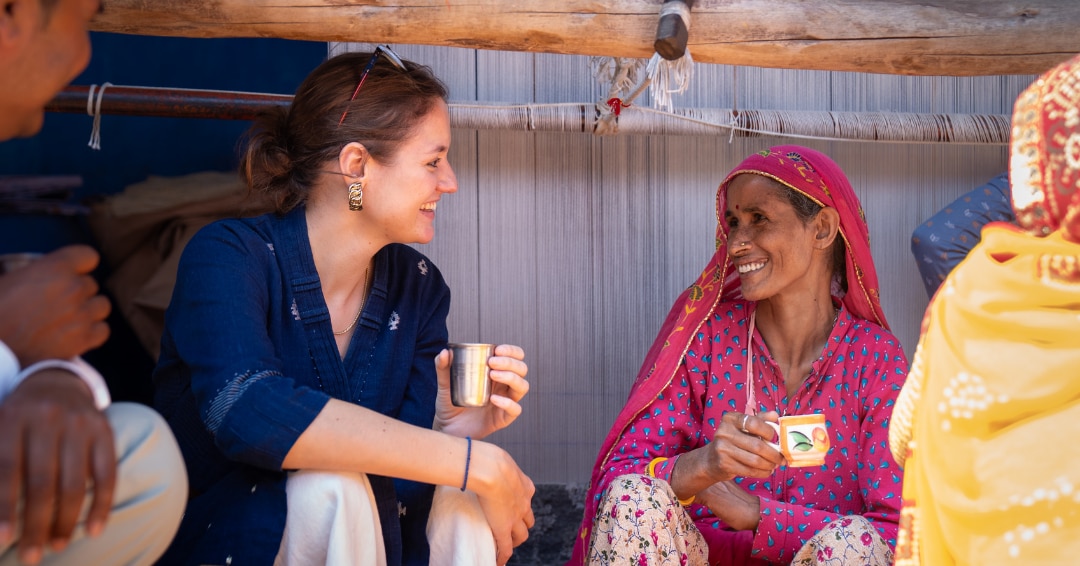
Craft-based tourism such as rug weaving can help boost local communities. Image: Jaipur Rugs
- Global travel and tourism is forecast to contribute $16 trillion to GDP by 2034, with cultural tourism alone could reach $2.6 trillion by 2035.
- But while tourism can greatly benefit local communities, small businesses and artisans often remain excluded from high-value visitor spending.
- Across India, community-led initiatives are showing how tourism can generate local income while supporting cultural knowledge and traditions.
The first time we visited Gulab ji, a Bhil tribal farmer, at his home in the forest of Jhadol, Rajasthan, he served us tea with sugar. A usual offering when you visit someone in India, but not in Jhadol. Tea and sugar are not grown in that region, and they're not part of the local diet. His family had bought both especially, because we were coming from the city.
Later, over a long conversation, he explained he had assumed visitors from the city would expect "white" sugar, not kakab, the sweetener his family makes from the sugarcane on their own farm.
That instinct, to dilute what is local because it feels like something to apologise for in front of an outsider, is a familiar one across rural India. But as our visits continued, something shifted.
The community began to sense genuine curiosity about their local culture, and it inspired a growing confidence in their way of life. On a more recent visit to Gulab ji, he served us ragi ki raab made from the finger millet and jaggery - a traditional unrefined sugar - grown on his own land.
Communities as hosts of tourism
That shift is playing out across India in different forms: artisans hosting travellers in their own homes instead of being observed as subjects at craft festivals and demonstrations in art galleries; tribal communities teaching food traditions directly to visitors; women being trained in foreign languages to guide tourists through their own city instead of remaining invisible in the value chain.
According to the World Economic Forum’s Beyond Tourism report, global travel and tourism is projected to reach 30 billion tourists and contribute $16 trillion to global GDP by 2034, with cultural tourism alone projected to reach $2.6 trillion by 2035.
This scale brings both opportunity and escalating tension points, and is a call to recognize travel and tourism as an interconnected “sector of sectors” with local communities at its centre. Across the world, this interconnected ecosystem approach is producing measurable gains in local economies.
This shift, visible in Gulab ji's Ragi ki Raab as much as anywhere else, directly answers a gap that the Forum's research has identified: that small businesses and artisans are too often excluded from high-value visitor spending, leaving community enterprises and informal workers without safety nets.
What this looks like on the ground
The clearest economic signal is in craft-based tourism, where visitor programmes are being structured to reach beyond a single transaction.
Jaipur Rugs Foundation's Rural Experiences initiative is one such model, bringing visitors into artisan villages across rural India so that income reaches not just rug weavers but potters, bangle makers and other craftspeople in the same villages.
For artisans who have historically been isolated and undervalued, working through intermediaries who captured most of the margin, these visits are also a direct connection to the world their craft is sold into: a buyer who has sat in a weaver's home and watched a rug being knotted values that rug differently than one seen only in a showroom. The craft's perceived worth rises simply from being encountered in its own ecosystem alongside the person who made it.
Bimla Devi, a weaver in Rajasthan, once worked entirely on designs created by qualified designers and artists. But a creative capacity-building initiative named Manchaha led her to design a rug drawn from her own memory.
Her Kamal rug went on to win the German Design Award, a recognition that reaches far beyond the village and repositions its maker as an author with global standing, not simply a craftsperson executing someone else’s vision.
Another case is of Pink City Rickshaw Company that recruits women from low-income households, many with no prior work experience, not simply as drivers but as shareholders in a collective they co-own.
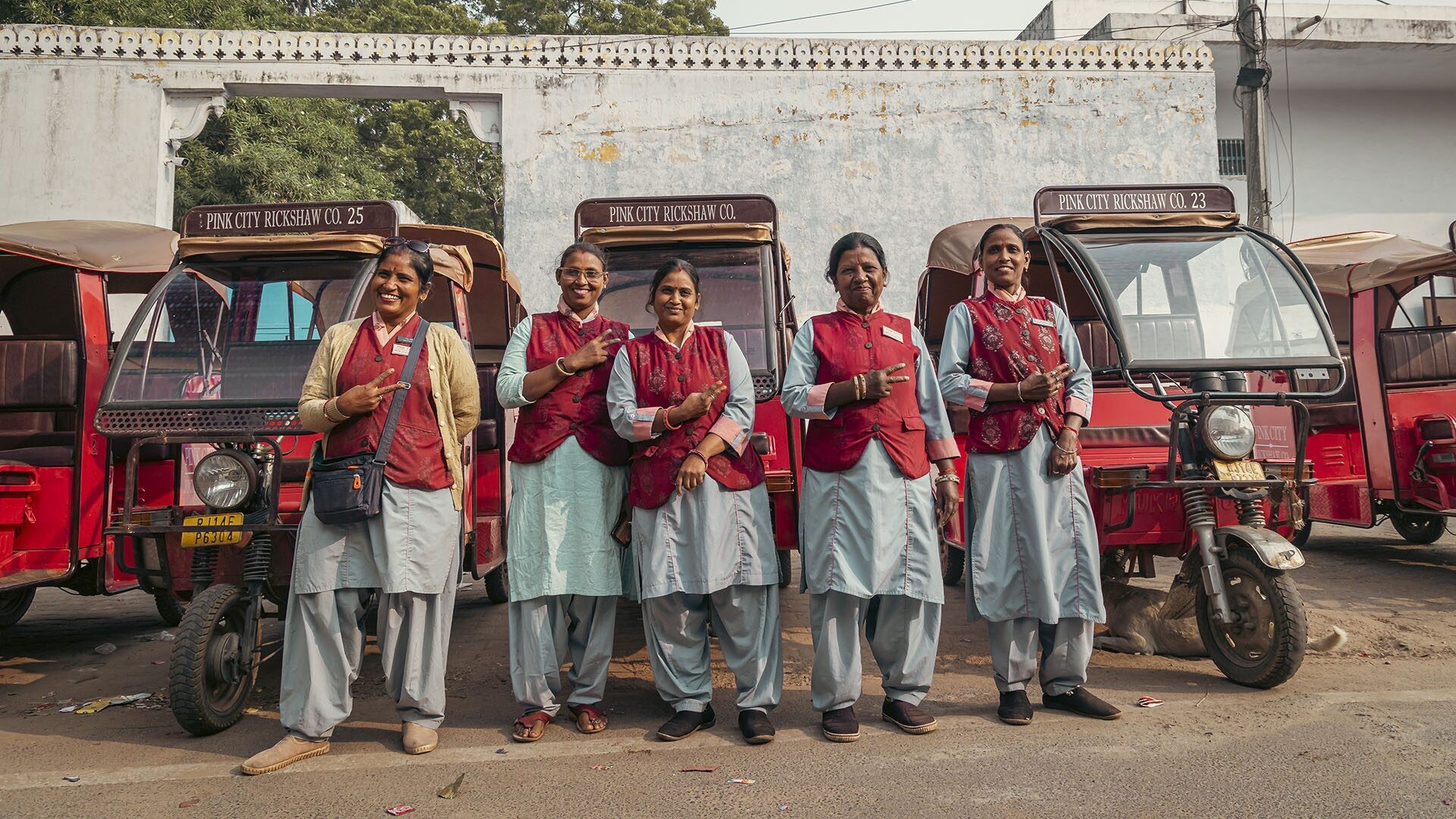
Yet even within that model, these women have remained on the margins of the value they help create: their work is largely limited to driving tourists from one place to another, while the actual guiding, the storytelling, the interaction that visitors remember and pay a premium for, has typically belonged to someone else.
Alliance Française Jaipur is training a group of these women in tourism-focused French, closing that gap directly rather than working around it. It also addresses another problem: Rajasthan's tourist season runs roughly six months a year, leaving these women without steady income the rest of the time.
French turns into something usable well beyond the season, hosting cultural immersion evenings in their own homes, welcoming French-speaking researchers, artists and independent travellers year-round, taking on one-off assignments for hotels and agencies that need a trusted local contact.
What starts as a language class becomes something closer to income infrastructure, rooted in the neighbourhood, available on demand, and owned by women who already know their city better than anyone guiding a tour through it ever could.
The programme is funded by Alliance Française du Touquet and the Fondation des Alliances Françaises in Paris that supports French learning and livelihood generation for marginalized communities across the world.
In Karnataka, Bibi Fatima has spent years safeguarding indigenous seed varieties through her seed-bank network built with the support of Sahaja Samruddha, a grassroots organization working with rural farmers.
Her work was recognized with the UN Development Programme Equator Award in 2025. What she protects is not simply biodiversity; it is agricultural and culinary knowledge built up over generations. When that knowledge is shared directly by the community rather than extracted and packaged by an intermediary, it stays alive, and it starts generating income on their terms.
Why such a tourism model works
What connects these examples is not the sector, food, water, craft, but who owns the value being created. In each case, the community moves from being the subject of someone else's tourism narrative to being its host and architect.
That single shift is what closes the gap that the Forum has identified: the value of high-visibility, high-spend tourism stops leaking away from the people who created what visitors came to see, and starts compounding locally instead.
This is also why the "sector of sectors" framing matters. Culture, ecosystems and economy were never separate line items in these communities to begin with: a seed variety is agricultural knowledge, food heritage, and income, all at once. Tourism models that keep those threads together, rather than extracting one and discarding the rest, are the ones producing durable outcomes.
These cases sit at different points on the same curve, one already operating at meaningful scale across hundreds of villages, the other a more contained but replicable model built around a single, specific skill. Together they suggest a pathway, targeted training and pilot projects, often backed by institutional or bilateral partnerships, followed by structured, community-managed models that can absorb demand without diluting the communities at their centre.
That will require the safety nets that the Forum's research says are still missing: mechanisms that let informal workers and small community enterprises capture value at the scale global institutions are already funding.
The opportunity in front of India is not to invent community-led tourism, it already exists across the country. It is to recognize it, fund it and get out of its way.
Don't miss any update on this topic
Create a free account and access your personalized content collection with our latest publications and analyses.
License and Republishing
World Economic Forum articles may be republished in accordance with the Creative Commons Attribution-NonCommercial-NoDerivatives 4.0 International Public License, and in accordance with our Terms of Use.
The views expressed in this article are those of the author alone and not the World Economic Forum.
Stay up to date:
Circular Economy
Related topics:


Forum Stories newsletter
Bringing you weekly curated insights and analysis on the global issues that matter.
More on Economic GrowthSee all

John Letzing
September 18, 2026


