Interventions drive trade policy surge in 2026, and other trade news to know
Global trade intervention climbed to record levels in 2026 as restrictions and subsidies accelerated. Image: REUTERS/Francois Lenoir
- This monthly round-up brings you a selection of the latest news and updates on global trade.
- Top international trade stories: Record surge in global trade intervention; EU advances supply chain risk group; Trade tensions intensify between the US and Canada.
1. WTO/IMF data shows surge in tariffs, restrictions and subsidies
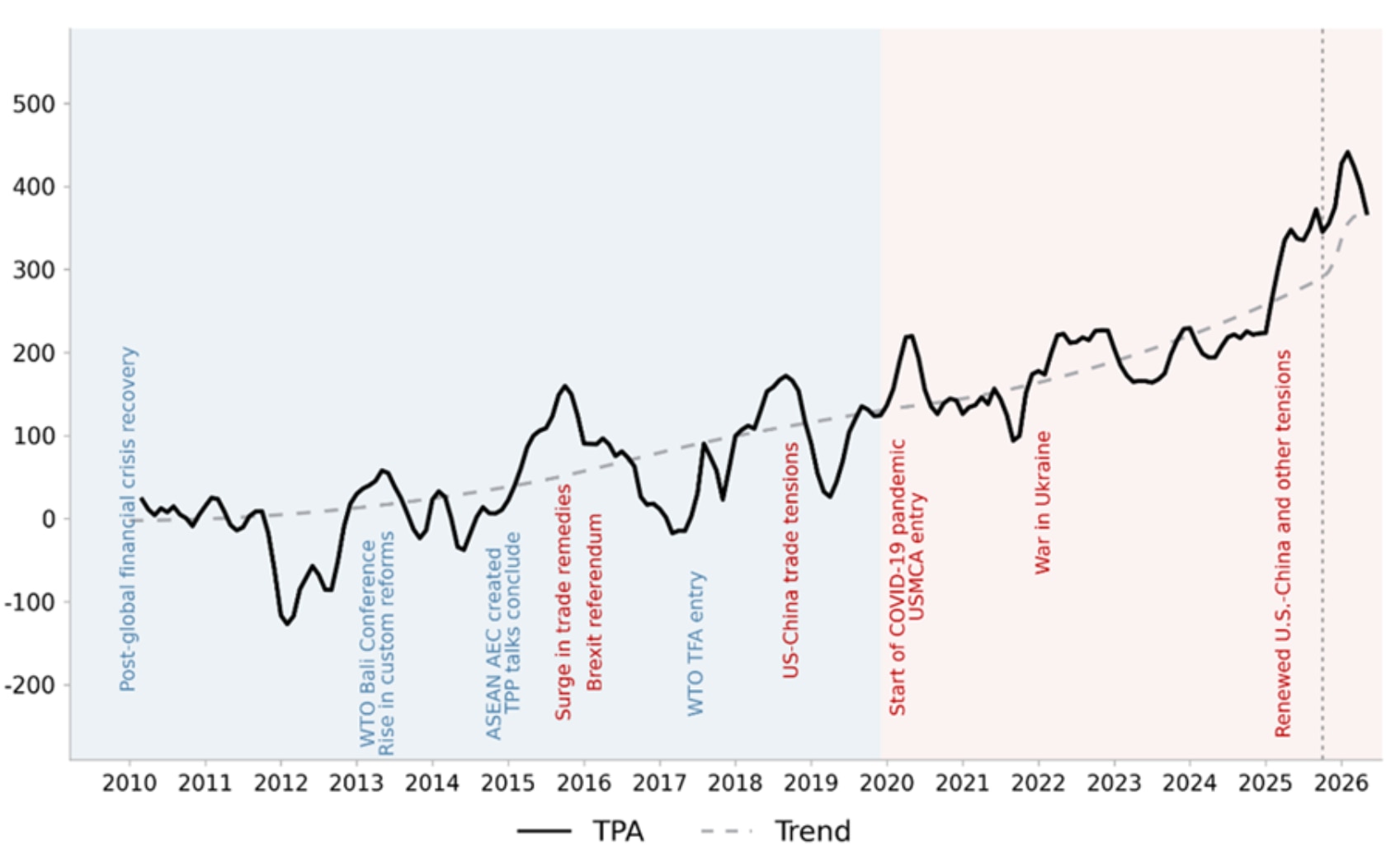
Global trade policy intervention reached an all-time high in early 2026 as governments increasingly turned to protectionist measures and state aid, according to new data from the World Trade Organization (WTO) and the International Monetary Fund (IMF).
The Trade Policy Activity Index, which covers 197 countries and territories, reveals:
- Record activity levels: Global trade policy activity from January to May 2026 ran nearly double 2024 levels and roughly 25% above the 2025 average, marking the highest peak since tracking began after the 2008 Financial Crisis.
- Restrictions outpace facilitation: The surge is overwhelmingly driven by restrictive measures (tariff hikes, import bans) and subsidies, while trade-easing measures have lost relative momentum.
- Widespread beyond major economies: Although G20 members show the sharpest spikes, non-G20 economies have also registered marked increases in intervention.
- Elevated short-term outlook: Preliminary nowcasting models through June 2026 point to a potential further increase in policy activity heading into the second half of the year.
"Understanding these shifts is increasingly important, as trade policy plays a growing role in shaping global supply chains, economic resilience and geopolitical dynamics," the researchers confirmed.
The new research comes as the US imposes sweeping new Section 301 tariffs on dozens of major trading partners to tackle forced labour in trade. The move is the latest escalation in the ongoing trade disputes pursued by US President Donald Trump since returning to office.
The new tariffs apply to the top 60 US trading partners and cover more than 99% of US imports, with most rates ranging from 10% to 12.5%, although higher duties apply to selected products and trading partners.
Global merchandise trade grew 1.9% in volume in the first quarter of 2026 compared to the previous quarter and 3.2% compared to the same quarter last year. The increase has been driven in part by strong demand for AI-related infrastructure, including semiconductors, data transmission equipment and other digital technologies. However, momentum may not last, WTO experts caution, citing continuous geopolitical tensions, trade policy uncertainty and elevated energy prices.

2. EU sets autumn launch for business group on trade risks
The European Commission plans to establish a corporate advisory group this autumn to improve information sharing on supply chain risks, Bloomberg reports, as the European Union (EU) responds to a more interventionist global trade environment.
First proposed under the EU’s economic security strategy, the forum was delayed while officials structured how companies could share sensitive data without compromising confidentiality. The group will bring together businesses on an ad hoc basis to advise officials on specific risks, potential responses and de-risking strategies.
The move comes as governments increasingly focus on supply-chain resilience, industrial policy and economic security as part of trade strategy. Brussels is also assessing challenges linked to major trading partners, including China and the United States, from export restrictions and industrial competition to access to critical goods.
How the Forum helps leaders make sense of regional, trade and geopolitical shifts
3. News in brief: Trade stories from around the world
Trade tensions between the US and Canada have intensified. In July, the US announced new 50% tariffs on a targeted list of approximately $20 billion of Canadian imports, including products such as wine, dairy, cement and sporting goods. The tariffs were imposed under a provision of the Tariff Act of 1930 that is being used for the first time since the law was enacted nearly a century ago. They add to existing tariffs on sectors including steel, aluminum and automobiles, increasing uncertainty for businesses as the two countries continue discussions of the upcoming review of the United States-Mexico-Canada Agreement (USMCA).

EU trade security developments are being watched in the UK, where the government is seeking closer ties with the EU while maintaining its own trade policy approach. The Financial Times has reported that greater use of EU trade defence measures could create challenges for Britain as it seeks to balance economic ties with Brussels and its independent trade priorities.
The Trump administration has introduced new restrictions on US imports of certain Chinese-made robots and connected power inverters, citing national security and cybersecurity concerns. The measures, implemented by the Federal Communications Commission, are intended to protect US AI-related supply chains and critical infrastructure and are expected to affect suppliers including Unitree, Sungrow and Huawei, says Reuters.
This comes as Ford CEO Jim Farley told employees the company is preparing for the possibility that Chinese automakers could enter the US market within five to 10 years, Reuters reports. Ford is developing lower-cost electric vehicles to compete with Chinese rivals such as BYD, despite existing US trade barriers on Chinese vehicles.
Australia and Singapore have signed a protocol on economic resilience and essential supplies to strengthen cooperation on critical supply chains and trade, Reuters reports. The agreement forms part of an existing free trade pact between the two countries and aims to improve resilience against global supply disruptions.
4. More on trade on Forum Stories
Clean energy has become one of the defining economic growth stories of the 21st century. As China’s manufacturing scale drives down costs for solar and wind, countries are weighing the benefits of competition against concerns over industrial dependence and trade barriers. In this video, Kelly Sims Gallagher of Tufts University explores what comes next for the global clean energy race:
Can greener ports become the next competitive advantage in global trade? As climate risks and supply-chain disruptions reshape logistics, ports are looking beyond speed and scale – investing in clean energy, digital systems and nature-based resilience to protect the future of global commerce.
Is the developed-emerging market divide becoming outdated? Countries once labelled 'emerging' are increasingly competing at the forefront of global industries, from semiconductors to aerospace. This article explores how changing economic realities are blurring traditional classifications and reshaping the way investors view markets.
Last year's initial deluge of US tariffs was met with warnings about the typical impact these trade restrictions have on inflation. Following a legal setback, the protectionist measures have been revived. So what does recent experience tell us about how tariffs affect the cost of everything from sofas to toothbrushes? This article examines new research on the impact of tariffs.
License and Republishing
World Economic Forum articles may be republished in accordance with the Creative Commons Attribution-NonCommercial-NoDerivatives 4.0 International Public License, and in accordance with our Terms of Use.
The views expressed in this article are those of the author alone and not the World Economic Forum.

Forum Stories newsletter
Bringing you weekly curated insights and analysis on the global issues that matter.