Live from Davos 2026: What to know on Day 3
More about the meeting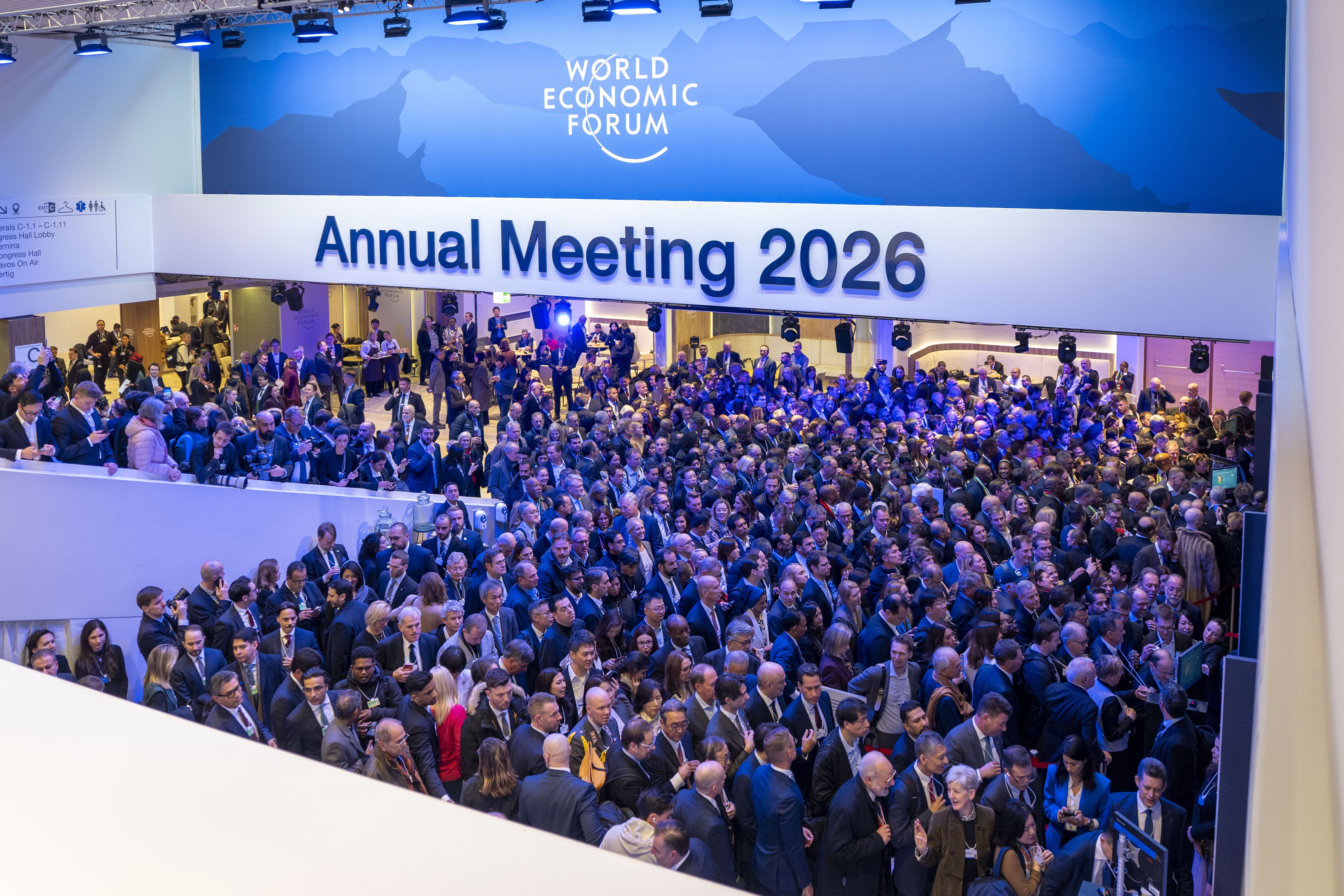
WEF/Mattias Nutt
Forum live blog team
Special Address by Donald J. Trump
US President Donald Trump took the stage at a fraught geopolitical moment, as traditional patterns of global commerce have been upended and the biggest economies are seeking a technological edge.
In lengthy remarks that ranged from Greenland to Minnesota and back again, President Trump touched on a variety of issues including trade and tariffs, regional security, AI development, nuclear power, housing affordability, migration, and pandemics.
One highlight came in relation to Greenland; “I won’t use force” to attain it, he said.
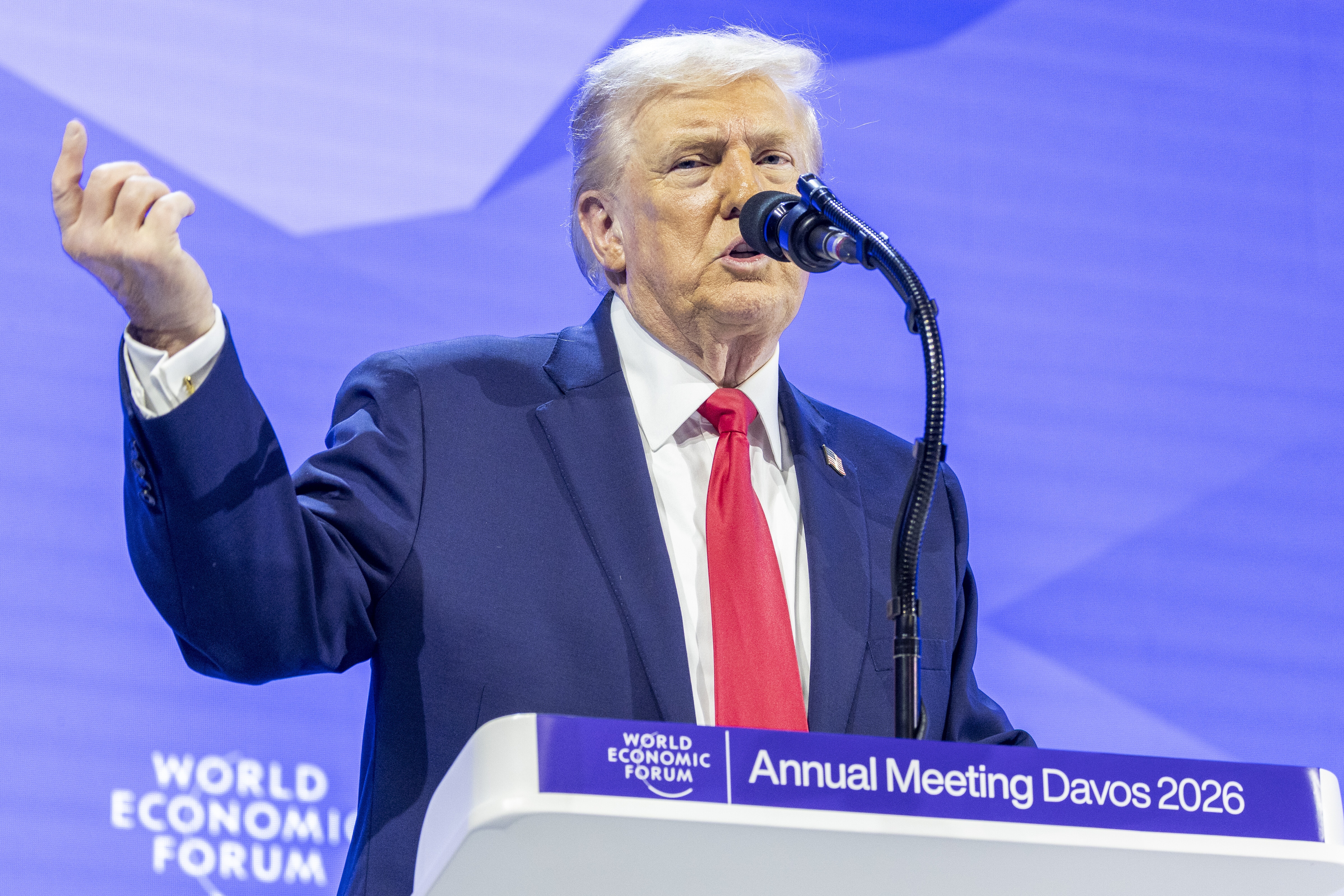
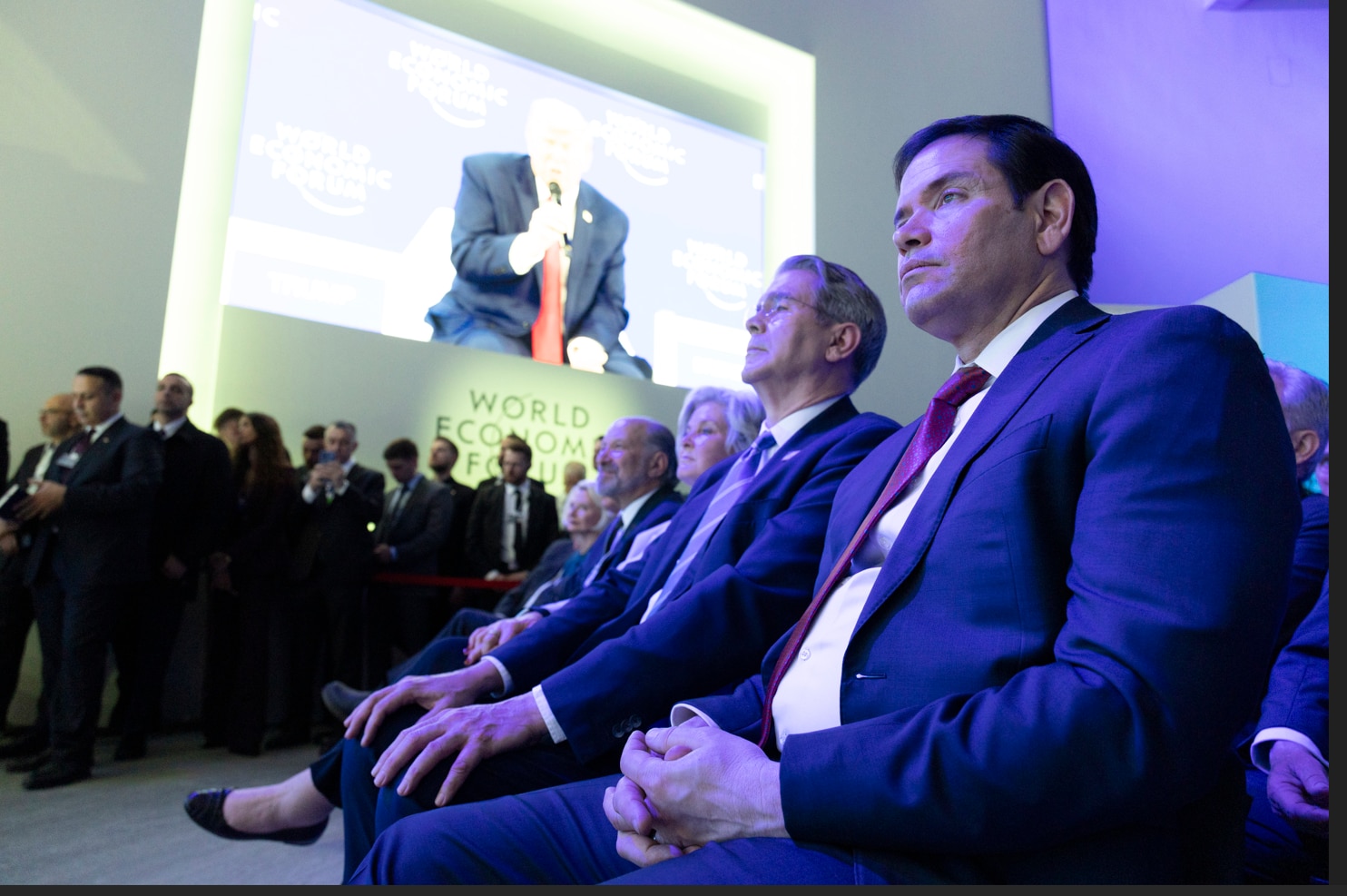
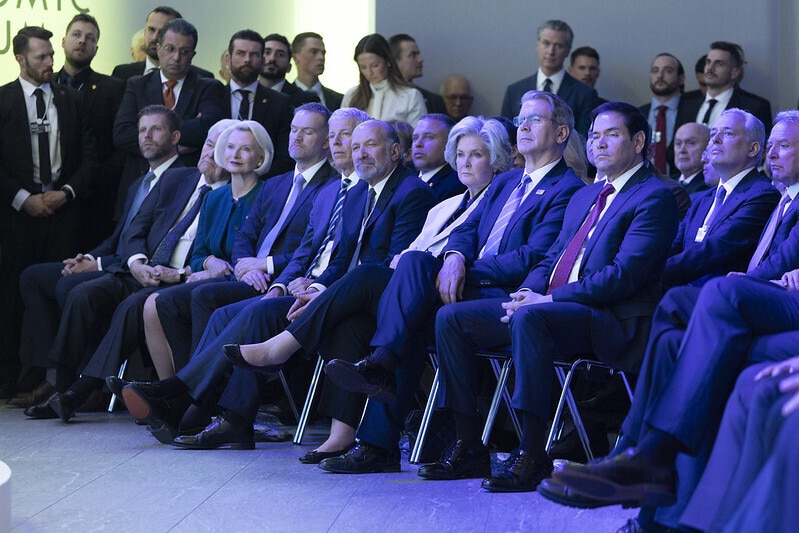
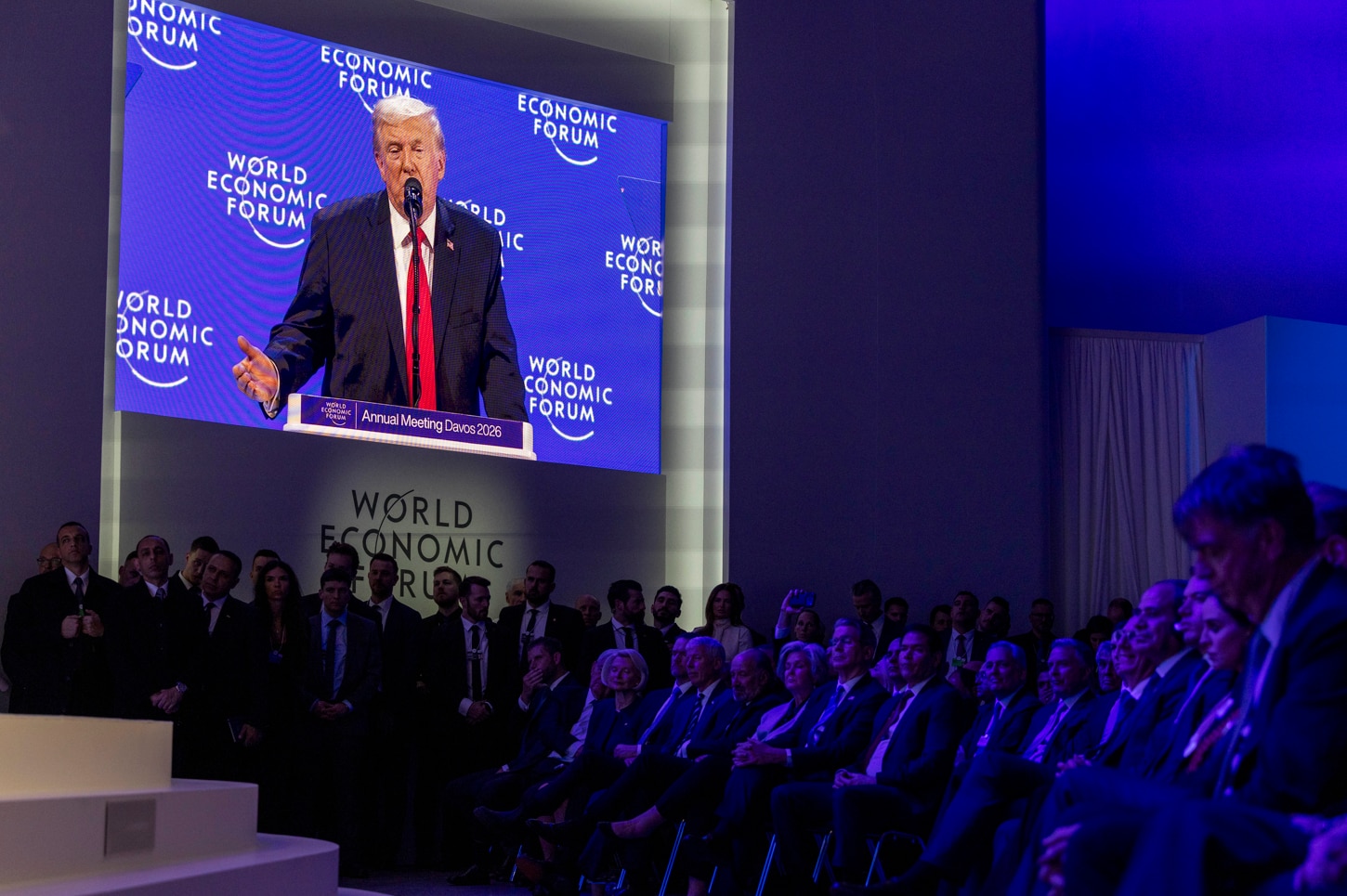
The address is available in its entirety here:
Stay up-to-date with Davos 2026 daily live blogs
Q&A with Larry Fink and André Hoffman
On the sidelines of the meeting, we asked the World Economic Forum’s interim co-chairs, Larry Fink and André Hoffman, about their vision for the future, hopes for what Davos 2026 will achieve, why dialogue is more needed than ever, and reasons for optimism.
Here's what they said.
How to give women better health
Women spend 25% more of their lives in poorer health than men. Closing this gap is not only a moral imperative, but an economic one, but how do we make this happen?
In a session titled Breakthroughs in Women's Health, the discussion brought together leaders spanning global health, science, finance and policy, including Sania Nishtar, CEO, Gavi, the Vaccine Alliance; Severin Schwan, Chairman, Roche; Gargee Ghosh Chasin, President, Global Policy and Advocacy, Gates Foundation; Nadia Calviño, President, European Investment Bank, Orazio Schillaci, Minister of Health, Ministry of Health of Italy, with Magdalena Skipper, Editor-in-Chief, Nature, as moderator.
The panel was unanimous in arguing that the focus needs to be on the human side of implementation. Some of the most successful interventions don’t require breakthroughs in true scientific meaning. Instead, it’s about context, accessibility and affordability.
Speaking about Italy’s experience, where there are 19,000 women over the age of 100, Schillaci argued that success was not about low and high tech issues, but instead universal healthcare, lifestyle, surveillance, community, and support to maintain independence for longer.
Treat women’s health as longevity infrastructure.
”Addressing the importance of philanthropies’ role in healthcare, Chasin focused on three areas – science, product and delivery. She argued that philanthropies can act as a catalyst for action, signalling what’s worth looking at, supporting product development and manufacturing, and of course, funding.
The speakers listed the primary means they believed would help accelerate attempts to minimize the gender gap by 2030, suggesting:
- Get smart on the issues
- Explicitly articulate policy
- Disaggregate data
- Keep the issue on the agenda in terms of economic progress
- Preserve the role of Europe as a sanctuary of research
- See health as an investment into people and the economy, not just a cost
Catch up here.
Have you read?
Prepping economies for future shocks
This session explored how economies can endure disruption and sustain long-term progress.
Secretary-General of the United Nations Conference on Trade and Development Rebeca Grynspan said one of the shocks she fears the most is a public-debt crisis, particularly for developing countries where governments have had to make difficult fiscal choices.
“They don’t want to default on the debt, but they’re defaulting on development,” she said.
Lebanon’s Minister for Economy and Trade Amer Bisat agreed that public debt has gotten out of control. His nightmare, he said, is belatedly realizing "we’ve spent much more than we produce.”
President of Latvia Edgars Rinkēvičs noted that it wasn't too long ago that the country was anxious about its energy dependence on Russia. More recently, he acknowledged, Greenland has become a source of anxiety.
"I very much hope this issue is going to be solved with dialogue,” he said.
Watch the full session here:
Ideas on the Move - Ray Dalio
What drives Ray Dalio?
Between sessions, we catch up with the world-renowned investor to ask what still drives him after decades at the heart of global finance. His answer: curiosity, challenge - and a determination to pass on hard-won lessons.
Watch the latest instalment of Ideas on the Move here:
Closing the Humanitarian Aid Gap
David Miliband, President and Chief Executive Officer, International Rescue Committee, set the scene for this press conference by saying the humanitarian aid sector shrunk by 50% in 2024: "The need for new thinking about how to finance development finance comes into sharp relief."
He introduced Elisabeth Carpenter, Chief Strategic Engagement Officer at Circle, a global, internet financial platform company.
"Our mission is our product and our product is our mission," she said, announcing a new grant to support the United Nations' Digital Hub of Treasury Solutions (DHoTS) in partnership with UNHCR: “It’s the perfect expression of our mission.”
Ewan Watson, UNHCR Head of Global Communication Service, explained how transformative the platform is, because it means refugees can access aid faster.
Circle Foundation’s grant to UNHCR in support of DHoTS builds on Circle’s 2022 collaboration with UNHCR when the agency pioneered USDC-based aid payouts for displaced Ukrainians.
"Modern humanitarian finance needs modern infrastructure and we’re here to make that happen," said Carpenter. "We expect to see significant cost savings, traceability and visibility of the funds."
The goal is to ensure aid reaches the most vulnerable quickly, while safeguarding treasury transparency and transaction integrity, and promoting trust among donors and beneficiaries.
Watch live here.
Conversation between David Sacks and Marc Benioff
At a time when technology’s influence spans politics, markets and geopolitics, David Sacks, the White House AI and crypto czar, and Marc Benioff, CEO and Co-Founder of Salesforce, sit down for a wide-ranging conversation.
The two leaders discussed where innovation, governance and economic opportunity intersect, especially with regards to artificial intelligence. Sacks noted that facilitating a culture of innovation — like in Silicon Valley which has a “culture of disruption, of moving fast, of innovating” — is key to achieving technological breakthroughs.
Sacks and Benioff also examined how regulation can be enacted to foster innovation and avoid stifling growth. In the United States, Sacks warned that one threat to innovation is that the 50 US states are all working to regulate AI independently. “We have 1,200 bills going through state legislatures right now,” he warned.
Special Address by Javier Milei, President of Argentina
Javier Milei, who has served as President of Argentina since December 2023, has delivered his special address in Davos.
Milei's party, La Libertad Avanza, secured a decisive result in the midterm elections late last year – winning around 40% of the vote and expanding its share of seats in Congress.
During the speech, President Milei spoke about the "substantial transformation" that Argentina is undergoing, and how his country is transitioning from recession and hyperinflation towards fiscal discipline.
As well as inflation and fiscal reform, Milei's speech also covered justice and values, productivity, entrepreneurship, and how to regulate AI.
Here's the full session:
A transcript is available here.
Reasons why men and women are falling behind
This session brought together leaders and experts to ask how we construct a shared narrative of progress that honours the real struggles of men and women?
Answering the session's title Is Everyone Falling Behind?, an overriding sentiment was that the situation is a lot more nuanced than it appears. Using the US as an example, educationally, women are performing far more strongly than men, but girls and young women are struggling with more mental health issues.
Men are registering far more suicides and young men are falling further and faster than any other cohort in an environment where overall there has been a consistent transfer of political power from young to old.
The participants talked about the idea of people having a “package of goods”, which make them attractive in the marketplace. In an age of hyper engagement with social media, many men are failing to develop the social skills needed for coupling. At the same time, women are increasingly expecting more, a situation that is creating growing numbers of single people.
Men in their twenties are spending as much time on their own as men over 70.
”There were calls for a lot of policy and mindset change. Among the ideas tabled were the need to recreate good jobs for non-college educated men; creating better workplace cultures that offer employees (male and female) greater meaning; making fundamental changes to early-years education, including having girls and boys start their education at different ages.
One of the most striking ideas was to introduce national service, but not necessarily of a military nature. Instead, young people could elect to go into services like healthcare or senior care and experience a leadership environment filled with men and women.
Speaking were Scott Galloway, Clinical Professor of Marketing, NYU Stern School of Business; Alice Evans, Visiting Associate Professor in Economics, Stanford University; Christy Hoffman, General Secretary, UNI Global Union; and Michael Ensser, Chairman, Egon Zehnder.
Catch up here.
Here's some background reading on the global gender gap:
Special Address by Donald J. Trump
US President Donald Trump took the stage at a fraught geopolitical moment, as traditional patterns of global commerce have been upended and the biggest economies are seeking a technological edge.
In lengthy remarks that ranged from Greenland to Minnesota and back again, President Trump touched on a variety of issues including trade and tariffs, regional security, AI development, nuclear power, housing affordability, migration, and pandemics.
One highlight came in relation to Greenland; “I won’t use force” to attain it, he said.
The address is available in its entirety here:
Markets, AI and trade with Jamie Dimon
As Chairman and CEO of JPMorgan Chase, Jamie Dimon sits at the intersection of capital, risk and real-world economic activity. His assessments are closely followed not just on Wall Street, but by policy-makers and business leaders worldwide.
Zanny Minton Beddoes, Editor-in-Chief of The Economist, sat down with him for what was a wide-ranging discussion on the state of markets, AI and trade.
Dimon opened by sharing his secrets to success from his long years in business:
On AI, Dimon advised companies to face transformation head on: "Don’t put your head in the sand, it is what it is, we’re going to deploy it." Rapid technological development has changed the competitive landscape, Dimon said, bringing new players into many industries.
Watch the full session below:
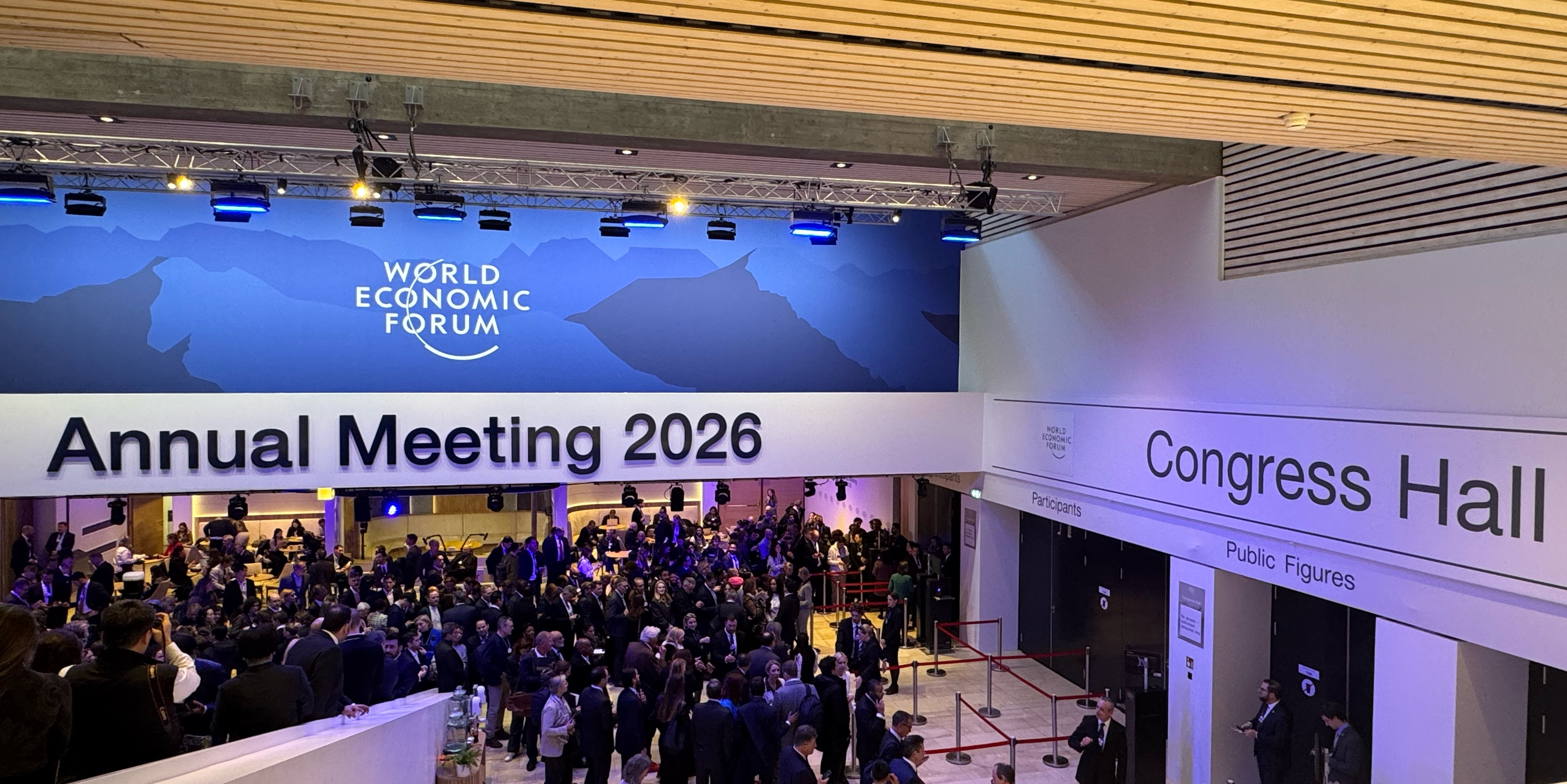
Line forming early for President Trump's address
The queue for US President Donald Trump's special address started forming before 1pm for his scheduled 2:30pm appearance.
Watch the session live here.
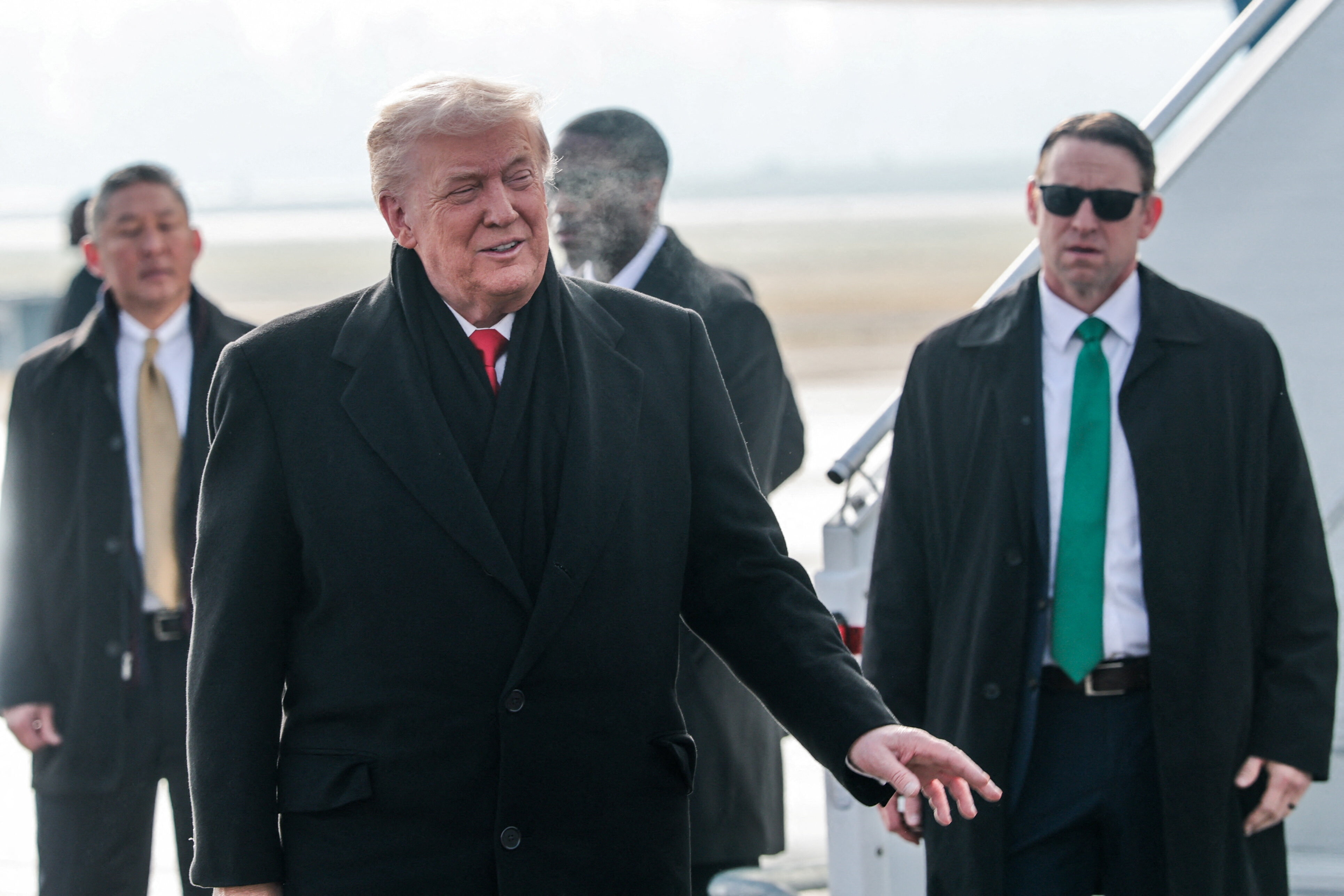
US President Donald Trump lands in Switzerland
After a minor delay due to an airplane technical issue, US President Donald Trump has landed in Switzerland and is on his way to Davos.
Trump will join key members of his cabinet who are already in Davos, including Treasury Secretary Scott Bessent and Commerce Secretary Howard Lutnick.
AI: work tool or co-worker?
AI is no longer just a tool – it’s starting to feel like a co-worker. From automating tasks to supporting decisions, artificial intelligence is reshaping how people work, how organisations operate and how societies adapt.
But as AI takes a seat at the table, how do we redesign roles, incentives and responsibilities so humans can thrive alongside digital systems?
For Kian Katanforoosh, Founder and Chief Executive Officer, Workera, the language matters. “Personally I’m not a fan of calling AI agents agents or co-workers,” he says. AI excels at tasks, not entire jobs. Humans, by contrast, perform “100s of tasks at times”. Predictions that AI would replace jobs, he adds have so far been wrong.
Munjal Shah, Co-founder and Chief Executive Officer, Hippocratic AI, agrees that AI will augment rather than replace people – but at a massive scale. In the near future, he says, there will be “8bn people and 80bn AIs”. Most won’t replace what humans already do. Instead, they’ll enable new use cases. He points to an AI system that called thousands of people during a heatwave, guiding them to cooler locations and offering health advice. Getting it right required rigorous testing. “We have models that check models that check models.”
For Kate Kallot, Founder and Chief Executive Officer, Amini, AI remains firmly in the “tool” category. The new interface is changing how people work, she says, but AI can’t make value-based decisions. It “can’t choose the best outcomes” because it doesn’t yet have the right inputs.
Still, the experience can feel more human than expected. Christoph Schweizer, Chief Executive Officer, BCG, says, “You are now in a reality where it feels like a co-worker, whether you call it that or not.” AI, in many contexts, feels like more than just a piece of software.
That perception creates new expectations. Enrique Lores, President and Chief Executive Officer, HP, urges balance. “We need to be careful not to be more demanding with the AI coworkers…than what we are with our own employees.” AI systems, he says, aren’t perfect – but neither are people. In HP’s call centres, AI sometimes gives the wrong answer, yet overall accuracy is higher than before and customer satisfaction has improved. “Everybody makes mistakes,” he says.
Technology alone, however, isn’t enough.
Schweizer argues that success depends on how companies change their organizations, not just their tools. “They will succeed if they really change how their people work.” That means rethinking processes, incentives, leadership and culture – and treating AI as “a CEO problem”, not something to delegate. When leaders take ownership, invest boldly and upskill their teams, he says, employees start to see the benefits. “Oh wow, this really helps me… I love this.”
Right now, the conversation focuses too much on technology, he adds. “We should talk a whole lot more about the skills and the positive sentiment and the change management around it.”
The message from the session: whether AI is seen as a tool or a co-worker, its real impact depends on how people choose to use it – and how organisations choose to change.
In case you missed it, you can watch the session in full here.

A notable CEO on the move
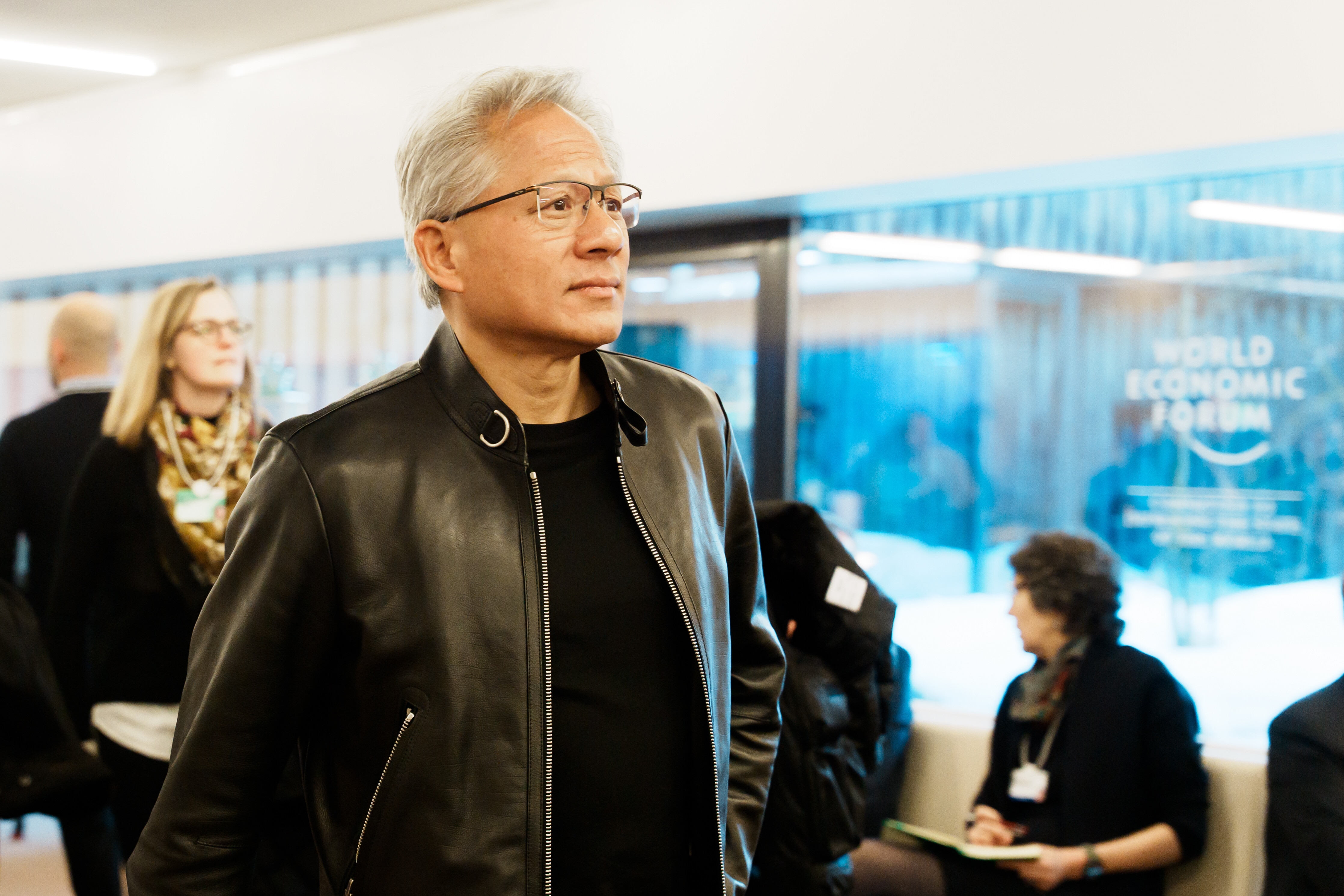
A small crowd formed quickly in the Congress Centre as Jensen Huang, President and Chief Executive Officer of NVIDIA, passed through – pausing repeatedly for handshakes, selfies and quick exchanges.
His session Conversation with Jensen Huang is available in full here.

Jensen Huang on AI: 'Get involved!'
NVIDIA has reshaped computing through AI acceleration, but the company's influence extends far beyond chips.
Jensen Huang discusses how AI infrastructure, compute power and GPU innovation are defining the next era of technological transformation and economic growth.
Huang is joined by Larry Fink, Chair and CEO, BlackRock; Interim Co-Chair, World Economic Forum, BlackRock.
The layers of AI
Huang explained that now we have a computer that can understand unstructured data and reason on what to do about it. It's not a 'pre-recorded computer' but rather takes context and can reason intent, meaning etc.
So the question, he says, is 'wat is AI'. AI is essentially a 5-layered cake. At the bottom is energy. The second layer is chips and computing infrastructure,
The next layer is cloud, then next layer is AI. The most important layer at the top is the application layer (be it financial services, healthcare, manufacturing...). But he says "this computing platform requires all of the layers beneath it". He said it's the largest infrastructure build out in human history. There are trillions of dollars of infrastructure that needs to be built out and it's "sensible".
On jobs: Purpose versus task
He enthused about the potential of AI and even the creation of jobs. "It's wonderful that the jobs are related to trade craft - we're going to have plumbers and electricians... all of these jobs, we're seeing quite a significant boom and salaries have gone up. Nearly double."
Using the example of a radiologist - he said the purpose of the job is to diagnose disease. But AI has taken away the drudgery of processing scans. The counterfactual is that hospitals are hiring more radiologists because the entire health ecosystem is seeing growth as a result.
He said you need to think about jobs in terms of purpose versus tasks. "The purpose is enhanced and made more productive because the task has been automated."
What about emerging markets?
He says every country should build the infrastructure. He also reminded Davos how 'easy' it is to use AI. "Everybody should get involved", he said. I is essential to learn how to use AI. These skills are no different than leading people, managing people, things we do all the time. "Recognize that AI is likely to close the technology divide. I'm fairly optimistic about the potential of AI to lift the countries that are emerging" and to empower people.
On Europe?
Now is an opportunity to get in early and fuse industrial capabilities with AI and enter the world of physical AI and robotics. It's a once in a generation opportunity.
AI bubble
The opportunity is extraordinary and everybody ought to get involved. We need more energy, we need more trade-skill workers.
Watch the livestream here.
''We need to challenge how society views burns' survivors"
At 24, Katie Piper survived a life-threatening acid attack that shattered her body and her sense of self. Through pioneering reconstructive surgery and extraordinary resilience, she transformed trauma into purpose.
"My life ended and began all at the same time on that day," said Piper, describing the sulphuric acid attack on a busy London high street in 2008.
She wants to help people to step out of conformism:
Authoring my own identity has been the most powerful place for me.
”In terms of leadership, her story illustrates that empathy, kindness and diversity are just as important as finance and policy, she added.
The experience has changed the way she lives every day and she now sees it as "a gift".
Resilience is in all of us, but some people don’t find that strength of character until it’s too late, she said.
"I was given a gift that day - to learn that everything changes in a second... But I wasn’t in the palliative care ward, I was able to go into the future and feel all those things and come back and live differently."
Turning to the tragedy of the Crans-Montana fire in Switzerland, Piper gave a message of hope:
“This isn’t the end, temporarily it feels permanent, but it’s not. There’s a new life out there, and one day this will be a distant memory.”
“We have been able to change the landscape" for survivors, she added.
"We need to challenge how society receives our survivors… and help them connect with others and seek intimacy and self-worth."
Today, as a writer, activist, TV presenter and model, Piper has dedicated herself to supporting burn and scar survivors -advocating for better prevention, challenging stigma and proving that survival is not the end of one's story but the beginning of a new chapter.
She spoke to CNBC anchor Tania Bryer about how personal tragedy can catalyze systemic change and collective healing.
Watch the full session here.
Cybersecurity threats in 2026
As cyber and physical risks become increasingly intertwined, disruption in one domain can cascade across all others.
With 54% of large organizations citing supply chain challenges as the biggest barrier to cyber resilience, vulnerabilities now reach far beyond traditional networks and into the very systems that sustain global commerce and critical infrastructure.
In this session, panellists explored how leaders can better anticipate and contain the next generation of interconnected threats. Participants include Michelle Zatlyn, Co-Founder and President of Cloudflare; Michael Miebach, CEO of Mastercard; Catherine De Bolle, Executive Director of Europol; Hatem Dowidar, Group CEO of e&; and Samir Saran, President of the Observer Research Foundation.
Watch the session here.
Pondering the impact of an AI bubble burst
Soaring valuations for AI-related companies made many people wealthy last year, and not just top executives or savvy investors. This discussion zeroed in on the question of whether this AI investment boom is perhaps more of a bubble – and the potential ramifications of a burst.
The panellists generally agreed that there are significant differences this time around compared with the dot-com bubble days more than two decades ago. With the companies pushing AI forward now, said Ardian Executive President Mark Benedetti, ““there’s an actual impact that we can measure.”
Not everyone is sold on the idea of a rosy future, however.
Harvard University Gregory and Ania Coffey Professor of Economics Gita Gopinath said there’s a necessary distinction between sky-high company valuations and AI’s potential to spur productivity growth.
“It’s unclear what the revenue model is going to be for companies,” she said, noting that big AI names may be profitable but their revenue tends to not stem from their AI investments.
And any real productivity gain generated by AI, added Hong Kong Exchanges and Clearing CEO Bonnie Y Chan, “has to be backed up by people willing to pay for that productivity gain.”
Another difference from the dot-com days, Chan said: “the craziness” related to AI-related stock prices which, should they abruptly cease climbing higher, “this time around will be multiplied.”
“We need to accept that some investors will suffer,” said UBS Group CEO Sergio Ermotti.
Conversation with Ken Griffin, President and CEO of Citadel
What is Citadel Investment Group President and CEO Ken Griffin watching in markets right now?
In a wide-ranging conversation with Zanny Minton Beddoes, Editor-in-Chief of The Economist, Griffin gave his take on everything from the ongoing volatility in the Japanese bond market to US government debt.
“This administration is hoping we can grow our way out of the current fiscal situation,” Griffin said, adding that the strategy is a major bet with significant consequences. On US tariffs, Griffin noted that increased tariffs have hurt the American economy, stressing that the policy uncertainty makes it difficult for businesses to plan and grow.
Have you read?
Cresting the peak: Wednesday Davos media checkup
The Annual Meeting has scaled the heights and here we are – this is the proverbial climax of this week’s goings-on and media attention is mostly focused on two key threads: the geopolitical and the technological (read: AI).
So much focus in Davos on the potential for conflict over a certain Arctic island has drawn attention away from an actual conflict still unfolding in Ukraine. (Politico)
“We are in the midst of a rupture, not a transition.” The Canadian Prime Minister’s special address recognizes a new reality and draws widespread attention. (Guardian)
The fraught dynamics of the Western alliance have inevitably soaked up much of the attention at this year’s Annual Meeting. (New York Times)
“Sit back, take a deep breath.” The US Treasury Secretary had his own message for participants in Davos. (Wall Street Journal)
One impact of the AI boom that’s already very clear: the total wealth of speakers at this year’s Annual Meeting looks nothing like it did last year. (Bloomberg)
Mainstreaming AI throughout health systems
Technologies like AI offer the potential to revolutionize healthcare. Healthcare systems the world over are exploring and developing these technological applications and solutions.
This session, titled On the Cusp of Healthcare for All, considered the practical uses of AI, and how it is already entering the health system in some countries, right down to the patient. Developing nations offer great opportunities, particularly in the level of integration that’s possible from the outset.
Bill Gates, Chair and Board Member, Gates Foundation, suggested that he "would expect that developing world health may even get ahead of rich world" in terms of using AI in health systems.
A key issue that was highlighted was that a country has to be deliberate in its prioritization, identifying specific health problems that require solutions.
Areas in which AI creates opportunity include among disease surveillance, resource optimization and offering greater access to resources for patients.
Challenges, however, remain, including reduced funding, infrastructure issue, better measuring and scaling up pilots, and providing reasons for health workers who are trained in AI to remain in their country and health service.
Speakers included Paula Ingabire, Minister of Information Communication Technology and Innovation, Ministry of Information Communication Technology and Innovation of Rwanda and Peter Sands, Executive Director, The Global Fund to Fight AIDS, Tuberculosis and Malaria (TGF), with Sara Eisen, Anchor, CNBC, as moderator.
Catch up here.
Is Tokenization the Future?
Asset tokenization is moving fast from pilot projects to live deployments across stocks, bonds, real estate and more. The pitch includes fractional ownership, faster settlement, lower costs and new investment access for retail participants.
This session looked at what that shift means in practice: who benefits, who bears risk, and how market infrastructure needs to adapt as digital assets intersect with traditional finance.
The panel brought together voices from across that spectrum, including Bill Winters, Group Chief Executive, Standard Chartered; Brian Armstrong, Co-Founder and CEO, Coinbase; Valérie Urbain, CEO, Euroclear; Brad Garlinghouse, CEO, Ripple; and François Villeroy de Galhau, Governor, Central Bank of France.
A useful frame comes from the Forum’s Transforming Capital for the Next Era (2025), which argues that digital market infrastructure could reshape liquidity, access and settlement — if governance keeps pace.
Catch up with the session here.
Here's some useful background reading:
Can India Become the Third Largest Economy in the World?
India enters 2026 as the fastest-growing major economy, expanding at around 6.5% while much of the global outlook remains subdued. Infrastructure investment, digital public systems and an expanding manufacturing base are driving momentum.
But beneath the momentum lie structural challenges: employment gaps, fiscal pressures, uneven productivity and rising trade tensions.
This session asked a direct question: can India convert scale and speed into sustained, broad-based growth — and what will determine whether the trajectory holds?
On stage were voices spanning business, policy and economics, including Sunil Bharti Mittal, Chairman, Bharti Enterprises; Gita Gopinath, Gregory and Ania Coffey Professor of Economics, Harvard University; Ashwini Vaishnaw, Minister of Electronics and Information Technology; Minister of Railways; Minister of Information and Broadcasting, Government of India; and Juvencio Maeztu Herrera, CEO and President, INGKA Group | IKEA.
Watch the full session here.
Can Europe defend itself?
Europe is facing urgent security gaps: recent airspace breaches have exposed vulnerabilities, while years of underinvestment, fragmentation and dependency have weakened the continent’s defence industrial base. This raises an important question: Can Europe defend itself?
It’s a question that “has been thrust to the forefront” because of the events surrounding Greenland, said Sarah Kelly, who hosts Deutsche Welle news programme Conflict Zone, in a session she moderated here in Davos.
While the situation in the Arctic region is worrying, tensions between NATO members are not unheard of, pointed out Mark Rutte, Secretary-General of the alliance, referencing the history between Turkey and Greece. “There are tensions at the moment, there is no doubt. But the only way to deal with it is through thoughtful diplomacy,” he remarked, noting that he would not make any official statements on the matter, but was “working on this issue behind the scenes.”
There are tensions at the moment, there is no doubt. But the only way to deal with it is through thoughtful diplomacy.
”For Alexander Stubb, President of Finland, these tensions could actually be an opportunity to strengthen Europe’s ability to defend itself. “I think we’re in the process of creating the strongest NATO since the end of the Cold War,” he told participants at the session, which included many other heads of state, including the President of Latvia. “This is NATO 3.0.”
Karol Nawrocki, President of Poland, agreed, noting that despite recent tensions between the US and Europe, “there is the necessity of solidarity in Europe, but there is also the necessity of building good transatlantic relations.”
It was a sentiment echoed by others on the panel, including Rutte, who pointed out that if Europe is able to defend itself, it is precisely because it has been prioritizing its own defence spending and its ongoing relationship with its US ally: “Europe is safe because it’s defending itself and because of the strong transatlantic relationship.”
Watch the session in full here.
Water in the balance
The water crisis is solvable and in our lifetimes. The moment is now.
Matt Damon, Co-founder, Water.org, announced the Get Blue initiative to expand access to safe water and sanitation worldwide. He spoke alongside conservationists, corporate leaders and advocates to explore how water stress is reshaping supply chains, ecosystems and access to essential services – and what solutions are starting to emerge.
He was joined by star power on the stage: Richard Dickson, Chief Executive Officer, Gap; Aulani Wilhelm, Chief Executive Officer, Nia Tero; Kris Licht, Chief Executive Officer, Reckitt; and Jennifer Morris, Chief Executive Officer, The Nature Conservancy.
Richard Dickson said that the fashion and consumer industries have both an opportunity and a responsibility to lead—using scale, creativity, and influence to turn awareness into action.
The discussion was moderated by Haslinda Amin, Chief International Correspondent, Bloomberg.
Water is no longer just a basic utility – it’s becoming a pillar of global stability. Nearly 70% of climate impacts are linked to how water is managed, from rising sea levels and prolonged droughts to tensions over shared waterways and the trade routes they support. As these pressures grow, the question is whether societies can turn risk into opportunity.
Indigenous knowledge is key. Before taking the helm at Nia Tero, Wilhelm led the charge to design and establish the Papahānaumokuākea Marine National Monument, one of the world's largest protected areas encompassing 582,578 square miles of ocean waters, including 10 islands and atolls of the Northwestern Hawaiian islands. The monument integrated culture community and science to bring together the water and ocean agendas. It's the poster child for building prosperity within planetary boundaries.
This session brought together corporate leaders, conservationists and advocates to explore how water stress is reshaping supply chains, ecosystems and access to essential services – and what solutions are starting to emerge.
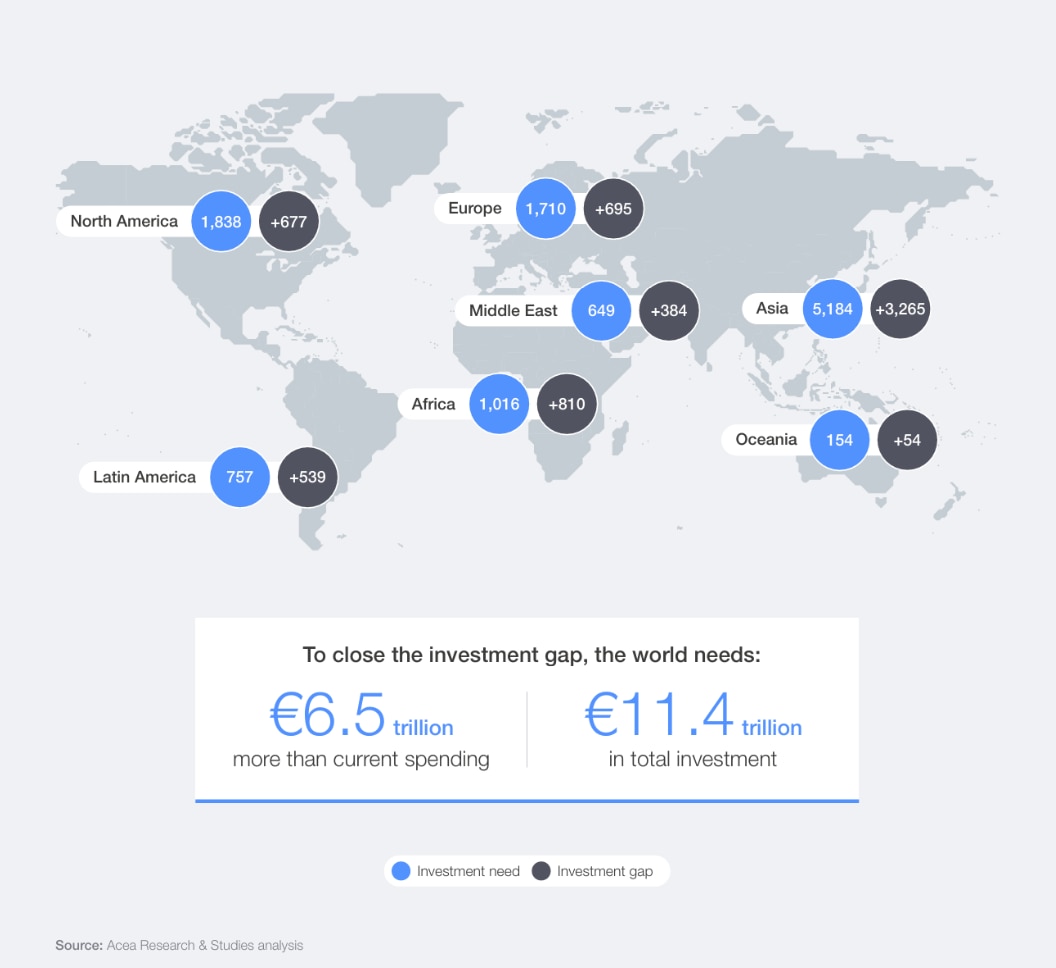
Watch the full session here.
Conversation with US State Governors
Federal policy-making in the United States may draw global attention but many decisions, from zoning regulation and transport investment to training and education, begin at the state level.
In this session, a bipartisan panel of US governors explored the role that states play in US competitiveness and future growth, and what impact could their decisions have far from home.
The panellists included Governor Gretchen Whitmer of Michigan, Governor Andy Beshear of Kentucky and Governor Kevin Stitt of Oklahoma.
Watch the session here.
Human creativity is "AI-proof"
"Fearful, but optimistic."
Well-known musician Harvey Mason jr., CEO, The Recording Academy, reflected on generative AI's impact on the music industry and the role of artists around the world.
"I'm a human creator. I love making music and I consider it an art form. I've taken years and years to perfect my craft. But I can see how AI can be beneficial to creators."
Joining him were will.i.am, Founder and President, i.am Angel Foundation, and Juliet Mann, TV Host, China Global Television Network (CGTN), who outlined AI’s potential impacts on authorship, equity and the fundamental qualities that make music truly human.
One application of AI in creative industries is to generate viral or trendy content, but will.i.am emphasized one of its shortcomings: "Live moments are what we are, human-to-human interactions, emotions and feelings — that’s AI-proof".
Both panellists addressed the risks of AI for creators, with Mason jr. calling for "regulations to make sure that artists are protected and paid fairly".
Watch the full session below.
Special Address by Abdel Fattah El-Sisi, President of Egypt
Egypt stands at a critical juncture - navigating regional instability, economic transformation, and the Suez Canal's strategic significance.
10 years since his last participation, President Abdel Fattah El-Sisi addressed the global community on Egypt's vision for stability, development and its role in shaping the future of the Middle East and beyond.
Watch the session live here. And read the full speech:
He spoke about hopes for regional stability, security and prosperity. He also mentioned phase 2 of the Gaza peace plan and a willingness to engage with all parties concerned.
Ambitious economic reform was mentioned as a key focus, with a monetization programme and expanded participation of the private sector in the Egyptian market.
On infrastructure, he assured Davos of investment in highways, communications, transport, logistics, free zones (particularly the economic zone of the Suez Canal).
Keeping humans in the loop to prevent jobless growth
This session brings together experts to confront the central question: How do we harness AI's productivity potential while ensuring shared prosperity?
Opening the session, moderator and Stanford academic Erik Brynjolfsson explained his 'canary in a coalmine' research, which has found a 13% decline in employment since LLMs were introduced among 22 to 26-year-olds in the most exposed occupations like call centres. More encouraging data shows if people used AI to augment their work, they had growing employment.
Ravi Kumar S., CEO, Cognizant, said context engineering and integrating work between machines and people is very important.
"The infrastructure of enterprises has been built for humans not machines..." AI is going to be in the middle of a workflow - with people at the front doing ideation and people at the back doing validation, for example.
We have to reinvent processes and amplify the potential of humans rather than eliminate work.
”Policymakers need to think carefully about how we share the benefits of AI, said Laura D'Andrea Tyson, Distinguished Professor of the Graduate School, Haas School of Business, University of California, Berkeley.
"The productivity benefits are substantial, the question is how will they be shared?" There is polarization, but the labour share of income is declining, while the capital share rises.
Educators will need to have very tight links with the business community - around what sorts of jobs they will want and need: "These decisions will be made by the companies, so policymakers have to respond."
Jonas Prising, Chair and CEO, ManpowerGroup, took a positive and pragmatic view. To get the full benefit of AI, it will require new skills and it will take time.
It’s like the evolution of Word and Excel, he said. So what can people do to upskill? First: learn how to prompt, learn how to create a document and learn how to augment your skills when you are accompanied by an LLM and you can do your work in a different way.
The most successful candidates today write in their CVs ‘I work with ChatGPT’.
”He added that youth unemployment in the US is partly due to labour market weakening in 2025: "When companies go through an economic cycle, they hire more experienced workers."
But, said Elizabeth Shuler, President, American Federation of Labor and Congress of Industrial Organizations (AFL-CIO), people in the US are working multiple jobs, with 40% of workers not having $400 for an emergency.
"People are anxious and insecure about what the future holds... I think we need to stop and say who are we doing this for?"
Workers should be upstream in the cycle, she said.
If we’re going to have AI in transportation, we ought to have bus drivers in that lab...
”"If you’re looking to displace people, you’re going to have a revolution."
Valdis Dombrovskis, Commissioner for Economy and Productivity, Implementation and Simplification, European Commission, said we are seeing a huge shortage of AI skills. There are not enough graduates with the necessary skills, so we need to upskill those entering the labour force.
We have used the Turing Test to walk into a Turing Trap said Brynjolfsson, where we are over-relying on AI being able to achieve human intelligence, rather than focusing on augmentation.
The panellists concluded that we need to make it a worker-centred transition, with guardrails, and not get too overawed by the technology and the impact it will have.
Watch the session in full here.
Averting a climate policy recession
This session, titled How Can We Avert a Climate Recession, explored what meaningful climate ambition might look like in an era of polarization, economic constraints and geopolitical tensions?
Speakers included Ester Baiget, President and Chief Executive Officer, Novonesis, Jai Shroff, Chairman and Group Chief Executive Officer, UPL, Carsten Schneider, Federal Minister for the Environment, Climate Action, Nature Conservation and Nuclear Safety of Germany, Al Gore, Vice-President of the United States (1993-2001); Chairman and Co-Founder, Generation Investment Management LLP, Zhang Lei, Founder and Chief Executive Officer, Envision, and Elizabeth Thurbon, Professor of International Political Economy; Director, Green Energy Statecraft Project, University of New South Wales.
There was broad support for Gore’s suggestion that the world is seeing a “climate policy recession” but not an energy transition recession. Calls were made for green energy statecraft, with leaders pursuing an integrated approach to governance.
This tied with calls for a change in the narrative to explain that the climate crisis isn’t just about the climate, but issues like growth, national security and inclusivity, as well as ensuring that people understand the benefits.
There is an enormous good news story to be told
”All stressed that the energy transition is irreversible for at least two reasons: renewables are the cheapest form of electricity, and the market is being driven by Chinese investment.
Picking this up, Zhang looked to the future – and one dominated by energy-hungry AI – where he stressed that economies will need infinite and inexpensive energy resources, and only renewables offer this.
Catch up here.
Decoding some unsettling parallels with the past
Technological revolutions, global trade resets and soaring stock markets are nothing new. This panel focused on the similarities between the current decade and the one a century ago.
The 1920s famously ended with a market crash and financial depression. Moderator Andrew Ross Sorkin clarified that there may be parallels – but no crisis is now preordained.
Director of the European Institute at Columbia University Adam Tooze noted an unsettling lesson possibly not learned: the decade a century ago saw a global order undermined by “hubris and the failure of imagination.”
European Central Bank President Christine Lagarde cited a key difference between eras in terms of the scale and potential network effects of the global economy – it now relies on access to massive amounts of data, which could be limited by “protectionist barriers.”
Another story of today’s economy, according to Citadel Founder and CEO Ken Griffin: governments that “with little exception all spending beyond their means.”
Sorkin hit on the issue of central bank independence. He described diaries of central bankers in the US in the 1920s who were worried about the politics of the moment, and whether the central bank would survive them.
Lagarde cited the heroic performance of former US central bank chief Paul Volker, who delivered “price stability” not least because of his relationship with then-President Nixon. It’s “something we should, you know, keep in the back of our minds.”
BlackRock Chair and CEO and Interim Co-Chair at the Forum Larry Fink said more economies now have “hyper-winners” and losers. That’s a narrowing of the global economy that points to the democratization potential of AI. Can the technology be spread widely enough across small businesses to give them necessary advantages?
“It’s going to represent some huge social issues,” Fink said.
A huge issue for global trade: US tariffs.
Lagarde said it may be decades before the real impact of these measures on the global economy will become clear.
“Who pays for the tariff?” Griffin said.
It seems, he noted, that studies show the burden is falling on the American consumer.
Watch the full session here:
Radio Davos Daily: Day 3, with Katty Kay
Want a quick take on the day ahead? Here's Katty Kay, BBC correspondent and co-host of The Rest Is Politics US, on the Radio Davos podcast with her pick of Day 3's highlights.
Welcome to Day 3 of Davos 2026
Welcome to the third day of the World Economic Forum's Annual Meeting in Davos.
We're bringing you a rundown of what's happening on the ground, the key sessions to watch, live snapshots, essential reading, and an inside track on the conversations that matter.
Here's a recap of what you may have missed yesterday.
We'll be covering special addresses from heads of state, and all the top issues from jobless growth to European defence, tokenization to global aid, and healthcare for all to global debt.
Here are some of the key session and notable speakers:
- Special Address by Abdel Fattah El-Sisi, President of Egypt at 9:30 CET
- Conversation with Jensen Huang, President and CEO of NVIDIA at 11:30 CET
- Conversation with Jamie Dimon, Chairman and CEO of JPMorgan Chase at 13:00 CET
- Special Address by Donald J. Trump, President of the United States of America at 14:30 CET
- Special Address by Javier Milei, President of Argentina at 15:45 CET
License and Republishing
World Economic Forum articles may be republished in accordance with the Creative Commons Attribution-NonCommercial-NoDerivatives 4.0 International Public License, and in accordance with our Terms of Use.
The views expressed in this article are those of the author alone and not the World Economic Forum.

Forum Stories newsletter
Bringing you weekly curated insights and analysis on the global issues that matter.
More on Forum in FocusSee all

Kaya Bülbül and Kate Whiting
January 30, 2026


