If electricity and data are the ‘new oil’, is grid connectivity the strategic bottleneck in the AI transformation?
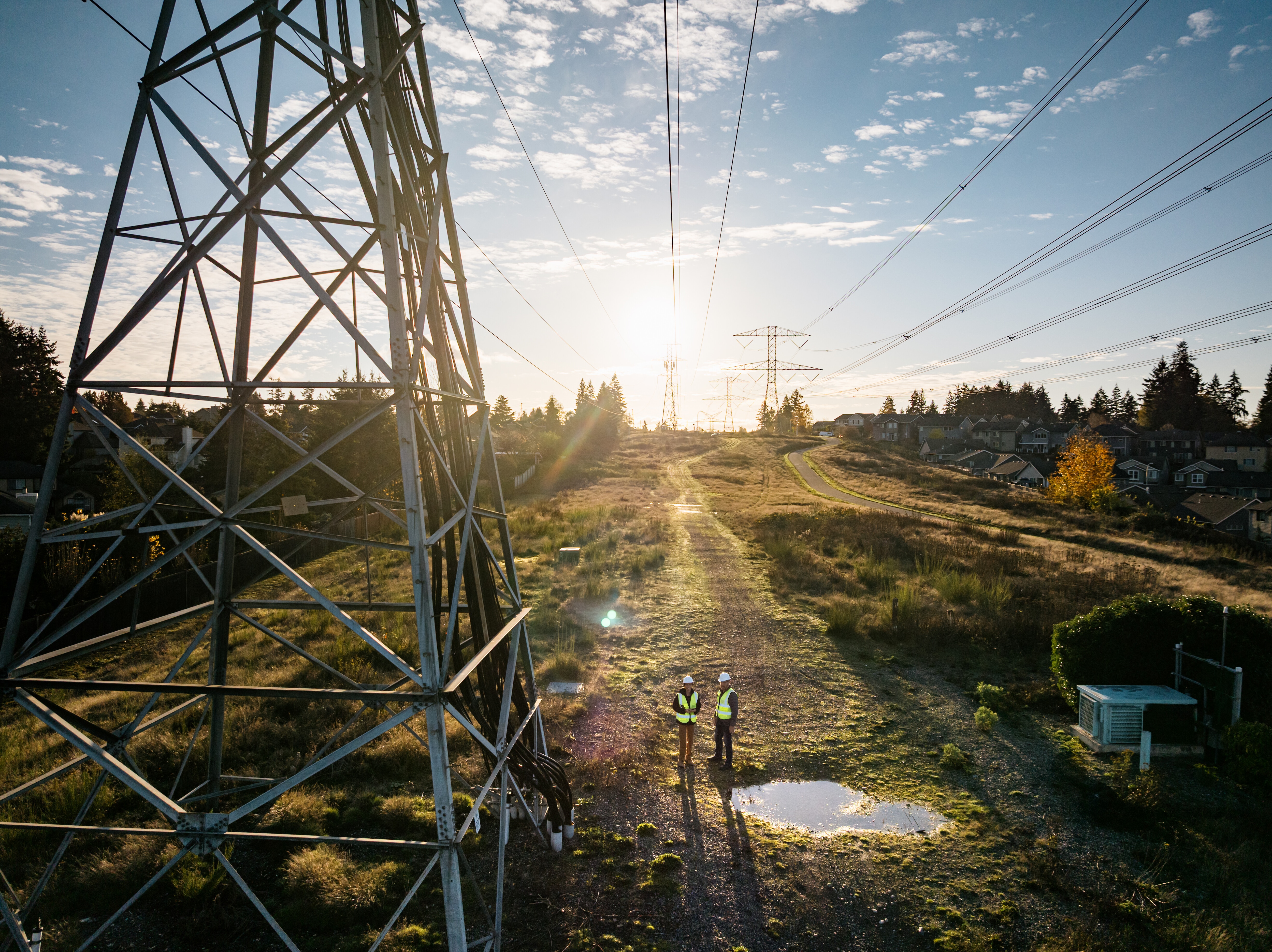
Investment in AI data centres is accelerating faster than power grids are capable of keeping up with. Image: Getty Images
- Artificial intelligence (AI) is advancing faster than ever before, but the global energy system needs to keep pace for this progress to continue.
- Investment in AI data centres is growing faster than power grids can keep up, making grid connectivity a constraint.
- Strong leadership and a new mindset is needed to align clean energy investments, power grid build-out and AI growth for the benefit of all.
Artificial intelligence (AI) technology is advancing at an extraordinary pace. At the same time, the computing power used to train frontier AI models has been doubling every five to six months. Unlike the semiconductor scaling that defined previous technological eras, this growth is driven not by shrinking transistors but by deploying ever-larger chip clusters.
Combined with the scale of investment in data and computing infrastructure, this progress is already transforming entire industries. But the energy system must keep pace for progress to continue. This shift from silicon efficiency to physical scale is precisely why grid connectivity has become the binding constraint. Strong leadership is needed to align clean energy investments, grid build-out and AI growth.
The underlying issue is that investment in AI data centres is accelerating faster than power grids were designed to accommodate. While compute capacity, capital and talent remain critical, in many regions, connecting a new facility to the power grid can take 4-10 years, while AI data centres are typically planned and built within two to three. This misalignment increasingly determines which projects advance and which stall.
AI and data centre demand due to rise sharply
According to DNV’s Global 2025 Energy Transition Outlook, electricity demand from AI and data centres will rise sharply up to 2030, with North America consuming half of the total demand by then.
From 2035, AI training and inference (the moment where a trained model is applied to real-world data to generate answers) will become the dominant driver of data centre electricity use. By 2060, DNV estimates ~80% of data centre electricity demand will come from AI, and the sector reaches 11% (6,400 TWh) of final electricity demand, slightly less than for global space cooling demand.
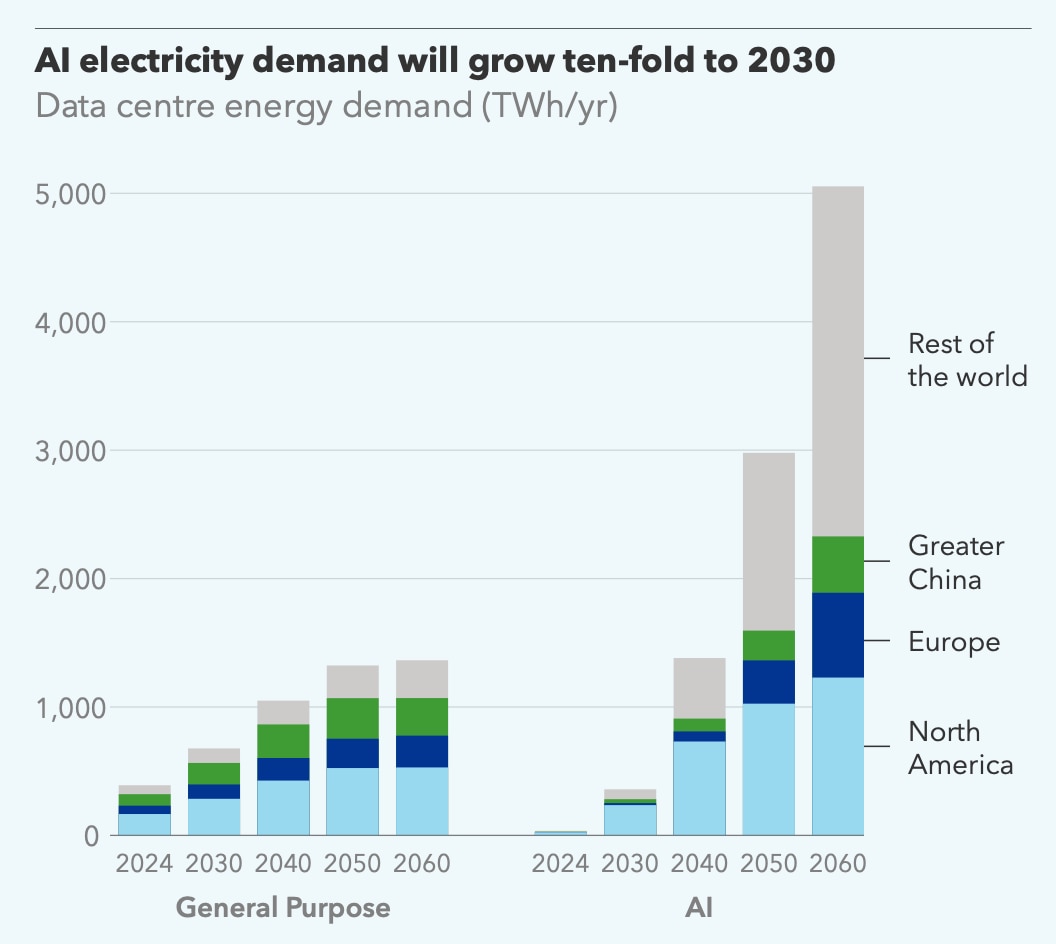
Most of this additional load will connect through transmission grids. Approximately 10% of new transmission line connection requests in 2030, and 12% in 2040, will be for data centres, globally.
According to the International Energy Agency (IEA), permitting reform, grid-code harmonization, new financing models, and public-engagement efforts are moving, but not fast enough to match current AI investment. Efficiency helps, but it cannot remove the need for physical capacity, firm connections, and predictable operating envelopes.
The risk profile has shifted: access to the grid – rather than chips, capital, or algorithms – is increasingly the binding constraint. For developers, grid-connection uncertainty now rivals technology risk. For operators and policy-makers, the challenge is integrating a new demand class without compromising reliability.
Grid connectivity challenges for AI data centres
Until recently, most data-centre electricity demand fell into two categories: hyperscale cloud sites (predictable, suited to long-term planning) and cryptocurrency mining (volatile but often interruptible). AI data centres sit between these extremes.
They combine very high-power density with fast, uncertain ramping and a low tolerance for interruptibility – making them the most challenging load for today’s grid planning and interconnection frameworks.
This makes AI data centres something of a stress test for grid connectivity as they turn it into a system‑level challenge. Grid operators must assess not just individual projects, but also how clusters of AI data centres interact with existing assets and each other − often with limited data and under significant time pressure.
Near term, the aim is to reduce risk and deploy systems assurance, rather than bypassing the grid. Practical measures include:
- Choosing the right location from the start. Before committing land or capital, developers should assess where grid capacity is actually available, how long connection queues are and what technical limits apply locally. Sites near retired power plants or underused grid infrastructure can connect significantly faster than greenfield locations in congested areas.
- Behind‑the‑meter assets: Assets such as batteries, limited on‑site generation, power‑quality equipment, plus capacity procurement, like off‑site power purchase agreements or own generation, enable operations within grid limits and reduce short‑term stress.
- Interruptible ‘emergency lane’ connections: Power grids hold spare capacity in reserve for emergencies. Under managed contracts, this reserve can be made available to data centres willing to accept occasional, planned interruptions. A recent DNV study of the Dutch transmission network[1] suggests this approach could unlock 5–15% of additional capacity in congested areas without compromising system security, so long as clear rules govern when and how connections are curtailed. Regulators recognizing this as a standard option for data centres would meaningfully shorten connection queues.
- Demand flexibility: Data centres can ease grid pressure not just by using less power, but by using it more flexibly. Deferring non-urgent computing tasks, redirecting workloads to less congested locations, and prioritizing operations by criticality all reduce strain on local networks without cutting total output.
An AI campus, for example, secures capital and hardware but faces a multi‑year grid queue. By combining phased connections with on‑site storage and operational load controls, the project can begin operations earlier − while grid reinforcements are still under way − without compromising system security.
Leadership priorities for the next phase of AI
AI is already supporting grid planning and operations, such as accelerating power‑flow studies, congestion analysis, AI-enhanced digital twins. But it cannot remove the regulatory, institutional and physical risk constraints, and it will not be able to offset AI‑driven load growth within the timeframes that matter.
Leadership is needed from three stakeholder groups:
- Utilities and regulators should treat AI data centres as a distinct load class and adapt interconnection, queue management, and grid‑code practices accordingly.
- Developers and hyperscalers need to price grid realities into early investment decisions, treating connection timelines, operational limits and compliance risks as core, not an afterthought.
- Policy-makers and investors must accelerate grid build-out while enabling interim flexibility mechanisms that protect reliability and maintain public trust.
The future electrification of our societies requires a new mindset toward digitalization and systems thinking: data centres can act as an important enabler for faster scaling, thanks to their strong business case, just as we are seeing with batteries for EVs, making storage another important enabler for the energy transition. Aligning AI growth with grid connectivity is now a central leadership responsibility.
Don't miss any update on this topic
Create a free account and access your personalized content collection with our latest publications and analyses.
License and Republishing
World Economic Forum articles may be republished in accordance with the Creative Commons Attribution-NonCommercial-NoDerivatives 4.0 International Public License, and in accordance with our Terms of Use.
The views expressed in this article are those of the author alone and not the World Economic Forum.
Stay up to date:
AI and Energy Use
Related topics:

Forum Stories newsletter
Bringing you weekly curated insights and analysis on the global issues that matter.
More on Artificial IntelligenceSee all

Tony Pan
October 1, 2026


