From doom loops to boom loops: How to rebuild economic dynamism by learning from Asia
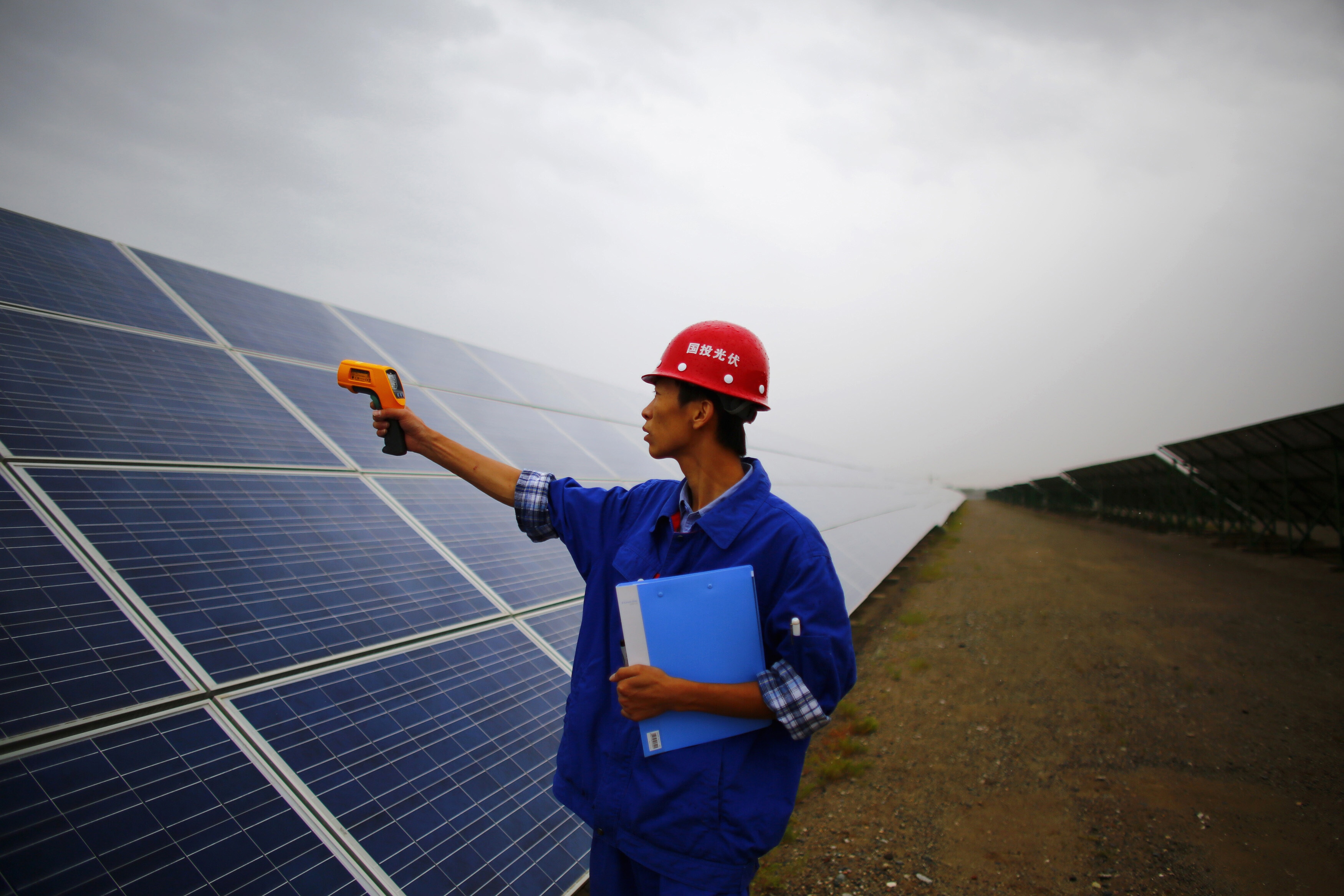
Boom loops are a positive self-reinforcing cycle that can be triggered by investment in clean tech Image: REUTERS/Carlos Barria
Elizabeth Thurbon
Professor of International Political Economy; Director, Green Energy Statecraft Project, University of New South Wales- While many economists and policymakers place great emphasis on doom loops and polycrises, positive feedback cycles or “boom loops” can also be fostered to create long-term economic momentum.
- Boom loops do not emerge automatically and governments can step in to help build successive waves of industrial growth and technological advancement, as seen in South Korea.
- Decarbonization can be reframed as a boom loop. Investments in clean technologies can drive innovation, lower costs, strengthen competitiveness, create jobs and improve energy, environmental and economic security.
At this year's World Economic Forum Annual Meeting in Davos, Switzerland, one recurring theme was that the global economy is caught in a series of self-reinforcing crises.
Economist Eswar Prasad describes this dynamic as a “doom loop” – a negative feedback cycle in which economic, domestic political and geopolitical dynamics amplify and reinforce each other in destabilizing ways.
Closely related is the idea of “polycrisis,” popularized by historian Adam Tooze: the notion that overlapping shocks, such as climate instability, pandemics, extreme inequality and democratic erosion, interact to amplify risk and uncertainty.
There is no doubt that today's challenges are deeply interconnected. But as scholars such as Yuen Yuen Ang have argued, the way we frame these challenges matters.
Doom loop and polycrisis narratives highlight important forms of systemic risk. However, by focusing primarily on breakdown, volatility and crisis, they can unintentionally suggest that events are spiralling beyond control and that governments are left to react rather than shape outcomes.
They can also obscure what is happening in non-Western contexts, as elsewhere, particularly in Northeast Asia, governments have spent decades generating self-reinforcing cycles of investment, innovation and industrial upgrading.
At Davos, I argued that these positive feedback dynamics, which I call “boom loops,” deserve as much attention as doom loops.
The challenge is not only to understand how systems break down but also how they build momentum.
How do ‘boom loops’ work?
If systems can spiral downwards, can they also generate self-reinforcing cycles of success? Yes.
A boom loop describes a cycle in which investment, innovation, productivity growth and broadly shared prosperity reinforce one another over time, generating cumulative gains for the economy and society.
At their core, they are mechanisms for creating positive economic and political momentum. Productive investment drives innovation. Innovation improves productivity and competitiveness. Growth creates new opportunities and capabilities.
When the gains from growth are broadly shared through good jobs, rising incomes and expanded opportunity, public support for economic transformation strengthens. This, in turn, gives governments the legitimacy and capacity to sustain long-term investment and future-focused economic reform, reinforcing the cycle.
However, boom loops are not automatic. In sectors characterized by high uncertainty, long time horizons and significant coordination challenges, such as transport, the energy transition or biotech, firms are often reluctant to move first and markets are slow to form.
This is where governments matter. By reducing uncertainty, coordinating investment, creating demand and sharing risk, governments can help catalyze the conditions under which boom loops emerge.
Several economies in Northeast Asia have demonstrated a remarkable capacity to build and extend such loops across successive waves of industrial transformation.
In South Korea, strategic state action helped catalyze successive cycles of capability-building and growth – from heavy industry and shipbuilding to semiconductors, batteries and advanced digital technologies – and increasingly the green industries of the future.
China has similarly demonstrated the power of coordinated investment and strategic, adaptive governance to build new industries at extraordinary speed, particularly in clean energy, where sustained support has driven rapid scaling, falling costs and global competitiveness.
These experiences differ in important respects. But they share a common feature: a sustained capacity to generate and renew self-reinforcing cycles of investment, innovation and capability-building that, for extended periods, delivered broad improvements in living standards and economic opportunity.
The lesson is not that Northeast Asian models should be copied wholesale. Rather, they demonstrate that economic dynamism is not simply a product of market forces. It can be cultivated through institutions and policies designed to create momentum, build capabilities and sustain long-term transformation.
How system building will lead to boom loops
If doom loops describe how systems deteriorate, boom loops highlight how they can improve – this shift has practical implications, especially for the energy transition.
Too often, decarbonization is framed in terms of costs and trade-offs, reinforcing defensive policymaking. But it can also be an opportunity to build a new boom loop in which clean tech investment drives innovation, reduces costs, strengthens competitiveness, creates new industries and generates broadly shared prosperity.
This is the logic underpinning the Green Energy Statecraft Project, which treats the energy transition as a strategic opportunity to align economic, energy, environmental and national security objectives.
At their core, many successful boom loop policies do the same thing: they reduce uncertainty and create the conditions for productive investment to move.
Policy mechanisms such as the Clean Commodities Trading Initiative illustrate this approach. Governments use long-term offtake agreements to create demand where markets do not yet exist, such as green iron and sustainable aviation fuel.
The environmental attributes embodied in these emerging clean commodities are separated, certified and converted into tradable certificates that can later be sold into compliance and mandate markets.
This creates a fiscal recycling mechanism that helps transform early public support into self-sustaining market growth, allowing governments to recover much of the cost of catalyzing new industries over time.
The result is a powerful boom-loop dynamic: reduced uncertainty crowds in private investment, investment drives industrial scale-up and cost reductions and new certificate markets help finance further growth.
We can use the energy transition to rebuild our capacity to generate self-reinforcing growth and advance a comprehensive security-enhancing agenda – one that boosts energy, economic, environmental and social security simultaneously.
How to start creating boom loops
None of this implies that Northeast Asian models can or should be directly transplanted elsewhere. Different societies face different constraints and must find their own pathways to renewal.
But the Northeast Asian experience does demonstrate something important: in complex and uncertain environments, it is possible to build systems that generate momentum rather than merely manage risk.
The global conversation has successfully been diagnosing doom loops, so how do we build their opposite?
Crucially, we must move beyond one country’s industrial policy – countries should work together to build future industries and generate shared prosperity.
Later this month, these issues will be the focus of a Forum meeting in Seoul, South Korea, where leaders from government, industry and finance will explore how demand formation, enabling policy, finance and regional cooperation can strengthen competitiveness and accelerate industrial transformation across the Asia-Pacific.
While many advanced economies are losing the capacity to generate economic dynamism and broad-based prosperity, doom loops will dominate the conversation until we recover the tools, institutions or imagination needed to build their positive counterpart.
The opportunity we have is not simply to manage crises but to build the systems capable of generating the next generation of economic dynamism, social resilience and shared prosperity.
Don't miss any update on this topic
Create a free account and access your personalized content collection with our latest publications and analyses.
License and Republishing
World Economic Forum articles may be republished in accordance with the Creative Commons Attribution-NonCommercial-NoDerivatives 4.0 International Public License, and in accordance with our Terms of Use.
The views expressed in this article are those of the author alone and not the World Economic Forum.
Stay up to date:
The Digital Economy


Forum Stories newsletter
Bringing you weekly curated insights and analysis on the global issues that matter.
More on Climate Action and Waste Reduction See all

Janka Oertel and Massimo Portincaso
September 9, 2026


