Why the circular economy needs data to scale

More data about how people dispose of products would help to boost the circular economy. Image: Getty Images/SB Stock
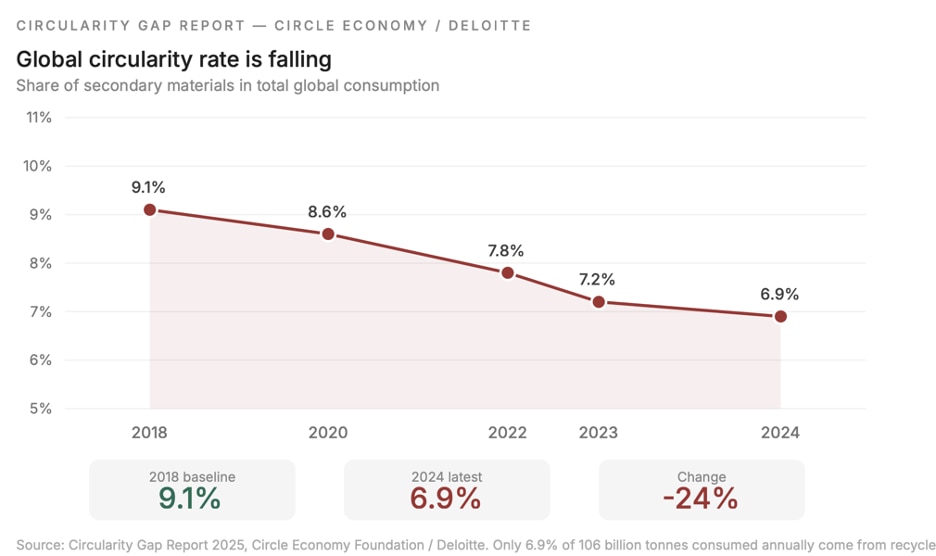
- Despite growing investment and awareness, the global circularity rate has fallen from 9.1% to 6.9% in five years.
- Using AI to capture and record data about how people dispose of the products they buy could help to boost the circular economy.
- Scaling promising ideas for impact is a key focus at the World Economic Forum’s Annual Meeting of the New Champions, also known as 'Summer Davos', in China from 23–25 June 2026.
Global supply chains can provide near-perfect visibility from raw material to point of sale. But when the product reaches the consumer's hands, the data disappears.
This leads to one of the largest information voids in the global economy, when consumers dispose of products.
Search, social media and commerce each became trillion-dollar industries by solving the same structural problem. They built "attention layers" that made fragmented human behaviour visible, measurable and monetizable.
An attention layer is the data infrastructure that captures human behaviour at the moment of decision. Google built one for search queries, Spotify built one for listening, payments networks built them for spending. But disposal has never had one.
Disposal, one of the most repeated consumer behaviours on earth – with billions of decisions happening daily at bins, cafeteria trays and recycling stations worldwide – has not yet developed a way to track and record this behaviour.
This means the circular economy is attempting to operate as a modern industry without a ledger.
Recording waste-related data
The global packaging industry was valued at $1.1 trillion last year. The value of the global advertising market exceeded $1.14 trillion in 2025, largely built on captured consumer attention.
Meanwhile, the World Bank projects global waste generation could grow from 2.56 billion tonnes in 2022 to 3.86 billion tonnes by 2050 – a 50% increase at a management cost already exceeding $250 billion a year. But only a fraction of a percent of waste-related data exists at the item level.
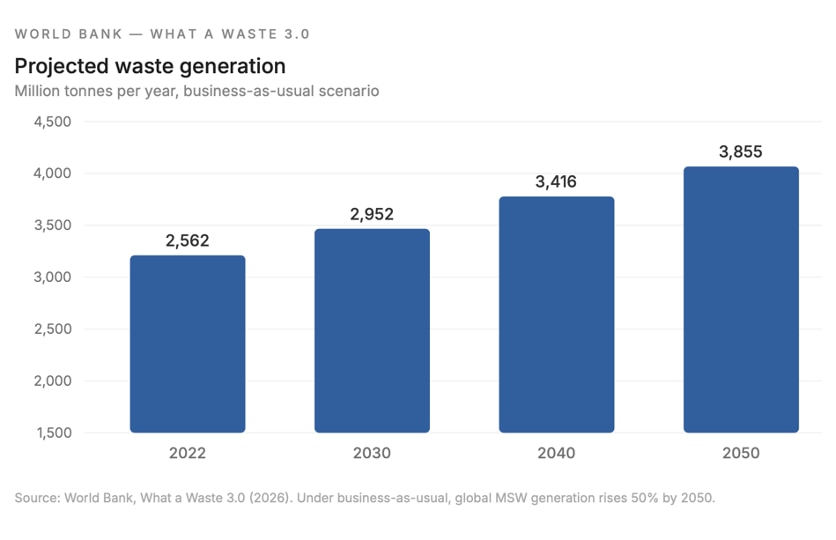
The blind spot is not the waste stream itself. It is the missing intelligence layer above trillions of dollars of consumer goods flowing through the global economy.
And despite growing investment and awareness, the global circularity rate has fallen from 9.1% to 6.9% in five years. Efforts to recycle and reuse waste are losing ground because we cannot see what is happening at the most critical node in the product value chain.
Closing the circular economy data gap
For decades, the technology to close this gap did not exist at an accessible price point. That has changed as edge artificial intelligence (AI) hardware costs have dropped dramatically. Capable computer vision devices are now available for a few hundred dollars and camera sensors cost as little as $2.
Computer vision models – capable of identifying items, recognizing materials and brands, and delivering real-time behavioural feedback – run entirely on-device, requiring no cloud infrastructure and consuming the energy equivalent of a single laptop. What once demanded a research lab now fits inside a waste station.
At the same time, regulatory demand is creating an urgent need for exactly the kind of data an attention layer would produce. Extended producer responsbility legislation now spans more than 70 jurisdictions worldwide, with the EU's Packaging and Packaging Waste Regulation taking effect in August 2026. Corporate sustainability reporting requirements under frameworks like the Corporate Sustainability Reporting Directive in the EU are also expanding. Deposit return systems are proliferating. Plastic reduction mandates are tightening.
Every one of these frameworks depends on measuring waste, but the measurement infrastructure barely exists. You cannot regulate what you cannot see.
Using AI to strengthen the circular economy
Emerging AI systems are beginning to fill this void on both sides of the waste value chain. At the point of disposal, computer vision deployed at waste stations can now identify items in real time, recognize materials and brands, deliver behavioural feedback and meter every interaction.
Research in behavioural science confirms that real-time cues at the bin shape sorting behavior far more effectively than signage or education campaigns alone. Early deployments of these systems across over 20 countries have demonstrated sorting accuracy above 90% and consumer engagement increases of more than tenfold at the bin.
Downstream, AI-powered waste analytics are now auditing materials recovery facilities at scale. They can track billions of waste objects to identify contamination patterns that were previously invisible.
When every disposal decision generates a structured record of item, material, brand, location and stream, two things happen simultaneously. People change their behaviour because they are engaged at the moment of decision. But circularity also gains something it has never had – item-level intelligence across the entire value chain.
Attention drives both changes. For the first time, the moment between consumption and recovery becomes visible and actionable.
From subsidies to unit economics
Europe faces an €82 billion annual investment gap in its circular economy transition. Globally, high-impact circular solutions also remain chronically underfunded. Private capital requires measurable, repeatable unit economics. Financial models cannot be built on estimates of what might be in a waste stream.
Circularity's financing problem is, at root, a data problem.
An attention layer would change the equation for every stakeholder. Brands would gain a transactable consumer touchpoint at disposal – not just at purchase – with real data on how packaging performs in the field. Venues and property operators could turn waste from a pure cost centre into a data-rich, revenue-generating operation. Waste processors could receive cleaner, verified feedstock. Regulators could get compliance intelligence in real time instead of self-reported estimates.
Circularity would finally gain unit economics that do not depend on subsidies, commodity volatility or political cycles.
Solving the circular economy’s data problem
The circular economy has spent decades trying to solve a materials problem. The evidence suggests it is an information problem.
Every major consumer industry that has scaled did so by building a data layer that made human behaviour visible, valuable and investable.
Waste is one of the largest behavioural datasets humanity produces – and one of the least measured. But the technology to change this exists and the regulatory demand exists.
The question is whether policy-makers, investors and industry leaders will recognize that circularity doesn’t just need better infrastructure, but its first attention layer.
The Forum is spotlighting how innovation moves from breakthrough to scale to impact ahead of 'Summer Davos' in China, 23–25 June 2026. Follow the latest.
Don't miss any update on this topic
Create a free account and access your personalized content collection with our latest publications and analyses.
License and Republishing
World Economic Forum articles may be republished in accordance with the Creative Commons Attribution-NonCommercial-NoDerivatives 4.0 International Public License, and in accordance with our Terms of Use.
The views expressed in this article are those of the author alone and not the World Economic Forum.
Stay up to date:
Circular Economy
Related topics:


Forum Stories newsletter
Bringing you weekly curated insights and analysis on the global issues that matter.